Chevrolet Corvette C3 — the Shark-Bodied Corvette, 1968 to 1982
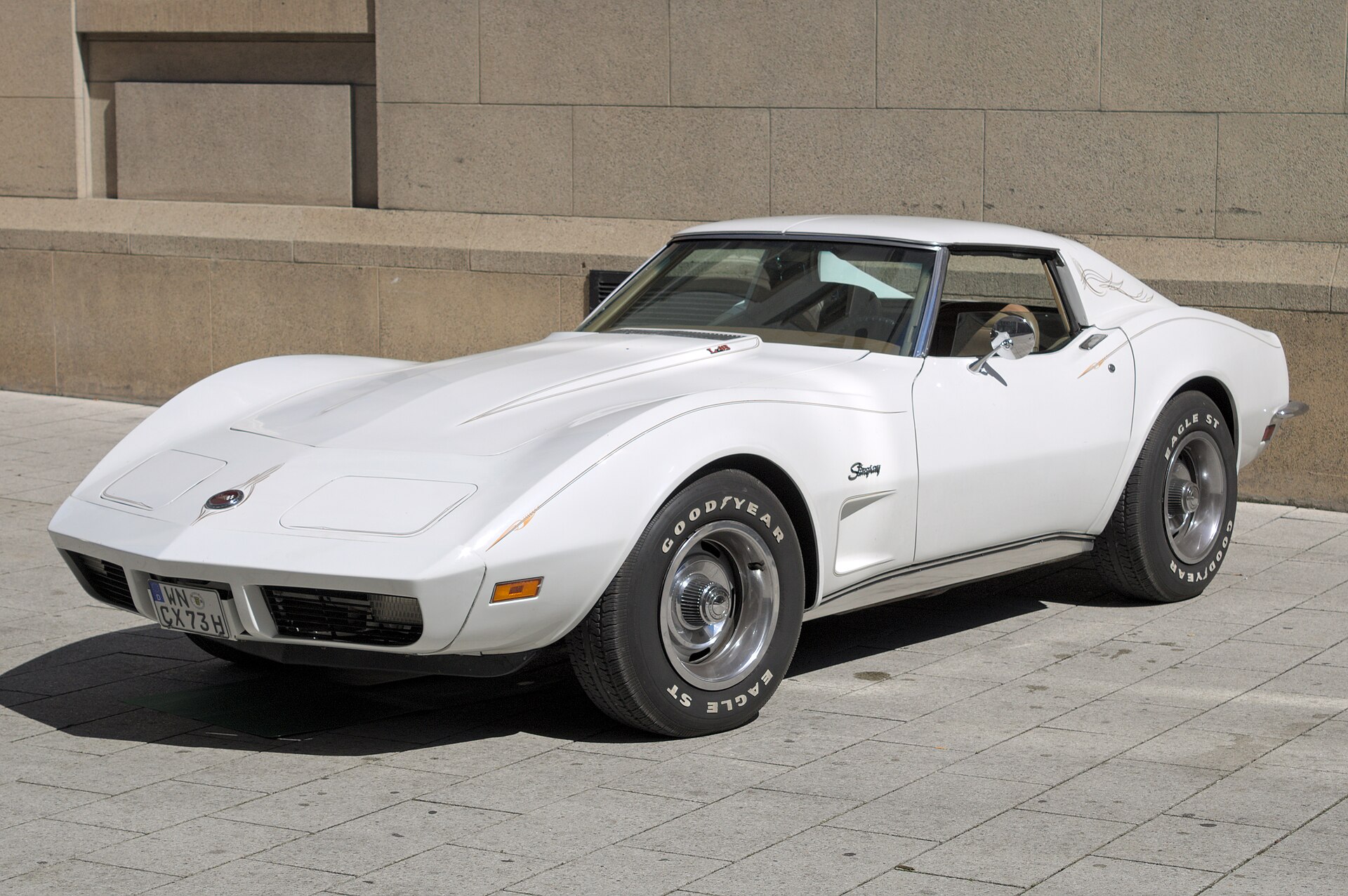
The Chevrolet Corvette C3 is the third generation of America's two-seat sports car, sold for the 1968 to 1982 model years. Its long, pinched "Coke-bottle" body came from the Mako Shark II show car, while the chassis was a development of the 1963–1967 Sting Ray. No Corvette generation lasted longer or sold more: 542,741 cars left the St. Louis and Bowling Green plants in fifteen seasons.
Key takeaways
- Built from August 1967 to October 1982 as a T-top coupé and, until 1975, a convertible; 542,741 made.
- Engines from the 5.0-litre small block to the 7.4-litre 454 big block; peak 324 kW (435 hp, SAE gross) for the 1968–1969 L71 427.
- Chevrolet moved to SAE net ratings for 1972; by 1975 the base engine had only 123 kW (165 hp).
- Record year 1979 with 53,807 cars; the 1982 Collector Edition was the first Corvette to cost more than US$20,000.
Chevrolet Corvette C3 at a glance
| Specification | Chevrolet Corvette C3 |
|---|---|
| Model years | 1968–1982 (production August 1967 – October 1982) |
| Plants | St. Louis, Missouri (to mid-1981); Bowling Green, Kentucky (1981–1982) |
| Cars built | 542,741 |
| Body | two-seat coupé with removable T-top panels; convertible to 1975 |
| Layout and drivetrain | front-mid engine, rear-wheel drive (RWD), independent rear suspension |
| Engines | V8 from 305 cu in (5.0 l) to 454 cu in (7.4 l) |
| Power | 123–324 kW (165–435 hp); gross ratings to 1971, net from 1972 |
| Gearboxes | 3- and 4-speed manual; 3-speed Turbo Hydra-matic; 4-speed 700-R4 automatic (1982) |
| Wheelbase | 2,489 mm |
| Length | 4,625 mm (1968) to 4,707 mm (1982) |
| Kerb weight | about 1,597 kg (Wikipedia infobox) |
| Predecessor / successor | C2 Sting Ray / C4 |
The generation before it is described in our Corvette C2 Sting Ray guide, and the story of all eight generations is in the history of the Chevrolet Corvette.
Size at a glance
Chevrolet Corvette C7
The Chevrolet Corvette C8 is 137 mm longer and 56 mm wider than the Chevrolet Corvette C7.
| Dimensions | Chevrolet Corvette C8 | Chevrolet Corvette C7 | Difference |
|---|---|---|---|
| Length | 4,630 mm182.3 in | 4,493 mm176.9 in | +137 mm+5.4 in |
| Width | 1,933 mm76.1 in | 1,877 mm73.9 in | +56 mm+2.2 in |
| Height | 1,234 mm48.6 in | 1,234 mm48.6 in | Same |
| Wheelbase | 2,723 mm107.2 in | 2,710 mm106.7 in | +13 mm+0.5 in |
From Mako Shark II to showroom
Work on the Mako Shark II show car began in early 1964. Larry Shinoda shaped it under GM's styling chief Bill Mitchell, and the original idea was a mid-engined car. When that layout was dropped, Henry Haga's studio adapted the design to the existing front-engined Sting Ray chassis. The tunnelled "sugar scoop" roof with a near-vertical rear window was borrowed from mid-engine studies by the engineering group of Zora Arkus-Duntov.
The production car kept the concept's sharp beltline, bulging front wings and hidden headlamps, now raised and lowered by vacuum. A curious leak came from a toy: Mattel's Hot Wheels "Custom Corvette" reached shops several weeks before Chevrolet unveiled the real car. Early build quality was a weak point. Hagerty notes first-year problems, yet more than 28,000 buyers took a 1968 model anyway.
Duntov remained chief engineer until 1975, when Dave McLellan took over. Over its life the car moved through three internal platform codes: Series 194 (1968–1971), Series Z (1972–1975) and Series Y (1976–1982).
Body, roof and a changing nose
The 1968 coupé introduced removable T-top roof panels, which made it an open car without the weight of a full convertible. Up to 1972 the rear window could also be taken out. The convertible had a folding soft top and an optional hardtop, but demand faded: only 12 % of 1975 cars were ordered open, and that was the last C3 convertible.
Federal bumper rules reshaped the car. For 1973 the chrome front bumper gave way to a body-coloured urethane nose designed to absorb 5 mph impacts, adding about 16 kg. A matching urethane tail with an aluminium impact bar followed in 1974. For 1978, the 25th anniversary year, a large curved fastback window replaced the sugar-scoop roof and the fuel tank grew from 17 to 24 US gallons (about 64 to 91 litres). New front and rear fascias with integrated spoilers arrived for 1980, and the final 1982 Collector Edition gained an opening glass hatch.
| Period | Bumpers and roof | Body versions |
|---|---|---|
| 1968–1972 | chrome front and rear; removable rear window | coupé, convertible |
| 1973 | urethane front, chrome rear | coupé, convertible |
| 1974–1975 | urethane front and rear | coupé, convertible |
| 1976–1977 | urethane, sugar-scoop roof | coupé only |
| 1978–1982 | urethane, glass fastback; hatch on 1982 Collector Edition | coupé only |

Engines: from big block to Cross-Fire Injection
In 1968 buyers could choose between six V8s, two small blocks and four big blocks. By 1982 a single small block remained. The figures below are Chevrolet's ratings as listed by Wikipedia: SAE gross up to 1970, both gross and net for 1971, and SAE net from 1972. A net figure is measured with the full exhaust and accessories fitted, so it is always lower than a gross figure for the same engine.
| Year | Engine (RPO) | Displacement | Power | Torque |
|---|---|---|---|---|
| 1968 | L30 base | 327 cu in (5.4 l) | 224 kW (300 hp) gross | 488 Nm |
| 1968 | L88 | 427 cu in (7.0 l) | 321 kW (430 hp) gross | 658 Nm |
| 1968 | L71 Tri-Power | 427 cu in (7.0 l) | 324 kW (435 hp) gross | 624 Nm |
| 1970 | LT-1 | 350 cu in (5.7 l) | 276 kW (370 hp) gross | 515 Nm |
| 1970 | LS5 | 454 cu in (7.4 l) | 291 kW (390 hp) gross | 678 Nm |
| 1971 | LS6 | 454 cu in (7.4 l) | 317 kW (425 hp) gross, 242 kW (325 hp) net | 529 Nm net |
| 1972 | LT-1 | 5.7 l | 190 kW (255 hp) net | 380 Nm |
| 1973 | LS4 | 454 cu in (7.4 l) | 205 kW (275 hp) net | 536 Nm |
| 1975 | L48 base | 350 cu in (5.7 l) | 123 kW (165 hp) net | 346 Nm |
| 1980 | L82 | 350 cu in (5.7 l) | 172 kW (230 hp) net | 373 Nm |
| 1982 | L83 Cross-Fire | 350 cu in (5.7 l) | 149 kW (200 hp) net | 386 Nm |
The L88 was a thinly disguised racing engine with aluminium heads, a 12.5:1 compression ratio and a large four-barrel carburettor; only 80 were fitted in 1968. Lower compression for low-lead fuel arrived in 1971, catalytic converters in 1975. The big-block 454 disappeared after 1974, together with true dual exhausts. In 1980 Californian cars received a 305 cu in (5.0 l) V8 with 134 kW (180 hp), and the 1982 L83 brought throttle-body fuel injection, which GM called Cross-Fire Injection. To translate old gross and net figures into other units, use the 1cars power converter.
Gearboxes changed with the market. In 1968 the three-speed Turbo Hydra-matic replaced the old two-speed Powerglide, and about 82 % of buyers still chose a manual. By 1979 fewer than 20 % did. The four-speed manual was last offered in 1981, and every 1982 car had the new four-speed 700-R4 automatic with overdrive, a unit Wikipedia describes as troublesome.
Year by year: what changed
- 1969: The small block grew from 327 to 350 cu in, and the Stingray name returned as one word. A labour dispute stretched production into December. GM leased three Stingrays to the Apollo 12 astronauts for one dollar a year each.
- 1970: Flared wheel arches, egg-crate grilles and the high-revving LT-1. Output fell to 17,316 cars, the lowest since 1962.
- 1971: Compression ratios dropped so the engines could run on lower-octane fuel; air conditioning was fitted to about 53 % of cars.
- 1972: Last chrome bumpers, last removable rear window and the first SAE net ratings.
- 1973–1974: Urethane bumpers, standard radial tyres and the L82 small block in place of the LT-1.
- 1975: Catalytic converter, electronic ignition and the last convertible.
- 1976–1977: Steel floor panels, optional aluminium wheels and, in 1977, standard power steering and brakes. That year Chevrolet passed half a million Corvettes since 1953.
- 1978: Fastback glass, the Silver Anniversary paint option and 6,502 Indianapolis 500 Pace Car replicas.
- 1979: Optional spoilers that cut drag by about 15 %, glass roof panels on nearly 15,000 cars and the all-time sales record.
- 1980–1981: A diet with an aluminium rear differential, thinner panels and, in 1981, a composite rear leaf spring that saved 16 kg. Production moved to Bowling Green in mid-1981.
- 1982: Cross-Fire Injection, automatic only, and the Collector Edition.
Production and prices by model year
Chevrolet's US base price climbed almost fourfold during the C3's life. The figures are the original sticker prices in US dollars for the base car, as listed by Wikipedia; they are not adjusted for inflation.
| Model year | Cars built | US base price |
|---|---|---|
| 1968 | 28,566 | US$4,663 |
| 1970 | 17,316 | US$5,192 |
| 1972 | 27,004 | US$5,533 |
| 1974 | 37,502 | US$6,001 |
| 1976 | 46,558 | US$7,604 |
| 1978 | 46,776 | US$9,750 |
| 1979 | 53,807 | US$10,220 |
| 1980 | 40,614 | US$13,140 |
| 1981 | 40,606 | US$16,258 |
| 1982 | 25,407 | US$18,290 |
The 1979 total of 53,807 remains the best single year in Corvette history. By our calculation, the C3 averaged about 36,000 cars a year, around half as many again as the C2 managed in its five seasons.
Acceleration and top speed in period tests
Road tests show how much the emissions era cost. A 1968 small-block car reached 60 mph in about 6.5 seconds. Motor Trend timed a 1970 LT-1 over the quarter mile in 14.36 seconds at 101.69 mph. By 1975 Car and Driver needed 7.7 seconds to 60 mph in a base automatic.
The later cars were not slow by the standards of their day. Road & Track timed a 1978 L82 at 6.6 seconds to 60 mph and 15.3 seconds over the quarter mile, and the car reached 204 km/h (127 mph). The last 1982 car needed 7.9 seconds to 60 mph. Car and Driver summed up the early choice in October 1968: the small-engine Corvettes were "marginally faster and extraordinarily civilized".
Special versions and rare cars
| Version | Years | Built | What it was |
|---|---|---|---|
| ZL1 | 1969 | 2–3 factory cars | all-aluminium 427 big block; quarter mile in 10.89 s |
| ZR1 package | 1970–1972 | 53 | LT-1 with racing brakes and suspension |
| ZR2 package | 1971 | 12 | the same idea with the LS6 454 |
| Pace Car replica | 1978 | 6,502 | black and silver paint, Indianapolis 500 decals |
| Collector Edition | 1982 | 6,759 | silver-beige paint, glass hatch, own VIN digit |
The 1982 Collector Edition cost US$22,537.59 and was the first Corvette to pass US$20,000. Its sixth VIN digit is "0" instead of "8", which helps to spot copies. At the top of the market, a lightweight 1969 L88 sold at Barrett-Jackson in January 2014 for US$2.86 million, and one of the factory ZL1 cars fetched US$3.14 million at RM Sotheby's in Arizona in 2023.

Buying a C3 today: reliability and what to check
Mechanically the C3 is simple: a pushrod V8, a conventional gearbox and parts shared with other GM cars, so routine maintenance and service are within reach of any classic specialist. Reliability problems usually come from age and neglect rather than design. Classic Motorsports advised buyers in 2021 to treat condition as more important than originality, especially on later cars. Its main warnings:
- Frame and "birdcage": dried T-top seals let water reach the steel structure. Owners also report rust in the birdcage around the cabin and at the frame kick-up ahead of the rear wheels, sometimes hidden under fresh underseal.
- Vacuum system: the hidden headlamps and the wiper door are vacuum-operated, and leaks can take a long time to trace.
- Bumpers: the urethane ends crack with age; many have been replaced by fibreglass copies that look almost the same.
- Fit: drivers taller than about 1.88 m (6 ft 2 in) may find the cabin tight. Seats were reshaped for wider drivers in the late 1970s.
Which C3 to choose depends on use. Chrome-bumper cars from 1968–1972 are the most sought after and the most expensive, with documented big-block and LT-1 cars at the top. The 1978–1982 cars have more room, a fastback window and better comfort. Classic Motorsports singles out the 1979 as a good-value buy because so many were made. Parts supply and club knowledge are excellent across the range. To weigh a C3 against a later Corvette or a European rival, put both cars into the 1cars comparison tool; more American classics are collected in the 1cars classics section.

Legacy
The C3 carried the Corvette through its most difficult decade. It began with 324 kW big blocks and ended with a 149 kW fuel-injected small block, yet sales rose almost every year. Its shape stayed in production longer than any other Corvette design, and its replacement, the 1984 C4, finally brought a new chassis. The brand's other generations and specifications are listed on the Chevrolet Corvette catalogue page.
Photo gallery


FAQ
What years are the C3 Corvette?
The C3 covers the 1968 to 1982 model years. Production ran from August 1967 to October 1982, first in St. Louis and from mid-1981 in Bowling Green, Kentucky.
How many C3 Corvettes were made?
Chevrolet built 542,741 C3 Corvettes. The best year was 1979 with 53,807 cars; the quietest was 1970 with 17,316.
What is the most powerful C3 Corvette engine?
On paper it is the 1968–1969 L71 427 Tri-Power with 324 kW (435 hp, SAE gross). The racing L88 was rated at 321 kW (430 hp), a figure widely believed to understate its real output.
Why did C3 power drop after 1971?
Lower compression for low-lead fuel came in 1971, and from 1972 Chevrolet quoted SAE net instead of gross figures. Catalytic converters followed in 1975, when the base engine fell to 123 kW (165 hp).
What is special about the 1982 Corvette?
It was the last C3 and the first with Cross-Fire fuel injection. The Collector Edition, 6,759 of 25,407 cars, had a glass hatch and cost US$22,537.59.