Chevrolet Corvette History: Eight Generations Since 1953
The Chevrolet Corvette is a two-seat sports car built by General Motors since 30 June 1953. It has gone through eight generations, from the fibreglass C1 roadster with a 112 kW six-cylinder to the mid-engined C8, whose ZR1X hybrid produces 932 kW. About 1.9 million Corvettes have been built, most of them since 1981 in Bowling Green, Kentucky.
Key takeaways
- C1 to C7 (1953–2019): front-engined, rear-wheel drive, with fibreglass or composite bodies.
- Small-block V8 from 1955, big blocks in the 1960s, supercharged ZR1 models from 2009.
- C8 (from 2020): the first mid-engined Corvette, now also offered as the E-Ray hybrid with all-wheel drive.
- Ten class wins at Le Mans by 2026, the first in 1960.

Chevrolet Corvette generations at a glance
| Generation | Years | Engines | Power range | Notes |
|---|---|---|---|---|
| C1 | 1953–1962 | 3.9 l six, 4.3–5.4 l V8 | 112–268 kW | 300 cars in 1953, fuel injection from 1957 |
| C2 Sting Ray | 1963–1967 | 5.4–7.0 l V8 | 186–324 kW | Coupé, independent rear suspension |
| C3 | 1968–1982 | 5.0–7.4 l V8 | 123–324 kW | Mako Shark II styling, T-tops |
| C4 | 1984–1996 | 5.7 l V8 | 153–302 kW | Digital dash, ZR-1 with Lotus-designed engine |
| C5 | 1997–2004 | 5.7 l V8 | 257–302 kW | LS1 aluminium V8, Z06 from 2001 |
| C6 | 2005–2013 | 6.0–7.0 l V8 | 298–476 kW | Fixed headlamps, ZR1 with supercharger |
| C7 Stingray | 2014–2019 | 6.2 l V8 | 339–563 kW | Last front-engined Corvette |
| C8 | 2020– | 5.5–6.2 l V8, hybrid | 354–932 kW | Mid-engine, dual-clutch gearbox |
Power figures before 1972 are SAE gross ratings, which read higher than today's net figures. Even so, by our calculation, the ZR1X has more than eight times the output of the 1953 car.
Size at a glance
Chevrolet Corvette C7
The Chevrolet Corvette C8 is 137 mm longer and 56 mm wider than the Chevrolet Corvette C7.
| Dimensions | Chevrolet Corvette C8 | Chevrolet Corvette C7 | Difference |
|---|---|---|---|
| Length | 4,630 mm182.3 in | 4,493 mm176.9 in | +137 mm+5.4 in |
| Width | 1,933 mm76.1 in | 1,877 mm73.9 in | +56 mm+2.2 in |
| Height | 1,234 mm48.6 in | 1,234 mm48.6 in | Same |
| Wheelbase | 2,723 mm107.2 in | 2,710 mm106.7 in | +13 mm+0.5 in |
1953: a Motorama dream car goes into production
The Corvette began as EX-122, a show car designed under GM styling chief Harley Earl. It was unveiled at the GM Motorama in the Waldorf-Astoria hotel in New York on 17 January 1953. Myron Scott suggested the name, taken from a small, fast warship, and production began in Flint, Michigan, on 30 June 1953.

The first 300 cars were hand-built convertibles, all painted Polo White. Their fibreglass body sat on a steel frame, and power came from the 3.9-litre "Blue Flame" six with 112 kW (150 hp), paired with a two-speed Powerglide automatic. In 1954 production moved to St. Louis, Missouri, where it stayed until 1981, and 3,640 cars were built that year.
C1: from six-cylinder roadster to V8 sports car (1953–1962)
Sales were slow at first: in 1955 output was limited to 700 cars. That year the 265 cu in (4.3-litre) small-block V8 arrived and changed the car's character. Engineer Zora Arkus-Duntov pushed the car towards real performance and took it to Daytona Speedweek and Sebring in 1956.

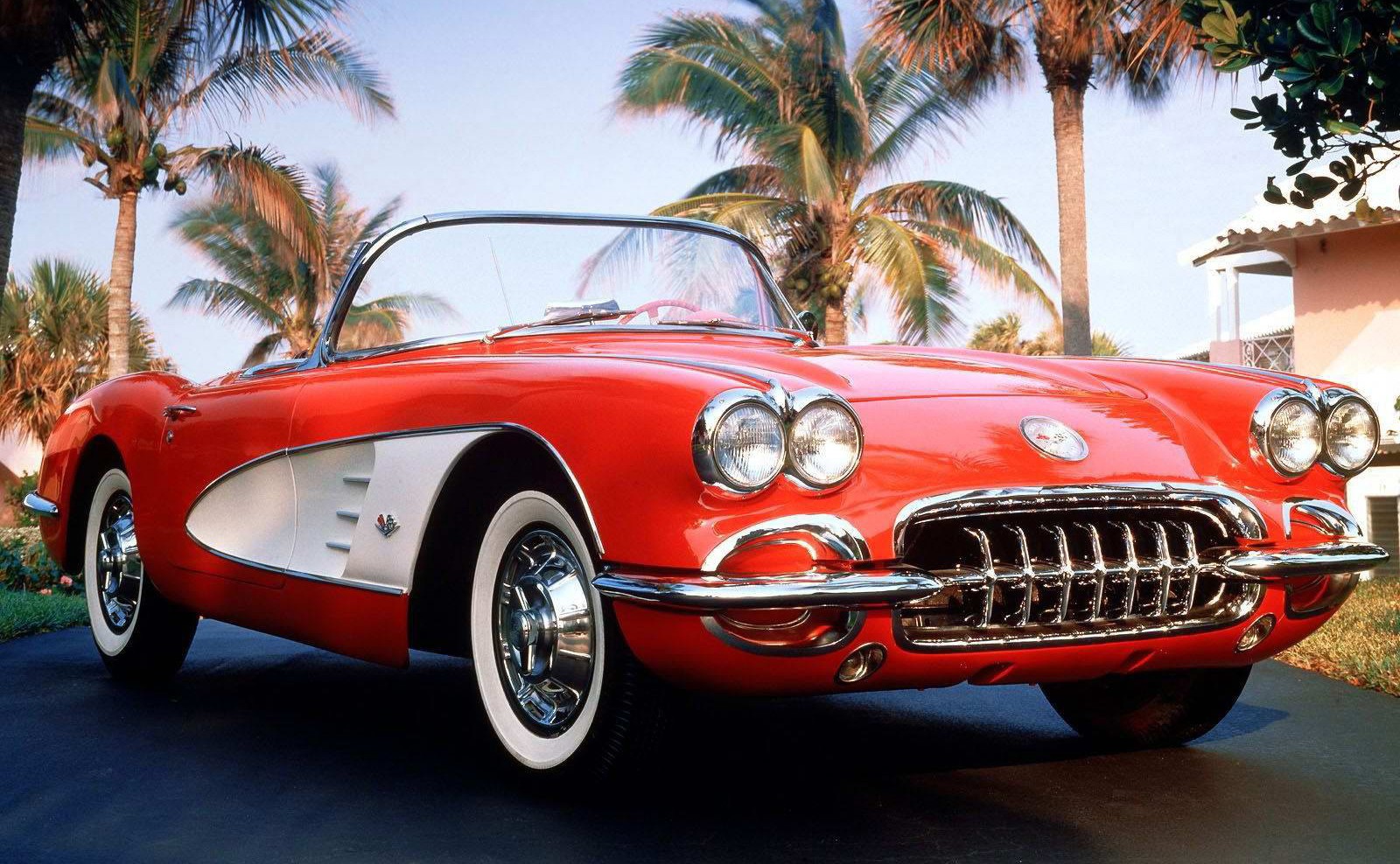
Mechanical fuel injection, branded "Ramjet", became an option in 1957, and four headlights followed in 1958. Production climbed steadily: 6,339 cars in 1957, 9,168 in 1958 and 14,531 in 1962. In 1960 a Corvette entered by Briggs Cunningham won the GT 5.0 class at Le Mans. The 1962 car's 327 cu in (5.4-litre) V8 produced up to 268 kW (360 hp) with fuel injection. The full story of this generation is in the Corvette C1 guide.
C2 Sting Ray: the split-window coupé (1963–1967)
The second generation brought a coupé for the first time and the name "Sting Ray". Larry Shinoda drew it under the direction of design chief Bill Mitchell. Independent rear suspension replaced the old live axle, and the 1963 coupé had a split rear window that lasted only one year.

Power grew quickly. Four-wheel disc brakes and the 396 cu in big block arrived in 1965, followed by the 427 in 1966. The racing-oriented L88 of 1967 was officially rated at 321 kW (430 hp), though its real output was believed to be higher. Five lightweight Grand Sport racers were built. In all, about 118,000 C2 cars were made in five years, including 27,720 in 1966. See the Corvette C2 Sting Ray page for engines and dimensions.
C3: the Mako Shark shape and the emissions era (1968–1982)
The C3 of 1968 took its long nose and curved wings from the Mako Shark II concept, and introduced removable T-top roof panels. In 1970 the LT-1 small block was rated at 276 kW (370 hp). A rare ZR-1 racing package was offered from 1970 to 1972, and only 53 were built.

Then the rules changed. Compression ratios fell in 1971 for low-lead fuel, and from 1972 power was quoted in SAE net figures. The LT1 dropped to 201 kW (270 hp) net. Bumpers designed to absorb 5 mph impacts came in 1973, catalytic converters in 1975, and the convertible disappeared after 1975. By 1981 the base L81 V8 had only 142 kW (190 hp).
Popularity still rose. The C3 sold 53,807 cars in 1979, the best year in Corvette history. In mid-1981 production moved to a new plant in Bowling Green, Kentucky, where every Corvette has been built since. The C3 lasted 15 years, longer than any other generation.
C4: a digital dashboard and the ZR-1 (1984–1996)
Chevrolet skipped the 1983 model year: only 43 prototypes were built before regular production began on 3 January 1983. The C4 went on sale as a 1984 model, with a hatchback body and a liquid-crystal digital dashboard. The old 1cars text also mentions aluminium brake calipers and aluminium suspension parts to save weight. The fuel-injected L98 V8 of 1985 produced 172 kW (230 hp), and the convertible returned in 1986.

The headline car was the ZR-1 of 1990. Its LT5 engine, designed by Lotus with four valves per cylinder and two camshafts per bank, produced 280 kW (375 hp). Production ended in 1995 after 6,939 cars. The LT1 of 1992 gave 224 kW (300 hp), and the 1996 LT4 reached 246 kW (330 hp) in the final Grand Sport.
C5: the LS1 and a modern chassis (1997–2004)
The C5 was a clean-sheet design. Its new LS1 aluminium V8 produced 257 kW (345 hp), later 261 kW, and the gearbox moved to the rear for better weight balance. The old 1cars text added two engineering details: transverse composite leaf springs and a sandwich floor with a balsa-wood core, chosen to damp vibration.

A convertible arrived in 1998 with a proper boot, and a fixed-roof hardtop in 1999. That hardtop became the Z06 in 2001, with the LS6 at 287 kW (385 hp) and, from 2002, 302 kW (405 hp). The 2004 car had a drag coefficient of 0.29 and a top speed of 283 km/h.
C6: fixed headlamps, Z06 and ZR1 (2005–2013)
The C6 dropped the pop-up headlamps used since 1963. Its 6.0-litre LS2 produced 298 kW (400 hp), replaced in 2008 by the 6.2-litre LS3 with 321 kW (430 hp). The Z06 of 2006 had an aluminium frame and a 7.0-litre LS7 with 377 kW (505 hp).

In 2009 the ZR1 brought a supercharged LS9 with 476 kW (638 hp) and a top speed of 330 km/h. The last C6 was built in February 2013.
C7 Stingray: the last front-engined Corvette (2014–2019)
The C7 revived the Stingray name for 2014, now written as one word. It combined an aluminium frame with carbon-fibre and composite panels, and its 6.2-litre LT1 delivered 339 kW (455 hp). The old 1cars text noted a kerb weight of just over 1.5 tonnes despite the size. The supercharged Z06 of 2015 had 485 kW (650 hp), and the 2019 ZR1 reached 563 kW (755 hp). Read the Corvette C7 guide for its versions.

C8: the mid-engined Corvette (2020–)
GM revealed the C8 on 18 July 2019 at the Kennedy Space Center. It was the first mid-engined Corvette and GM's first mid-engined production car since the 1984 Pontiac Fiero. The base LT2 V8 produces 369 kW (495 hp) and drives through an eight-speed dual-clutch gearbox. In 2020, its first year, 20,368 were built.
| C8 version | Engine | Power |
|---|---|---|
| Stingray | 6.2 V8 LT2 | 369 kW (495 hp) |
| Z06 | 5.5 V8 LT6, flat-plane crank | 500 kW (670 hp) |
| E-Ray | 6.2 V8 + front electric motor | 488 kW (655 hp) combined |
| ZR1 | 5.5 V8 LT7 twin-turbo | 793 kW (1,064 hp) |
| ZR1X | 5.5 V8 twin-turbo + electric motor | 932 kW (1,250 hp) |
The ZR1X lapped the Nürburgring Nordschleife in 6:49.275. Use the 1cars rankings to see where the current versions stand on power and acceleration.
Racing, records and the museum sinkhole
Racing has been part of the car since Duntov's first tests. Chevrolet withdrew from factory racing in 1957 under an industry agreement, but private and later factory teams kept the Corvette on track. By 2026 it had ten class victories at Le Mans.
Off the track, a sinkhole opened under the National Corvette Museum in Bowling Green on 12 February 2014. Eight cars were badly damaged, and the only surviving 1983 prototype was nearly lost. Total production has passed 1.9 million cars, which by our calculation is an average of about 26,000 a year since 1953.
Which Corvette to buy: our verdict by generation
For a classic to drive and show, a 1963–1967 C2 Sting Ray is the most desired, with the 1963 split-window coupé at the top. The C3 is the most affordable way into a chrome-bumper V8 Corvette, but post-1972 cars are much slower. For a modern classic, the C5 Z06 and the C6 Grand Sport offer strong performance at sensible prices. The C7 Stingray is the best used buy for daily use, and the C8 suits buyers who want mid-engined supercar pace. To weigh a Corvette against its long-time rival, read the history of the Ford Mustang or set two cars side by side with the 1cars comparison tool. All models are listed on the Chevrolet brand page.
FAQ
When was the first Chevrolet Corvette made?
GM showed the EX-122 show car in New York on 17 January 1953. The first production cars followed that summer in Flint, and only 300 hand-built white convertibles were completed by the end of the year.
How many generations of the Corvette are there?
There are eight: C1 (1953–1962), C2 (1963–1967), C3 (1968–1982), C4 (1984–1996), C5 (1997–2004), C6 (2005–2013), C7 (2014–2019) and the mid-engined C8, built since 2020. The C3 lasted longest.
Why is there no 1983 Corvette?
Chevrolet cancelled the 1983 model year because the new C4 was delayed. Only 43 prototypes were built, and the C4 was sold as a 1984 model. One prototype survives at the National Corvette Museum.
Where is the Corvette built?
Every Corvette since mid-1981 has been built at the GM plant in Bowling Green, Kentucky. Earlier cars came from Flint, Michigan, in 1953 and from St. Louis, Missouri, between 1954 and 1981.
What is the most powerful Corvette?
The C8 ZR1X, introduced for the 2026 model year, is the most powerful. Its twin-turbo 5.5-litre V8 and electric motor give a combined 932 kW (1,250 hp) and all-wheel drive.
Videos 2

Video 1

Video 2