
Corvette C1 vs Ford Thunderbird: the 1950s two-seaters
Updated Report an error By Oleksandr Hnatiuk

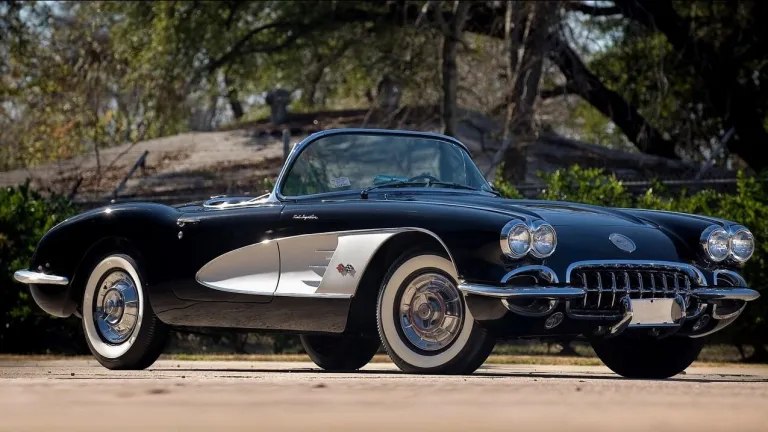
Chevrolet · 1953–1962
Corvette C1
- Power
- 145 kW197 PS
- Kerb mass
- 1,272 kg
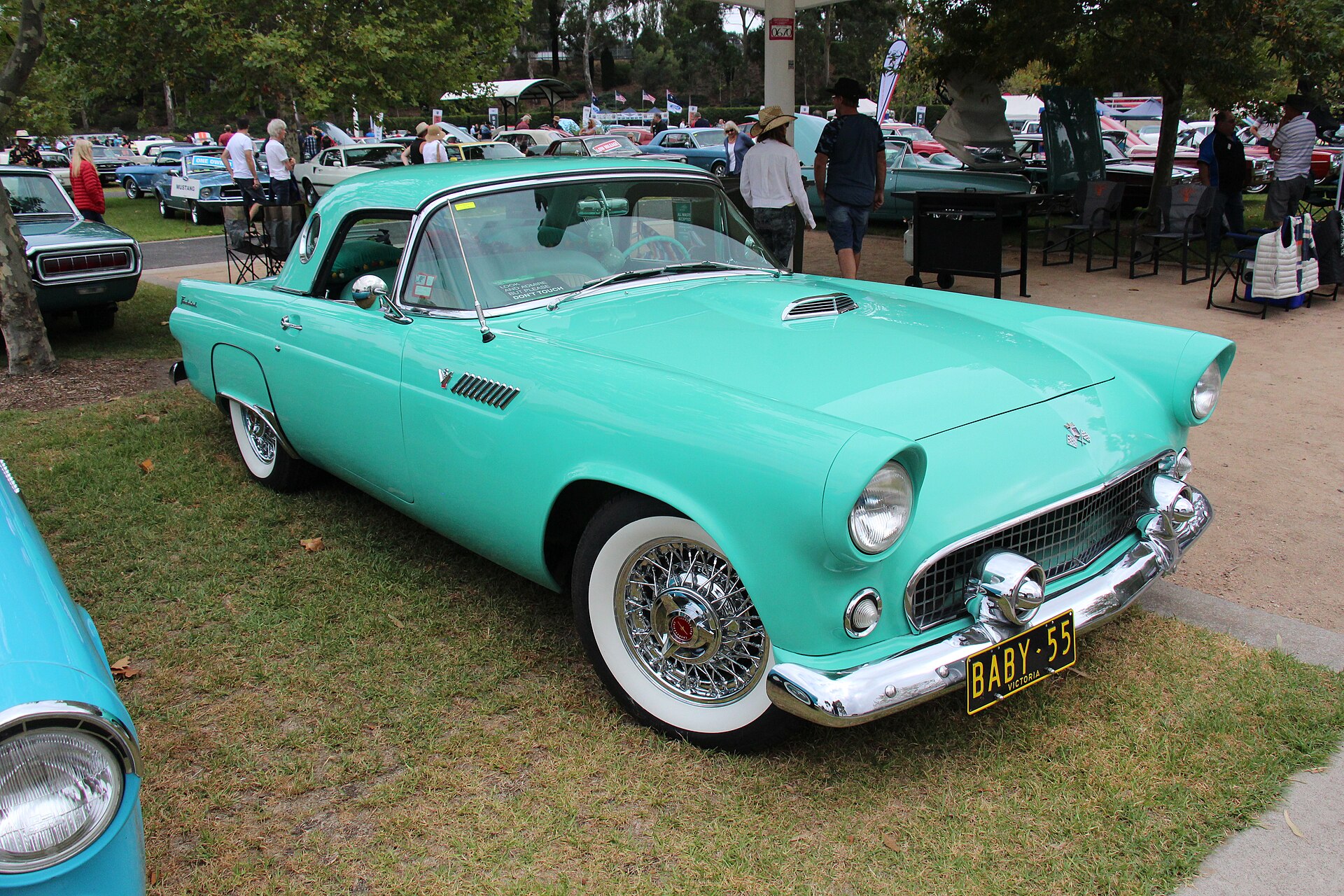
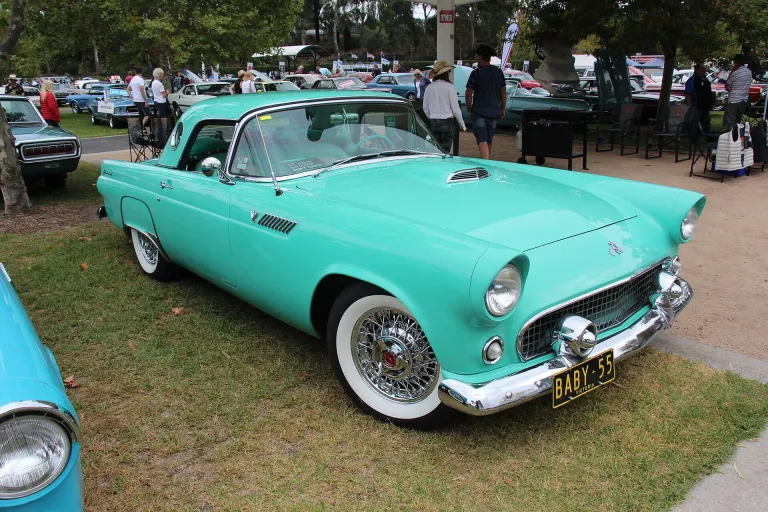
Ford · 1955–1957
Thunderbird I
- Power
- 144 kW196 PS
- Kerb mass
- —
At a glance
Who suits what, worked out from the catalog figures of the versions above.
Categories won: Corvette C1 1 Thunderbird I 0
- City Corvette C1 Length: 4,249 mm vs 4,453 mm
- Off-road Too close to call Drive and body: Rear-wheel drive · Convertible vs Rear-wheel drive · Convertible
Verdict Opinion
In 1955 the Thunderbird clearly won the market, and Wikipedia even counts Ford's success among the factors that kept the Corvette alive: Chevrolet answered with a V8, a manual gearbox and the new body of 1956. After 1957 the paths split. For 1958 Ford turned the Thunderbird into a four-seater and created the personal luxury class, while the Corvette stayed a two-seat sports car and is still built today.
As classics, the first Thunderbird is the more comfortable and more numerous car, and the supercharged 1957 cars are the most powerful two-seat Thunderbirds. The 1953–1955 Corvettes are much rarer and represent the start of America's longest-running sports car.
— Oleksandr Hnatiuk
In the mid-1950s two American companies built two-seat convertibles with exactly the same 2,591 mm (102-inch) wheelbase. Chevrolet's Corvette appeared as the EX-122 show car at the 1953 Motorama in New York on 17 January and began production in Flint on 30 June 1953. Ford unveiled the Thunderbird at the Detroit Auto Show on 20 February 1954; the first one was built on 9 September 1954 and it went on sale on 22 October as a 1955 model.
They are often called rivals, but they were aimed at different buyers. Chevrolet wanted an American answer to the European sports cars that servicemen had brought home after the war. Ford marketed a personal car built around comfort, with a folding fabric top and a detachable hardtop. The sales figures show which idea found more customers at first, and the later history shows which one lasted.
Corvette C1 vs Ford Thunderbird: 1955–1957 compared
Six, Y-block V8 and fuel injection
Early Corvettes had a six-cylinder engine, the Blue Flame, rated at 112 kW (150 hp gross), and a two-speed Powerglide automatic as the only gearbox. A 265 cu in V8 with 145 kW (195 hp) arrived for 1955. Ford started with V8s only: the 292 cu in Y-block delivered 193 hp with the manual and 198 hp with the Ford-O-Matic, about 144–148 kW. The 312 arrived as an option for 1956, and for 1957 Ford offered two supercharged versions rated at 224 and 254 kW (300 and 340 hp). Chevrolet's reply in 1957 was the fuel-injected 283 V8 and, from 9 April 1957, a four-speed manual.
Fibreglass roadster against personal car
The Corvette's body was fibreglass. Until 1955 it had clip-in side curtains instead of glass windows and no outside door handles; wind-up windows and an optional removable hardtop came with the 1956 redesign. The Thunderbird came with a removable fibreglass top as standard and a fabric roof as a common option. For 1956 Ford added porthole windows in the hardtop, free of charge, to improve rear visibility.
1955–1957 production: five to one
The numbers are one-sided. In 1955 Ford sold 16,155 Thunderbirds; Chevrolet built about 700 Corvettes, and the Thunderbird's own Wikipedia article gives 674. Over the three two-seat model years Ford built 53,166 Thunderbirds against about 10,500 Corvettes (700, 3,467 and 6,339), roughly five to one by our calculation.
Original US prices
The 1955 Thunderbird had a base price of US$2,944. The first 1953 Corvette was listed at about US$3,500 (sources give US$3,490 to US$3,513), so Ford's car was cheaper than the original Chevrolet.
Corvette weight per kW
Wikipedia gives a kerb weight of 1,272 kg for the 1955 Corvette, which with the 145 kW V8 means about 8.8 kg per kW by our calculation.
Size and weight
| Corvette C1 | Thunderbird I | |
|---|---|---|
| Length | 4,249 mm167.3 in | 4,453 mm175.3 in +204 mm +8.0 in +4.8% |
| Width | 1,773 mm69.8 in | 1,786 mm70.3 in +13 mm +0.5 in +0.7% |
| Wheelbase | 2,591 mm102.0 in | 2,591 mm102.0 in |
| Fits a standard garage? | Yes | Yes |
Difference vs Corvette C1 (±). Garage check: a standard single garage takes a car up to about 5.0 m (16 ft 5 in) long and 1.9 m (6 ft 3 in) wide (width as listed in the catalog; some makers include the mirrors). Leave about 0.6 m (2 ft) to open the doors.
Full specifications
| Chevrolet Corvette C1 | Ford Thunderbird | |
|---|---|---|
| General | ||
| Version | 265 V8 (SAE gross) · petrol · 145 kW (197 PS) | Thunderbird I · 292 Y-block V8 · petrol · 144 kW (196 PS) |
| Production years | 1953–1962 | 1955–1957 |
| Body | Convertible | Convertible |
| Class | Sports car | No data |
| Country | United States | United States |
| Performance | ||
| Power Why it matters: More power means stronger acceleration and easier overtaking, especially with a full load. | 145 kW (197 PS) 194 hp | 144 kW (196 PS) 193 hp |
| Power, all versions | 110–270 kW (150–367 PS) 148–362 hp | 84–268 kW (114–364 PS) 113–359 hp |
| Power per tonne | 114 kW/t 139 hp/ton calculated | No data |
| Engine and transmission | ||
| Fuel | Petrol | Petrol |
| Engine | 4,300 cc · 8 cyl 4.3 l | 4,785 cc · 8 cyl 4.8 l |
| Drive | Rear-wheel drive | Rear-wheel drive |
| Dimensions and weight | ||
| Length | 4,249 mm 167.3 in | 4,453 mm 175.3 in |
| Width | 1,773 mm 69.8 in | 1,786 mm 70.3 in |
| Height | 1,308 mm 51.5 in | No data |
| Wheelbase | 2,591 mm 102.0 in | 2,591 mm 102.0 in |
| Kerb weight Why it matters: A lighter car is usually more agile and uses less energy. | 1,272 kg 2,804 lb | No data |
These cars do not differ in the data we have.
Equal rows hidden (5): Body, Country, Fuel, Drive, Wheelbase.
In plain words
Chevrolet Corvette C1 has more power: 145 kW (197 PS) against 144 kW (196 PS) for Ford Thunderbird. Ford Thunderbird is 204 mm longer than Chevrolet Corvette C1 (4,453 mm vs 4,249 mm). Chevrolet Corvette C1 is the older design (from 1953); Ford Thunderbird arrived in 1955. On the catalog figures, the Chevrolet Corvette C1 is the pick for city. Our catalog has no kerb mass for the Ford Thunderbird yet, so some checks above leave it out.
Which one to choose
Choose a Corvette C1 if you want a true sports car with a fibreglass body, a rare early car with the Blue Flame six, or a 1957 fuel-injected V8 with the four-speed.
Choose a 1955–57 Ford Thunderbird if you prefer comfort and a hardtop from the start, want a car that is easier to find, or are looking for the supercharged 1957 version described in our Thunderbird Special Supercharged 312 article.
The next Corvette is covered in our C2 Sting Ray guide.
Frequently asked questions
Was the Ford Thunderbird a rival to the Corvette?
Partly. Ford developed it after the Corvette appeared at the 1953 Motorama, but marketed it as a comfortable personal car. In 1955 it outsold the Corvette by 16,155 to about 700.
Which was more powerful in 1955?
The two were close. The Corvette's 265 V8 had 145 kW (195 hp), the Thunderbird's 292 V8 144–148 kW (193–198 hp), all SAE gross ratings.
When did the Thunderbird get four seats?
For the 1958 model year. The two-seat Thunderbird was built only for 1955, 1956 and 1957.
Did the first Corvette have a V8?
No. The 1953 and 1954 cars used the 112 kW Blue Flame six; the V8 arrived in 1955.