
Mercedes EQS vs Tesla Model S: electric luxury saloons
Updated Report an error By Oleksandr Hnatiuk
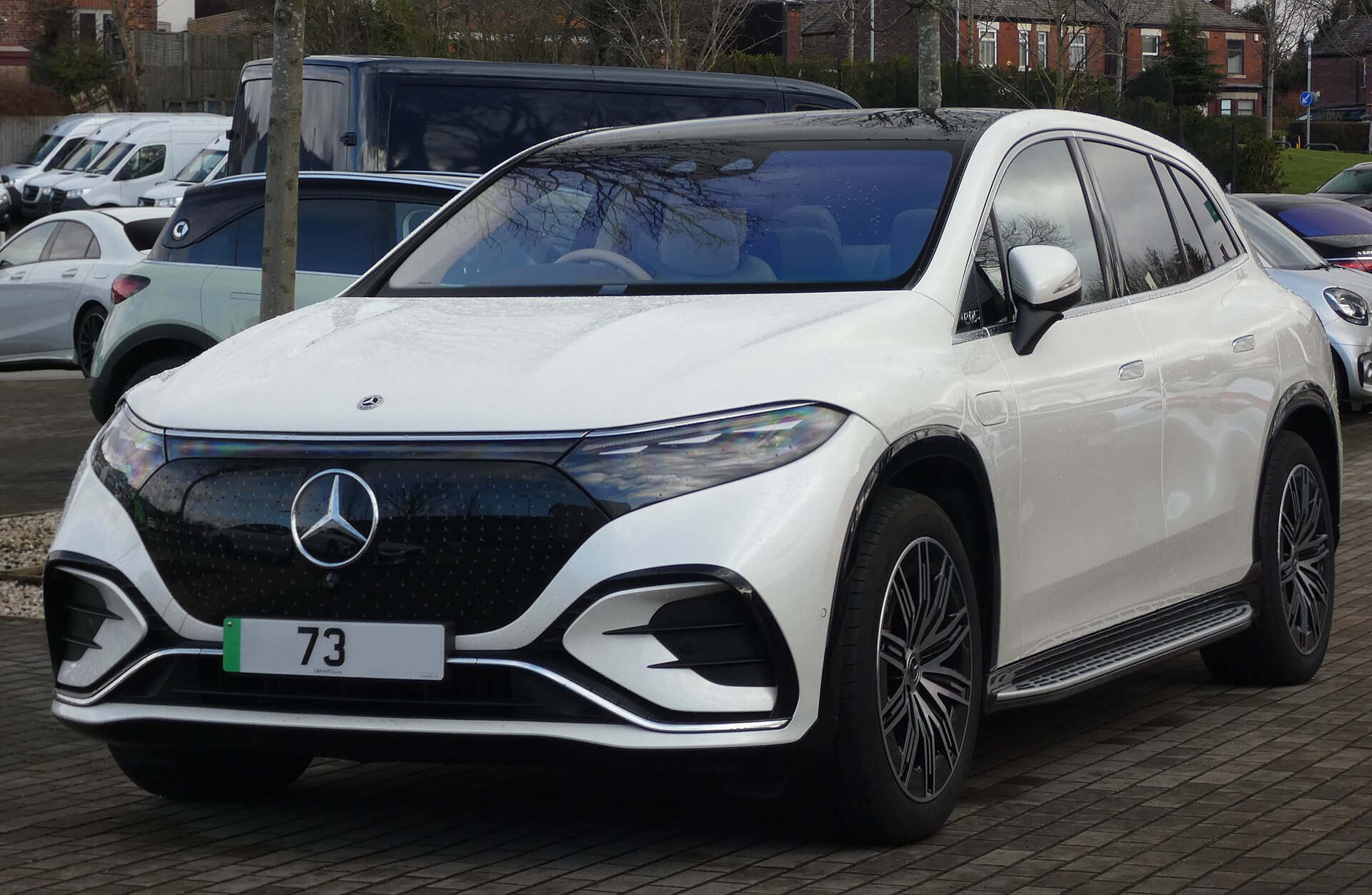
Mercedes-Benz · 2021–present
EQS V297
- Power
- 245 kW333 PS
- Top speed
- 210 km/h
- Kerb mass
- 2,480 kg

Tesla · 2012–2026
Model S
- Power
- 360 kW489 PS
- Top speed
- -
- Kerb mass
- 2,311 kg
At a glance
Who suits what, worked out from the catalog figures of the versions above.
Categories won: EQS V297 1 Model S 3
- City Model S Length: 4,980 mm vs 5,216 mm
- Performance Model S Power per tonne: 156 kW/t vs 99 kW/t
- Running costs EQS V297 Fuel per year: €790 vs €830 (estimated)
- Off-road Model S Drive and body: All-wheel drive · Sedan vs Rear-wheel drive · Liftback
Verdict Opinion
The EQS is the better luxury car. It is longer and roomier between the axles, its 450+ version has the longest official range of the pair at 785 km WLTP, and it is a current model with a 2024 facelift and assembly in several countries.
The Model S is the faster and more practical car. The Plaid's 760 kW and 1.98-second 0–60 mph time are in supercar territory, the hatchback opens to 1,650 litres plus a front trunk, and owners can use Tesla's own Supercharger network. With production over, it is now a used or remaining-stock buy.
- Oleksandr Hnatiuk
The Mercedes-Benz EQS and the Tesla Model S are the two best-known large electric saloons. Tesla started series production of the Model S at Fremont in June 2012, refreshed it in 2021 with the Plaid version and a yoke steering wheel, and ended production in 2026. Mercedes-Benz revealed the EQS on 15 April 2021 as the first model on its dedicated electric MEA platform, built at Sindelfingen, and gave it a facelift in April 2024.
In short: the EQS is bigger, more luxurious and has the longer official range, with 785 km WLTP for the EQS 450+. The Model S is quicker, especially as the 760 kW Plaid, and has a larger luggage area plus a front trunk. Both cars are in our catalogue: Mercedes-Benz EQS and Tesla Model S.
EQS vs Model S: range, performance, size and charging
Range and batteries
The EQS 450+ uses a battery with 107.8 kWh of usable capacity and is rated at 785 km on the WLTP cycle; the EQS 350 has 90.6 kWh. The Model S went through many battery sizes from 60 kWh to 100 kWh. The 100D of 2017–2019 combined two motors with 360 kW and 660 Nm and a range of 539 km. The 2021 Long Range has 500 kW and a range of 652 km, raised to 660 km by a 2026 update.
- EQS 450+: 245 kW, rear-wheel drive, 107.8 kWh usable, 785 km WLTP
- Model S Long Range (2021): 500 kW, 652 km
- Model S Plaid: 760 kW, 1,050 Nm, three motors
Performance
Mercedes offers the EQS from 215 kW in the EQS 350 through 245 kW in the rear-wheel-drive 450+ and 265 kW in the 450 4MATIC to 385 kW in the EQS 580 4MATIC. The AMG EQS 53 4MATIC+ has 484 to 560 kW. Tesla's Plaid uses three motors with 760 kW (1,020 hp) and 1,050 Nm, reaches 60 mph in 1.98 seconds according to Wikipedia and has a top speed of 322 km/h. No EQS comes close to that acceleration.
Size, drag and luggage
The EQS is 5,216–5,265 mm long on a 3,210 mm wheelbase. The Model S is 4,980–5,021 mm long on 2,960 mm, so the Mercedes has 250 mm more between the axles. Both are very slippery shapes: the EQS has a drag coefficient as low as 0.20 and the refreshed Model S 0.208, which Wikipedia describes as the lowest of any production car at the time. The Tesla has a 150-litre front trunk and 750 litres under its rear hatch, or 1,650 litres with the rear seats folded.
Charging
The EQS charges at up to 200 kW DC. Tesla owners use its own Supercharger network, which began operating in late 2012, and Tesla quotes up to 71 km of range per hour from its home wall connector.
Euro NCAP
Both cars have five stars. The EQS 450+ was tested in 2021: 96% for adult occupants, 91% for children, 76% for vulnerable road users and 80% for safety assist. The Model S first received five stars in 2014 and was tested again in 2022: 94%, 91%, 85% and 98%.
Race Stats side by side
Each figure is a 0–100 score from the catalog numbers, the same as on the 1CARS Race cards. PI is the overall performance index (100–999) and its class D–S.
| Stat | EQS V297 | Model S |
|---|---|---|
| PI | B · 514 | A · 700 |
| Power | 50 | 64 |
| Grip | 36 | 60 |
| Handling | 41 | 52 |
| Top speed | 42 | 86 |
| Launch | 57 | 78 |
Grip and handling are estimates from drive type, weight, height and body (hover a figure to see where it comes from). 1CARS Race
Who wins a race?
Quarter-mile (402 m) drag from a standing start, dry road, no reaction time - the 1CARS Race physics on the catalog figures of these versions.
- 1 Model S100D · electric · 360 kW (489 PS) 11.99 sat 188 km/h
- 2 EQS V297450+ · electric · 245 kW (333 PS) 14.15 sat 161 km/h · +2.16 s
Size and weight
Side view to scale, all cars from the front bumper.
| EQS V297 | Model S | |
|---|---|---|
| Length | 5,216 mm205.4 in | 4,980 mm196.1 in † −236 mm −9.3 in −4.5% |
| Width | 1,926 mm75.8 in † | 1,960 mm77.2 in † +34 mm +1.3 in +1.8% |
| Height | 1,512 mm59.5 in † | 1,440 mm56.7 in † −72 mm −2.8 in −4.8% |
| Wheelbase | 3,210 mm126.4 in | 2,960 mm116.5 in † −250 mm −9.8 in −7.8% |
| Kerb weight | 2,480 kg5,467 lb | 2,311 kg5,095 lb −169 kg −373 lb −6.8% |
| Fits a standard garage? | Too long and too wide | Too wide |
Difference vs EQS V297 (±). Garage check: a standard single garage takes a car up to about 5.0 m (16 ft 5 in) long and 1.9 m (6 ft 3 in) wide (width as listed in the catalog; some makers include the mirrors). Leave about 0.6 m (2 ft) to open the doors. † from another version of this generation.
Full specifications
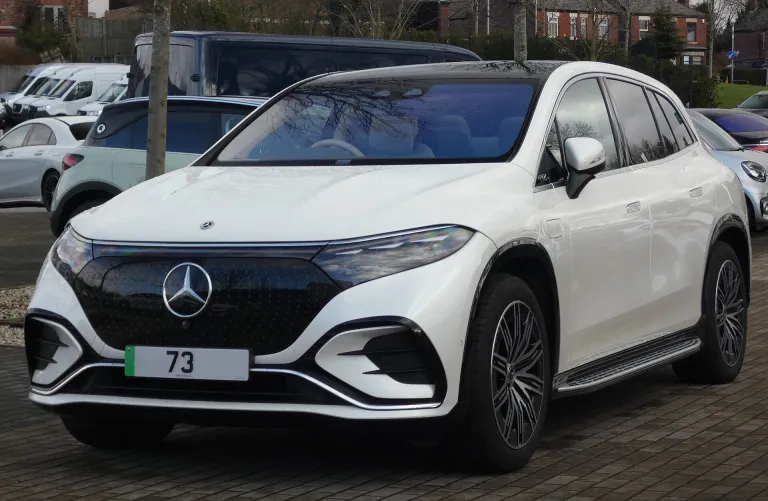
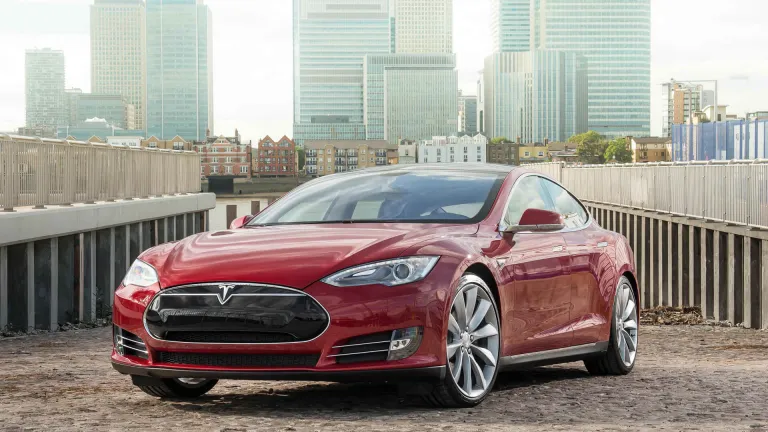
| Mercedes-Benz EQS | Tesla Model S | |
|---|---|---|
| General | ||
| Version | 450+ · electric · 245 kW (333 PS) | 100D · electric · 360 kW (489 PS) |
| Production years | 2021–present | 2012–2026 |
| Body | Liftback | Sedan |
| Country | Germany | United States |
| Performance | ||
| Power Why it matters: More power means stronger acceleration and easier overtaking, especially with a full load. | 245 kW (333 PS) 329 hp | 360 kW (489 PS) 483 hp Better |
| Power, all versions | 215–560 kW (292–761 PS) 288–751 hp | 225–760 kW (306–1,033 PS) 302–1,019 hp |
| Torque Why it matters: Torque is the pulling force you feel when accelerating from low revs, towing or climbing hills. | 568 Nm 419 lb-ft | 660 Nm 487 lb-ft Better |
| Top speed Why it matters: Top speed hints at how relaxed the car is at motorway speeds, even if you never reach it. | 210 km/h 130 mph | No data |
| Power per tonne | 99 kW/t 120 hp/ton calculated | 156 kW/t 190 hp/ton calculated Better |
| Engine and transmission | ||
| Fuel | Electric | Electric |
| Gearbox | 1-speed single-speed | No data |
| Drive | Rear-wheel drive | All-wheel drive |
| Dimensions and weight | ||
| Length | 5,216 mm 205.4 in | 4,980 mm 196.1 in † |
| Width | 1,926 mm 75.8 in † | 1,960 mm 77.2 in † |
| Height | 1,512 mm 59.5 in † | 1,440 mm 56.7 in † |
| Wheelbase | 3,210 mm 126.4 in | 2,960 mm 116.5 in † |
| Kerb weight Why it matters: A lighter car is usually more agile and uses less energy. | 2,480 kg 5,467 lb | 2,311 kg 5,095 lb Better |
| Boot Why it matters: A bigger boot fits more luggage, shopping or a pram. | No data | 745 l 26.3 cu ft |
| Economy and running costs | ||
| Fuel cost per year | €790/year estimated Better | €830/year estimated |
| Electric | ||
| Battery Why it matters: A bigger battery usually gives more range, but takes longer to charge fully. | 108 kWh | No data |
| Energy use | 17.5 kWh/100 km Better | 18.5 kWh/100 km |
| Safety | ||
| Euro NCAP | ★★★★★ (2021) | ★★★★★ (2022) |
These cars do not differ in the data we have.
Equal rows hidden (1): Fuel.
Better marks the stronger figure - only for measurable specs (power, torque, 0–100 km/h, consumption, boot, weight).
Estimated at 15,000 km a year with fuel at €0.30/kWh electricity. † from another version of this generation.
In plain words
Tesla Model S has more power: 360 kW (489 PS) against 245 kW (333 PS) for Mercedes-Benz EQS. Mercedes-Benz EQS is 236 mm longer than Tesla Model S (5,216 mm vs 4,980 mm). Tesla Model S is lighter by 169 kg (2,311 kg vs 2,480 kg). At 15,000 km a year, fuel would cost about €790 (Mercedes-Benz EQS), €830 (Tesla Model S) (estimated). Tesla Model S is the older design (from 2012); Mercedes-Benz EQS arrived in 2021. Mercedes-Benz EQS is still in production; Tesla Model S is not. On the catalog figures, the Tesla Model S is the pick for city, performance and off-road; the Mercedes-Benz EQS is the pick for running costs.
Which one to choose
Choose the Mercedes-Benz EQS if range, luxury and a long 3,210 mm wheelbase matter most, or you want a model that is still in production.
Choose the Tesla Model S if you want the strongest acceleration, a large hatchback boot plus a front trunk, or a used electric saloon with access to the Supercharger network.
The Model S also meets Porsche in Porsche Taycan vs Tesla Model S, and Tesla's SUV meets Audi in Audi e-tron vs Tesla Model X.
Frequently asked questions
Which has more range, the EQS or the Model S?
The EQS 450+, with 785 km WLTP from 107.8 kWh of usable battery. The 2021 Model S Long Range is listed at 652 km, and 660 km after the 2026 update.
Which is faster?
The Model S Plaid, with three motors, 760 kW and 1.98 seconds to 60 mph. The most powerful EQS is the AMG EQS 53 with up to 560 kW.
Which one is bigger?
The EQS. It is up to 5,265 mm long, and its wheelbase is 250 mm longer than the Tesla's 2,960 mm.
Is the Tesla Model S still made?
No. Tesla ended Model S production in 2026; according to Wikipedia the final cars left the line in May 2026. The EQS remains in production.
How safe are they?
Both have five Euro NCAP stars. The EQS scored 96% for adult occupants in 2021; the Model S scored 94% in its 2022 test and 98% for safety assist.