
Porsche Taycan vs Tesla Model S: electric saloon duel
Updated Report an error By Felix Hartmann
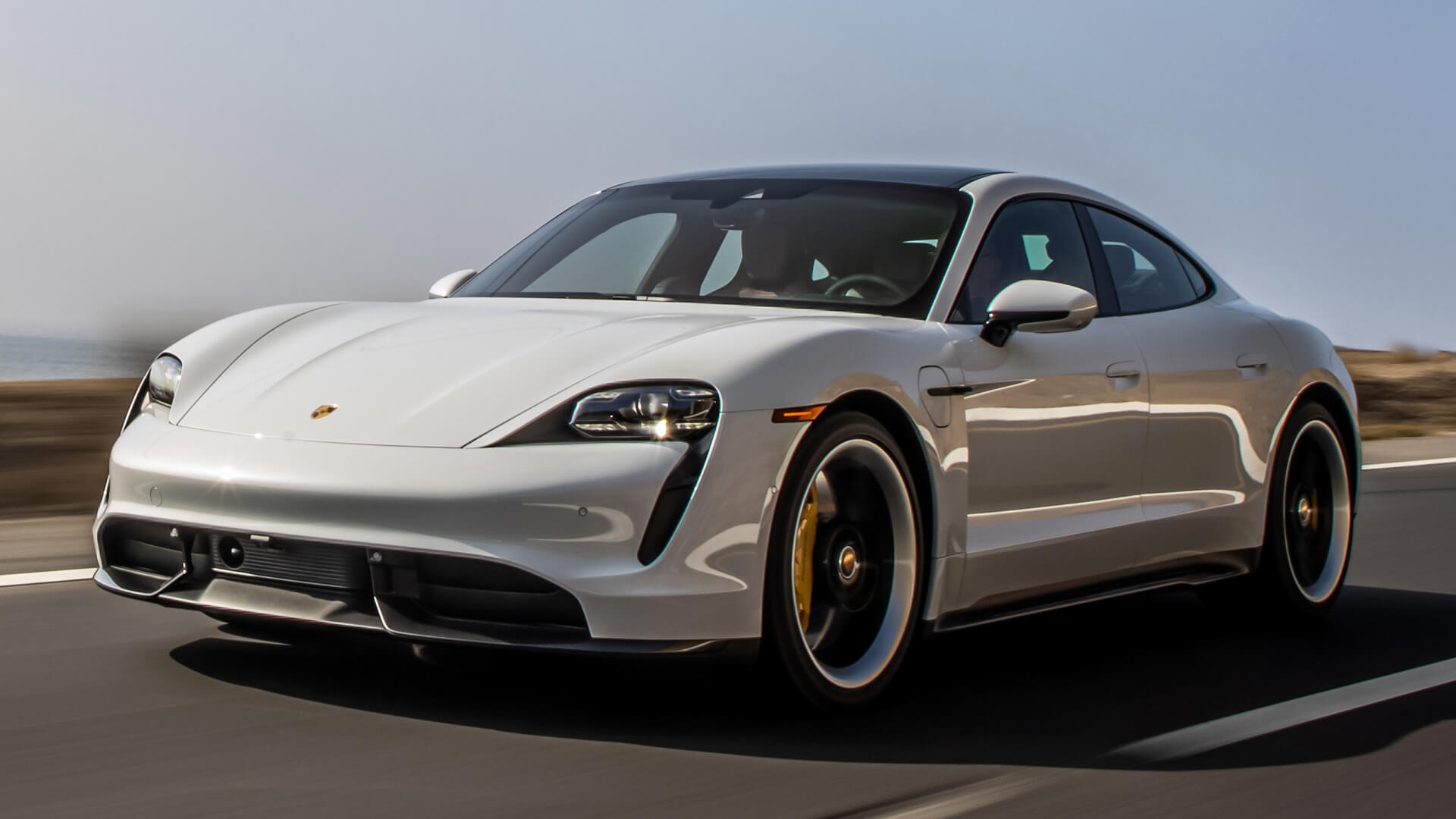
Porsche · 2019–present
Taycan I
- Power
- 390 kW530 PS
- 0–100 km/h
- 4.0 s
- Top speed
- 250 km/h
- Kerb mass
- 2,140 kg

Tesla · 2012–2026
Model S
- Power
- 568 kW772 PS
- 0–100 km/h
- —
- Top speed
- —
- Kerb mass
- 2,108 kg
At a glance
Who suits what, worked out from the catalog figures of the versions above.
Categories won: Taycan I 0 Model S 1
- City Too close to call Length: 4,963 mm vs 4,980 mm
- Performance Model S Power per tonne: 269 kW/t vs 182 kW/t
Verdict Opinion
The Model S is the better long-distance electric car for most families. It carries more, it went further than the early Taycans, and Tesla launched its Supercharger network together with it.
The Taycan is the better car to drive. Its low seating position, air springs with active anti-roll bars and the two-speed rear transmission make it feel like a Porsche first and an electric car second, and the 2024 facelift closed most of the range gap.
— Felix Hartmann
When the Porsche Taycan was unveiled on 4 September 2019, the car it was measured against was obvious. The Tesla Model S had been in production in Fremont since June 2012 and had shown that a battery car could cross a continent and still outrun most petrol saloons.
The two took different routes. Tesla built a large liftback around range and software. Porsche built a lower four-door sports car on the J1 platform it shares with the Audi e-tron GT, with 800-volt electrics and a rear axle that shifts between two gears. Their stories now diverge again: Fremont stopped building the Model S in May 2026, while the Taycan received a thorough facelift in February 2024.
Porsche Taycan vs Tesla Model S: drive, range and practicality
Two ways to deliver power
Every all-wheel-drive Taycan has one motor per axle, and the rear one drives through two gears: a short first for acceleration and a long second for efficiency at speed. The Model S began with a single rear motor, added dual-motor versions in 2014 and three motors in the 2021 Plaid. At the very top the two meet at the same number. The Plaid has 760 kW (1,020 hp) and needs 1.98 seconds to 60 mph; the 2024 Taycan Turbo GT reaches 760 kW (1,033 PS) with launch control and 100 km/h in 2.2 seconds.
Range and charging
Range was the Tesla's strong card from the start. The 2021 Long Range was quoted at 652 km and the 2025 update at about 660 km, while the Plaid manages about 628 km. Early Taycans with 79.2 or 93.4 kWh gross batteries were rated at 333–463 km WLTP. The facelift changed that: 89 or 105 kWh gross and 592–634 km WLTP. On a fast charger Porsche quotes up to 270 kW before the update and 320 kW after it, which is where the 800-volt layout pays off.
Space for people and luggage
The Model S is the more practical car. Behind its liftback there are 750 litres, which become 1,650 litres once the back seats are down, plus a 150-litre front trunk. Two rear-facing child seats in the boot were once an option, turning it into a seven-seater. The Taycan saloon has a boot lid and between 366 and 407 litres at the rear depending on version, plus a small front compartment, and it is a 4+1 seater with limited rear legroom. Buyers who need more space can choose the Cross Turismo of 2021 or the Sport Turismo of 2022.
Size, weight and chassis
The Tesla is longer at 4,981–5,021 mm against the Porsche's 4,963 mm, and taller at 1,435 mm against 1,378–1,381 mm. Weights are close: 1,961–2,250 kg for the Model S, 2,050–2,305 kg for the pre-facelift Taycan. Porsche adds three-chamber air springs, active anti-roll bars and optional rear-wheel steering; the Model S offered adjustable air suspension.
Prices and sales
The Taycan entered the market as a top-end car: at launch in September 2019 the Turbo cost about €152,000 and the Turbo S at least €185,000. Cheaper 4S and rear-wheel-drive versions followed. Sales show the Tesla's earlier reach: 50,366 Model S deliveries in 2015 alone, against a Taycan peak of 41,296 in 2021.
Race Stats side by side
Each figure is a 0–100 score from the catalog numbers, the same as on the 1CARS Race cards. PI is the overall performance index (100–999) and its class D–S.
| Stat | Taycan I | Model S |
|---|---|---|
| PI | A · 684 | S · 809 |
| Power | 69 | 81 |
| Grip | 62 | 73 |
| Handling | 57 | 56 |
| Top speed | 58 | 100 |
| Launch | 74 | 87 |
Grip and handling are estimates from drive type, weight, height and body (hover a figure to see where it comes from). 1CARS Race
Who wins a race?
Quarter-mile (402 m) drag from a standing start, dry road, no reaction time — the 1CARS Race physics on the catalog figures of these versions.
- 1 Model SP90D · electric · 568 kW (772 PS) 10.58 sat 224 km/h
- 2 Taycan I4S · electric · 390 kW (530 PS) 12.38 sat 180 km/h · +1.80 s
Size and weight
Side view to scale, all cars from the front bumper.
| Taycan I | Model S | |
|---|---|---|
| Length | 4,963 mm195.4 in | 4,980 mm196.1 in +17 mm +0.7 in +0.3% |
| Width | 1,966 mm77.4 in | 1,960 mm77.2 in −6 mm −0.2 in −0.3% |
| Height | 1,378 mm54.3 in † | 1,440 mm56.7 in +62 mm +2.4 in +4.5% |
| Wheelbase | 2,900 mm114.2 in | 2,960 mm116.5 in +60 mm +2.4 in +2.1% |
| Kerb weight | 2,140 kg4,718 lb | 2,108 kg4,647 lb −32 kg −71 lb −1.5% |
| Fits a standard garage? | Too wide | Too wide |
Difference vs Taycan I (±). Garage check: a standard single garage takes a car up to about 5.0 m (16 ft 5 in) long and 1.9 m (6 ft 3 in) wide (width as listed in the catalog; some makers include the mirrors). Leave about 0.6 m (2 ft) to open the doors. † from another version of this generation.
Full specifications
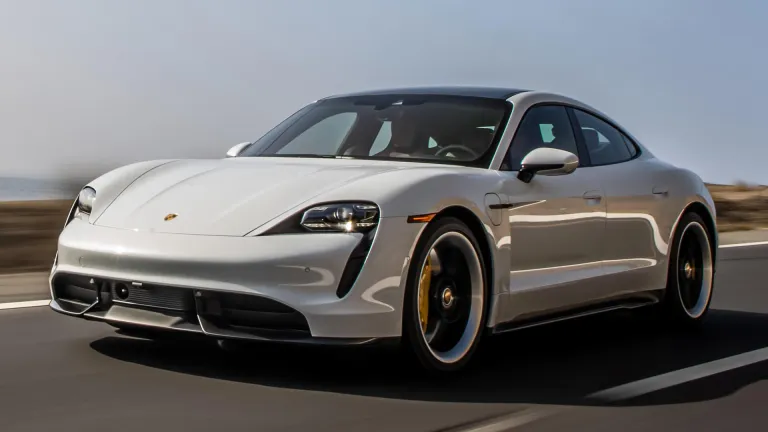
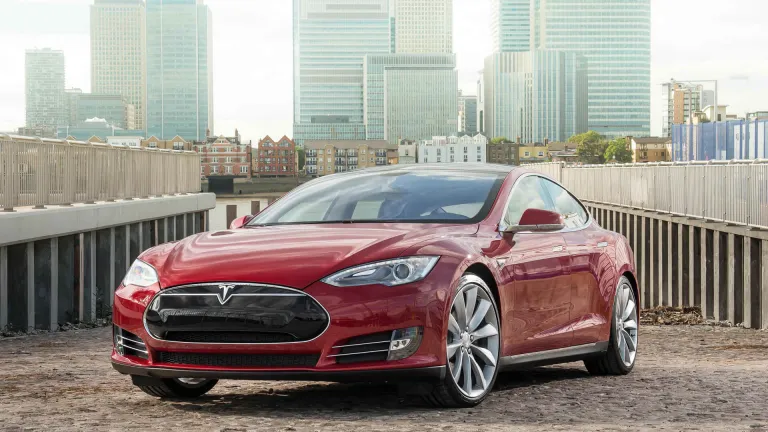
| Porsche Taycan | Tesla Model S | |
|---|---|---|
| General | ||
| Version | 4S · electric · 390 kW (530 PS) | P90D · electric · 568 kW (772 PS) |
| Production years | 2019–present | 2012–2026 |
| Body | Sedan | Sedan |
| Country | Germany | United States |
| Performance | ||
| Power Why it matters: More power means stronger acceleration and easier overtaking, especially with a full load. | 390 kW (530 PS) 523 hp | 568 kW (772 PS) 762 hp Better |
| Power, all versions | 300–760 kW (408–1,033 PS) 402–1,019 hp | 225–760 kW (306–1,033 PS) 302–1,019 hp |
| Torque Why it matters: Torque is the pulling force you feel when accelerating from low revs, towing or climbing hills. | 640 Nm 472 lb-ft | 967 Nm 713 lb-ft Better |
| 0–100 km/h Why it matters: A shorter 0–100 km/h time means quicker getaways and safer merging onto fast roads. | 4.0 s | No data |
| Top speed Why it matters: Top speed hints at how relaxed the car is at motorway speeds, even if you never reach it. | 250 km/h 155 mph | No data |
| Power per tonne | 182 kW/t 222 hp/ton calculated | 269 kW/t 328 hp/ton calculated Better |
| Engine and transmission | ||
| Fuel | Electric | Electric |
| Drive | All-wheel drive | All-wheel drive |
| Dimensions and weight | ||
| Length | 4,963 mm 195.4 in | 4,980 mm 196.1 in |
| Width | 1,966 mm 77.4 in | 1,960 mm 77.2 in |
| Height | 1,378 mm 54.3 in † | 1,440 mm 56.7 in |
| Wheelbase | 2,900 mm 114.2 in | 2,960 mm 116.5 in |
| Kerb weight Why it matters: A lighter car is usually more agile and uses less energy. | 2,140 kg 4,718 lb | 2,108 kg 4,647 lb |
| Boot Why it matters: A bigger boot fits more luggage, shopping or a pram. | No data | 900 l 31.8 cu ft |
| Economy and running costs | ||
| Fuel cost per year | No data | €900/year estimated |
| Electric | ||
| Battery Why it matters: A bigger battery usually gives more range, but takes longer to charge fully. | 79 kWh | No data |
| Electric range Why it matters: A longer range means fewer charging stops on long journeys. | 408 km 254 mi | No data |
| Energy use | No data | 20.0 kWh/100 km |
| Safety | ||
| Euro NCAP | No data | ★★★★★ (2022) |
These cars do not differ in the data we have.
Equal rows hidden (3): Body, Fuel, Drive.
Better marks the stronger figure — only for measurable specs (power, torque, 0–100 km/h, consumption, boot, weight).
Estimated at 15,000 km a year with fuel at €0.30/kWh electricity. † from another version of this generation.
In plain words
Tesla Model S has more power: 568 kW (772 PS) against 390 kW (530 PS) for Porsche Taycan. Tesla Model S is 17 mm longer than Porsche Taycan (4,980 mm vs 4,963 mm). Tesla Model S is lighter by 32 kg (2,108 kg vs 2,140 kg). Tesla Model S is the older design (from 2012); Porsche Taycan arrived in 2019. Porsche Taycan is still in production; Tesla Model S is not. On the catalog figures, the Tesla Model S is the pick for performance. Our catalog has no 0–100 km/h for the Tesla Model S yet, so some checks above leave it out.
Which one to choose
Choose the Taycan if steering, braking and body control matter more than boot volume, or if you want the higher charging power of the facelifted car.
Choose the Model S if you need a big liftback boot, five proper seats and long range at a lower price, and if you are comfortable with a model that is no longer in production.
Still undecided? Our electric cars section lists more battery saloons and SUVs.
On the used market check the battery state of a Model S and the charging history and tyre wear of a Taycan; both are heavy and fast, so tyres and brakes deserve a close look.
Frequently asked questions
Which is faster, the Taycan or the Model S Plaid?
Both top versions have 760 kW. By Tesla's count the Plaid needs 1.98 seconds to 60 mph, and Porsche's figure for the 2024 Taycan Turbo GT is 2.2 seconds to 100 km/h.
Which has the longer range?
Before 2024 the Model S clearly did. After its facelift the Taycan is rated at 592–634 km WLTP, close to the Model S Long Range at about 660 km.
Why does the Taycan have a two-speed gearbox?
First gear gives strong acceleration and second gear lowers motor speed at high road speeds, which helps efficiency and top speed.
Is the Tesla Model S still made?
No. The last Model S left the Fremont line in May 2026, and Tesla converted that line, which had also built the Model X.