
Hyundai Ioniq vs Kia Niro: hybrid and electric twins
Updated Report an error By Oleksandr Hnatiuk

Hyundai · 2016–2022
Ioniq
- Power
- 100 kW136 PS
- Kerb mass
- 1,602 kg

Kia · 2016–2022
Niro I
- Power
- 100 kW136 PS
- Kerb mass
- 1,667 kg
At a glance
Who suits what, worked out from the catalog figures of the versions above.
Categories won: Ioniq 4 Niro I 2
- Family Ioniq Euro NCAP: 5★ vs 4★
- City Niro I Length: 4,355 mm vs 4,470 mm
- Long trips Ioniq Range: 311 km vs 289 km (estimated)
- Performance Ioniq Power per tonne: 62 kW/t vs 60 kW/t
- Running costs Ioniq Fuel per year: €620 vs €690 (estimated)
- Off-road Niro I Drive and body: Front-wheel drive · SUV vs Front-wheel drive · Liftback
Verdict Opinion
The Hyundai Ioniq is the better choice for maximum efficiency. Its low drag, its EPA efficiency record and its five-star Euro NCAP rating make it an economical, safe used car, and the Ioniq Electric's 311 km WLTP range suits drivers who mostly stay near home.
The Kia Niro is the better electric car for longer journeys. The 64 kWh e-Niro with 455 km WLTP and 150 kW has 144 km more WLTP range than any Ioniq Electric, and its crossover body suits buyers who prefer an SUV shape. The trade-off is a four-star Euro NCAP rating with lower pedestrian and safety-assist scores.
— Oleksandr Hnatiuk
The Hyundai Ioniq and the first-generation Kia Niro are technical twins from the same group. Hyundai launched the Ioniq in South Korea in January 2016 and showed all three versions, hybrid, plug-in hybrid and electric, at the Geneva and New York shows that year. Kia unveiled the Niro at the 2016 Chicago Auto Show on the same platform and began full production at Hwaseong in May 2016. The Ioniq ended production in July 2022; the Niro moved on to a second generation in 2022.
In short: both hybrids use the same 1.6 GDi system with 104 kW and a six-speed dual-clutch gearbox. The Ioniq is a low, aerodynamic liftback and its Electric version was the US EPA's most efficient vehicle for three model years. The Niro is a taller crossover, and the e-Niro's 64 kWh battery gives it far more range than any Ioniq Electric. Both are in our catalogue: Hyundai Ioniq and Kia Niro.
Ioniq vs Niro: hybrid, electric range, efficiency and safety
The shared hybrid system
The Ioniq Hybrid combines a 1.6-litre Kappa four-cylinder Atkinson-cycle petrol engine of 78 kW with a 32 kW electric motor, for a system output of 104 kW (139 hp). The Niro Hybrid uses the same 1.6 GDi engine plus motor with 104 kW combined. Both drive the front wheels through a six-speed dual-clutch gearbox, not a CVT. Plug-in hybrids of both cars use an 8.9 kWh battery; Kia offered its plug-in from September 2018.
- Ioniq Electric (2020 refresh): 100 kW, 38.3 kWh, 311 km WLTP
- e-Niro 39.2 kWh: 100 kW, 288 km WLTP
- e-Niro 64 kWh: 150 kW, 455 km WLTP
- Hybrids: 104 kW system output, six-speed dual-clutch
Electric versions and range
The Ioniq Electric started in 2016 with a 28 kWh battery and an 88 kW motor. Its update raised the battery to 38.3 kWh and output to 100 kW, with a WLTP range of 311 km. The e-Niro arrived in 2018 with a 39.2 kWh battery, a 100 kW motor and 288 km WLTP, or a 64 kWh battery, a 150 kW motor and 455 km WLTP. With the smaller battery the two are close; with the larger battery the Kia has 144 km more range than the best Ioniq.
Efficiency and shape
The Ioniq is built for low consumption. Its drag coefficient is 0.24, and the Ioniq Electric was the most efficient vehicle rated by the US EPA from 2017 to the 2019 model year, at 136 MPGe or 15.4 kWh/100 km. The Ioniq Blue Hybrid is rated at 4.1 l/100 km. The Niro trades some of that efficiency for a taller crossover body; the e-Niro is 4,375–4,385 mm long, against 4,470 mm for the Ioniq on a 2,700 mm wheelbase.
Euro NCAP
The Ioniq earned five stars in 2016; the Euro NCAP-aligned scores are 90% for adult occupants, 80% for children, 70% for vulnerable road users and 70% for safety assist. The first Niro earned four stars in 2016, with 83%, 80%, 57% and 59%.
The successors
Hyundai ended Ioniq production in July 2022. The second-generation Niro was revealed on 25 November 2021 and launched in January 2022, again with a 104 kW hybrid, and its electric version uses a 64.8 kWh battery. With the facelift revealed on 20 January 2026, Kia discontinued the plug-in hybrid and electric Niro.
Race Stats side by side
Each figure is a 0–100 score from the catalog numbers, the same as on the 1CARS Race cards. PI is the overall performance index (100–999) and its class D–S.
| Stat | Ioniq | Niro I |
|---|---|---|
| PI | C · 482 | C · 436 |
| Power | 35 | 34 |
| Grip | 36 | 30 |
| Handling | 66 | 54 |
| Top speed | 43 | 35 |
| Launch | 38 | 36 |
Grip and handling are estimates from drive type, weight, height and body (hover a figure to see where it comes from). 1CARS Race
Who wins a race?
Quarter-mile (402 m) drag from a standing start, dry road, no reaction time — the 1CARS Race physics on the catalog figures of these versions.
- 1 IoniqElectric (2019 update) · 100 kW (136 PS) 16.37 sat 135 km/h
- 2 Niro INiro I · electric · 100 kW (136 PS) 16.63 sat 131 km/h · +0.26 s
Size and weight
Side view to scale, all cars from the front bumper.
| Ioniq | Niro I | |
|---|---|---|
| Length | 4,470 mm176.0 in | 4,355 mm171.5 in −115 mm −4.5 in −2.6% |
| Width | 1,820 mm71.7 in | 1,805 mm71.1 in −15 mm −0.6 in −0.8% |
| Height | 1,450 mm57.1 in | 1,545 mm60.8 in +95 mm +3.7 in +6.6% |
| Wheelbase | 2,700 mm106.3 in | 2,700 mm106.3 in |
| Kerb weight | 1,602 kg3,532 lb | 1,667 kg3,675 lb +65 kg +143 lb +4.1% |
| Fits a standard garage? | Yes | Yes |
Difference vs Ioniq (±). Garage check: a standard single garage takes a car up to about 5.0 m (16 ft 5 in) long and 1.9 m (6 ft 3 in) wide (width as listed in the catalog; some makers include the mirrors). Leave about 0.6 m (2 ft) to open the doors.
Full specifications
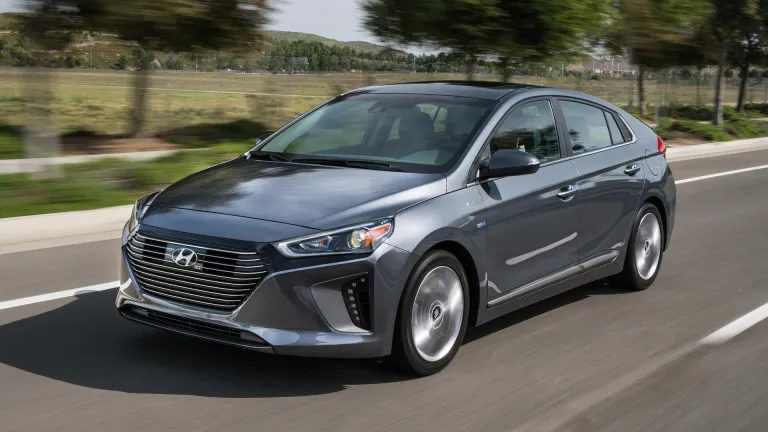
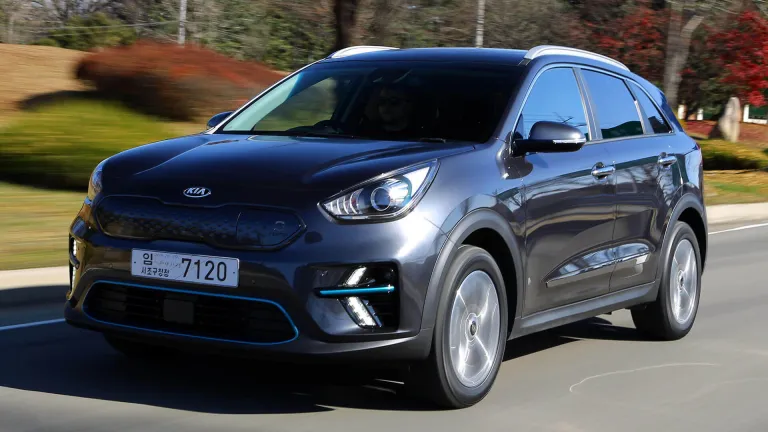
| Hyundai Ioniq | Kia Niro | |
|---|---|---|
| General | ||
| Version | Electric (2019 update) · 100 kW (136 PS) | Niro I · electric · 100 kW (136 PS) |
| Production years | 2016–2022 | 2016–2022 |
| Body | Liftback | SUV |
| Class | No data | SUV / crossover |
| Country | South Korea | South Korea |
| Performance | ||
| Power Why it matters: More power means stronger acceleration and easier overtaking, especially with a full load. | 100 kW (136 PS) 134 hp | 100 kW (136 PS) 134 hp |
| Power, all versions | 88–104 kW (120–141 PS) 118–139 hp | 100–150 kW (136–204 PS) 134–201 hp |
| Torque Why it matters: Torque is the pulling force you feel when accelerating from low revs, towing or climbing hills. | No data | 395 Nm 291 lb-ft |
| Power per tonne | 62 kW/t 76 hp/ton calculated Better | 60 kW/t 73 hp/ton calculated |
| Engine and transmission | ||
| Fuel | Electric | Electric |
| Gearbox | single-speed | No data |
| Drive | Front-wheel drive | Front-wheel drive |
| Dimensions and weight | ||
| Length | 4,470 mm 176.0 in | 4,355 mm 171.5 in |
| Width | 1,820 mm 71.7 in | 1,805 mm 71.1 in |
| Height | 1,450 mm 57.1 in | 1,545 mm 60.8 in |
| Wheelbase | 2,700 mm 106.3 in | 2,700 mm 106.3 in |
| Kerb weight Why it matters: A lighter car is usually more agile and uses less energy. | 1,602 kg 3,532 lb Better | 1,667 kg 3,675 lb |
| Boot Why it matters: A bigger boot fits more luggage, shopping or a pram. | No data | 450 l 15.9 cu ft |
| Economy and running costs | ||
| Fuel cost per year | €620/year estimated Better | €690/year estimated |
| Electric | ||
| Battery Why it matters: A bigger battery usually gives more range, but takes longer to charge fully. | 38 kWh | 39 kWh |
| Electric range Why it matters: A longer range means fewer charging stops on long journeys. | 311 km 193 mi Better | 289 km 180 mi |
| Energy use | 13.8 kWh/100 km Better | 15.3 kWh/100 km |
| Safety | ||
| Euro NCAP | ★★★★★ (2016) Better | ★★★★☆ (2016) |
These cars do not differ in the data we have.
Equal rows hidden (6): Production years, Country, Power, Fuel, Drive, Wheelbase.
Better marks the stronger figure — only for measurable specs (power, torque, 0–100 km/h, consumption, boot, weight).
Estimated at 15,000 km a year with fuel at €0.30/kWh electricity.
In plain words
Hyundai Ioniq is 115 mm longer than Kia Niro (4,470 mm vs 4,355 mm). Hyundai Ioniq is lighter by 65 kg (1,602 kg vs 1,667 kg). At 15,000 km a year, fuel would cost about €620 (Hyundai Ioniq), €690 (Kia Niro) (estimated). Kia Niro is still in production; Hyundai Ioniq is not. On the catalog figures, the Hyundai Ioniq is the pick for family, long trips, performance and running costs; the Kia Niro is the pick for city and off-road.
Which one to choose
Choose the Hyundai Ioniq if you want the lowest consumption, a five-star safety rating, or a hybrid or small-battery electric car for daily commuting.
Choose the Kia Niro if you need more electric range, prefer a crossover body, or want the 64 kWh e-Niro as a used family EV.
The Ioniq Hybrid also meets the class pioneer in Hyundai Ioniq vs Toyota Prius, and Hyundai and Kia's SUVs meet in Hyundai Tucson vs Kia Sportage.
Frequently asked questions
Are the Ioniq and the Niro the same car?
They share a platform and the 104 kW 1.6 GDi hybrid system with a six-speed dual-clutch gearbox. The Ioniq is a low liftback; the Niro is a taller crossover.
Which has more electric range?
The 64 kWh e-Niro, rated at 455 km WLTP. The updated Ioniq Electric with 38.3 kWh is rated at 311 km, and the 39.2 kWh e-Niro at 288 km.
Which is more efficient?
The Ioniq. Its Electric version was the most efficient vehicle rated by the US EPA from 2017 to the 2019 model year, at 15.4 kWh/100 km, and its drag coefficient is 0.24.
Which is safer?
The Ioniq earned five Euro NCAP stars in 2016 with 90% for adult occupants. The first-generation Niro earned four stars with 83%.
Are they still made?
The Ioniq ended production in July 2022. The Niro continues in its second generation, but since the 2026 facelift it is sold as a hybrid only.