 Porsche Taycan
Specs, engines and history
Published Sources (2) Report an error
By Felix Hartmann, Automotive Technology & EV Contributor
- Built
- 2019–present
- Top power
- 760 kW (1,033 PS)
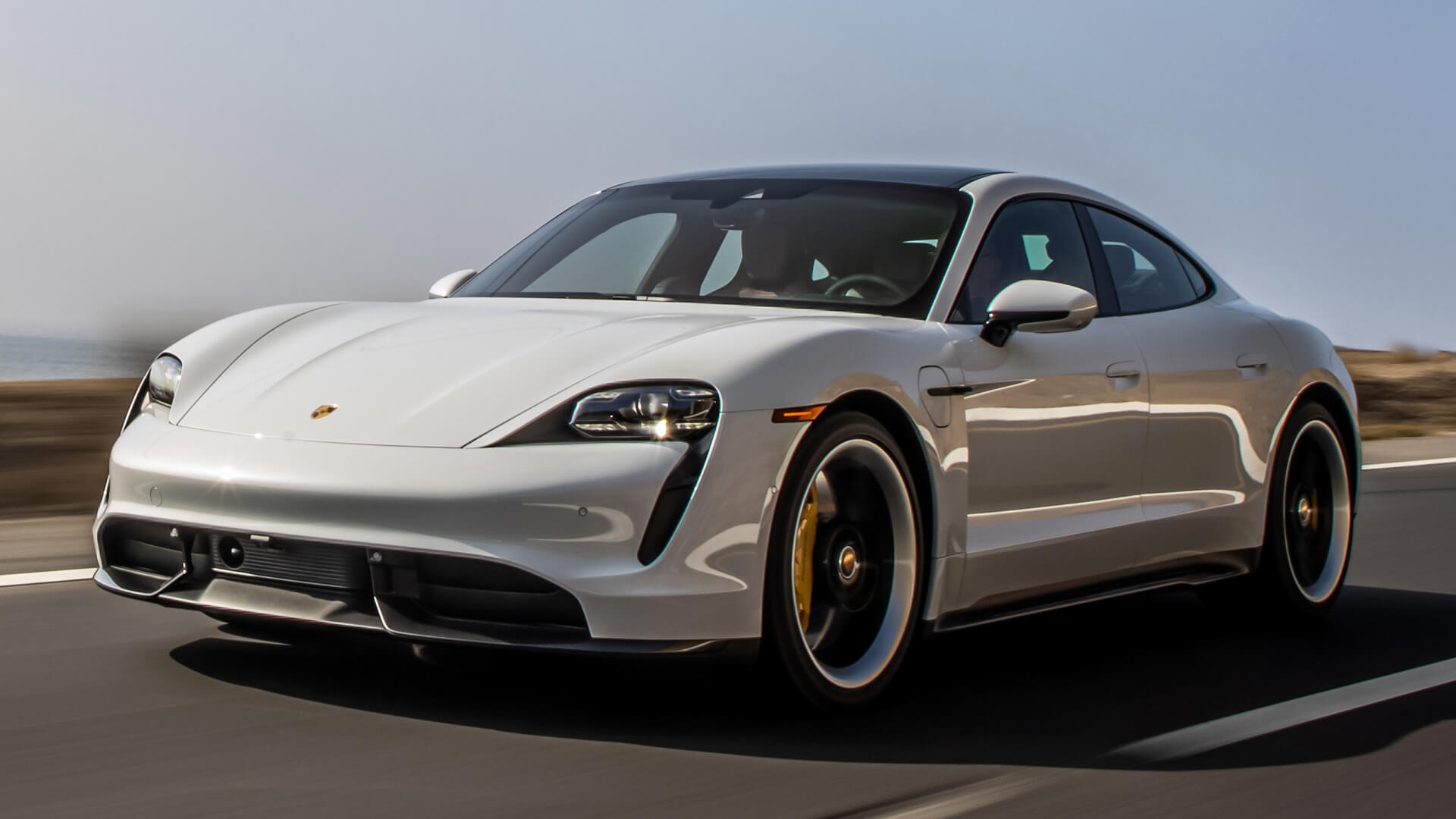
The Porsche Taycan is a fully electric four-door sports saloon — Porsche's first series-production electric car. It was previewed by the Mission E concept at the 2015 Frankfurt motor show. The production car was unveiled on 4 September 2019 at simultaneous events on three continents and then shown at the Frankfurt motor show later that month. It offers a modern cabin, expressive styling, advanced technology and genuine driving engagement. A facelift arrived in February 2024.
In short
- Built in Stuttgart on the Volkswagen Group J1 platform, shared with the Audi e-tron GT, with an 800-volt electrical system.
- Rear-wheel-drive and all-wheel-drive versions from 300 kW (408 PS) to the Turbo GT with up to 760 kW (1,033 PS) with launch control.
- Two-speed gearbox on the rear axle; 0–100 km/h in as little as 2.2 seconds.
- Body styles: saloon, Cross Turismo (2021) and Sport Turismo (2022).
Size at a glance
| Dimensions | Porsche Taycan I |
|---|---|
| Length | 4,963 mm195.4 in |
| Width | 1,966 mm77.4 in |
| Height | 1,378 mm54.3 in |
| Wheelbase | 2,900 mm114.2 in |
Specs by version
Engines
| Version | Engine | Power | Torque | Drive | Production years |
|---|---|---|---|---|---|
| Taycan (RWD) | Electric | 300 kW 408 PS402 hp | 344 Nm254 lb-ft | Rear-wheel drive | 2020–2024 |
| Taycan 4S | Electric | 390 kW 530 PS523 hp | 640 Nm472 lb-ft | All-wheel drive | 2019–2024 |
| Taycan 4S (2024 facelift) | Electric | 400 kW 544 PS536 hp | 695 Nm513 lb-ft | All-wheel drive | 2024 |
| Taycan Turbo | Electric | 500 kW 680 PS671 hp | — | All-wheel drive | 2019–2024 |
| Taycan Turbo S | Electric | 560 kW 761 PS751 hp | 1,050 Nm774 lb-ft | All-wheel drive | 2019–2024 |
| Taycan Turbo S (2024 facelift) | Electric | 700 kW 952 PS939 hp | 1,110 Nm819 lb-ft | All-wheel drive | 2024 |
| Taycan Turbo GT | Electric | 760 kW 1,033 PS1,019 hp | 1,340 Nm988 lb-ft | All-wheel drive | 2024 |
Performance
Show all 6 versions
| Version | 0–100 km/h | Top speed | Fuel consumption | Range |
|---|---|---|---|---|
| Taycan (RWD) | 5.4 s 0–62 mph | 230 km/h143 mph | 17.4 kWh/100 km28.0 kWh/100 mi | 431 km268 mi |
| Taycan 4S | 4.0 s 0–62 mph | 250 km/h155 mph | — | 408 km254 mi |
| Taycan Turbo | 3.2 s 0–62 mph | 260 km/h162 mph | 19.1 kWh/100 km30.7 kWh/100 mi | 452 km281 mi |
| Taycan Turbo S | 2.8 s 0–62 mph | 260 km/h162 mph | — | 416 km258 mi |
| Taycan Turbo S (2024 facelift) | — | — | 20.7 kWh/100 km33.3 kWh/100 mi | — |
| Taycan Turbo GT | 2.2 s 0–62 mph | 290 km/h180 mph | — | 555 km345 mi |
Dimensions and weight
Show all 7 versions
| Version | Length | Width | Wheelbase | Kerb weight | Battery |
|---|---|---|---|---|---|
| Taycan (RWD) | 4,963 mm195.4 in | 1,966 mm77.4 in | 2,900 mm114.2 in | 2,050 kg4,519 lb | 79 kWh |
| Taycan 4S | 4,963 mm195.4 in | 1,966 mm77.4 in | 2,900 mm114.2 in | 2,140 kg4,718 lb | 79 kWh |
| Taycan 4S (2024 facelift) | 4,963 mm195.4 in | 1,966 mm77.4 in | 2,900 mm114.2 in | — | 89 kWh |
| Taycan Turbo | 4,963 mm195.4 in | 1,966 mm77.4 in | 2,900 mm114.2 in | 2,305 kg5,082 lb | 93 kWh |
| Taycan Turbo S | 4,963 mm195.4 in | 1,966 mm77.4 in | 2,900 mm114.2 in | 2,295 kg5,060 lb | 93 kWh |
| Taycan Turbo S (2024 facelift) | 4,963 mm195.4 in | 1,966 mm77.4 in | 2,900 mm114.2 in | 2,326 kg5,128 lb | — |
| Taycan Turbo GT | 4,963 mm195.4 in | 1,966 mm77.4 in | 2,900 mm114.2 in | — | 105 kWh |
Verified Manufacturer and type-approval data from our catalog · Sources and methodology
Porsche Taycan at a glance
The Taycan sits alongside the Panamera in Porsche's range but is a lower four-door saloon rather than a five-door liftback. It has two luggage compartments: 81 litres at the front and 366 litres at the rear. More Porsche models are listed in our Porsche catalogue.
Exterior
The Taycan closely follows the Mission E concept, apart from details such as the door handles. From the front it resembles the Panamera, with LED matrix headlights that can mask out sections to avoid dazzling oncoming drivers, a bumper with a battery-cooling intake and numerous sensors, and a sculpted bonnet. The Turbo's drag coefficient of 0.22 is the lowest of any current Porsche.
The doors have frameless windows and flush handles. Pronounced front and rear wings emphasise the sporting character; the prototype's cameras were replaced by conventional mirrors with heating, power adjustment and memory. Wheels are 19 inches as standard, with 20- and 21-inch options. The charging flap on the front wing opens electrically. Adaptive air suspension varies ground clearance between 108 and 150 mm. At the rear, a full-width LED light bar runs across the boot lid, and a hidden spoiler extends automatically above 90 km/h. A diffuser, two LED rear fog lamps and an outlet that removes warm air from the battery sit in the lower bumper. The roof can be solid, with a panoramic sunroof or with a fixed full-length glass panel.
Interior
The cabin uses several types of leather, aluminium, carbon, Alcantara and wood. Sports seats with integrated head restraints have strong side bolstering and extensive electric adjustment. A small three-spoke steering wheel faces a curved 16.8-inch digital instrument display with touch controls for the lights and a customisable section for navigation. A clock sits on top of the dashboard. A 10.9-inch central touchscreen controls infotainment, and an optional matching screen in front of the passenger allows music, video and phone functions. An 8.4-inch touch panel at the base of the console handles the climate system; there is no gear lever on the tunnel, which holds covered storage, cupholders and an armrest.
The Taycan is a 4+1 seater: two contoured rear seats with a storage tray and a fold-down armrest, and a short-trip centre position. Rear passengers have their own climate controls and display, but legroom is limited.
Versions and performance
| Version (launch) | Peak power (kW / PS) | 0–100 km/h |
|---|---|---|
| Taycan (RWD) | 300 kW / 408 PS | 5.4 s |
| Taycan 4S | 390 kW / 530 PS | 4.0 s |
| Taycan GTS | 440 kW / 598 PS | 3.7 s |
| Taycan Turbo | 500 kW / 680 PS | 3.2 s |
| Taycan Turbo S | 560 kW / 761 PS | 2.8 s |
| Taycan Turbo GT (2024) | 760 kW / 1,033 PS (with launch control) | 2.2–2.3 s |
Peak figures include overboost. The launch Turbo had a continuous output of 460 kW (625 PS) and 850 Nm, with a 160 kW (218 PS) front motor and a 300 kW (408 PS) rear motor; the Turbo S reaches 1,050 Nm. Top speed for the launch Turbo and Turbo S is 260 km/h. After the 2024 facelift, outputs rose — for example to 400 kW for the 4S and 700 kW for the Turbo S.
All-wheel-drive versions use two permanent-magnet synchronous motors, one per axle. The front motor has a single-speed gearbox, while the rear has a two-speed transmission: first gear for acceleration and second for efficiency and top speed. An electronically controlled locking rear differential is fitted, and drive modes include Range, Normal, Sport, Sport Plus and Individual.
Battery, range and charging
| Period | Battery (gross / net) | WLTP range | DC charging |
|---|---|---|---|
| 2019–2024 | 79.2 / 71.0 kWh or 93.4 / 83.7 kWh | 333–463 km | up to 270 kW |
| From 2024 facelift | 89 / 82.3 kWh or 105 / 97 kWh | 592–634 km | up to 320 kW |
The liquid-cooled lithium-ion battery is integrated into the floor structure, lowering the centre of gravity. At a 270 kW fast charger, charging from 5 to 80% takes about 22.5 minutes; a full charge from a household socket takes about 11 hours. A 150 kW on-board booster allows charging at 400-volt stations.
Chassis
The body uses high-strength steel in the structure and aluminium for most outer panels. Suspension is fully independent and made of aluminium, with double wishbones at the front, a multi-link rear, three-chamber air springs and active anti-roll bars. The body can be raised by 20 mm and lowers by 22 mm at speed. Adaptive electric power steering and rear-wheel steering (optional on the Turbo, standard on the Turbo S) are available. Brakes are tungsten-carbide-coated discs (415 mm front, 365 mm rear), or carbon-ceramic discs (420/410 mm) on the Turbo S.
Body styles
The Taycan Cross Turismo, a raised estate with crossover styling and all-wheel drive only, arrived in March 2021. The Sport Turismo, announced in January 2022, offers the estate body with a lower ride height, including a rear-wheel-drive base version; the GTS was announced in November 2021 with the Sport Turismo body.
Safety and equipment
Equipment includes a full set of airbags, parking assistance, a surround-view camera, night vision, lane-change assist, adaptive cruise control, keyless entry, driver monitoring, a head-up display, digital instruments, 4G LTE and Wi-Fi, smartphone remote control, adaptive headlights and traffic-jam assistance. Standard features also include leather upholstery, a power tailgate, lane keeping, traffic-sign recognition, voice-controlled navigation, electric heated front seats, 19-inch wheels, full-LED lights, dual-zone climate control and a 14-speaker Bose sound system.
Sales
Global deliveries reached 20,015 in 2020, 41,296 in 2021, 34,801 in 2022 and 40,629 in 2023, before falling to 20,836 in 2024 and 16,339 in 2025.
Strengths and weaknesses
Owners praise the Taycan's styling, a very supple ride even on 20-inch wheels, excellent performance, sound insulation and high-quality lighting. Complaints include a confusing surround-view camera, no headlight washers, narrow door openings and no interior button for the boot, as well as the high price. Rivals include the Tesla Model S, its sister the Audi e-tron GT, the Mercedes-Benz EQE and the Lucid Air.
Popular comparisons
Porsche Taycan in our rankings
- No. 1 of 124 · Most powerful German cars (760 kW)
- No. 1 of 103 · Quickest cars of the 2020s, 0–100 (2.2 s)
- No. 1 of 70 · Quickest German cars, 0–100 (2.2 s)
- No. 1 of 68 · Most torque: sedans (1,340 Nm)
- No. 1 of 52 · Power-to-weight: sedans (301 kW/t)
- No. 1 of 48 · Fastest electric cars (290 km/h)
More powerful than 99% of ranked German cars in the 1CARS catalog (No. 1 of 124).
FAQ
What platform is the Porsche Taycan built on?
The Volkswagen Group J1 platform, shared with the Audi e-tron GT, with an 800-volt system.
How fast is the Porsche Taycan?
The launch Turbo S reaches 100 km/h in 2.8 seconds; the 2024 Turbo GT does it in 2.2–2.3 seconds.
What is the range of the Porsche Taycan?
333–463 km WLTP before the 2024 facelift and 592–634 km afterwards.
Why does the Taycan have a two-speed gearbox?
The rear axle uses a short first gear for acceleration and a longer second gear for efficiency and top speed.
Data sources
Data checked by an editor against the sources below.
- Wikipedia — Porsche Taycan
- EEA CO₂ monitoring (European Environment Agency, CC BY 4.0)