 Porsche 924
Specs, engines and history
Published Sources (1) Report an error
By Felix Hartmann, Automotive Technology & EV Contributor
Verdict
Our verdict · Felix Hartmann
Despite the long-standing dislike of many Porsche enthusiasts, the 924 eventually became a classic. It did not have the familiar 911 look or layout, yet whatever the engine and version, it carried the Porsche gene that makes the brand's cars special. Its solid German build quality has kept many cars alive to this day, often in good condition.
The Porsche 924 is a sports car built by Porsche from 1976 to 1988. It began life as a Volkswagen project, intended as the successor to the VW-Porsche 914, but it was launched as Porsche's own entry-level sports coupé. Once dismissed by many Porsche purists, it has since become a respected classic.
In short
- Built from 1976 to 1988 at the former NSU plant in Neckarsulm; just over 150,000 were made, including the 924S.
- The first Porsche with a front-mounted, water-cooled engine and a rear transaxle.
- 2.0-litre four-cylinder with 92 kW (125 PS); the 924 Turbo had 125–130 kW (170–177 PS) and the Carrera GT 154 kW (210 PS).
- The 924S of 1986 used a 2.5-litre engine from the 944 with 110–118 kW (150–160 PS).
Porsche 924 at a glance
More Porsche models are listed in our Porsche catalogue.
| Version | Years | Engine | Power (kW / PS) |
|---|---|---|---|
| 924 | 1976–1985 | 2.0 four-cylinder, K-Jetronic | 92 kW / 125 PS |
| 924 Turbo | 1978–1982 | 2.0 turbo | 125 kW / 170 PS, from 1981 130 kW / 177 PS |
| 924 Carrera GT | 1980 | 2.0 turbo, intercooled | 154 kW / 210 PS |
| 924 Carrera GTS | 1981 | 2.0 turbo | 180 kW / 245 PS |
| 924S | 1986–1988 | 2.5 four-cylinder (from the 944) | 110 kW / 150 PS, from 1988 118 kW / 160 PS |
History
For Porsche, the 924 was a radical departure: it had a front-mounted, water-cooled engine and a transaxle layout, with the engine and gearbox separated, which the brand had never used before. The project started at Volkswagen as "Project 425". The oil crisis of the mid-1970s hit the car industry hard, and Volkswagen dropped the project in favour of the Scirocco; Porsche bought the design back.
Porsche had its own reasons to welcome it. Despite the great popularity of the 911, the company needed to try a new layout that met current technical standards and the economic situation. The result was an affordable car that cost about a third less than a 911. It was not built on the 911's platform; the structure was completely new, and in 1976 Porsche launched its first car with an almost conventional design. The transaxle concept placed the engine at the front and the gearbox together with the final drive at the rear. The 924 was built in the former NSU factory at Neckarsulm, with Volkswagen employees working on the line under Porsche supervision.
Design and body
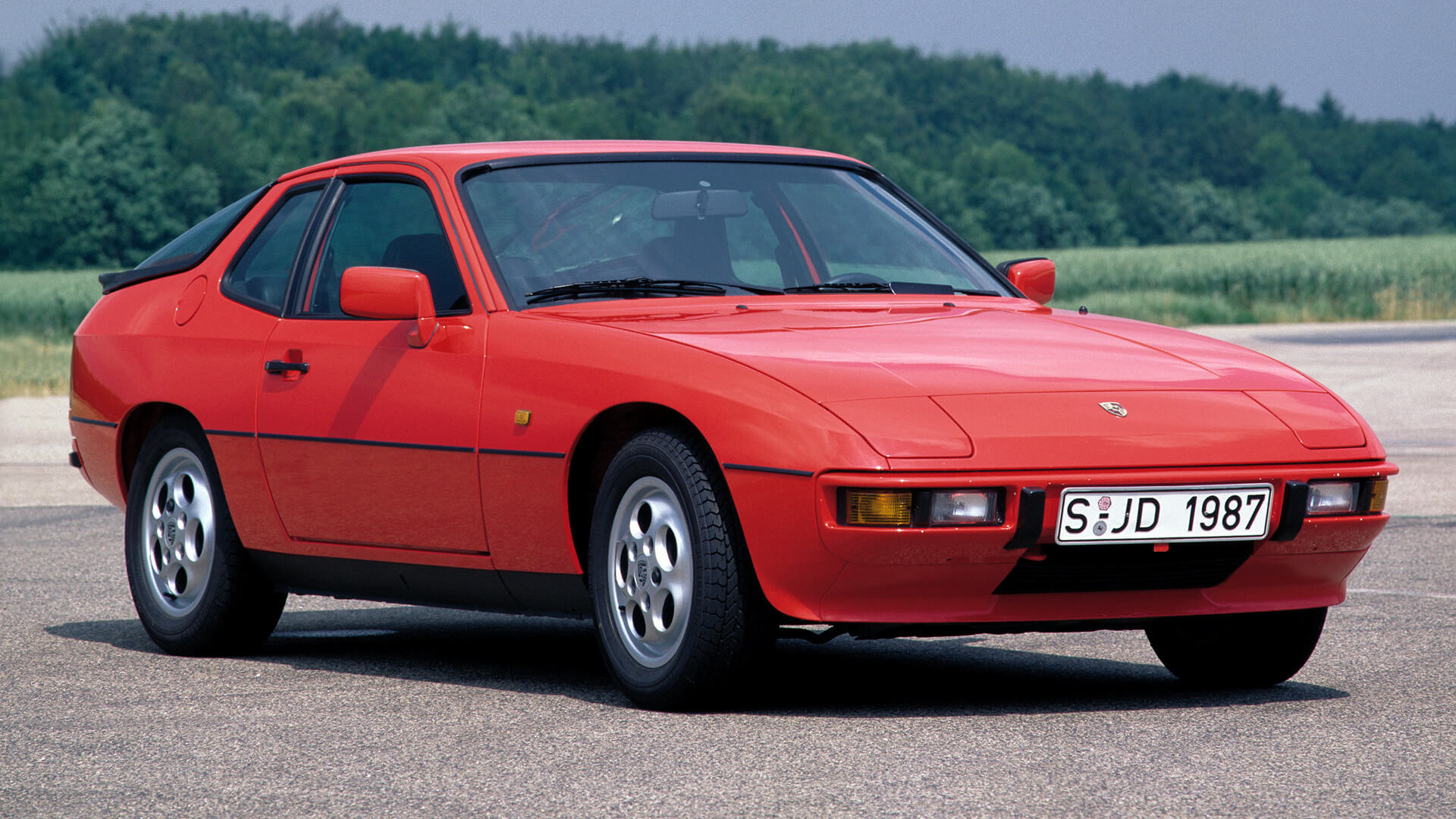
The 924 has a long, low bonnet and pronounced wings. The large front bumper is visually unobtrusive, with indicators and sidelights at its sides and an air intake in the centre below them. Ground clearance is 125 mm. The doors are simple, with rectangular windows, the rear wings are large and distinctive, and a black plastic strip runs along the whole side. The rear is defined by the large, curved glass hatch.
The body was galvanised, which is why many 924s have survived in good condition. Aerodynamics were a priority: pop-up headlights helped give the 924 a drag coefficient of 0.36, and on the Turbo a duck-tail rear spoiler lowered it to 0.33.
Interior
The cabin has an unusual and attractive look in a classic style with clean geometric lines, a four-spoke steering wheel and three recessed dials in the instrument panel. The rectangular centre console carries the controls for various systems, although the gear lever, placed conveniently for the driver, hides some of the buttons. The glovebox and air vents are small, partly because of the compact front section.
Even the base car had Recaro seats, and the handbrake lever sits by the driver's left hand. The seats of the 924 Turbo are comfortable, with excellent side support. The rear seats are suitable only for teenagers, because of the sharply sloping roof. Visibility is excellent, and the large glass area makes the cabin bright, especially with beige trim. The interior was updated several times; for example, it later received an instrument panel styled like that of the Porsche 928.
Engines
The 924's 2.0-litre four-cylinder is water-cooled — unusual for a Porsche — with Bosch K-Jetronic fuel injection and a belt-driven overhead camshaft, producing 92 kW (125 PS) in European form; US versions had less power. The engine was not a Porsche design: it is the Volkswagen EA831 unit, which first appeared in an Audi and was also used in the VW LT van. That earned the car much criticism from Porsche enthusiasts.
In 1978 Porsche introduced the 924 Turbo, with 125 kW (170 PS), four-wheel disc brakes and other improvements; from 1981 the Series 2 Turbo had 130 kW (177 PS). In its day it was regarded as one of the most economical sports cars in the world. Over its production life the 924 used many engines, but almost all were petrol four-cylinders of 2.0 litres with a single overhead camshaft, in road and racing versions. In 1986 the 924S arrived with a detuned version of the 944's 2.5-litre engine, producing 110 kW (150 PS), and 118 kW (160 PS) in its final year.
Transmission
Power reaches the rear wheels through a four- or five-speed manual gearbox — the four-speed came from Audi at launch, and five-speed gearboxes followed from 1979 — or a three-speed automatic, available from 1977. The gearbox position is unusual: with the engine at the front, placing the gearbox there too would have spoiled the weight distribution. Instead, the engineers combined the gearbox with the final drive at the rear and placed the driveshaft inside a steel tube that added rigidity. The result is a weight distribution of 48:52 front to rear. According to published figures, 18 variants of this transmission were used in the 924; it is reliable, though not free of minor ailments.
Chassis
The suspension is independent, with MacPherson struts and lower wishbones at the front and semi-trailing arms with torsion bars and telescopic dampers at the rear. This layout gave good handling. There is no power steering, yet the steering is excellent, with precise, sharp responses. The base car has solid front discs and rear drums — a slightly odd choice for a sporty model — while the Turbo and cars with the S package from 1980 have discs all round.
Racing versions
The 924 Carrera GT of 1980, with an intercooled turbo engine producing 154 kW (210 PS), is especially sought after: 406 were built, including prototypes. It was followed by the Carrera GTS of 1981, with 180 kW (245 PS) and only 59 made, and the GTR racing car with around 280 kW (375 hp) and a weight of just 930 kg.
Sales and legacy
The 924 was a commercial success. In 1980 Porsche celebrated the 100,000th 924. Published figures count 135,400 cars of the 924 and 924 Turbo, the vast majority — 121,289 — with the naturally aspirated engine; including the 924S, just over 150,000 were built. The simpler design kept the price down, which helped sales.
The 924's natural successor and stablemate is the Porsche 944, which offers a more comfortable driving position and better sound insulation, at a higher price.
Porsche 924 in our rankings
In production longer than 65% of ranked nameplates in the 1CARS catalog (No. 296 of 912).
FAQ
When was the Porsche 924 built?
From 1976 to 1988 at Neckarsulm, Germany.
What engine does the Porsche 924 have?
A 2.0-litre water-cooled four-cylinder from Volkswagen/Audi with 92 kW (125 PS); the Turbo had up to 130 kW (177 PS) and the 924S a 2.5-litre engine from the 944.
Why is the Porsche 924 called a transaxle car?
Its engine is at the front, while the gearbox and final drive are combined at the rear axle, connected by a driveshaft in a rigid tube.
How many Porsche 924s were built?
Just over 150,000, including the 924S.
Data sources
Data checked by an editor against the sources below.