 Porsche 944
Specs, engines and history
Published Sources (5) Report an error
By Felix Hartmann, Automotive Technology & EV Contributor
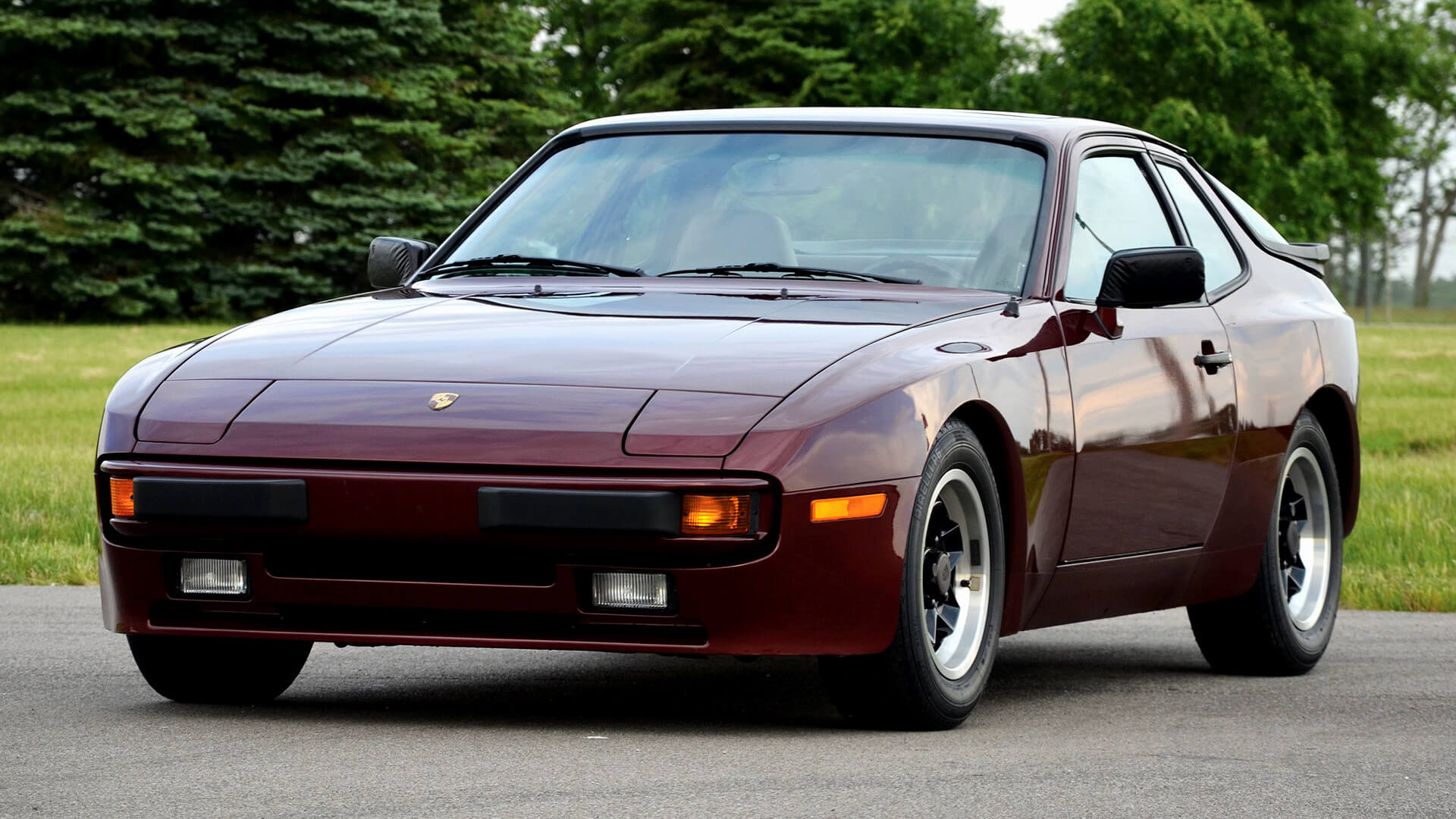
The Porsche 944 is a rear-wheel-drive 2+2 sports car that Porsche built from 1982 to 1991, at the Audi plant in Neckarsulm and at Porsche's own plant in Stuttgart. With 163,192 cars produced, it was Porsche's most successful sports car until the arrival of the Boxster and the 997-generation 911. It was offered as a coupé and, later, as a cabriolet.
In short
- Built on the platform of the Porsche 924, a car originally conceived with Volkswagen, and inspired by the 924 GTP that raced at Le Mans in 1981.
- Powered by a 2.5- to 3.0-litre four-cylinder engine - essentially half of the 928's V8 - with two balance shafts.
- Outputs ranged from 120 kW (163 PS) in the original 944 to 184 kW (250 PS) in the 944 Turbo S and later Turbo.
- A front engine and rear transaxle gave near-perfect weight distribution of 50.7% front and 49.3% rear.
Specs by version
Engines
| Version | Engine | Gearbox | Drive | Production years |
|---|---|---|---|---|
| 2.5 L 4 cyl Automatic 3-spd · 1988 (EPA) | 2.5 l · 4 cyl 2,500 cc | 3-sp Automatic | Rear-wheel drive | 1988 |
| 2.5 L 4 cyl Manual 5-spd · 1988 (EPA) | 2.5 l · 4 cyl 2,500 cc | 5-sp Manual | Rear-wheel drive | 1988 |
| 2.5 L 4 cyl Automatic 3-spd · 1987 (EPA) | 2.5 l · 4 cyl 2,500 cc | 3-sp Automatic | Rear-wheel drive | 1987 |
| 2.5 L 4 cyl Automatic 3-spd · 1987 (EPA) | 2.5 l · 4 cyl 2,500 cc | 3-sp Automatic | Rear-wheel drive | 1987 |
| 2.5 L 4 cyl Manual 5-spd · 1987 (EPA) | 2.5 l · 4 cyl 2,500 cc | 5-sp Manual | Rear-wheel drive | 1987 |
| 2.5 L 4 cyl Manual 5-spd · 1987 (EPA) | 2.5 l · 4 cyl 2,500 cc | 5-sp Manual | Rear-wheel drive | 1987 |
| 2.5 L 4 cyl Manual 5-spd · 1987 (EPA) | 2.5 l · 4 cyl 2,500 cc | 5-sp Manual | Rear-wheel drive | 1987 |
| 2.5 L 4 cyl Automatic 3-spd · 1986 (EPA) | 2.5 l · 4 cyl 2,500 cc | 3-sp Automatic | Rear-wheel drive | 1986 |
| 2.5 L 4 cyl Manual 5-spd · 1986 (EPA) | 2.5 l · 4 cyl 2,500 cc | 5-sp Manual | Rear-wheel drive | 1986 |
| 2.5 L 4 cyl Manual 5-spd · 1986 (EPA) | 2.5 l · 4 cyl 2,500 cc | 5-sp Manual | Rear-wheel drive | 1986 |
| 2.5 L 4 cyl Manual 5-spd · 1985 (EPA) | 2.5 l · 4 cyl 2,500 cc | 5-sp Manual | Rear-wheel drive | 1985 |
| 2.5 L 4 cyl Automatic 3-spd · 1984 (EPA) | 2.5 l · 4 cyl 2,500 cc | 3-sp Automatic | - | 1984 |
| 2.5 L 4 cyl Automatic 3-spd · 1984 (EPA) | 2.5 l · 4 cyl 2,500 cc | 3-sp Automatic | - | 1984 |
| 2.5 L 4 cyl Manual 5-spd · 1984 (EPA) | 2.5 l · 4 cyl 2,500 cc | 5-sp Manual | - | 1984 |
| 2.5 L 4 cyl Manual 5-spd · 1984 (EPA) | 2.5 l · 4 cyl 2,500 cc | 5-sp Manual | - | 1984 |
| 2.7 L 4 cyl Automatic 3-spd · 1989 (EPA) | 2.7 l · 4 cyl 2,700 cc | 3-sp Automatic | Rear-wheel drive | 1989 |
| 2.7 L 4 cyl Manual 5-spd · 1989 (EPA) | 2.7 l · 4 cyl 2,700 cc | 5-sp Manual | Rear-wheel drive | 1989 |
Performance
Show all 17 versions
| Version | Fuel consumption |
|---|---|
| 2.5 L 4 cyl Automatic 3-spd · 1988 (EPA) | 13.1 l/100 km18.0 mpg US · 21.6 mpg UK |
| 2.5 L 4 cyl Manual 5-spd · 1988 (EPA) | 11.8 l/100 km19.9 mpg US · 23.9 mpg UK |
| 2.5 L 4 cyl Automatic 3-spd · 1987 (EPA) | 12.4 l/100 km19.0 mpg US · 22.8 mpg UK |
| 2.5 L 4 cyl Automatic 3-spd · 1987 (EPA) | 12.4 l/100 km19.0 mpg US · 22.8 mpg UK |
| 2.5 L 4 cyl Manual 5-spd · 1987 (EPA) | 11.2 l/100 km21.0 mpg US · 25.2 mpg UK |
| 2.5 L 4 cyl Manual 5-spd · 1987 (EPA) | 12.4 l/100 km19.0 mpg US · 22.8 mpg UK |
| 2.5 L 4 cyl Manual 5-spd · 1987 (EPA) | 11.8 l/100 km19.9 mpg US · 23.9 mpg UK |
| 2.5 L 4 cyl Automatic 3-spd · 1986 (EPA) | 12.4 l/100 km19.0 mpg US · 22.8 mpg UK |
| 2.5 L 4 cyl Manual 5-spd · 1986 (EPA) | 11.8 l/100 km19.9 mpg US · 23.9 mpg UK |
| 2.5 L 4 cyl Manual 5-spd · 1986 (EPA) | 11.8 l/100 km19.9 mpg US · 23.9 mpg UK |
| 2.5 L 4 cyl Manual 5-spd · 1985 (EPA) | 11.8 l/100 km19.9 mpg US · 23.9 mpg UK |
| 2.5 L 4 cyl Automatic 3-spd · 1984 (EPA) | 13.1 l/100 km18.0 mpg US · 21.6 mpg UK |
| 2.5 L 4 cyl Automatic 3-spd · 1984 (EPA) | 13.8 l/100 km17.0 mpg US · 20.5 mpg UK |
| 2.5 L 4 cyl Manual 5-spd · 1984 (EPA) | 11.8 l/100 km19.9 mpg US · 23.9 mpg UK |
| 2.5 L 4 cyl Manual 5-spd · 1984 (EPA) | 11.8 l/100 km19.9 mpg US · 23.9 mpg UK |
| 2.7 L 4 cyl Automatic 3-spd · 1989 (EPA) | 13.1 l/100 km18.0 mpg US · 21.6 mpg UK |
| 2.7 L 4 cyl Manual 5-spd · 1989 (EPA) | 12.4 l/100 km19.0 mpg US · 22.8 mpg UK |
Verified Manufacturer and type-approval data from our catalog · Sources and methodology
History
Porsche did not set out to make the fastest, best-handling or most luxurious car with the 944. The aim was a good, high-quality sports coupé that would make buyers of affordable sports cars think: "Why not spend a little more and buy a Porsche?" The 944 grew out of an agreement between Porsche and the Volkswagen Group on affordable sports cars, which had first produced the Porsche 924. The 944 used the 924's body structure but added flared wheel arches and a new Porsche-designed engine, and it was in effect a road-going, detuned version of the 924 GTP race car that appeared at Le Mans in 1981.
The car was a hit: it made Car and Driver's Ten Best list from 1983 to 1985, and the 944 Turbo followed in 1986. In 1985 Porsche gave the 944 a substantial mid-year update, and later versions brought more power, a 16-valve engine, the 944 Turbo and finally the 3.0-litre 944 S2. The 944 was replaced by the Porsche 968 for the 1992 model year. More of the brand's cars are in our Porsche catalogue, and its story is in Porsche's history.
Exterior
The 944 clearly belongs to the Porsche family, yet it differs from the brand's traditional rear-engined cars. It has pop-up headlights, unusual for a Porsche at the time, and a long bonnet, because the engine sits at the front. The frontal design also shows that the engine is water-cooled. The flared wheel arches give it a muscular stance compared with the slimmer 924. Early cars rode on "Cookie Cutter" wheels, later replaced by the "Phone Dial" design.
At the rear, a large glass hatch with a wiper and a small spoiler sits above large tail lights with the number plate between them and a protruding bumper. Alongside the coupé, Porsche built a cabriolet from 1989; the S2 Cabriolet bodies were converted from coupé shells by the American Sunroof Corporation in Heilbronn. The 944 Turbo Cabriolet is particularly rare, with only about 625 built.
Interior
The cabin is pleasant and comfortable. The update of 1985 brought a new dashboard and door panels, along with a larger fuel tank, a flush-mounted windscreen, a more powerful alternator and revised suspension and wheels. The driver's seat could have an electrically adjustable cushion as an option. Large air vents dominate the centre of the dashboard, with climate and audio controls below. The short gear lever falls nicely to hand, and there is a small armrest.
The updated instrument cluster has four round dials: on the left, engine temperature and fuel level; in the centre, the speedometer and rev counter; and on the right, oil pressure and battery charge. Some versions had a sunroof. The rear seats are small and suit children or teenagers best.
Engines and versions
| Version | Years | Engine | Power (kW / PS) |
|---|---|---|---|
| 944 | 1982–1989 | 2.5 inline-4, 8 valves | 120 kW / 163 PS (US about 112 kW / 150 hp) |
| 944 Turbo | 1985–1988 | 2.5 turbo inline-4 | 162 kW / 220 PS |
| 944 S | 1987–1989 | 2.5 inline-4, 16 valves | 140 kW / 190 PS |
| 944 Turbo S | 1988 | 2.5 turbo inline-4 | 184 kW / 250 PS |
| 944 2.7 | 1989 | 2.7 inline-4 | 121 kW / 165 PS |
| 944 S2 | 1989–1991 | 3.0 inline-4, 16 valves | 155 kW / 211 PS |
| 944 Turbo | 1989–1991 | 2.5 turbo inline-4 | 184 kW / 250 PS |
The original engine is a 2.5-litre four-cylinder with a single overhead camshaft and eight valves - roughly half of the V8 used in the Porsche 928. To keep such a large four-cylinder smooth, it uses two counter-rotating balance shafts, a design licensed from Mitsubishi. According to published figures, the original 944 reached 100 km/h in 8.4 seconds, while the most powerful versions needed about 6 seconds. In 1984 Porsche enlarged the oil sump to prevent oil starvation in hard cornering.
Transmission and chassis
Most cars had a five-speed manual gearbox, and a three-speed automatic was available on some models; published figures give a top speed of about 220 km/h for the base car. The gearbox is mounted at the rear as a transaxle connected to the engine by a torque tube, so the 944 achieves nearly ideal weight distribution: 50.7% front and 49.3% rear. The result is excellent balance, good handling, stability and grip. From 1984 aluminium suspension arms improved the handling further, although owners note that they can wear more quickly.
Strengths and weaknesses
Porsche's plan worked: buyers accepted a front-engined Porsche, and the 944 became a big sales success. It stands out for its pleasant cabin, superb balance and handling, and technology that was modern for its time. It is not the fastest Porsche, and the rear seats are small. Today, good examples are increasingly valued by enthusiasts as an accessible way into classic Porsche ownership.
Porsche 944 in our rankings
- No. 400 of 912 · Longest-running car nameplates (9 years · top 49%)
- No. 303 of 557 · Biggest engines: cars (2,700 cc · top 55%)
- No. 191 of 256 · Most economical cars (11.2 l/100 km · top 75%)
In production longer than 51% of ranked nameplates in the 1CARS catalog (No. 400 of 912).
FAQ
Who built the Porsche 944?
Porsche engineered it, and it was built from 1982 to 1991 at the Audi plant in Neckarsulm and at Porsche in Stuttgart.
What engine does the Porsche 944 have?
A front-mounted four-cylinder of 2.5 to 3.0 litres with balance shafts, producing 120 to 184 kW (163 to 250 PS) depending on the version.
How many Porsche 944s were made?
163,192 cars, making it one of Porsche's best-selling sports cars.
Why does the Porsche 944 handle so well?
Its front engine and rear transaxle give a near-perfect weight distribution of 50.7% front and 49.3% rear.
What replaced the Porsche 944?
The Porsche 968, introduced for the 1992 model year.
Data sources
Data checked by an editor against the sources below.
- Wikipedia - Porsche 944
- US EPA fueleconomy.gov - 5294.shtml
- US EPA fueleconomy.gov - 5295.shtml
- US EPA fueleconomy.gov - 4173.shtml
- US EPA fueleconomy.gov - 4174.shtml