 Porsche 356
Specs, engines and history
Published Sources (1) Report an error
By Felix Hartmann, Automotive Technology & EV Contributor
- Built
- 1948–1965
- Top power
- 71 kW (97 PS)
Which 356 to choose
Our verdict · Felix Hartmann
- For history: an early Pre-A coupé or cabriolet from the first Zuffenhausen years.
- For open driving: a Speedster (4,854 built) or the more practical Convertible D with its taller windscreen.
- For everyday use: a 356 C with disc brakes all round, or a 1600 SC with 71 kW (95 hp).
- For rarity: a four-cam Carrera, of which about 140 were made.
Engine type and body should match the car's records, since many 356s have been restored. Today's models are in the Porsche catalogue, and other cars of the decade are under 1950s classics.
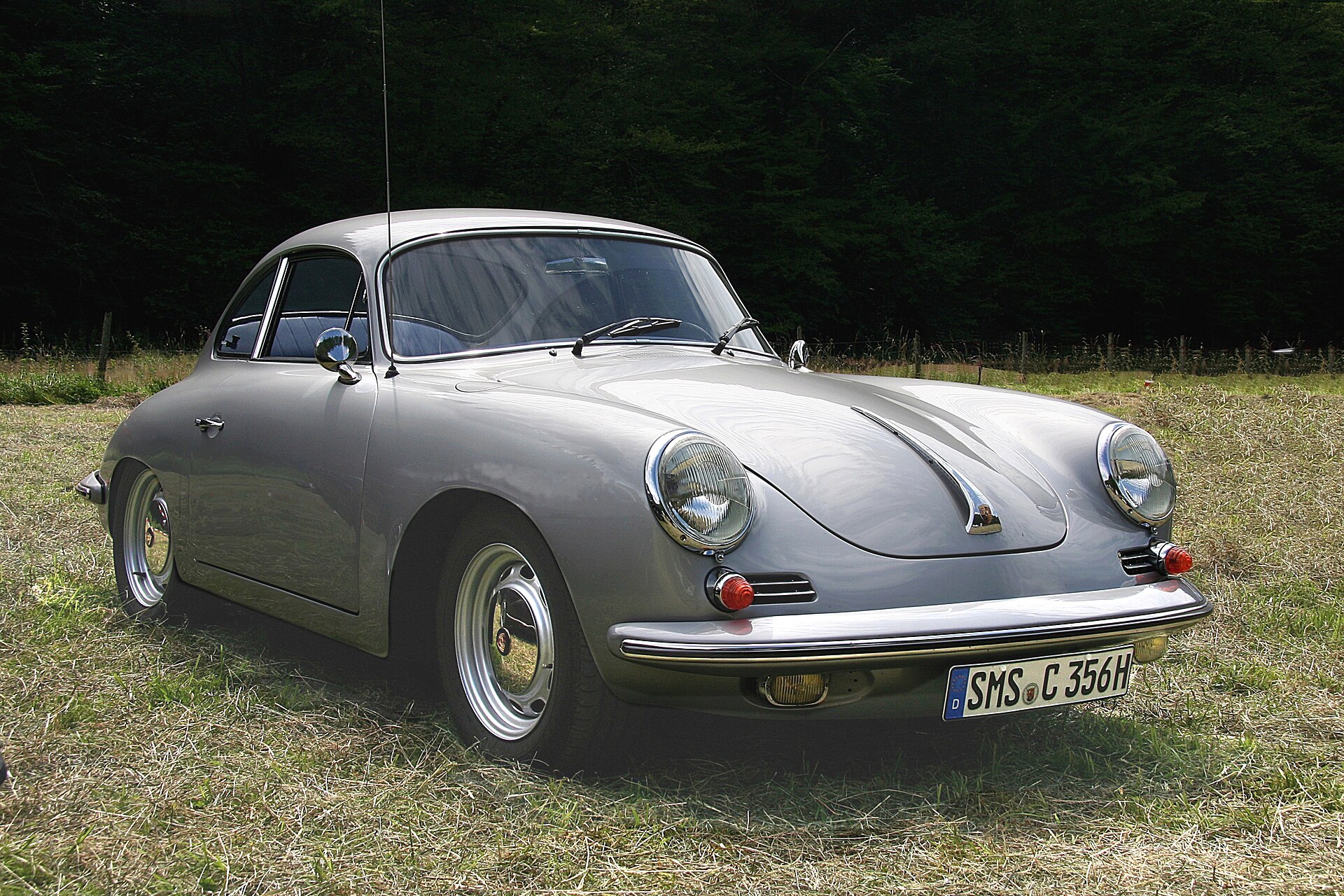
The Porsche 356 is the first production car of the Porsche company: a light, rear-engined sports car built first in Gmünd, Austria, from 1948 and then in Stuttgart-Zuffenhausen until April 1965. About 76,000 were made in coupé, cabriolet, Speedster, Convertible D, roadster and hardtop form, and about half of them are thought to survive. Its air-cooled flat-four began with Volkswagen parts; by the end Porsche made most of the engine itself, and the 356 handed over to the 911 and the 912.
In short
- First 356 road-certified in Austria on 8 June 1948; about 50 hand-built aluminium cars at Gmünd in 1948–1949.
- Four generations: the original (Pre-A), 356 A from late 1955, 356 B from late 1959 and 356 C for the 1964 model year.
- Engines from 1.1 to 2.0 litres; the 1600 gave 44 kW (60 PS), the 1600 SC 71 kW (95 hp), the most powerful pushrod engine Porsche built.
- A class win at the 1951 24 Hours of Le Mans and 4,854 Speedsters made for the US market.
Specs by version
Engines
| Version | Engine | Power | Torque | Drive | Production years |
|---|---|---|---|---|---|
| 1100 (Type 369) | 4 cyl · Petrol | - | - | Rear-wheel drive | 1948–1953 |
| 1600 | 4 cyl · Petrol | 44 kW 60 PS59 hp | 110 Nm81 lb-ft | Rear-wheel drive | - |
| 1600 SC | 4 cyl · Petrol | 71 kW 97 PS95 hp | - | Rear-wheel drive | - |
Dimensions and weight
Show all 3 versions
| Version | Wheelbase |
|---|---|
| 1100 (Type 369) | 2,100 mm82.7 in |
| 1600 | 2,100 mm82.7 in |
| 1600 SC | 2,100 mm82.7 in |
Verified Manufacturer and type-approval data from our catalog · Sources and methodology
Porsche 356 at a glance
| Parameter | Value |
|---|---|
| Maker | Porsche Konstruktionen GesmbH, Gmünd (1948–1949); Dr. Ing. h.c. F. Porsche, Zuffenhausen (from 1950) |
| Production | 1948 – April 1965 (last cabriolets for the Dutch police in March 1966) |
| Built | about 76,000; peak 14,151 in 1964 |
| Body styles | coupé, cabriolet, Speedster, Convertible D, roadster, Karmann hardtop |
| Engines | 1.1–2.0 l air-cooled flat-four, rear-mounted |
| Power | 44 kW (60 PS) 1600 to 71 kW (95 hp) 1600 SC |
| Designers | Ferry Porsche; body by Erwin Komenda |
| Successor | 911 (from September 1964) and 912 (from April 1965) |
Development and production history
The 356 was created by Ferdinand "Ferry" Porsche; the company in Austria had been founded by his sister Louise. The prototype 356/1 of 1948 was a mid-engined car on a tubular chassis. The production cars that followed used the rear-engine, air-cooled four-cylinder layout of the Volkswagen Beetle, with an engine case and some suspension parts based on, and at first sourced from, Volkswagen. Erwin Komenda designed the body. The first prototype is described in our Porsche 356 "No. 1" Roadster article.
About 50 cars with aluminium bodies were made by hand at Gmünd in 1948 and 1949. In 1950 production moved to Zuffenhausen near Stuttgart, and from then on the steel bodies came from the coachbuilder Reutter, which Porsche bought in 1963; its seat business became Recaro. In the early 1950s cabriolets sometimes made up more than half of output. In 1948 the coupé was priced at US$3,750 and the cabriolet at US$4,250.
As the 1950s went on, the 356 shared fewer parts with Volkswagen. Porsche designed its own cylinder heads, camshaft and crankshaft, and the engine grew from 1.1 litres to 1.6 litres. Output reached its peak in 1964, the last full year, with 14,151 cars. Production ended in April 1965, with the 911 already on sale since September 1964; the last ten cabriolets were assembled in March 1966 as 1965 models for the Dutch state police (Rijkspolitie).
| Year | Event |
|---|---|
| 8 June 1948 | First 356 road-certified in Austria |
| 1948–1949 | About 50 aluminium cars built at Gmünd |
| 1950 | Production moves to Zuffenhausen; Reutter steel bodies |
| 1951 | Class win at the 24 Hours of Le Mans |
| Late 1954 | Speedster introduced |
| Late 1955 | 356 A with curved windscreen; four-cam Carrera engine offered |
| Late 1958 | Convertible D replaces the Speedster |
| Late 1959 | 356 B (T5) |
| 1962 | 356 B T6 with twin engine-lid grilles and external fuel filler |
| 1964 model year | 356 C with disc brakes all round |
| April 1965 | End of series production; 912 introduced |


Design and engineering
The 356 is a small car: its wheelbase is 2,100 mm and its length 3,870–4,010 mm, depending on the version. Kerb weight ranges from 771 to 1,041 kg. The air-cooled four-cylinder sits at the rear and drives the rear wheels, the layout Porsche kept for the 911.
Each generation refined the body without changing its outline. The 356 A of late 1955 gained a curved windscreen. The 356 B of late 1959, known as the T5, brought what English Wikipedia calls significant styling and technical refinements. The T6 of 1962 added twin grilles on the engine cover, an external fuel filler and a larger rear window in the coupé. The 356 C for the 1964 model year had disc brakes on all four wheels.

Engines and drivetrain
| Engine | Used in | Notes |
|---|---|---|
| 1.1 l (Type 369) | 1948–1953 | first engine, Volkswagen-based case |
| 1.3 l | 1300, 1300 A, 1300 S | Type 506 and 506/2 in the 356 A |
| 1.5 l | 1500, 1500 S, 1500 GS/GT Carrera | 1955–1959 |
| 1.6 l | 1600, 1600 S, Super 90, 1600 SC, 1600 C | 1600: 44 kW (60 PS) at 4,500 rpm, 110 N·m |
| 1.6 l SC | 356 C | 71 kW (95 hp), the most powerful Porsche pushrod engine |
| 2.0 l four-cam (Type 587) | Carrera 2 GS / Carrera 2 | about 140 Carreras of all types |
The Carrera engine, with four overhead camshafts, was a racing design that Porsche also offered in the road car from late 1955 as an option on the 356 A. English Wikipedia counts only about 140 Carreras. All other 356s used pushrod engines, and the 1600 SC of the 356 C, with 71 kW (95 hp), was the most powerful of them. Our power converter gives the PS and hp figures in kW for comparisons with later Porsches.
Porsche 356 specifications
| Parameter | Metric | Imperial |
|---|---|---|
| Wheelbase | 2,100 mm | 82.7 in |
| Length | 3,870–4,010 mm | 152.4–157.9 in |
| Width | 1,660 mm | 65.4 in |
| Height | 1,220–1,320 mm | 48.0–51.8 in |
| Kerb weight | 771–1,041 kg | 1,700–2,296 lb |
| Engine | air-cooled flat-four, rear | - |
| Power (1600) | 44 kW (60 PS) at 4,500 rpm | - |
| Torque (1600) | 110 N·m | 81 lb·ft |
| Brakes | discs all round on the 356 C | - |
Variants and derivatives
| Variant | Years | Body / purpose | Notes |
|---|---|---|---|
| Gmünd coupé and cabriolet | 1948–1949 | aluminium body | about 50 built |
| Coupé | 1948–1965 | closed two-door | Reutter steel body from 1950 |
| Cabriolet | 1948–1965 | open, folding roof | more than half of output in the early 1950s |
| Speedster | late 1954 – late 1958 | open, low raked windscreen | 4,854 built |
| Convertible D | from late 1958 | open, taller windscreen | replaced the Speedster |
| Roadster | - | open | listed among the body styles |
| Karmann hardtop | 1961–1962 | cabriolet body with a fixed metal roof | - |
| Carrera | from late 1955 | four-cam engine | about 140 built |
The Speedster came from the US importer Max Hoffman, who advised Porsche that a lower-cost, somewhat spartan open car would sell well; Hoffman was also behind the "Continental" name used in the United States. The Karmann hardtop of 1961–1962 was a cabriolet-style body with a permanent metal roof.

Racing
At the 1951 24 Hours of Le Mans Porsche was, in English Wikipedia's words, the first and only German manufacturer to compete. Auguste Veuillet and Edmond Mouche drove the aluminium 356 SL "Gmünd-Coupé" to a class win in the 751–1,100 cc category and 20th place overall. The win started the Le Mans history that led to cars such as the Porsche 917.
Legacy and collecting today
Sports Car International ranked the 356 C tenth among the sports cars of the 1960s in 2004. The 912 of April 1965 used numerous 356 components with the 616/36 four-cylinder engine, and nearly 33,000 912 coupés and Targas were sold. The six-cylinder 911 continued the line and is covered in our Porsche 911 generations article. The company's wider story is in our Porsche history.
Photo gallery

Porsche 356 in our rankings
- No. 204 of 912 · Longest-running car nameplates (17 years · top 25%)
- No. 797 of 859 · Most powerful cars (71 kW · top 93%)
- No. 116 of 124 · Most powerful German cars (71 kW · top 94%)
- No. 305 of 313 · Most powerful coupes (71 kW · top 98%)
- No. 359 of 368 · Most torque: cars (110 Nm · top 98%)
- No. 105 of 106 · Most torque: coupes (110 Nm)
In production longer than 75% of ranked nameplates in the 1CARS catalog (No. 204 of 912).
FAQ
When was the Porsche 356 produced, and where?
From 1948 to April 1965: about 50 cars at Gmünd in Austria in 1948–1949, then in Zuffenhausen, Stuttgart, from 1950.
How many Porsche 356 were built?
About 76,000, of which about half are thought to survive. The best year was 1964 with 14,151 cars.
What engine does the Porsche 356 have?
An air-cooled, rear-mounted flat-four of 1.1 to 2.0 litres. The 1600 gave 44 kW (60 PS); the 1600 SC 71 kW (95 hp).
What is the difference between the 356 A, B and C?
The 356 A (late 1955) introduced a curved windscreen, the 356 B (late 1959, T5 and T6) brought styling and technical updates, and the 356 C (1964 model year) added disc brakes all round.
What replaced the Porsche 356?
The six-cylinder 911 from September 1964 and the four-cylinder 912 from April 1965.
Data sources
Data checked by an editor against the sources below.