Porsche 917 — the Car That Won Le Mans
The Porsche 917 is a racing sports car that Porsche built in 1969 to win the 24 Hours of Le Mans outright. It did exactly that in 1970 and 1971, gave Porsche the world championship for makes in both years, and in turbocharged open form went on to dominate the North American Can-Am series. Many consider it one of the greatest racing cars ever made.
Key takeaways
- Developed in about ten months from July 1968 under Ferdinand Piëch, with Hans Mezger designing the engine and Helmuth Bott the chassis.
- Shown at the Geneva motor show on 12 March 1969 at a price of DM 140,000; 25 cars were built for homologation.
- Its air-cooled flat-12 grew from 4.5 to 5.0 litres and from about 382 kW (520 PS) to around 463 kW (630 PS).
- The 917K won Le Mans in 1970 and 1971; the turbocharged 917/10 and 917/30 won the Can-Am titles of 1972 and 1973.
Porsche 917 at a glance
By the late 1960s Porsche had won many class victories and finished second overall at Le Mans in 1968, but in almost two decades of racing it had never won the race outright. The management knew that only victories at the highest level would do, and the timing was right: the sporting authority introduced new rules for sports cars with engines of up to 5 litres, provided at least 25 examples were built — originally the requirement was 50. Every team had to start from scratch, and Porsche set out to build a car that would exploit the new rules perfectly.
The work was led by Ferdinand Piëch. Hans Mezger designed the engine, Helmuth Bott the chassis, and the car drew on experience with the Porsche 908. Development took a record ten months, including testing. In March 1969 Porsche displayed the 917 at the Geneva motor show with a price of DM 140,000 — several times the price of a 911, yet still well below what each car actually cost to build. In April 1969 Piëch lined up 25 completed cars for the homologation inspectors. More of the brand's cars are in our Porsche catalogue, and its story is told in Porsche's history.
Design and cockpit
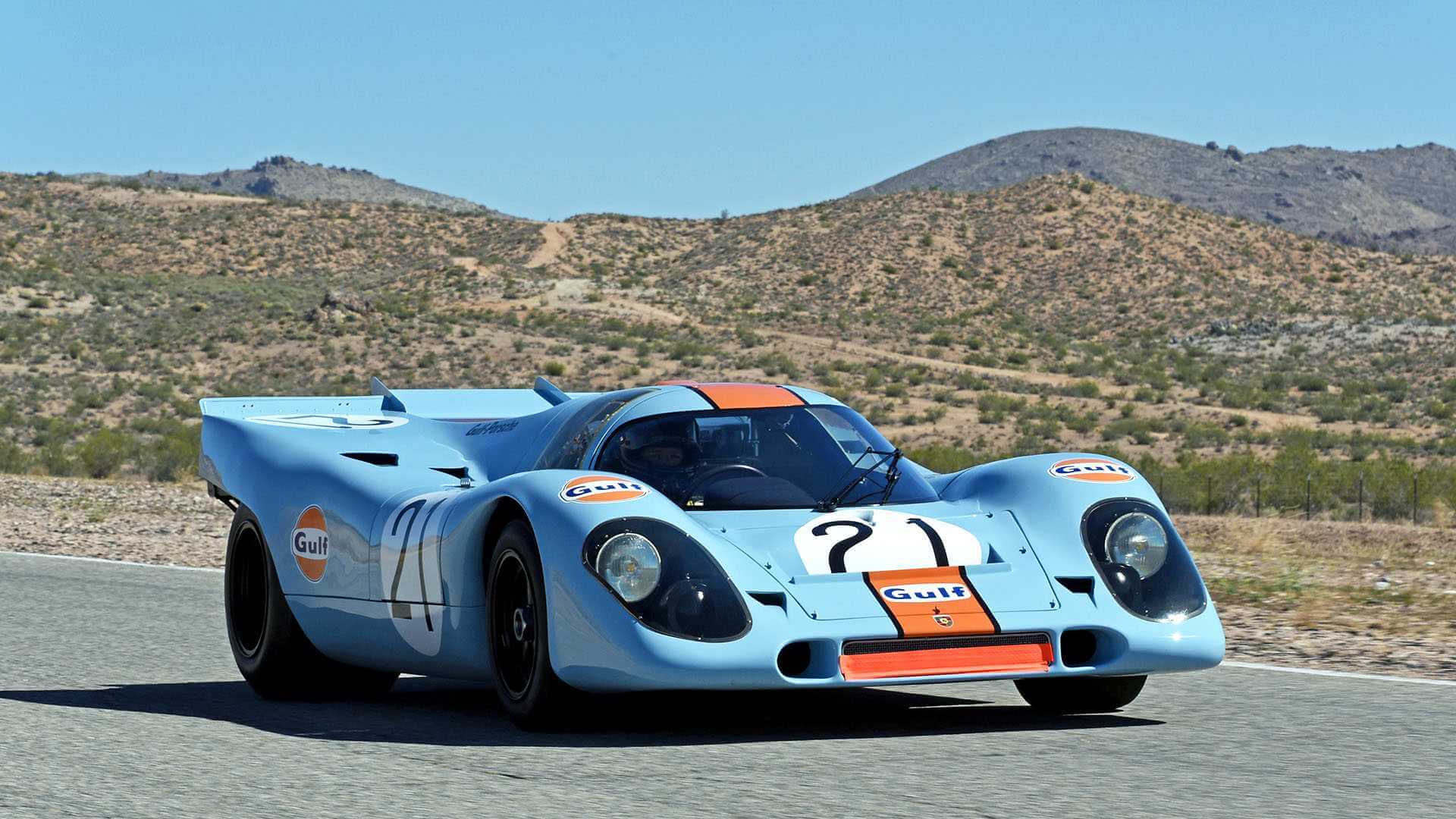
In those days, the technical package mattered more than the styling, yet the 917 looked striking. At the front were large round headlights behind glass covers and a narrow rectangular intake. Small doors, streamlined mirrors and a central rear-view mirror mounted outside on top of the windscreen, to give the driver a clearer view behind, marked the side view. The rear tyres were much wider than the fronts, the body had smooth curves and a raised tail, and exhaust pipes emerged at the back beneath aerodynamic fins.
The cockpit was built purely for racing, with sparse trim and a hard bucket seat. Although the car looks like a single-seater from outside, the rules required space for two. The driver held a three-spoke sports steering wheel and faced a large rev counter, with gauges such as engine-oil temperature beside it — the engine was air-cooled. The cockpit has often been compared to that of a fighter plane.
Engine and chassis
| Version | Engine | Power (approx.) |
|---|---|---|
| 917 (1969) | 4.5-litre air-cooled flat-12 | 382 kW / 520 PS |
| 917K / 917LH (1970–1971) | 4.9–5.0-litre flat-12 | up to 463 kW / 630 PS |
| 917/10 Can-Am (1972) | 5.0-litre twin-turbo flat-12 | about 634 kW / 850 hp |
| 917/30 Can-Am (1973) | 5.4-litre twin-turbo flat-12 | about 820 kW / 1,100 hp |
The heart of the car was the Type 912 flat-12, an air-cooled engine with a large horizontal cooling fan on top. No one had built a boxer engine with so many cylinders for racing before. The chassis was a lightweight space frame, and aluminium, titanium and magnesium were used extensively; the 917K weighed only around 820 kg. With 4.5 litres and about 382 kW (520 PS), the early car could exceed 340 km/h.
From problem child to winner
The first tests revealed a serious weakness: the 917 was unstable at high speed because the long tail produced too little downforce. Aerodynamic downforce was only just becoming understood in motor racing. When the 917 made its debut at the 1000 km of Spa in May 1969, the factory drivers preferred the proven, less powerful Porsche 908, and the same happened at the Nürburgring, where Porsche had to hire outside drivers who finished eighth. At Le Mans in 1969 the long-tail 917s led but did not finish. The first win came at the Zeltweg 1000 km in Austria later that year.
The turning point came from John Wyer, whose Gulf-sponsored JWA team agreed to run the 917 for Porsche. During tests at the Österreichring, engineers taped a shorter, sharply upswept tail made of aluminium sheet onto the car, transforming its handling. The result was the 917K — K for Kurzheck, "short tail". For the high-speed Le Mans circuit Porsche also developed long-tail versions (917L, later 917LH) with low drag and, in their later form, much better stability, using the 4.9- and 5.0-litre engines with about 441 kW (600 PS) and speeds of over 350 km/h.
In 1970 Hans Herrmann and Richard Attwood won Le Mans in the red and white 917K of Porsche Salzburg, giving Porsche its first overall victory. In 1971 Helmut Marko and Gijs van Lennep won again in a Martini 917K with a magnesium frame, setting a distance record that stood until 2010. Thanks largely to the 917, Porsche won the international championship for makes in 1970 and 1971.
Can-Am and the end of an era
Because the sporting authority limited sports-car engines to 3 litres from 1972, the big 917s had to leave the world championship after 1971 while still at the top. Porsche turned to the Can-Am series in North America, where the rules were much freer. With the roof removed and twin turbochargers fitted, the 917/10 produced about 634 kW (850 hp) and carried George Follmer to the 1972 title for the Penske team. The 917/30 of 1973 had a 5.4-litre twin-turbo engine with about 820 kW (1,100 hp) and reached around 390 km/h; Mark Donohue won all but two races and the championship. A fuel-consumption rule introduced in 1974 effectively ended its Can-Am career, although in 1975 a 917/30 set a closed-circuit speed record of 221.16 mph (about 356 km/h) at Talladega.
Legacy and rivals
The 917's main rival in its heyday was the Ferrari 512, with a V12 of around 404 kW (550 PS). Decades later, Porsche returned to the top class at Le Mans with the 919 Hybrid, which won the race several times from 2015. The 917 — especially in Gulf and Martini colours — remains one of the most famous racing cars of all time, and surviving examples are among the most valuable collector cars in the world.
FAQ
When did the Porsche 917 win Le Mans?
In 1970, with Hans Herrmann and Richard Attwood, and in 1971, with Helmut Marko and Gijs van Lennep.
What engine did the Porsche 917 have?
An air-cooled flat-12 of 4.5 to 5.0 litres, producing from about 382 kW (520 PS) to around 463 kW (630 PS); the Can-Am versions were twin-turbocharged.
What does the K in Porsche 917K mean?
Kurzheck, German for "short tail". The shorter, upswept tail cured the original car's high-speed instability.
How powerful was the Porsche 917/30?
Its 5.4-litre twin-turbo flat-12 produced about 820 kW (1,100 hp) in race trim.
Why was the Porsche 917 retired?
A 3-litre engine limit for sports cars from 1972 ended its world championship career, and a fuel-consumption rule from 1974 ended its Can-Am dominance.