 Porsche 911( 993) RS Club Sport
Specs, engines and history
Published Sources (2) Report an error
By Felix Hartmann, Automotive Technology & EV Contributor
Which 993 RS to buy - verdict
Our verdict · Felix Hartmann
The Clubsport is the purist's choice and the rarer car, but it was built for the track. It is much less suited to everyday road use than the Carrera RS. Buyers should verify the M003 option in the car's documentation rather than rely on the wing, because many road RS cars also carried the Clubsport-style aero package. For regular road use, the M002 Carrera RS or a standard Carrera offers most of the experience with more comfort. Our car comparison tool sets the RS against later GT models, the car finder filters sports cars by power and weight, and our supercar section covers the wider class.
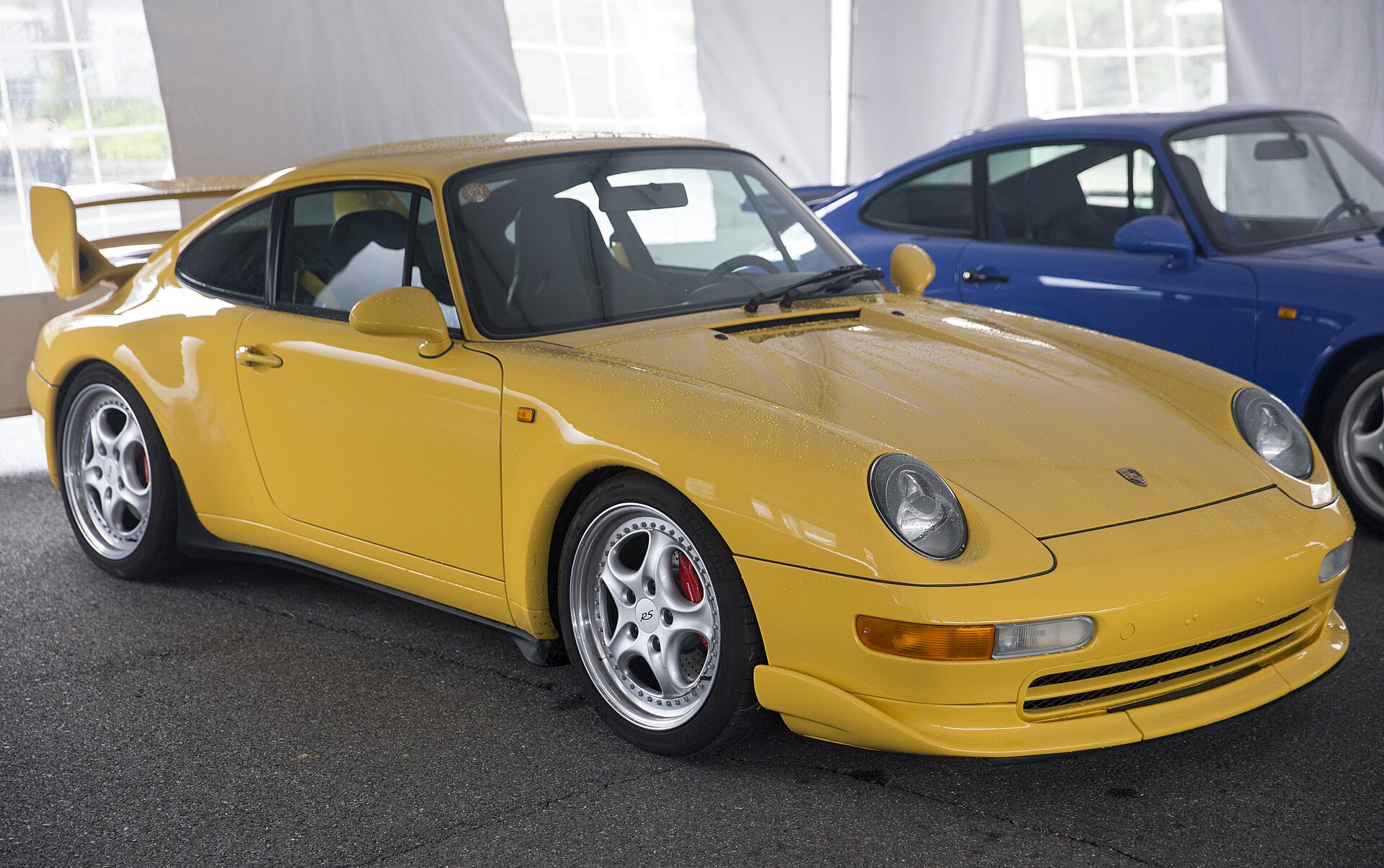
The Porsche 911 Carrera RS Clubsport is the track-focused version of the 993-generation Carrera RS, built in 1995 and 1996. It combined the RS's 3.8-litre, 221 kW (300 PS) air-cooled flat-six with a welded roll cage, racing seats and a bigger rear wing, and only 227 were made. As one of the last lightweight air-cooled 911s, it now ranks among the most sought-after 993s.
In short
- Built in 1995–1996 as option M003 of the 993 Carrera RS; 227 Clubsport cars.
- 3,746 cc naturally aspirated flat-six with Varioram intake: 221 kW (300 PS) and 355 Nm.
- Welded roll cage, composite bucket seats and racing belts; no carpets, air conditioning, electric windows or radio as standard.
- Not approved for import into the United States.
Specs by version
| Version | Engine | Torque | Gearbox | Drive | Production years |
|---|---|---|---|---|---|
| Carrera RS 3.8 Clubsport | 3.7 l · 6 cyl · Petrol 3,746 cc | 355 Nm262 lb-ft | 6-sp Manual | Rear-wheel drive | 1995–1996 |
Verified Manufacturer and type-approval data from our catalog · Sources and methodology
Carrera RS Clubsport at a glance
| Specification | Porsche 911 (993) Carrera RS Clubsport |
|---|---|
| Production | 1995–1996 |
| Numbers built | 227 Clubsport; the RS total is 1,014 (Wikipedia EN) or 1,104 (Elferspot) |
| Option code | M003 (road RS: M002) |
| Body | two-door coupé, two seats |
| Layout | rear engine, rear-wheel drive |
| Engine | 3.8 l (3,746 cc) air-cooled flat-six, Varioram |
| Power | 221 kW (300 PS) at 6,500 rpm |
| Torque | 355 Nm at 5,400 rpm |
| Gearbox | six-speed manual, shorter 4th–6th gears; limited-slip differential |
| Base car | Porsche 911 Carrera RS (993) |
The Clubsport belongs to our Porsche catalogue. The 911's full story from the 901 to the 992 is in our Porsche 911 guide.
The 993 and the return of the Carrera RS
The 993 was the last generation of the air-cooled 911, built from January 1994 to March 1998, with 68,029 cars according to Wikipedia's sales table. The English designer Tony Hatter drew its smoother body in 1991, and a new multi-link rear axle on an alloy subframe, known as the "Weissach axle", was derived from the 989 project.
For 1995 Porsche added a Carrera RS, the lightweight road car with the bigger engine. The previous generation and its versions are described in our Porsche 911 964 guide. The 993 RS was legal in Europe and most other markets, but never in the United States. The Clubsport was the RS with motorsport equipment, intended for club racing and track days and only partly suited to daily road use.

RS Clubsport engine and drivetrain
Both the RS and the Clubsport use a 3,746 cc version of the air-cooled flat-six, with a bore of 102.0 mm, a stroke of 76.4 mm and a compression ratio of 11.3:1. The standard Carrera had 3.6 litres. The extra capacity came with forged pistons, larger inlet valves, lightened rocker arms, twin oil coolers and the Varioram variable-length intake manifold, controlled by modified Bosch Motronic electronics.
The result was 221 kW (300 PS) at 6,500 rpm and 355 Nm at 5,400 rpm, against 200 to 210 kW for the regular Carrera models of the time. Elferspot notes that the Clubsport engine itself was unchanged from the road RS, but it was combined with a lightweight single-mass flywheel.
The gearbox is the six-speed G50 family. The road RS used the G50/31 with a short shifter and modified ratios for the first three gears. The Clubsport had its own version (G50/32, according to Elferspot) with shorter fourth, fifth and sixth gears and a shorter lever throw. A limited-slip differential was standard.
Performance figures
| Measurement | Figure | Source |
|---|---|---|
| 0–100 km/h | 5.1 s | auto motor und sport (Carrera RS) |
| 0–100 km/h | 5.2 s | Sport Auto 11/1994 (Carrera RS) |
| 0–160 km/h | 11.8 s | auto motor und sport |
| 0–200 km/h | 19.6 s | auto motor und sport |
| Standing kilometre | 24.3 s | auto motor und sport |
| Top speed | 277 km/h | auto motor und sport |
| Top speed | 287 km/h | Sport Auto 11/1994, as quoted by Wikipedia EN |
These tests were carried out on the road RS. The sources give no separate measured figures for the Clubsport, whose shorter top gears favour acceleration over top speed.
Weight saving: RS versus Clubsport
The Carrera RS was already a stripped car. Wikipedia lists a seam-welded bodyshell, an aluminium bonnet with a single strut and thinner glass. Racing seats replaced the rear seats, the door cards were simplified, sound deadening was cut to a minimum and the headlamp washers were deleted. The result was a kerb weight of 1,280 kg, or 5.8 kg per kW of engine output by our calculation. The Clubsport went further:
| Item | Carrera RS (M002) | RS Clubsport (M003) |
|---|---|---|
| Roll cage | none | welded-in roll cage |
| Seats | racing seats | lightweight composite buckets with harnesses (6-point, per Elferspot) |
| Carpets, sound deadening | reduced | removed; interior painted in body colour |
| Air conditioning, radio, electric windows | available | deleted (a few cars ordered with air conditioning) |
| Rear wing | large fixed wing | larger wing with adjustable blade |
| Front spoiler | small flaps | deeper chin spoiler / splitter |
| Gearbox | G50/31, shorter 1st–3rd | shorter 4th–6th, shorter shift |
| Flywheel and bushes | standard | single-mass flywheel, stiffer rubber bushes |
Elferspot adds that many road RS cars were also ordered with the more aggressive Clubsport-style aero package, so a big wing alone does not prove a car is an M003.


Chassis, brakes and wheels
Under the body, both versions share a racing-inspired chassis. Bilstein dampers, a lower ride height, adjustable front and rear anti-roll bars and a strut brace under the bonnet sharpen the handling. The brakes come from the 911 Turbo: 322 mm cross-drilled, ventilated discs with four-piston calipers at both axles. The cars run on three-piece 18-inch aluminium wheels.
From Clubsport to racing 993s
The Clubsport was the closest a customer could get to a factory racer while keeping a road registration. For professional teams, Porsche Motorsport built 45 RSR 3.8 racing cars for IMSA GT and the European GT series. The one-make Cup series used separate 993 Cup 3.8 cars. German Wikipedia records 147 cars for 1994–1995 and 69 for 1996–1997, and 15 Cup 3.8 RSR cars in 1997–1998, one of which was ordered for 238,500 DM in 1997. The fastest 993 racer was the GT2 based on the 911 Turbo; its road-legal homologation version was built only 57 times. Porsche's later Le Mans special is described in our Porsche 911 GT1 article.

Porsche 911( 993) RS Club Sport in our rankings
- No. 221 of 627 · Biggest engines: cars (3,746 cc · top 36%)
- No. 292 of 485 · Most torque: cars (355 Nm · top 61%)
- No. 124 of 181 · Biggest engines: coupes (3,746 cc · top 70%)
- No. 97 of 117 · Most torque: coupes (355 Nm · top 83%)
- No. 1050 of 1082 · Longest-running car nameplates (1 year)
Bigger engine than 64% of ranked cars in the 1CARS catalog (No. 221 of 627).
FAQ
How many Porsche 993 Carrera RS Clubsport were built?
227 Clubsport cars, out of a total Carrera RS production that Wikipedia gives as 1,014 and Elferspot as 1,104.
How much power does the 993 RS Clubsport have?
The 3.8-litre air-cooled flat-six gives 221 kW (300 PS) and 355 Nm, exactly as in the road Carrera RS.
What is the difference between the 993 Carrera RS and the RS Clubsport?
The Clubsport (option M003) adds a welded roll cage, composite bucket seats with racing belts, a bigger wing and front spoiler and shorter upper gears, and deletes carpets, air conditioning, radio and electric windows.
Is the 993 RS Clubsport street legal?
It was sold for road use in Europe and most other markets, although it was designed for the track. The Carrera RS was never approved for the United States.
Is the 993 the last air-cooled 911?
Yes. The last road 993, a Carrera 4S, was completed on 31 March 1998; after that the 911 switched to water cooling with the 996.
Data sources
Data checked by an editor against the sources below.
- Wikipedia - Porsche 911 (993)
- Rmsothebys