 Mercedes-Benz EQS
Specs, engines and history
Published Sources (3) Report an error
By Felix Hartmann, Automotive Technology & EV Contributor
- Built
- 2021–present
- Top power
- 560 kW (761 PS)
Which EQS to choose
Our verdict · Felix Hartmann
For most drivers the rear-wheel-drive EQS 450+ is the best version: the longest range of each generation and enough performance with 245 kW. Cars from April 2024 onwards have the 118 kWh battery and a standard heat pump, so a used example from that date is the sensible buy. The 4MATIC versions suit snowy regions and towing; the AMG EQS 53 is for buyers who want 560 kW, at the cost of about 200 km of range.
The 2026 model is the one to wait for if fast charging matters: 350 kW on 800 volts closes the main gap to rivals. CAR Magazine judged the earlier EQS less refined than hoped and its ride busier than the combustion Mercedes-Benz S-Class; buyers who drive long distances should try both. Among electric alternatives, the Tesla Model S is cheaper and quicker, and the Porsche Taycan sportier. Running costs over several years can be checked with the cost of ownership calculator.
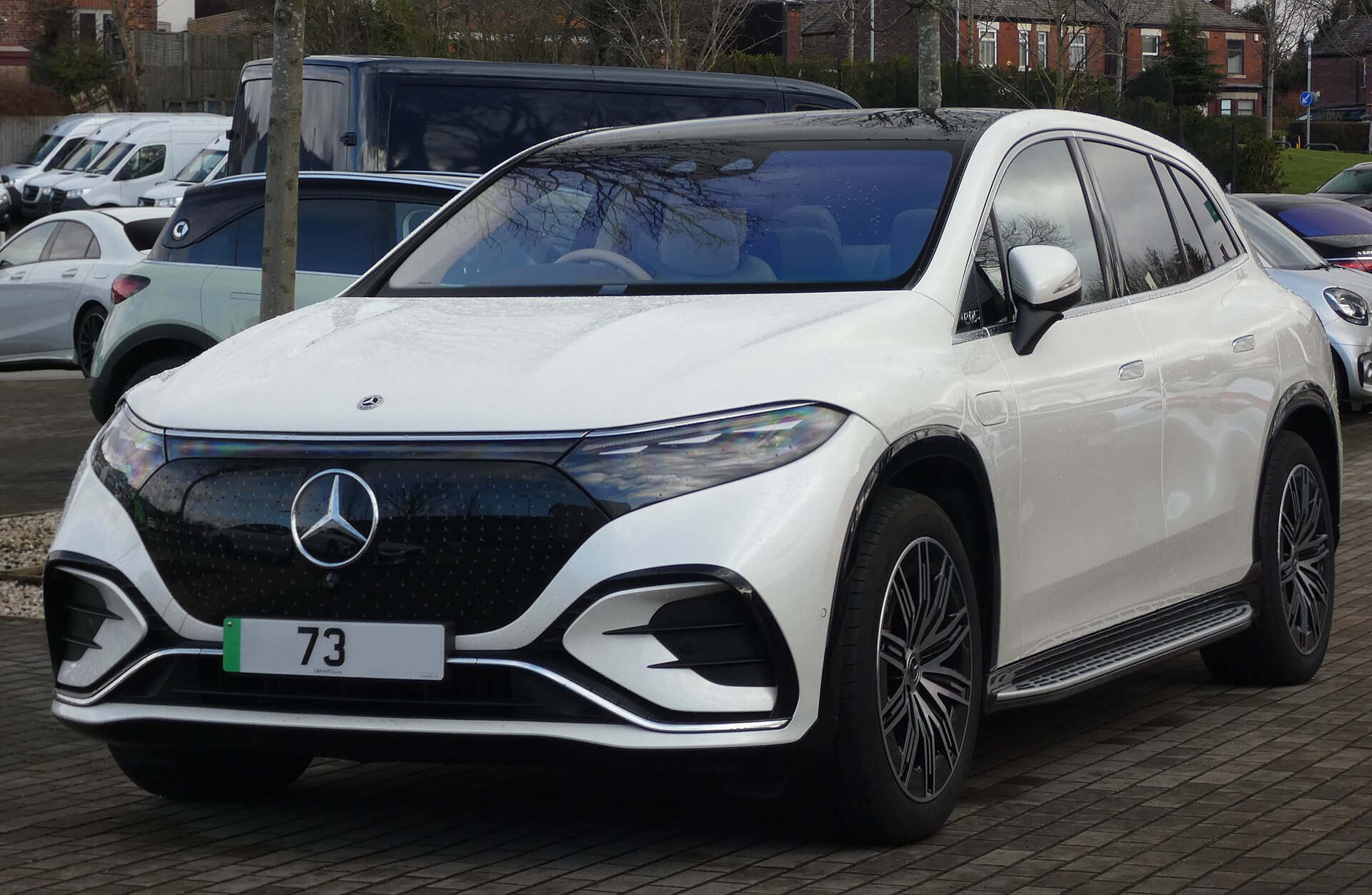
The Mercedes-Benz EQS is the brand's large battery-electric saloon, built in Sindelfingen since May 2021 under the series code V297. It sits beside the S-Class rather than replacing it, and it was the first EQ model built on a dedicated electric platform. Outputs range from 215 kW in the EQS 350 to 560 kW in the AMG EQS 53. The 2026 update moved the car to 800 volts and a WLTP range of up to 926 km.
In short
- Revealed on 15 April 2021 after the Vision EQS concept of IAA 2019; drag coefficient as low as 0.20.
- Batteries grew in three steps: 107.8 kWh net (2021), 118 kWh (2024) and 112 or 122 kWh with 800 V (2026).
- DC charging rose from about 200 kW to 350 kW with the 2026 update.
- In Germany the EQS 350 started at €97,806 when ordering opened in November 2021.
Size at a glance
| Dimensions | Mercedes-Benz EQS V297 |
|---|---|
| Length | 5,216 mm205.4 in |
| Width | 1,926 mm75.8 in |
| Height | 1,512 mm59.5 in |
| Wheelbase | 3,210 mm126.4 in |
Specs by version
Engines
| Version | Engine | Power | Torque | Gearbox | Drive | Production years |
|---|---|---|---|---|---|---|
| EQS 350 | Electric | 215 kW 292 PS288 hp | 565 Nm417 lb-ft | 1-sp Single-speed | Rear-wheel drive | 2021 |
| EQS 450+ | Electric | 245 kW 333 PS329 hp | 568 Nm419 lb-ft | 1-sp Single-speed | Rear-wheel drive | 2021 |
| EQS 450 4MATIC | Electric | 265 kW 360 PS355 hp | 800 Nm590 lb-ft | 1-sp Single-speed | All-wheel drive | 2021 |
| EQS 500 4MATIC | Electric | 330 kW 449 PS443 hp | 855 Nm631 lb-ft | 1-sp Single-speed | All-wheel drive | — |
| EQS 580 4MATIC | Electric | 385 kW 523 PS516 hp | — | 1-sp Single-speed | All-wheel drive | 2021 |
| AMG EQS 53 4MATIC+ | Electric | 484 kW 658 PS649 hp | — | 1-sp Single-speed | All-wheel drive | 2021 |
| AMG EQS 53 4MATIC+ Dynamic Plus | Electric | 560 kW 761 PS751 hp | — | 1-sp Single-speed | All-wheel drive | — |
Performance
Show all 7 versions
| Version | 0–100 km/h | Top speed | Fuel consumption | Range |
|---|---|---|---|---|
| EQS 350 | 6.6 s 0–62 mph | 210 km/h130 mph | 17.1 kWh/100 km27.5 kWh/100 mi | 638 km396 mi |
| EQS 450+ | — | 210 km/h130 mph | 17.5 kWh/100 km28.2 kWh/100 mi | — |
| EQS 450 4MATIC | 5.6 s 0–62 mph | 210 km/h130 mph | 19.1 kWh/100 km30.7 kWh/100 mi | 685 km426 mi |
| EQS 500 4MATIC | 4.8 s 0–62 mph | 210 km/h130 mph | 19.3 kWh/100 km31.1 kWh/100 mi | — |
| EQS 580 4MATIC | 4.3 s 0–62 mph | 210 km/h130 mph | 19.2 kWh/100 km30.9 kWh/100 mi | — |
| AMG EQS 53 4MATIC+ | 3.8 s 0–62 mph | 220 km/h137 mph | — | 586 km364 mi |
| AMG EQS 53 4MATIC+ Dynamic Plus | 3.4 s 0–62 mph | 220 km/h137 mph | — | — |
Dimensions and weight
Show all 7 versions
| Version | Length | Wheelbase | Kerb weight | Battery |
|---|---|---|---|---|
| EQS 350 | 5,216 mm205.4 in | 3,210 mm126.4 in | 2,439 kg5,377 lb | 91 kWh |
| EQS 450+ | 5,216 mm205.4 in | 3,210 mm126.4 in | 2,480 kg5,467 lb | 108 kWh |
| EQS 450 4MATIC | 5,216 mm205.4 in | 3,210 mm126.4 in | 2,794 kg6,160 lb | 108 kWh |
| EQS 500 4MATIC | 5,216 mm205.4 in | 3,210 mm126.4 in | 2,752 kg6,067 lb | — |
| EQS 580 4MATIC | 5,216 mm205.4 in | 3,210 mm126.4 in | 2,784 kg6,138 lb | — |
| AMG EQS 53 4MATIC+ | 5,216 mm205.4 in | 3,210 mm126.4 in | — | 108 kWh |
| AMG EQS 53 4MATIC+ Dynamic Plus | 5,216 mm205.4 in | 3,210 mm126.4 in | — | — |
Verified Manufacturer and type-approval data from our catalog · Sources and methodology
Mercedes-Benz EQS at a glance
| Parameter | EQS (V297) |
|---|---|
| Production | since May 2021, Factory 56 in Sindelfingen (Germany); kit assembly in India from September 2022 |
| Body | five-door liftback saloon |
| Platform | EVA2 (Mercedes calls it MEA), the first dedicated electric Mercedes platform |
| Length / wheelbase | 5,216–5,265 mm / 3,210 mm |
| Drive | rear-wheel drive (350, 450+) or 4MATIC dual-motor all-wheel drive |
| Power | 215 kW (EQS 350) to 560 kW (AMG EQS 53 with Dynamic Plus) |
| Battery | 90.6 kWh (350), 107.8 kWh, then 118 kWh (2024), 112/122 kWh (2026) |
| DC charging | about 200 kW; 350 kW after the 2026 update |
| Boot | 610 litres, 1,770 litres with the rear seats folded |
| Related | EQS SUV (X296), a separate model; S-Class (W223) as the combustion counterpart |
The rest of the Mercedes range, electric and combustion, is collected on the Mercedes-Benz catalogue page.
From Vision EQS to Factory 56
The Vision EQS show car appeared at the 2019 IAA in Frankfurt and set the basic shape: a cab-forward body with one continuous arc from the bonnet to the tail. The production saloon followed on 15 April 2021 and went into series production in May at Factory 56, a new assembly hall in Sindelfingen. The AMG version came in September 2021.
The car was designed around its battery from the start, with the pack lying flat between the axles. A wheelbase of 3,210 mm on a body of about 5.2 metres leaves short overhangs and a long, flat cabin floor.

Design and aerodynamics: Cd 0.20
Mercedes claimed a drag coefficient of 0.20, which Wikipedia DE describes as a record for a series production car at the time of launch. Low drag pays off most at motorway speed, where air resistance grows with the square of velocity and every hundredth of Cd shows up in the range.
The chassis uses a four-link front axle, a multi-link rear axle and air suspension that lowers the body by 20 mm above 120 km/h in Sport mode. Rear-axle steering is standard with 4.5 degrees of angle; the optional 10-degree setting cuts the turning circle from 11.9 m to 10.9 m, which is close to a compact car.

Battery, range and charging
The first cars used a 107.8 kWh (net) pack with NCM 8:1:1 cells from CATL; the entry EQS 350 had a smaller 90.6 kWh pack. Mercedes gives a battery warranty of 10 years or 250,000 km. With the April 2024 update the capacity rose to 118 kWh, and the 2026 update brought 112 or 122 kWh packs on an 800-volt system.
| Version (period) | Battery | WLTP range | Peak DC charging |
|---|---|---|---|
| EQS 350 (2021–) | 90.6 kWh | 638 km | about 200 kW |
| EQS 450+ (2021–2024) | 107.8 kWh | 770–785 km (sources differ) | about 200 kW |
| EQS 450 4MATIC (2021–) | 107.8 kWh | 685 km | about 200 kW |
| AMG EQS 53 4MATIC+ | 107.8 kWh | 586 km | about 200 kW |
| EQS 450+ (from 2024) | 118 kWh | about 822 km (511 miles) | 200 kW |
| EQS 450+ (2026 update) | 122 kWh | up to 926 km | 350 kW |
Charging has been the EQS's weaker side next to newer 800-volt rivals. CAR Magazine measured the 2024 car's strength in practice: 10 to 80 per cent in as little as 31 minutes at up to 200 kW, and 22 kW on a three-phase wallbox. On its mixed test route the 450+ covered about 375 miles (603 km), against the official 511 miles, at 3.2 miles per kWh. That gap of roughly a quarter between the WLTP figure and mixed real driving is typical for large electric cars in cool weather.

Versions and performance
| Version | Power | Torque | 0–100 km/h | Top speed |
|---|---|---|---|---|
| EQS 350 | 215 kW (292 PS) | 565 Nm | 6.6 s | 210 km/h |
| EQS 450+ | 245 kW (333 PS) | 568 Nm | — | 210 km/h |
| EQS 450 4MATIC | 265 kW (360 PS) | 800 Nm | 5.6 s | 210 km/h |
| EQS 500 4MATIC | 330 kW (449 PS) | 855 Nm | 4.8 s | 210 km/h |
| EQS 580 4MATIC | 385 kW (523 PS) | — | 4.3 s | 210 km/h |
| AMG EQS 53 4MATIC+ | 484 kW; 560 kW with Dynamic Plus | 949–1,020 Nm (sources differ) | 3.8 s; 3.4 s | 220 km/h |
Every road version except the AMG is limited to 210 km/h. The rear-driven 450+ is the efficiency choice: it carries the big battery without the weight and losses of a second motor. In 4MATIC cars the 2024 update allows the front motor to disconnect when it is not needed, and a heat pump became standard. Power alone says little about how quickly a 2.5-tonne car accelerates; the power-to-weight calculator puts the figures in context.
Interior, Hyperscreen and Drive Pilot
The optional MBUX Hyperscreen covers almost the whole dashboard with one glass panel. Beneath it sit three displays: the driver's screen, a central touchscreen and a separate screen for the front passenger, both touchscreens with haptic feedback. Cars without it have a conventional portrait-format centre screen.
The EQS also offers Drive Pilot, a Level 3 system available since May 2022. In approved conditions on motorways it drives itself at up to 60 km/h, so the driver may look away from the road in traffic jams. In Germany the option cost at least €5,950 in 2022. The 2024 update added reclining rear seats of up to 36 degrees as standard and raised the braked towing limit of the saloon from 750 kg to 1,700 kg.
Updates in 2024 and 2026
The first update, released on 10 April 2024, was described by Mercedes as an upgrade rather than a full facelift. Its main content was the 118 kWh battery, which Autocar put at more than 11 per cent extra range: up to 511 miles for the 450+ and 496 miles for the 450 4MATIC. Some trims also gained a chrome slatted grille with a bonnet-mounted star, closer to the S-Class.
The second update was unveiled on 14 April 2026. Wikipedia EN, citing Motor1, Auto Express and Carscoops, lists an 800-volt architecture and packs of 112 or 122 kWh. Every version charges at up to 350 kW, and the EQS 450+ is rated at up to 926 km. The line-up lists the EQS 400, 450+, 500 4MATIC and 580 4MATIC, and from late 2026 a steer-by-wire option with a yoke-style wheel is available. A 926 km rating means an EQS can, on paper, cover Munich to Hamburg without charging; in winter the real figure will be markedly lower.
Safety and Euro NCAP
Euro NCAP tested the EQS 450+ in 2021 and awarded five stars. Occupant scores reached 96 per cent for adults and 91 per cent for children; pedestrians and cyclists scored 76 per cent, and the assistance systems 80 per cent. Pedestrian protection is the relative weak point, as with many large, heavy saloons.
Sales and prices
When the price list appeared in August 2021, electrive reported a German starting price of €106,374; ordering for the cheaper EQS 350 opened in November 2021 at €97,806. In Germany 554 EQS were registered in 2021 and 2,717 in 2022.
Photo gallery

Popular comparisons
Mercedes-Benz EQS in our rankings
- No. 1 of 67 · Longest hatchbacks (5,216 mm)
- No. 1 of 66 · Widest hatchbacks (1,926 mm)
- No. 1 of 53 · Heaviest hatchbacks (2,794 kg)
- No. 1 of 51 · Quickest hatchbacks, 0–100 (3.4 s)
- No. 1 of 48 · Heaviest electric cars (2,794 kg)
- No. 2 of 106 · Most powerful hatchbacks (560 kW)
Longer than 98% of ranked hatchbacks in the 1CARS catalog (No. 1 of 67).
FAQ
What is the range of the Mercedes-Benz EQS?
It depends on the year. The original 450+ was rated at about 770–785 km WLTP, the 2024 car at about 822 km (511 miles) and the 2026 car at up to 926 km. CAR Magazine achieved about 603 km on a mixed route.
How big is the EQS battery?
The EQS 350 has 90.6 kWh, the other early versions 107.8 kWh net. The 2024 update raised it to 118 kWh, and the 2026 update offers 112 or 122 kWh.
How fast does the EQS charge?
Up to about 200 kW DC before 2026, which allows 10–80 per cent in about half an hour. The 2026 update with 800 volts allows up to 350 kW.
Is the EQS the electric S-Class?
Not officially. It is a separate model on its own electric platform, built in the same Sindelfingen factory as the S-Class and sold alongside it.
Which EQS is the most powerful?
The AMG EQS 53 4MATIC+ with 484 kW, or 560 kW with the Dynamic Plus package, which cuts 0–100 km/h to 3.4 seconds.
Data sources
Data checked by an editor against the sources below.
- Wikipedia — Mercedes Benz EQS
- Wikipedia — Mercedes Benz V 297
- EEA CO₂ monitoring (European Environment Agency, CC BY 4.0)