 Mercedes-Benz 35 PS
Specs, engines and history
Published Sources (1) Report an error
By Felix Hartmann, Automotive Technology & EV Contributor
- Built
- 1900–1902
- Top power
- 26 kW (35 PS)
Which early Mercedes to choose for a visit
Our verdict · Felix Hartmann
- For the car itself: the Mercedes-Benz Museum in Stuttgart, where Wikimedia Commons keeps a whole category of photographs of its example.
- For the next step: the Mercedes-Simplex of 1902 shows how quickly DMG refined the formula.
- For the background: the Benz Patent-Motorwagen of 1886, on the other side of the later merger, shows how far design moved in 15 years.
More Mercedes-Benz models, old and new, are in the Mercedes-Benz catalogue, and other early cars are collected in our classic cars section.
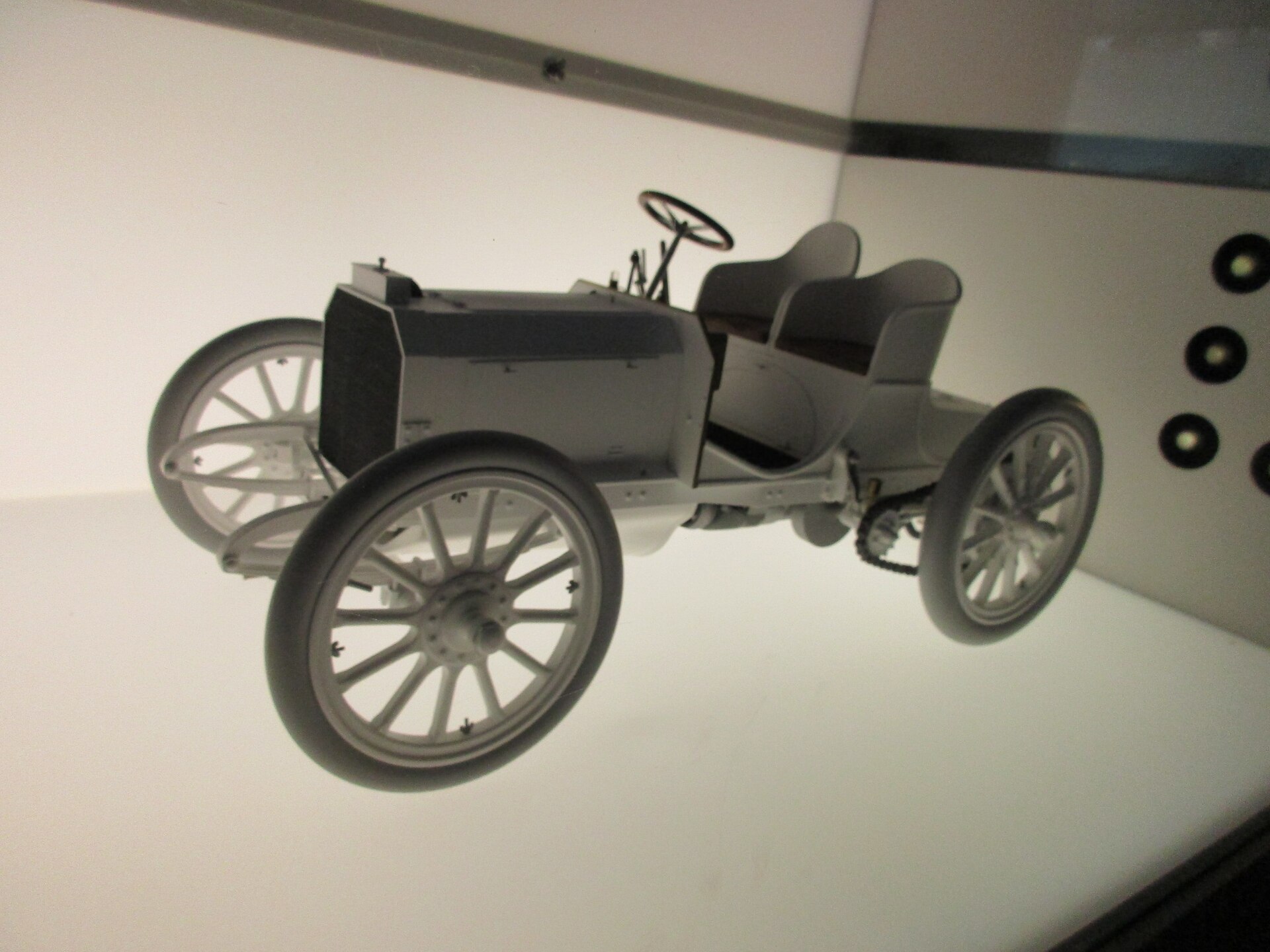
Rated at 26 kW, the Mercedes 35 PS was the racing and touring car that Daimler-Motoren-Gesellschaft (DMG) built from late 1900 to 1902 for the dealer Emil Jellinek. Wilhelm Maybach designed it with a long, low pressed-steel frame, a 5.9-litre four-cylinder engine and a honeycomb radiator It was the first car sold under the Mercedes name and is often called the first modern car. Its successor was the Mercedes-Simplex of 1902.
In short
- Ordered by Jellinek in April 1900 after a fatal crash of a Daimler racer; first test drive on 22 November 1900, first delivery on 22 December 1900.
- 5,918 cc straight-four with mechanically operated inlet valves and magneto ignition: 26 kW (35 PS) at 950 rpm.
- Pressed-steel frame, engine set low over the front axle, gate-change four-speed gearbox and chain drive.
- Won at the Nice week in March 1901, where it raised the Nice–La Turbie record average from 31.3 km/h to 51.4 km/h.
The first Mercedes at a glance
| Parameter | Metric | Imperial |
|---|---|---|
| Maker | Daimler-Motoren-Gesellschaft, Stuttgart | - |
| Production | November 1900 – 1902 | - |
| Built | 36 ordered by Jellinek (English Wikipedia) | - |
| Engine | 5,918 cc straight-four, bore 116 mm, stroke 140 mm | 361.1 cu in |
| Power | 26 kW (35 PS) at 950 rpm | - |
| Torque | 77 Nm at 400 rpm | 57 lb-ft |
| Gearbox | four forward speeds and reverse, gate change | - |
| Drive | rear wheels, roller chains | - |
| Wheelbase | 2,345 mm (English Wikipedia), 2,245 mm (German Wikipedia) | 92.3 in |
| Track | 1,400 mm | 55 in |
| Length × width × height | 2,766 × 1,345 × 1,300 mm | 108.9 × 53.0 × 51.2 in |
| Weight | about 1,200 kg | about 2,600 lb |
| Speed | 70–75 km/h for road cars, over 85 km/h in racing form | 43–47 mph, 53 mph |
| Predecessor / successor | Daimler Phoenix / Mercedes-Simplex | - |
Emil Jellinek and the order of 1900
Emil Jellinek was a wealthy Austro-Hungarian businessman and diplomat on the Côte d'Azur who sold Daimler cars in France, Italy and Switzerland. He also raced them under the pseudonym "Monsieur Mercedes", taken from the nickname of his daughter Adriana Manuela Ramona, then about ten years old.
The turning point came on 30 March 1900. In the Nice–La Turbie hill climb a Daimler Phoenix entered by Jellinek crashed, and DMG's chief mechanic Wilhelm Bauer was killed. DMG withdrew from racing. Jellinek answered with a demand for a lower, longer, more powerful car, and on 2 April 1900 he ordered it in large numbers; English Wikipedia gives 36 cars. He also asked for a new name. The Daimler name was already licensed to Panhard in France, so the cars were to carry the name Mercedes. DMG first used the Mercedes trademark on 23 June 1902 and registered it on 26 September 1902. Jellinek himself took the surname Jellinek-Mercedes in June 1903.
Development and the first deliveries
Wilhelm Maybach led the design, and English Wikipedia also credits Paul Daimler. Maybach tested the first car on 22 November 1900, and Jellinek took delivery of the first one on 22 December 1900.
The start in competition was difficult. In January 1901 the cars appeared at Pau but lasted only a few laps. Two months later, at the Nice week of March 1901, the result was very different. Jellinek's team ran five cars, and driver Wilhelm Werner raised the average speed record for the Nice–La Turbie climb from 31.3 km/h (19.4 mph) to 51.4 km/h (31.9 mph); top speeds reached 86 km/h (53 mph). Paul Meyan, director of the Automobile Club de France, remarked that the Mercedes era had begun. Between March and August 1901 DMG added two smaller models on the same principles, the 12/16 PS and the 8/11 PS.

Engine: how the car made 26 kW
The four cylinders were cast in grey iron in pairs, with fixed heads, and sat on a horizontally split aluminium crankcase, the first of its kind at Daimler. The main bearings were made of magnalium, an aluminium alloy with 5% magnesium. With a bore of 116 mm and a stroke of 140 mm, the engine displaced 5,918 cc according to English Wikipedia; German Wikipedia gives 5,913 cc. It produced 26 kW (35 PS) at 950 rpm and 77 Nm at 400 rpm.
Several details broke with the engines of the 1890s:
- Inlet valves: opened by camshafts driven by gears from the flywheel side, not by cylinder suction as before.
- Ignition: a low-voltage magneto with make-and-break contacts, fitted at Jellinek's insistence in place of hot-tube ignition.
- Mixture: two carburettors, each feeding one pair of cylinders.
- Control: a lever on the steering wheel varied engine speed between about 300 and 1,000 rpm.
- Starting: a hand crank with a decompressor.
The engine weighed about 230 kg, roughly 90 kg less than its predecessor's unit according to German Wikipedia, or about 6.6 kg per horsepower.
Chassis, radiator and gearbox
The car stood on a frame of pressed steel with a U-shaped cross-section, lighter and stronger than the wooden and tube frames of the time. The engine was bolted directly to the frame and sat low over the front axle, which lowered the centre of gravity. Both axles were rigid, on semi-elliptic leaf springs, and the steering column was raked back.
Cooling came from Maybach's honeycomb radiator. It used 8,070 square tubes of 6 × 6 mm and needed only 9 litres of water, half the capacity of his earlier tube radiator, with a fan behind it for low speeds.
A single lever moving in a gate selected four forward speeds and reverse, and roller chains drove the rear wheels. The wooden artillery wheels had twelve spokes and pneumatic tyres, 910 mm tall at the front and 1,020 mm at the rear. Drum brakes of 30 cm on the rear wheels worked from a hand lever, and a pedal braked the chain-drive countershaft. The racing two-seater could take an extra rear body section, fitted in a few minutes, to carry four.

The 1901 Mercedes range
| Variant | Years | Body / purpose | Engine | Notes |
|---|---|---|---|---|
| Mercedes 26 kW (35 PS) | 1900–1902 | racing two-seater, four-seat tourer with extra rear body | 5.9 l four, 26 kW (35 PS) | built for Jellinek |
| Mercedes 12/16 PS | 1901–1902 | smaller touring car | - | from March 1901 |
| Mercedes 8/11 PS | 1901–1902 | small car | - | from August 1901 |
| Mercedes-Simplex | from 1902 | successor range | - | see the gallery photo |
Performance in context
A weight of about 1,200 kg and 26 kW give about 21 kW per tonne. That sounds modest today, but on the roads of 1901 it meant 70–75 km/h for a road car. The racing version passed 85 km/h. Our power-to-weight calculator puts the figure next to any modern car.
The gap to the first cars of 1886 shows how quickly the motor car moved on. The Benz Patent-Motorwagen Nr. 1 had 0.5 kW and about 16 km/h; fifteen years later the Mercedes had 26 kW, roughly fifty times as much, and its racing version passed 85 km/h. Its engine alone, at about 230 kg, weighed almost as much as the whole Benz tricycle.
Legacy of the first Mercedes
The car started the Mercedes line of cars, and DMG's cars were sold as Mercedes until the merger with Benz & Cie., after which the brand became Mercedes-Benz in 1926. English Wikipedia describes the car as a major advance over modified stagecoaches and regards it as the first modern car. It began life as a racing car and was then adapted for the road, with two extra rear seats for family use. The full company story is in our history of Mercedes-Benz, and Maybach's later life and the brand that carries his name are covered in our Maybach history.
Photo gallery

Mercedes-Benz 35 PS in our rankings
- No. 75 of 79 · Most powerful convertibles and roadsters (26 kW · top 95%)
- No. 811 of 912 · Longest-running car nameplates (2 years · top 96%)
- No. 122 of 124 · Most powerful German cars (26 kW · top 99%)
- No. 851 of 859 · Most powerful cars (26 kW)
More powerful than 5% of ranked convertibles and roadsters in the 1CARS catalog (No. 75 of 79).
FAQ
Why is the 1901 Mercedes called the first modern car?
It combined a long pressed-steel frame, a front engine set low over the front axle, a honeycomb radiator and a gate-change gearbox. English Wikipedia calls it a major advance over the modified stagecoaches of the 1890s.
Who designed the first Mercedes?
Wilhelm Maybach of Daimler-Motoren-Gesellschaft, with Paul Daimler credited by English Wikipedia, for the dealer Emil Jellinek.
How powerful was the first Mercedes?
The 5.9-litre four produced 26 kW (35 PS) at 950 rpm and 77 Nm at 400 rpm.
Why is it called Mercedes?
Jellinek named the car after his daughter, known as Mercédès, and raced as "Monsieur Mercedes". The Daimler name was already licensed to Panhard in France.
How fast was the first Mercedes?
Road cars reached 70–75 km/h, racing versions more than 85 km/h, and the fastest cars at Nice in 1901 touched 86 km/h.
Data sources
Data checked by an editor against the sources below.