Maybach: History, Landmark Models and Mercedes-Maybach Today
Maybach began in 1909 as an engine maker for Count Zeppelin's airships, founded by Wilhelm Maybach, the engineer behind the first Mercedes, and his son Karl. It built luxury cars from 1921 to about 1940, passed to Daimler-Benz in 1960, returned as a separate brand from 2002 to 2012 and has been the Mercedes-Maybach sub-brand of Mercedes-Benz since 2014.
Key takeaways
- Founded on 23 March 1909 as Luftfahrzeug-Motorenbau GmbH, a Zeppelin subsidiary, by Wilhelm and Karl Maybach.
- About 1,800 cars were built between 1921 and about 1940 (one German reference gives 1,841), the best known being the V12 Zeppelin DS7 and DS8.
- Daimler-Benz bought the company in 1960; the engine business became MTU Friedrichshafen in 1969.
- The revived Maybach 57 and 62 (2002–2012) totalled about 3,300 cars (3,321 in the most detailed count); since 2014 Maybach is a Mercedes-Benz sub-brand.

Maybach at a glance
Maybach today is the top luxury sub-brand of Mercedes-Benz, not an independent carmaker. The key facts, as of October 2026:
| Fact | Value |
|---|---|
| Founders | Wilhelm Maybach and his son Karl Maybach |
| Founded | 23 March 1909, as Luftfahrzeug-Motorenbau GmbH |
| Original base | Bissingen an der Enz; Friedrichshafen from 1912 |
| Historic cars | 1921 to about 1940; about 1,800 built (one reference: 1,841) |
| Owner since 1960 | Daimler-Benz, today Mercedes-Benz |
| Revival brand | Maybach 57 and 62, 2002–2012; about 3,300 built (3,321 in the most detailed count) |
| Today | Mercedes-Maybach, a sub-brand of Mercedes-Benz since 2014 |
| Racing history | None |

Wilhelm and Karl Maybach: from Daimler to Zeppelin
Maybach is named after a father and son, both engine designers. Wilhelm Maybach was born in Heilbronn on 9 February 1846 and began working with Gottlieb Daimler in 1883. He co-founded Daimler-Motoren-Gesellschaft (DMG) in 1890 and became its technical director in 1895. His spray-nozzle carburettor of 1893 came into wide use, and he was chief designer of the first Mercedes of 1900–01. The parent brand's story is told in the history of Mercedes-Benz.

Wilhelm left DMG in 1907. His eldest son Karl was born in Deutz on 6 July 1879, and on 23 March 1909 the two set up Luftfahrzeug-Motorenbau GmbH at Bissingen an der Enz as a subsidiary of Count Ferdinand von Zeppelin's airship company. Karl was technical manager and Wilhelm technical assistant. In 1912 the firm moved to Friedrichshafen, home of the Zeppelin works.
The company was later renamed Maybach-Motorenbau GmbH. English-language sources date the change to 1912 and German ones to 1918. Wilhelm died in Stuttgart on 29 December 1929, aged 83. Karl ran the company from then on, left it in 1952 and died in Friedrichshafen in February 1960.
1909–1918: engines for Zeppelin airships
For its first decade Maybach built only aero engines, for airships and aircraft. The first engine, the CX, was a 22.8-litre (1,391 cu in) six-cylinder rated at 154 kW (210 PS) at 1,300 rpm. It was built until 1915 and fitted to 28 airships.

The HS series followed at 177 kW (240 PS). The MB type of 191 kW (260 PS), approved in March 1917, was built at up to 200 a month, and more than 2,000 were made. The Mb.IVa is usually described as the first true high-altitude engine, built to keep its power in thin air.
1919–1929: the first Maybach cars
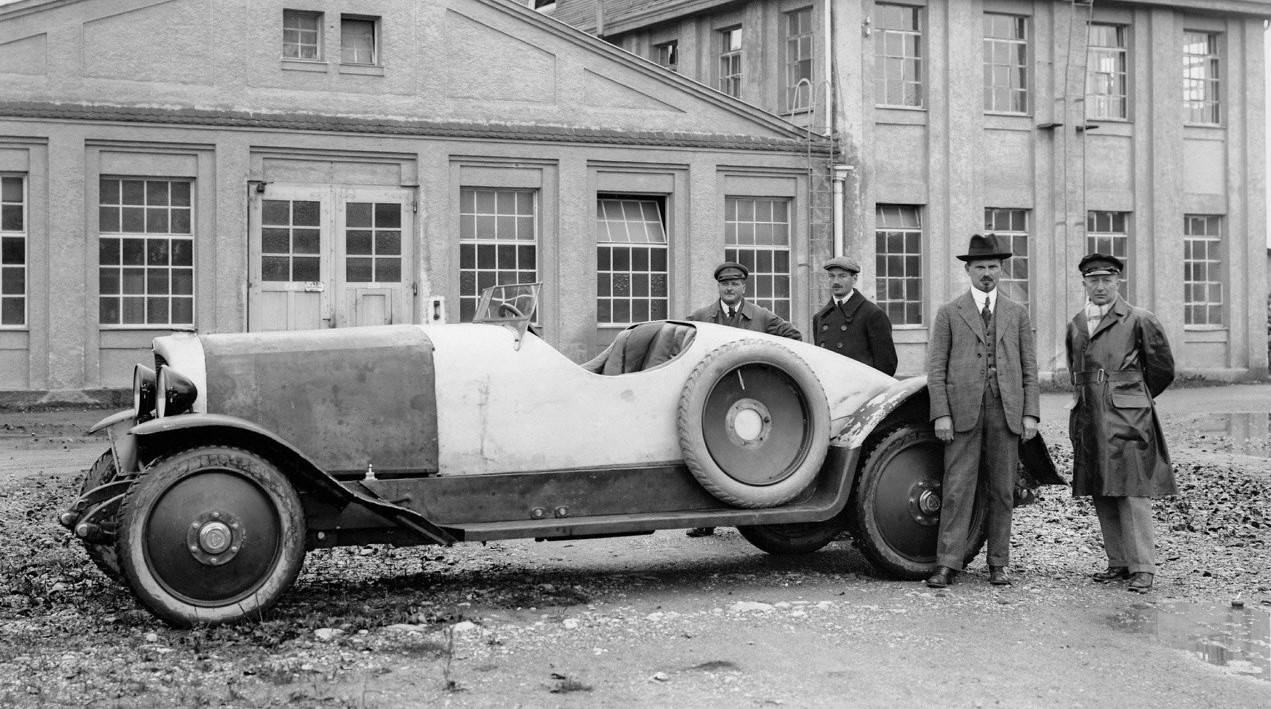
Maybach became a carmaker in the early 1920s, when it began building complete cars around its own engines. An experimental car, the W1, was completed in 1919, and only one was built.
The first production model, the W3, was shown at the Berlin Motor Show on 23 September 1921. It had a 5.7-litre (348 cu in) inline six of 51 kW (70 PS), sold as the "22/70 PS". About 300 were built up to 1928. The W5 of 1926 used a 7.0-litre (427 cu in) six of 88 kW (120 PS), called the "27/120 PS", and it also reached about 300 cars by 1928.
1929–1940: the Zeppelin V12 and the SW series
Maybach's best-known pre-war cars were its V12 models, introduced from 1929. The Type 12 was followed in 1930 by the DS7 Zeppelin, with a 7-litre V12 of 110 kW (150 PS). The DS8 Zeppelin had an 8.0-litre (488 cu in) V12 of 147 kW (200 PS) and was built until 1939–40. Its launch is dated 1930 or 1931. About 200 V12 cars were built in total, including the Type 12, DS7 and DS8.

Smaller six-cylinder models broadened the range in the mid-1930s. The SW35 of 1935 had a 3.5-litre engine, the SW38 of 1936 a 3.8-litre and the SW42 of 1939 a 4.2-litre; each is usually quoted at 103 kW (140 PS). Around 900 SW cars were made, the most numerous Maybachs of the era.
Engines remained central: in August 1929 the airship LZ 127 Graf Zeppelin was flying with five Maybach V12 engines, each rated at about 404 kW (550 PS).
Car production ended around the start of the Second World War. Sources give 1939, 1940 or 1941 as the last year (Britannica dates the Maybach-badged cars to 1922–1939). A French-language reference puts the total at about 1,800 cars, nearly 200 of them Zeppelins, and a German one at 1,841. Cars of this era are covered in the classic car archive.
1940–1969: engines only, then Daimler-Benz and MTU
After 1940 Maybach never returned to series car production. During the Second World War the company built engines for German military vehicles, and the Friedrichshafen plant was heavily damaged.

After 1945 the works served as a repair shop, and a French army contract for diesel engines kept the firm going. There was not enough capital to restart car building. Before the war, the "Fliegender Hamburger" express railcar used two Maybach V12 diesels of 302 kW (410 PS) each and ran at 160 km/h (99 mph).
Daimler-Benz acquired the company and the rights to the brand in 1960. In 1966 Maybach was merged with Daimler-Benz's large-engine business as Maybach Mercedes-Benz Motorenbau GmbH, which was renamed MTU Friedrichshafen in 1969. The name then went unused on cars for over three decades.
1997–2013: the Maybach 57 and 62 revival
Daimler revived Maybach in 2002 as an ultra-luxury brand to rival Rolls-Royce and Bentley. A Mercedes-Benz Maybach concept was shown at the Tokyo Motor Show in 1997, the decision to build it was announced in 2000, and production began in April 2002.

The Maybach 57 and the long-wheelbase 62 were built by a dedicated Maybach-Manufaktur inside Daimler's Sindelfingen plant. The numbers are generally explained as the cars' lengths in metres: the 57 measured 5,728 mm (225.5 in) and the 62 6,165 mm (242.7 in) before the 2010 update. Both used the M285 5.5-litre (336 cu in) twin-turbocharged V12, rated at 405 kW (550 PS) at 5,250 rpm and 900 Nm (664 lb ft) from 2,300 to 3,000 rpm. First deliveries followed at the end of 2002.
More powerful versions followed. The 57 S, shown at Geneva in 2005, had 450 kW (612 PS) and 1,000 Nm (738 lb ft); the 62 S came in 2006, and the later update raised the output to 463 kW (630 PS). A 62 S Landaulet with a folding roof section over the rear seats was shown in late 2007, and 22 were built.
The brand's best-known one-off is the Maybach Exelero, shown in Berlin in 2005. The tyre maker Fulda, part of Goodyear, ordered it to test a new high-speed tyre. Built by Stola, it used a 6.0-litre (366 cu in) version of the M285 V12 with 515 kW (700 PS) and 1,020 Nm (752 lb ft). Its quoted 351 km/h (218 mph) top speed is theoretical.
Why the revival ended
The Maybach brand ended because it sold far fewer cars than planned. Daimler had forecast about 2,000 a year, half of them in the United States. US sales peaked at 244 in 2004 and fell to 63 in 2010; in 2007 the US dealer network was cut from 71 to 42. Worldwide, 157 Maybachs found buyers in 2010 against 2,711 Rolls-Royces.
Daimler announced the end of the brand on 25 November 2011. The last car left Sindelfingen on 17 December 2012, though some sources date the end of sales to 2013. In total about 3,300 cars of the 57 and 62 family were built (3,321 in the most detailed count).
2014 onwards: Mercedes-Maybach as a sub-brand
Since 2014 Maybach has been a sub-brand for the most luxurious versions of Mercedes-Benz models. The relaunch was announced in November 2014 with long-wheelbase versions of the S-Class (X 222), shown as the S 500 and S 600, presented at the 2015 Geneva Motor Show.

The S 650 Cabriolet, revealed in Los Angeles in November 2016, went on sale in spring 2017 at a quoted EUR 357,000, and 300 were built. The G 650 Landaulet, shown at Geneva in March 2017, was quoted at EUR 749,700 in autumn 2017 and limited to 99 cars.
The GLS 600 SUV was shown in Guangzhou on 21 November 2019 and has been built at Vance, Alabama, since September 2020. The S-Class of the Z 223 generation followed in November 2020, with sales from May 2021 as the S 580 and S 680, and an S 580 e plug-in hybrid was added in February 2023. The electric EQS 680 SUV appeared in Shanghai in April 2023, and the SL 680 Monogram Series, a two-door roadster, was revealed at Monterey in August 2024.
Maybach today: the Mercedes-Maybach range
The Mercedes-Maybach range consists of four model lines, all based on Mercedes-Benz cars. The table follows the line-up as listed in 2025; individual versions may have changed since.

| Model | Segment | Body | Years |
|---|---|---|---|
| Mercedes-Maybach S-Class (S 580, S 580 e, S 680) | Luxury | Saloon | 2021– (current generation) |
| Mercedes-Maybach GLS 600 | Luxury SUV | SUV | 2020– |
| Mercedes-Maybach EQS 680 SUV | Electric luxury SUV | SUV | 2023– |
| Mercedes-Maybach SL 680 Monogram Series | Luxury sports car | Roadster | 2024– |
The 1cars Maybach catalogue lists the models covered on the site, and the specifications database covers the wider Mercedes-Benz range.
Records and engineering firsts
Maybach has no motorsport history; its records are engineering ones:
- The Mb.IVa high-altitude aero engine and the five V12s of the LZ 127 Graf Zeppelin.
- Seven- and eight-litre V12 engines in the Zeppelin DS7 and DS8 cars.
- Two V12 diesels in the "Fliegender Hamburger" railcar.

Terms such as V12 and landaulet are explained in the glossary.
Landmark Maybach models
Ten cars trace the brand from airship engine supplier to Mercedes-Benz sub-brand.

| Model | Years | Why it matters |
|---|---|---|
| W3 | 1921–1928 | First production Maybach car; 5.7-litre six |
| Zeppelin DS7 | from 1930 | First Zeppelin-named V12 car, 110 kW (150 PS) |
| Zeppelin DS8 | to 1939–40 | 8.0-litre V12 of 147 kW (200 PS), the flagship |
| Maybach 57 and 62 | 2002–2012 | Revival of the brand; 5.5-litre twin-turbo V12 |
| 57 S and 62 S | 2005/2006–2012 | Up to 463 kW (630 PS) |
| 62 S Landaulet | from 2007 | Open rear compartment; 22 built |
| Exelero | 2005 | One-off tyre-test coupé, 515 kW (700 PS) |
| Mercedes-Maybach S 600 | from 2014–15 | First car of the sub-brand era |
| G 650 Landaulet | 2017 | Off-roader with open rear; 99 built |
| GLS 600 | 2020– | Luxury SUV built in the USA, at Vance, Alabama |
Maybach timeline
Key dates of the Maybach name:
| Year | Event |
|---|---|
| 1909 | Luftfahrzeug-Motorenbau founded on 23 March by Wilhelm and Karl Maybach |
| 1921 | W3 shown at the Berlin Motor Show |
| 1929 | First V12 cars; Wilhelm Maybach dies on 29 December |
| c. 1940 | Car production ends after about 1,800 cars |
| 1960 | Daimler-Benz acquires Maybach |
| 1969 | Engine business renamed MTU Friedrichshafen |
| 1997 | Mercedes-Benz Maybach concept in Tokyo |
| 2002 | Maybach 57 and 62 go into production |
| 2011 | End of the brand announced on 25 November |
| 2012 | Last Maybach 57/62 built on 17 December |
| 2014 | Mercedes-Maybach announced as a sub-brand |
Maybach in numbers
Maybach has always been a small-volume brand:
- About 1,800 cars built between 1921 and about 1940 (1,841 in one German count), including about 900 SW models and about 200 V12 cars.
- 3,321 cars of the 2002–2012 family, according to the most detailed published breakdown: 1,104 Maybach 57, 1,058 Maybach 62, 492 62 S (236 plus 256 for the 2010 model year) and 22 Landaulets.
US sales of the revived brand, as usually reported:
| Year | US sales |
|---|---|
| 2003 | 166 |
| 2004 | 244 |
| 2005 | 152 |
| 2006 | 146 |
| 2007 | 156 |
| 2008 | 119 |
| 2009 | 66 |
| 2010 | 63 |
FAQ
Who founded Maybach?
Wilhelm Maybach and his son Karl founded the company on 23 March 1909 as Luftfahrzeug-Motorenbau GmbH, a subsidiary of Count Zeppelin's airship business. Wilhelm had designed the first Mercedes at Daimler.
Who owns Maybach today?
Maybach belongs to Mercedes-Benz. Daimler-Benz bought the company and the brand rights in 1960, and since 2014 the name has been used for the Mercedes-Maybach sub-brand.
Why did Maybach stop production in 2012?
Sales stayed far below the plan of about 2,000 cars a year: in 2010 only 157 were sold worldwide. The end was announced in November 2011; the last car was built on 17 December 2012.
What is the difference between Maybach and Mercedes-Maybach?
Maybach (2002–2012) was a separate brand with its own 57 and 62 models. Mercedes-Maybach, since 2014, is a sub-brand offering the most luxurious versions of Mercedes-Benz models such as the S-Class and GLS.
Where are Maybach cars made?
The 2002–2012 Maybach 57 and 62 were built at Daimler's Sindelfingen plant in Germany. The Mercedes-Maybach GLS 600 has been built at Vance, Alabama, since September 2020.
How many Maybach 57 and 62 were built?
In all, about 3,300 cars of the 57 and 62 family were built from 2002 to 2012 (3,321 in the most detailed count), including 1,104 Maybach 57 and 1,058 Maybach 62. The model numbers are generally explained as the approximate lengths of the cars in metres.