
 Mercedes-Benz 300SL
Specs, engines and history
Updated Published Sources (2) Report an error
By Felix Hartmann, Automotive Technology & EV Contributor Reviewed by Oleksandr Hnatiuk
- Built
- 1954–1963
- Top power
- 158 kW (215 PS)
Which Mercedes-Benz 300 SL to choose: verdict
Our verdict · Felix Hartmann
For pure history and the image, choose the Gullwing coupé; for the better drive, with improved suspension and, from 1961, disc brakes, choose a late Roadster. An alloy-bodied Gullwing or an alloy-block Roadster is the rarest of all. Whatever the version, buy with full documentation, matching numbers and an expert inspection of the injection system and the spaceframe.
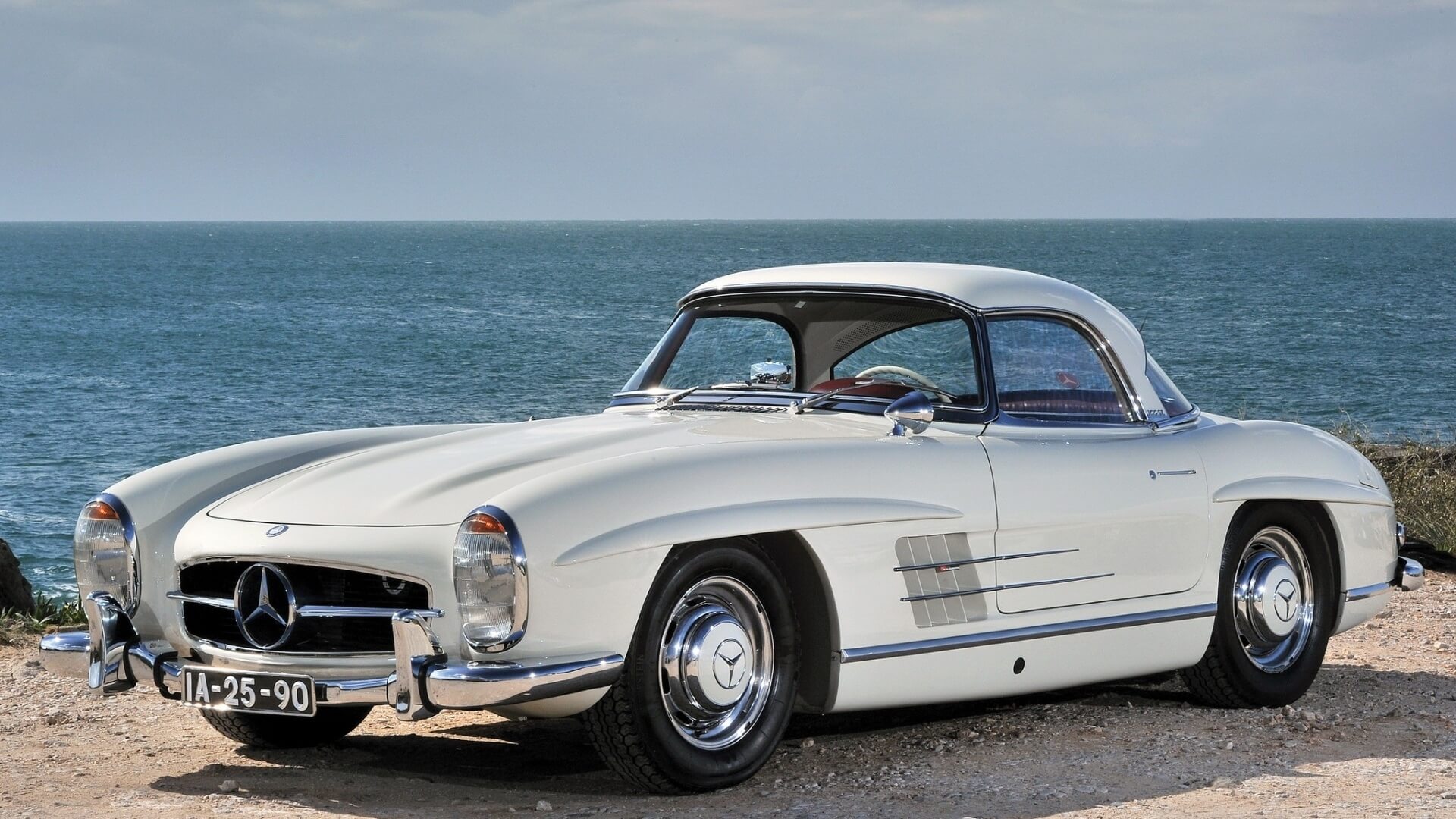
The Mercedes-Benz 300 SL (W198) is the sports car that turned Mercedes' 1952 racing success into a road car. Shown in New York in February 1954, it was the first production car with petrol direct injection: its 3.0-litre six gives 158 kW (215 PS DIN). Mercedes built 1,400 Gullwing coupés until 1957 and 1,858 Roadsters until 1963.
In short
- Two versions: the Gullwing coupé (1954–1957, 1,400 built) and the Roadster (1957–1963, 1,858 built), 3,258 in total.
- Engine: M198 2,996 cc straight-six with Bosch mechanical direct injection, 158 kW (215 PS) DIN and 275 Nm, four-speed manual.
- Performance: 0–100 km/h in 9.3 seconds and up to about 260 km/h with the longest axle ratio, the fastest production car of its day.
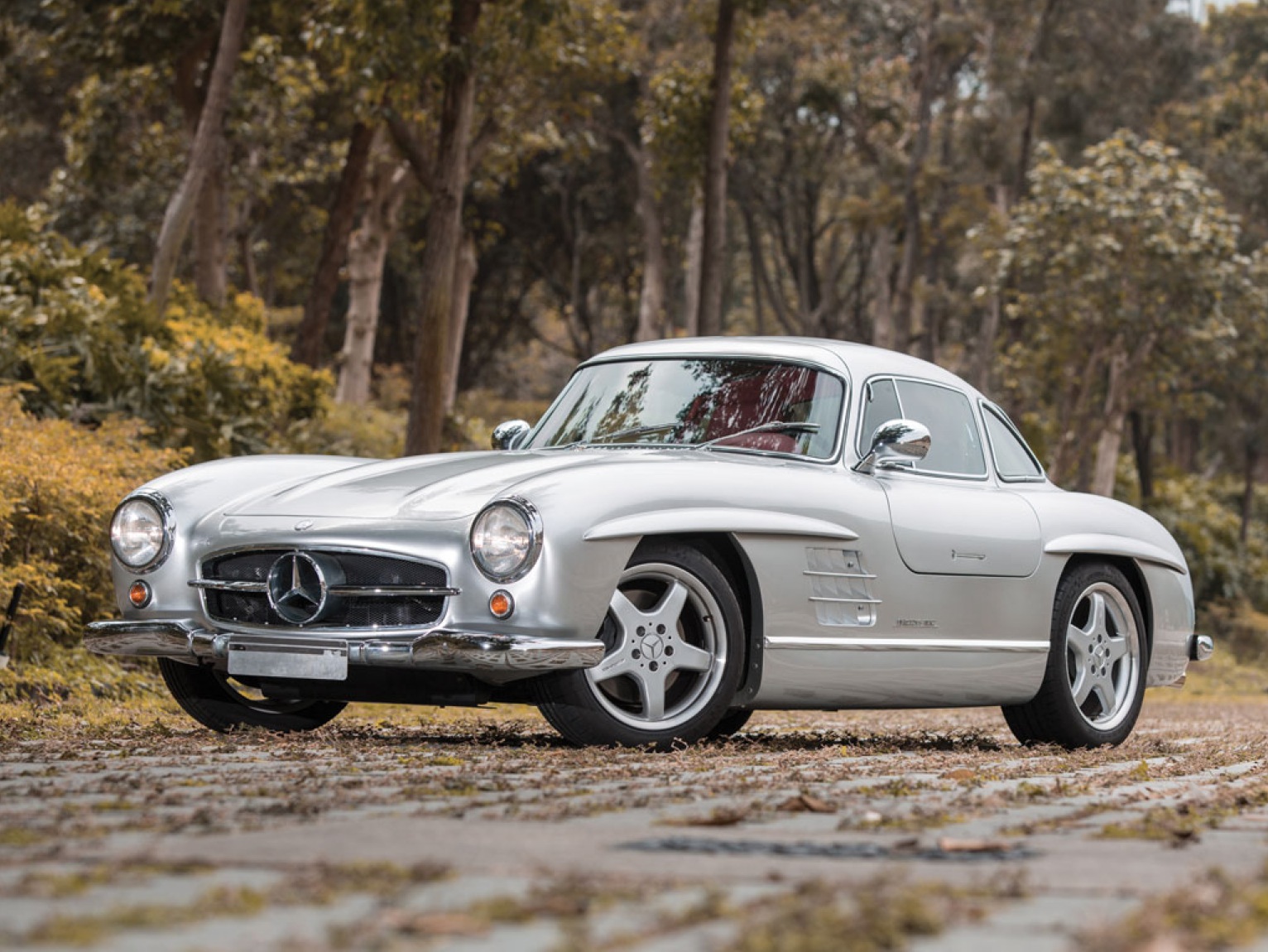
- Engineering: an 82 kg tubular spaceframe, which forced the high sills and the famous upward-opening doors.
Size at a glance
| Dimensions | Mercedes-Benz 300SL W198 |
|---|---|
| Length | 4,520 mm178.0 in |
| Width | 1,790 mm70.5 in |
| Height | 1,300 mm51.2 in |
| Wheelbase | 2,400 mm94.5 in |
Running cost
Fuel · 300SL W198 3.0 M198 158 kW (215 PS) Coupe
about 4,450 EUR fuel a year at 15,000 km
17.0 l/100 km · petrol at 1.75 EUR/l · change mileage, fuel price or version
Specs by version
Engines
| Version | Engine | Power | Torque | Gearbox | Drive |
|---|---|---|---|---|---|
| 3.0 M198 158 kW (215 PS) Coupe | 3.0 l · 6 cyl · Petrol M198 | 158 kW 215 PS212 hp | 275 Nm203 lb-ft | 4-sp Manual | Rear-wheel drive |
Performance
Show all 1 versions
| Version | 0–100 km/h | Fuel consumption |
|---|---|---|
| 3.0 M198 158 kW (215 PS) Coupe | 9.3 s 0–62 mph | 17.0 l/100 km13.8 mpg US · 16.6 mpg UK |
Dimensions and weight
Show all 1 versions
| Version | Length | Width | Height | Wheelbase | Kerb weight |
|---|---|---|---|---|---|
| 3.0 M198 158 kW (215 PS) Coupe | 4,520 mm178.0 in | 1,790 mm70.5 in | 1,300 mm51.2 in | 2,400 mm94.5 in | 1,295 kg2,855 lb |
Verified Manufacturer and type-approval data from our catalog · Sources and methodology
The 300 SL at a glance: from Le Mans to New York
The name stands for 3.0 litres and "Super Leicht" (super light). Its roots are in the W194 racing car of 1952, which won the 24 Hours of Le Mans with a one-two finish and took the Carrera Panamericana in Mexico. Max Hoffman, Mercedes' importer in the USA, convinced the board in 1953 that a road version would sell to wealthy American buyers, and he ordered 1,000 cars. The coupé was presented at the New York motor show in February 1954. The wider story of the brand is told in the history of Mercedes-Benz, and today's line-up is in the Mercedes-Benz catalogue.

| Fact | Value |
|---|---|
| Maker | Daimler-Benz, Stuttgart, Germany |
| Model code | W198 (racing predecessor W194) |
| Gullwing coupé | 1954–1957, 1,400 built |
| Roadster | 1957–1963, 1,858 built |
| Engine | M198 3.0 l straight-six, Bosch direct injection |
| Power | 158 kW (215 PS) DIN; 179 kW (243 PS) SAE gross |
| Top speed | up to about 260 km/h, depending on axle ratio |
| Debut | New York, February 1954 |
Gullwing and Roadster: the two 300 SL models
| Model | Code | Years | Body | Engine | Power (hp / kW) |
|---|---|---|---|---|---|
| 300 SL Coupé "Gullwing" | W198 I | 1954–1957 | Two-door coupé, gullwing doors | M198 3.0 I6 | 158 kW (215 PS) DIN |
| 300 SL Roadster | W198 II | 1957–1963 | Two-door roadster, optional hard top | M198 3.0 I6 | 158 kW (215 PS) DIN |
The Gullwing is the more famous of the two, but the Roadster was the better car to drive. It had conventional doors, lower sills, a revised rear swing axle with a low pivot point that calmed the handling, and from March 1961 disc brakes front and rear. From March 1963 until the end of production, 209 Roadsters received an aluminium-alloy engine block.

Engine and performance: direct injection in 1954
The M198 engine is a 2,996 cc straight-six derived from the 300 saloon, tilted by about 45 degrees so that it fits under the low bonnet. Its Bosch mechanical injection sprays fuel directly into the cylinders, a solution taken from aircraft engines and not seen again in mass-produced petrol cars for decades. Mercedes rated it at 158 kW (215 PS) DIN at 5,800 rpm and 275 Nm at 4,600 rpm; the American SAE gross figures were 179 kW (243 PS) and 294 Nm. The compression ratio was 8.55:1, or 9.5:1 for a higher-output option.
| Parameter | Value |
|---|---|
| Displacement | 2,996 cc |
| Fuel system | Bosch mechanical direct injection |
| Power (DIN) | 158 kW (215 PS) at 5,800 rpm |
| Torque (DIN) | 275 Nm at 4,600 rpm |
| Gearbox | 4-speed manual |
| 0–100 km/h | 9.3 s |
| Top speed | up to about 260 km/h with the longest final drive |
The top speed depended on the final-drive ratio chosen by the buyer. The often-quoted 260 km/h needed the longest ratio; a standard car reached about 237 km/h, according to the old 1cars text. The engine is also flexible: the old text notes that the car could pull in fourth gear from about 1,500 rpm. By our calculation, a 1,295 kg Gullwing carries about 8.2 kg per kW, a ratio few road cars of the 1950s could approach. To see how far road cars have moved on since, look at our ranking of the most powerful coupés.
Spaceframe, gullwing doors and dimensions
The doors were not a styling trick. The 300 SL uses a chrome-molybdenum tubular spaceframe weighing only 82 kg, and its tubes run high along the sides of the cabin. Normal doors would have been impossible, so the engineers hinged them in the roof. Most bodies are steel with aluminium bonnet, boot lid and door skins; only 29 Gullwings received an all-aluminium body, which saved about 80 kg.

| Parameter | Metric | Imperial |
|---|---|---|
| Length | 4,520 mm | 178.0 in |
| Width | 1,790 mm | 70.5 in |
| Height | 1,300 mm | 51.2 in |
| Wheelbase | 2,400 mm | 94.5 in |
| Kerb weight, coupé | 1,295 kg | 2,855 lb |
| Kerb weight, Roadster (from 1961) | 1,330–1,370 kg | 2,932–3,020 lb |
| Spaceframe weight | 82 kg | 181 lb |
Getting in is an art: the high, wide sill means the driver steps over it, and the steering wheel tilts down to make room. The old 1cars text adds that the side windows cannot be wound down, so the cabin becomes hot in summer. The spare wheel fills most of the boot, and luggage travels behind the seats. To compare the car's footprint with a modern coupé, try the size comparison tool.
Running and ownership today
A 300 SL is a collector's car that needs specialist care. The mechanical injection pump must be set up by experts, the drum-braked Gullwing needs a careful driver, and early cars have the tricky handling of the original swing axle at the limit. Parts support from Mercedes-Benz Classic is good, but restorations are very expensive. Silver was the most common colour when new, and other sports cars of the decade are gathered in our 1950s classics.

Safety and equipment
The 300 SL was built long before crash tests, airbags or seat belts were standard; the old 1cars text notes that seat belts were not in the standard equipment lists. The interior was trimmed in cloth or optional leather, with a chrome-finished dashboard. Its safety today depends on the brakes, tyres and steering being kept in perfect condition.

Rivals: how the 300 SL compared
| Model | Engines | Power (hp) | Boot (l) | Price from (EUR) |
|---|---|---|---|---|
| Mercedes-Benz 300 SL | 3.0 l I6, direct injection | 212 (DIN) | small | classic, auction only |
| Jaguar XK140 | 3.4 l I6 | about 190 | – | classic |
| Ferrari 250 GT | 3.0 l V12 | about 240 | – | classic |
Compared with the Jaguar XK140, the 300 SL was much more advanced, with fuel injection and a spaceframe, and it was faster than almost any rival on the road. Ferrari's V12 GTs matched its power but not its technology. For a very different Mercedes of the modern era, see the twelve-cylinder G65 AMG.

Rivals
Compare with…
Compare Mercedes-Benz 300SL with
- Shelby Cobra quick spec comparison
-
Classic
- Years
- 1962–1967
- Body
- Convertible
- Fuel
- Petrol
- Power
- 191–317 kW (260–431 PS)

Mercedes-Benz 300SL in our rankings
- No. 24 of 97 · Lightest coupes (1,295 kg · top 25%)
- No. 131 of 421 · Lightest cars (1,295 kg · top 32%)
- No. 151 of 418 · Power-to-weight: cars (122 kW/t · top 37%)
- No. 51 of 109 · Smallest coupes (4,520 mm · top 47%)
- No. 343 of 709 · Biggest engines: cars (2,996 cc · top 49%)
- No. 271 of 562 · Smallest cars (4,520 mm · top 49%)
Lighter than 75% of ranked coupes in the 1CARS catalog (No. 24 of 97).
Mercedes-Benz 300SL photos 15


FAQ
How many Mercedes-Benz 300 SL were made?
Mercedes built 3,258 cars in total: 1,400 Gullwing coupés from 1954 to 1957 and 1,858 Roadsters from 1957 to 1963. Only 29 coupés had an all-aluminium body.
How fast is a Mercedes 300 SL?
With the longest axle ratio it reaches about 260 km/h, which made it the fastest production car of its time. A standard car reaches about 237 km/h, and 0–100 km/h takes 9.3 seconds.
Why does the 300 SL have gullwing doors?
Its tubular spaceframe runs high along the sides of the cabin, so conventional doors were not possible. The engineers hinged the doors in the roof, which created the car's nickname and its most famous feature.
What engine does the 300 SL have?
It uses the M198, a 2,996 cc straight-six with Bosch mechanical direct injection, producing 158 kW (215 PS) DIN and 275 Nm. It was the first petrol engine with direct injection in a production car.
What is the difference between the 300 SL Gullwing and Roadster?
The Roadster of 1957–1963 has conventional doors, lower sills, a revised rear axle with better handling and, from 1961, disc brakes. The Gullwing coupé of 1954–1957 has the roof-hinged doors and drum brakes.
Data sources
Data checked by an editor against the sources below.
- The text of this article (1cars archive)
- Wikipedia - Mercedes Benz 300 SL


