
 Mercedes-Benz S-Class
All generations, specs and history
Updated Published Sources (6) Report an error
By Felix Hartmann, Automotive Technology & EV Contributor Reviewed by Oleksandr Hnatiuk

- Built
- 1972–present
- Generations
- 7 · W116 to W223
- Top power
- 463 kW (630 PS)
Timeline
S-Class generations
Click a generation for its own page
W116 and W126 overlapped in 1979–1980, so W126 sits on a second lane
- S-Class W116 1972–1980 · Sedan
- S-Class W126 1979–1991 · Sedan, Coupe
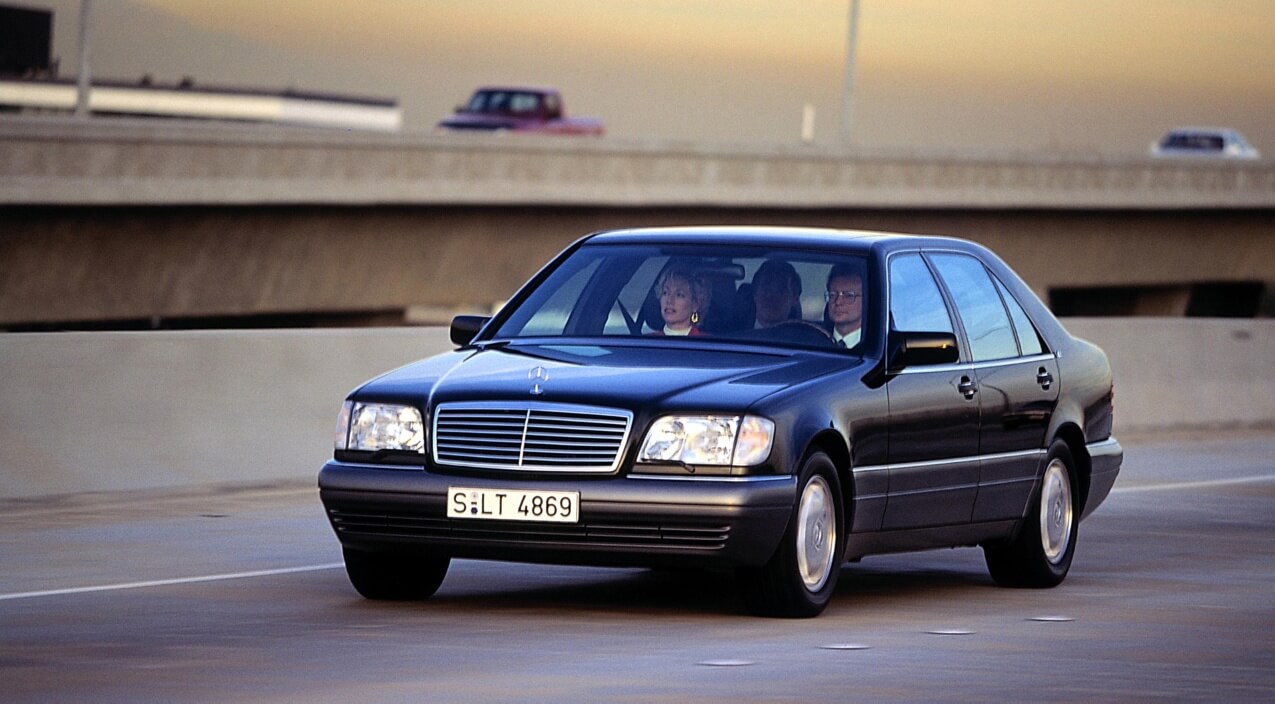
- S-Class W140 1991–1998 · Sedan, Coupe
- S-Class W220 1998–2005 · Sedan
- S-Class W221 2005–2013 · Sedan
- S-Class W222 2013–2020 · Sedan · 183–463 kW (249–630 PS)
- S-Class W223 Current 2020–now · Sedan
Newest first · 7 generations since 1972
-
2020
 W223 In production 2020–now · Sedan
-
2013

-
2005

-
1998

-
1991
-
1979

-
1972


All generations by year: S-Class W223 (2020–now) · S-Class W222 (2013–2020) · S-Class W221 (2005–2013) · S-Class W220 (1998–2005) · S-Class W140 (1991–1998) · S-Class W126 (1979–1991) · S-Class W116 (1972–1980)
Which one is mine?
Pick the year of first registration to see which generation it is.
Check by VINWhich S-Class to choose
Our verdict · Felix Hartmann
- Classic to keep: a late W126 or a W140 six-cylinder, simple enough for a specialist to maintain.
- Most car for the money: a well-documented W221 S 350 or S 500 with service records for the air suspension.
- Modern daily luxury: a facelifted W222 S 450 or S 400 d, with the nine-speed automatic and current assistance systems.
- Lowest running costs today: a W223 S 580 e, if you can charge it and drive most trips on electricity.
Avoid early W220s without proof of electrical and suspension repairs. To compare sizes before buying, the size comparison tool helps with garages and parking.
The Mercedes-Benz S-Class is the brand's flagship luxury saloon. The name became official in 1972 with the W116, and seven generations have followed, up to the W223 built since September 2020 and facelifted in January 2026. Mercedes-Benz built roughly 2.7 million S-Class cars in its first forty years, and many safety systems, from ABS to the airbag, reached buyers in this car first.
In short
- Generations: W116, W126, W140, W220, W221, W222 and W223, all built mainly at Sindelfingen in Germany.
- Power: from six-cylinder entry models to 590 kW (802 PS) in today's AMG S 63 E Performance plug-in hybrid.
- Bodies: saloons in two lengths throughout; two-door coupés ended with the C217 in 2020 and the cabriolet in 2021.

Size at a glance
| Dimensions | Mercedes-Benz S-Class W222 |
|---|---|
| Length | 5,296 mm208.5 in |
| Width | 1,899 mm74.8 in |
| Height | 1,496 mm58.9 in |
| Wheelbase | 3,165 mm124.6 in |
Specs by version
Engines
Dimensions and weight
Show all 4 versions
| Version | Wheelbase |
|---|---|
| W222 · 2013–2020 | |
| W222 · 183 kW (249 PS) Sedan | 3,165 mm124.6 in |
| W222 · 250 kW (340 PS) Sedan | 3,165 mm124.6 in |
| W222 · 270 kW (367 PS) Sedan | 3,165 mm124.6 in |
| W222 · 345 kW (469 PS) Sedan | 3,165 mm124.6 in |
Verified Manufacturer and type-approval data from our catalog · Sources and methodology
Mercedes-Benz S-Class generations at a glance
| Generation | Years | Built | Most powerful version | Notable first |
|---|---|---|---|---|
| W116 | 1972–1980 | 473,035 | 450 SEL 6.9 (6.8 l V8) | ABS as an option from 1978 |
| W126 | 1979–1991 | 892,096 (818,036 saloons, 74,060 coupés) | 560 SEL / SEC (5.6 l V8) | Driver airbag from December 1980 |
| W140 | 1991–1998 | 432,732 | 600 SEL, 300 kW (408 PS) | ESP in 1995 |
| W220 | 1998–2005 | about 485,000 | S 65 AMG, 450 kW (612 PS) | PRE-SAFE in 2002 |
| W221 | 2005–2013 | about 516,000 | S 65 AMG, 463 kW (630 PS) | Night View Assist |
| W222 | 2013–2020 | – | S 65 AMG, 463 kW (630 PS) | Magic Body Control |
| W223 | since 2020 | in production | AMG S 63 E Performance, 590 kW (802 PS) | Rear-seat airbags |
By our calculation, the W126 was the best-selling generation in the table, with more than twice the output of the W140 that replaced it.

Where the name comes from
"S" stands for Sonderklasse, German for "special class". Mercedes had used an S suffix on bigger saloons since the 170 S of 1949, and the line ran through the Ponton W180, the "Fintail" W111/W112 and the W108/W109, whose 300 SEL 6.3 borrowed the 6.3-litre V8 from the 600 limousine. Only in 1972 did the top Mercedes-Benz saloon get its own series name, and the W116 is counted as the first S-Class.

W116 (1972–1980): the first S-Class
The W116 set the pattern of a large, safe, technically ambitious saloon. The 450 SE was voted European Car of the Year for 1974. Its flagship, the 450 SEL 6.9, used a 6.8-litre V8, then the largest post-war Mercedes engine, with hydropneumatic self-levelling suspension. From 1978 the W116 could be ordered with ABS, developed with Bosch, and the 300 SD became the first series-production car with a turbodiesel engine.

W126 (1979–1991): the long-running favourite
The W126 stayed in production for twelve years and sold 818,036 saloons and 74,060 SEC coupés. Its engines ranged from straight-sixes and diesels to V8s of 3.8 to 5.6 litres. In December 1980 it became one of the first production cars with a driver's airbag, and a passenger airbag followed in 1988. Traction control was also added during its run. The SEC coupé arrived in 1981. Few luxury cars have stayed current for so long without looking dated.

W140 (1991–1998): the engineering peak
The third generation was larger, heavier and more expensive than the W126, and it introduced the brand's first passenger-car V12 with up to 300 kW. It also brought double glazing, ESP in 1995 and Brake Assist in 1996. In June 1993 the "SEL"-style names gave way to S 320, S 500 and S 600. The full story, engines and buying advice are on our Mercedes-Benz W140 page.

W220 (1998–2005): air suspension and radar cruise control
The W220 was presented in July 1998. It brought Airmatic air suspension, the COMAND system and Distronic radar cruise control and, from 2002, PRE-SAFE, which tightens the seat belts and closes the windows and sunroof when it senses an imminent crash. 4MATIC all-wheel drive appeared for the first time in an S-Class. The S 600 used a 5.5-litre V12 biturbo with 368 kW, and the S 65 AMG of 2003 a 6.0-litre V12 biturbo with 450 kW and about 1,000 Nm. About 485,000 were built, but early cars earned poor reliability ratings, a reputation that still affects their used value.

W221 (2005–2013): the technology flagship
Launched in autumn 2005, the W221 added Night View Assist with infrared cameras, Brake Assist Plus and a version of Distronic Plus that could bring the car to a full stop in traffic. The S 600 gave 380 kW, the later S 63 AMG 400 kW from a 5.5-litre biturbo V8 and the S 65 AMG 463 kW from its V12. Roughly 516,000 were built. A W221 is today the most affordable way into a modern S-Class, provided the air suspension and electronics have been looked after.

W222 (2013–2020): hybrids and Magic Body Control
The W222 was unveiled in May 2013. Its Magic Body Control used a stereo camera to read the road ahead and adjust the suspension before the wheels reached a bump. The S 400 Hybrid combined a 228 kW V6 with a 20 kW electric motor, and the S 500 Plug-in Hybrid paired a 245 kW V6 with an 80 kW motor and about 30 km of electric range. A long Pullman version (V222) and the Mercedes-Maybach S-Class sat above the regular saloon; the Mercedes-Maybach S600 page covers that branch.

The 2017 facelift brought new six-cylinder and V8 engines. The S 450 had a 270 kW turbo V6 and the S 560 a 345 kW biturbo V8 with 700 Nm, while the six-cylinder diesels gave 183 kW (249 PS) in the S 350 d and 250 kW (340 PS) in the S 400 d. A nine-speed automatic was fitted across the range. The C217 coupé (2014–2020) and A217 cabriolet (2015–2021) were the last two-door S-Class models; Mercedes has said no successors are planned.
W223 (since 2020): the current S-Class
The seventh generation was unveiled on 2 September 2020 and is built at Sindelfingen. It rides on the MRA platform, has a drag coefficient of 0.22 and offers rear-axle steering of up to 10 degrees, which cuts the turning circle from 13.1 m to 11.2 m. From the second half of 2021, German buyers could order Drive Pilot, a Level 3 system that lets the driver hand over control in heavy motorway traffic. Rear-seat airbags were a world first.

| W223 version | Engine | Power |
|---|---|---|
| S 350 d | 2.9 l straight-six diesel | 210 kW (286 PS) |
| S 400 d 4MATIC | 2.9 l straight-six diesel | 243 kW (330 PS) |
| S 450 4MATIC | 3.0 l straight-six petrol, 48 V | 270 kW (367 PS) |
| S 500 4MATIC | 3.0 l straight-six petrol, 48 V | 320 kW (435 PS) |
| S 580 4MATIC | 4.0 l V8 biturbo, 48 V | 370 kW (503 PS) |
| S 580 e | 3.0 l six plus 110 kW motor, plug-in | 375 kW (510 PS) system, up to 100 km electric |
| AMG S 63 E Performance | 4.0 l V8 plus electric motor | 590 kW (802 PS) system |
| Mercedes-Maybach S 680 | 6.0 l V12 biturbo | 450 kW (612 PS) |
The standard car is 5,179 mm long on a 3,106 mm wheelbase; the long version adds 110 mm to both. A facelift revealed on 29 January 2026 renewed more than 2,700 parts, about half the car. It brought a larger illuminated grille, a lit star on the bonnet, the MBUX Superscreen and a new MB.OS computer, with more power for every engine. Production started in March 2026.
Safety firsts by generation

| Year | System | Generation |
|---|---|---|
| 1978 | ABS anti-lock brakes (option) | W116 |
| 1980 | Driver airbag | W126 |
| 1995 | ESP stability control | W140 |
| 1996 | Brake Assist | W140 |
| 2002 | PRE-SAFE preventive occupant protection | W220 |
| 2005 | Night View Assist | W221 |
| 2013 | Magic Body Control | W222 |
| 2020 | Rear-seat airbags | W223 |
The S-Class and its rivals
The S-Class has always been measured against the BMW 7 Series and, since 1989, the Lexus LS. Our pages on the BMW 7 Series G11/G12 and the Lexus LS cover the closest rivals of recent S-Class generations. Other Mercedes-Benz models are listed in the Mercedes-Benz catalogue, and the car comparison tool puts any two of them head to head.
Mercedes-Benz S-Class evolution in numbers
Did you know?
- The Mercedes-Benz S-Class has been around for 54 years: 7 generations in our catalog since 1972.
- The longest-running generation is the S-Class W126 (1979–1991): 12 years.
Mercedes-Benz S-Class in our rankings
- No. 9 of 101 · Longest sedans (5,296 mm)
- No. 9 of 379 · Oldest car models still on sale (54 years)
- No. 11 of 1082 · Longest-running car nameplates (54 years · top 2%)
- No. 17 of 531 · Longest cars (5,296 mm · top 4%)
- No. 11 of 174 · Most powerful sedans (463 kW · top 7%)
- No. 27 of 411 · Cars with the most generations (7 generations · top 9%)
In production longer than 98% of ranked nameplates in the 1CARS catalog (No. 11 of 1082).
Mercedes-Benz S-Class photos 17


Mercedes-Benz S-Class videos 4

Mercedes-Benz S-Class video 1

Mercedes-Benz S-Class video 2

Mercedes-Benz S-Class video 3

Test drive
FAQ
How many generations of the S-Class are there?
There are seven: W116 (1972–1980), W126 (1979–1991), W140 (1991–1998), W220 (1998–2005), W221 (2005–2013), W222 (2013–2020) and the current W223 from 2020. Earlier big saloons such as the W108 and W111 are predecessors, not official S-Class models.
What does the S in S-Class mean?
It stands for Sonderklasse, German for "special class". Mercedes used an S suffix on its larger saloons from 1949, but the S-Class became a series name of its own in 1972 with the W116.
Which S-Class is the most reliable?
Specialists often point to the W126 and the six-cylinder W140 as the most durable, because they have fewer electronic systems. The early W220 had the weakest record, with poor reliability ratings in its first years.
What is the most powerful S-Class?
The current Mercedes-AMG S 63 E Performance, a plug-in hybrid with a 4.0-litre V8 and an electric motor, delivers 590 kW (802 PS). Before it, the V12 S 65 AMG models of the W221 and W222 led with 463 kW (630 PS).
Is there still an S-Class coupé?
No. The C217 coupé ended in 2020 and the A217 cabriolet in 2021, and Mercedes has said there will be no direct successors. The W223 is offered only as a saloon in standard and long wheelbase, plus the Mercedes-Maybach version.
Data sources
Data checked by an editor against the sources below.
- The text of this article (1cars archive)
- Wikipedia - Mercedes Benz S Class
- Wikipedia - Mercedes Benz W116
- Wikipedia - Mercedes Benz W126
- Wikipedia - Mercedes Benz W140
- Wikipedia - Mercedes Benz S Class (W220)


