
 Mercedes-Benz E-Class
All generations, specs and history
Updated Published Sources (7) Report an error
By Felix Hartmann, Automotive Technology & EV Contributor Reviewed by Oleksandr Hnatiuk

- Built
- 1984–present
- Generations
- 6 · W124 to W214
- Top power
- 450 kW (612 PS)
- New price
- from about €43,019 (2016)
Timeline
E-Class generations
Click a generation for its own page
- E-Class W124 1984–1995 · Sedan, Station wagon · 53–280 kW (72–381 PS)
- E-Class W210 1995–2002 · Sedan, Station wagon · 65–260 kW (88–354 PS)
- E-Class W211 2002–2009 · 90–378 kW (122–514 PS)
- E-Class W212 2009–2016 · Sedan, Station wagon · 100–430 kW (136–585 PS)
- E-Class W213 2016–2023 · 110–450 kW (150–612 PS)
- E-Class W214 Current 2023–now · Sedan, Station wagon
Newest first · 6 generations since 1984
-
2023

-
2016

-
2009

-
2002

-
1995

-
1984


All generations by year: E-Class W214 (2023–now) · E-Class W213 (2016–2023) · E-Class W212 (2009–2016) · E-Class W211 (2002–2009) · E-Class W210 (1995–2002) · E-Class W124 (1984–1995)
Which one is mine?
Pick the year of first registration to see which generation it is.
Check by VINWhich E-Class to choose
Our verdict · Felix Hartmann
- Classic: a W124 saloon or estate, robust and simple, with the most specialist support.
- Cheapest entry: a W210 only after a careful rust inspection.
- Used daily car: a W211 from the June 2006 facelift (no Sensotronic brakes) or a facelifted W212 E 220 or E 250 CDI.
- Recent and efficient: a W213 E 220 d or E 300 de, or a W214 E 300 e for mostly electric commuting.
Running costs differ widely between a four-cylinder diesel and a V8; the cost of ownership calculator helps compare them.
The Mercedes-Benz E-Class is the brand's executive car, placed between the C-Class and the S-Class. The name arrived in 1993 with a facelift of the W124, and six generations carry it: W124, W210, W211, W212, W213 and the W214 built since May 2023. Counting its post-war predecessors, Mercedes had sold more than 16 million E-Class cars by 2023.
In short
- Generations: W124 (1984–1997), W210 (1995–2003), W211 (2002–2009), W212 (2009–2016), W213 (2016–2023), W214 (since 2023).
- Volume: the W124 alone reached 2,721,817 cars, and the W210 another 1,653,437.
- Engines: from a 53 kW diesel in the W124 to the 450 kW plug-in hybrid AMG E 53 of the W214; saloon and estate are the core bodies.
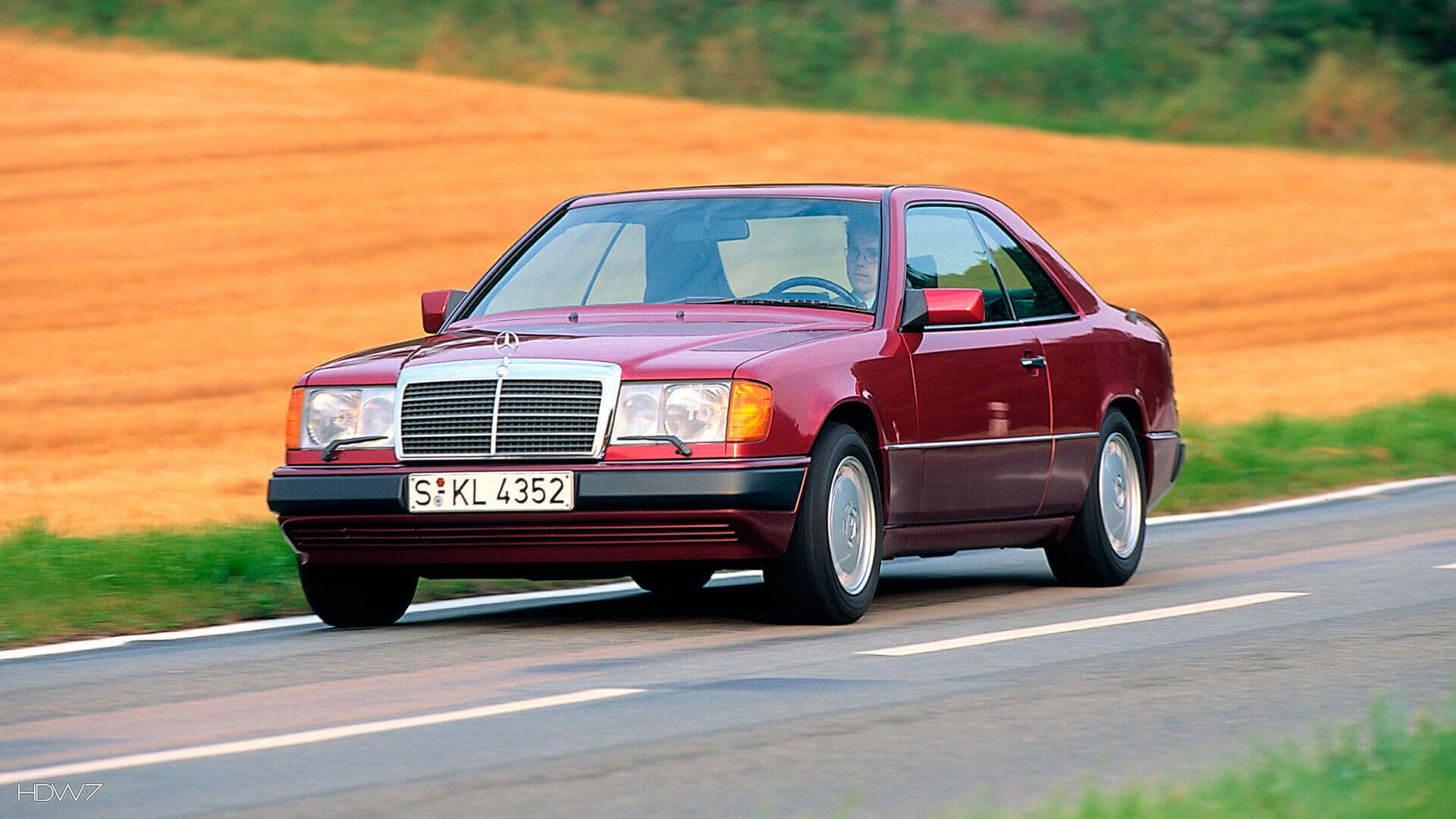
Size at a glance
GAZ-3102
The Mercedes-Benz E-Class W211 is 109 mm shorter and 23 mm lower than the GAZ-3102.
| Dimensions | Mercedes-Benz E-Class W211 | GAZ-3102 | Difference |
|---|---|---|---|
| Length | 4,851 mm191.0 in | 4,960 mm195.3 in | −109 mm−4.3 in |
| Width | 1,821 mm71.7 in | 1,820 mm71.7 in | +1 mm |
| Height | 1,453 mm57.2 in | 1,476 mm58.1 in | −23 mm−0.9 in |
| Wheelbase | 2,854 mm112.4 in | 2,800 mm110.2 in | +54 mm+2.1 in |
GAZ-3105
The Mercedes-Benz E-Class W211 is 199 mm shorter, 159 mm narrower and 23 mm taller than the GAZ-3105.
| Dimensions | Mercedes-Benz E-Class W211 | GAZ-3105 | Difference |
|---|---|---|---|
| Length | 4,851 mm191.0 in | 5,050 mm198.8 in | −199 mm−7.8 in |
| Width | 1,821 mm71.7 in | 1,980 mm78.0 in | −159 mm−6.3 in |
| Height | 1,453 mm57.2 in | 1,430 mm56.3 in | +23 mm+0.9 in |
| Wheelbase | 2,854 mm112.4 in | 2,870 mm113.0 in | −16 mm−0.6 in |
Specs by version
Engines
Dimensions and weight
Verified Manufacturer and type-approval data from our catalog · Sources and methodology
Safety
-
W213 · NHTSA 2022
US NCAP (NHTSA)
Full NHTSA rating
-
W212 · NHTSA 2015
US NCAP (NHTSA)
Full NHTSA rating
Stars from different years and organisations are not directly comparable: test protocols change every few years.
Mercedes-Benz E-Class generations at a glance

| Generation | Years | Bodies | Power range | Built |
|---|---|---|---|---|
| W124 | 1984–1997 | saloon, estate, coupé, cabriolet, six-door limousine | 53–280 kW | 2,721,817 |
| W210 | 1995–2003 | saloon, estate | 65–260 kW | 1,653,437 |
| W211 | 2002–2009 | saloon, estate | 90–378 kW | about 1.5 million |
| W212 | 2009–2016 | saloon, estate (coupé and cabriolet as C207/A207) | 100–430 kW | over 500,000 saloons by March 2012 |
| W213 | 2016–2023 | saloon, estate, All-Terrain, long saloon; coupé and cabriolet as C238/A238 | 110–450 kW | – |
| W214 | since 2023 | saloon, estate, All-Terrain, long saloon | to 450 kW (system) | in production |
The road to the E-Class name
Mercedes-Benz now traces the E-Class back to its mid-size post-war saloons. The W120 "Ponton" 180 of 1953 was the first modern mid-size Mercedes, followed by the W110 "Fintail", the W114/W115 "Stroke-8" of 1968 and the W123 of 1976, of which more than 2.6 million were built. Until 1993 a trailing "E" on a badge meant fuel injection (Einspritzung). With the W124 facelift of 1993 the letter moved to the front and came to stand for the class itself: the 300 E became the E 300.

W124 (1984–1997): the foundation
The W124 was presented in November 1984 and went into series production in January 1985. It used the multi-link rear axle first seen on the 190 and a plastic undertray. A single wiper on an eccentric arm reached the top corners of the screen, and the 200 and 200 D achieved a drag coefficient of 0.28. The estate followed in 1985, the coupé in 1987 and the cabriolet in 1992, and 4MATIC all-wheel drive was offered from 1987.

| W124 body | Production | Built |
|---|---|---|
| Saloon | January 1985 – August 1995 | 2,213,140 |
| Estate | October 1985 – February 1996 | 333,227 |
| Coupé | April 1987 – March 1996 | 141,498 |
| Cabriolet | March 1992 – July 1997 | 33,952 |
| Six-door limousine | May 1990 – July 1994 | 2,342 |
By our calculation, saloons made up 81% of all W124s. Engines ran from a 2.0-litre diesel with 53 kW (72 PS) to two V8s. The 500 E with 240 kW was assembled with Porsche at Zuffenhausen, and 10,479 were built from 1991 to 1993. The AMG E 60 topped the range with 280 kW (381 PS).
W210 (1995–2003): oval headlamps and a rust problem
The W210 replaced the W124 saloon in 1995 and introduced the four oval headlamps that defined the E-Class for two generations. It was 1.6 in (about 40 mm) longer and 2.3 in (about 58 mm) wider than before, with a drag coefficient of 0.27, and was Motor Trend's Import Car of the Year for 1996. The estate arrived in 1996 and 4MATIC, developed with Steyr-Daimler-Puch and built in Graz, in 1997. In June 1998 the E 200 CDI and E 220 CDI brought common-rail diesel injection to the E-Class.
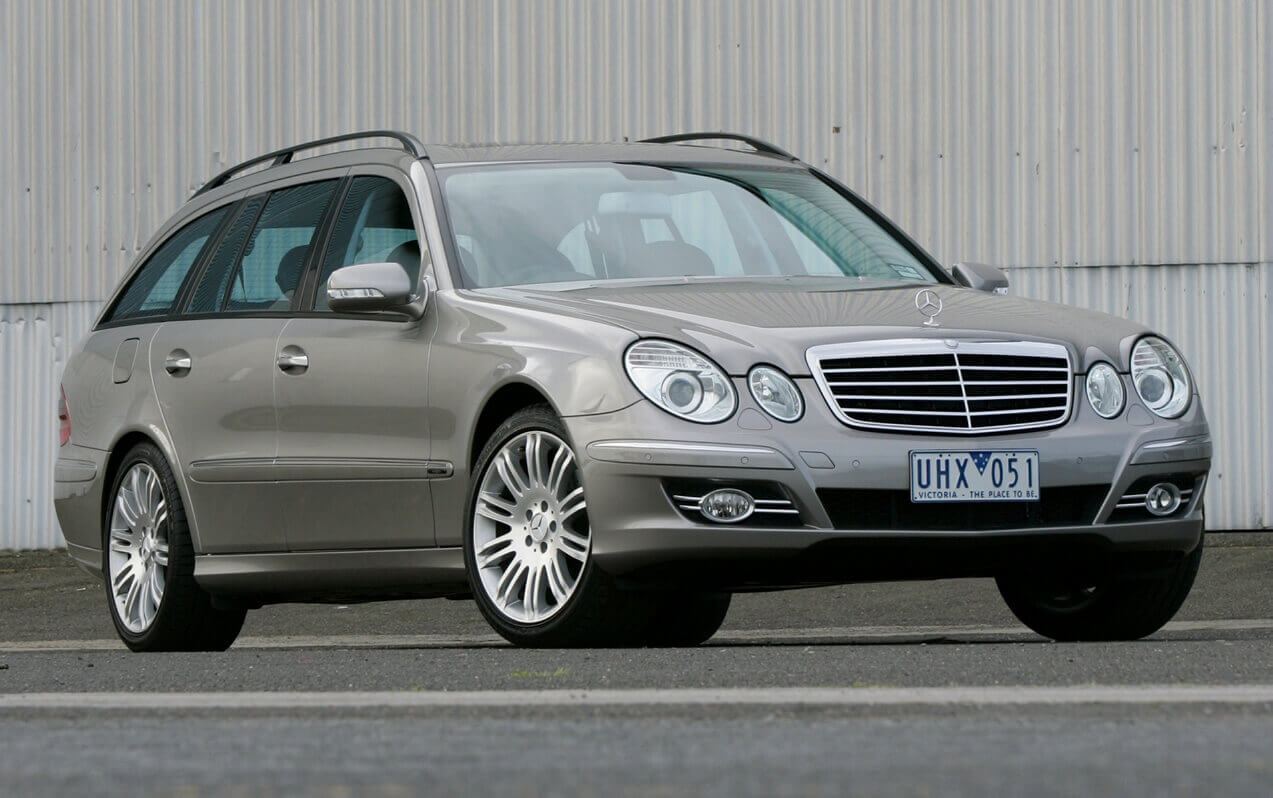
A facelift in August 1999 changed more than 1,800 parts. The weak point was corrosion: water-based paint introduced in 1993 and contaminated dip baths left door edges, spring towers and subframes vulnerable on all years. Mercedes paid goodwill repairs, generally up to the eighth year. Production ended at 1,374,409 saloons and 279,238 estates. The E 55 AMG with 260 kW (354 PS) was the fastest version.
W211 (2002–2009): electronics and the 2006 reset
The W211 saloon went on sale in 2002. Its Sensotronic Brake Control, a brake-by-wire system, was standard on early cars but drew complaints and was removed in the June 2006 facelift. That update also made PRE-SAFE standard and enlarged the E 500 engine from 5.0 to 5.5 litres.

Diesels started with the E 200 CDI at 90 kW (122 PS); the BlueTEC diesel arrived as the E 320 BlueTEC in the US in 2007 and the E 300 BlueTEC in Europe in 2008. The E 63 AMG of 2006 produced 378 kW (514 PS) from a 6.2-litre V8. By December 2008, Mercedes-Benz had made 1.5 million: 1.27 million saloons and 230,000 estates. By our calculation, saloons made up about 85% of the total, slightly more than in the W124's run.
W212 (2009–2016): one car, four bodies
The W212 saloon went on sale in Europe in March 2009 and the estate in November 2009. The coupé and cabriolet took different codes, C207 and A207, because they used the C-Class platform and were built in Bremen, where they replaced the CLK. The range spanned the E 200 CDI with 100 kW (136 PS) to the E 63 AMG S 4MATIC with 430 kW (585 PS) and 800 Nm. It also included the E 300 BlueTEC Hybrid, a diesel hybrid with 170 kW. Euro NCAP awarded five stars in 2010.

The 2013 facelift, which reportedly cost close to €1 billion, replaced the twin headlamps with a single unit and added a stereo camera for the assistance systems.
W213 (2016–2023): sixes and semi-automated driving
The W213 was unveiled at the Detroit show in January 2016. It brought back straight-six engines, introduced the OM654 four-cylinder diesel and offered the E 300 de, a diesel plug-in hybrid with 143 kW from the engine and 90 kW from the motor. The All-Terrain estate of 2016 rode 29 mm higher. Its assistance systems could steer, brake and keep distance on motorways at up to 210 km/h, with the driver's hands on the wheel. The 2020 facelift added MBUX, the M256 straight-six with EQ Boost in the E 450, and new four-cylinder petrol engines. The range peaked with the AMG E 63 S at 450 kW (612 PS), and the W213 was Motor Trend's 2021 Car of the Year.

W214 (since 2023): the current E-Class
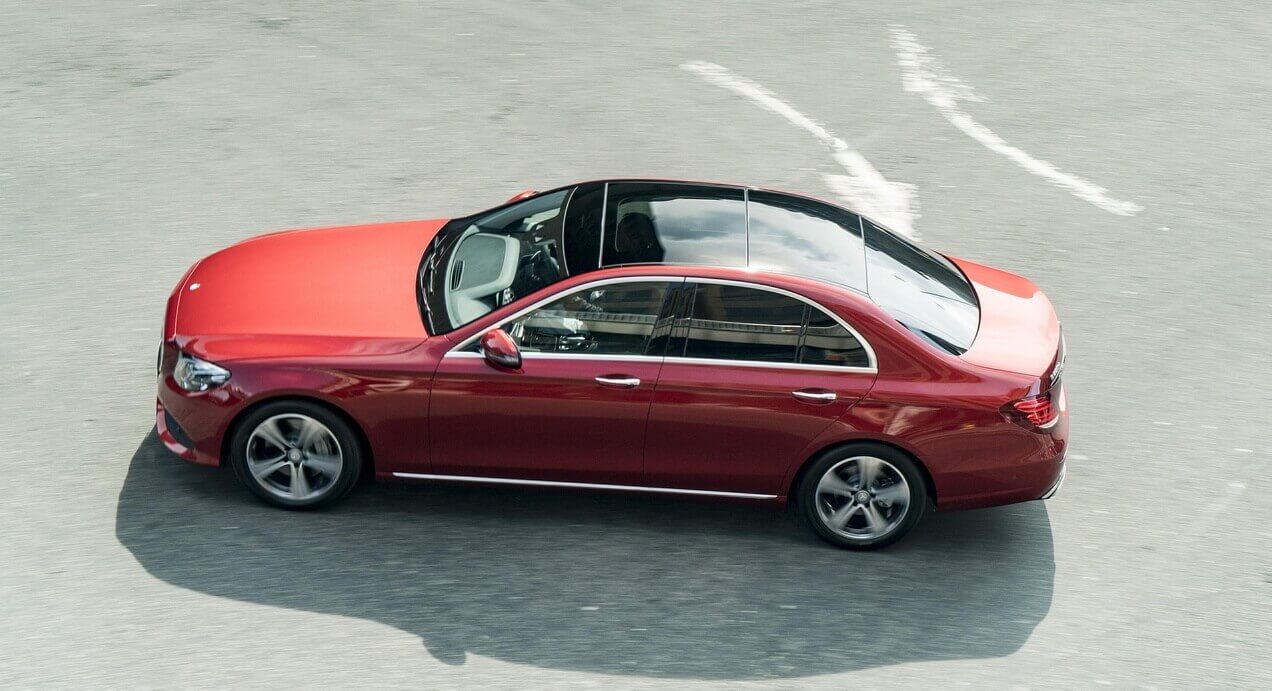
The sixth generation debuted on 25 April 2023, and production began at Sindelfingen on 2 May 2023. It is the first non-EQ Mercedes with the MBUX Superscreen: two 12.3-inch displays and a 17.7-inch central screen. Coupés and cabriolets moved to the new CLE.

| W214 version | Engine | Power | Electric range |
|---|---|---|---|
| E 200 | 2.0 l four, mild hybrid | 152 kW (207 PS) | – |
| E 220 d | 2.0 l diesel four, mild hybrid | 147 kW (200 PS) | – |
| E 300 e | 2.0 l four, plug-in hybrid | 233 kW (317 PS) system | 96–115 km |
| E 400 e | 2.0 l four, plug-in hybrid | 284 kW (386 PS) system | 97–109 km |
| E 450 | 3.0 l straight-six, mild hybrid | 284 kW (386 PS) | – |
| AMG E 53 Hybrid 4MATIC+ | 3.0 l six, plug-in hybrid | 450 kW (612 PS) system | – |
The saloon is 4,949 mm long on a 2,961 mm wheelbase with a drag coefficient of 0.23. By our calculation, the most powerful W214 has about 61% more power than the strongest W124, the E 60 AMG (450 against 280 kW). In the 2024 Euro NCAP test it scored 92% for adult occupants, 90% for children, 84% for pedestrians and 87% for safety assistance.
E-Class against its rivals
The E-Class competes mainly with the BMW 5 Series and the Audi A6. Our guides to the BMW 5 Series generations and the Audi A6 from C4 to C9 cover both. Inside Mercedes, the C-Class is the smaller saloon, the S-Class the larger one, and the Mercedes-Benz catalogue lists the rest. Any two of these cars can be set side by side with the car comparison tool.

Mercedes-Benz E-Class evolution in numbers
Did you know?
- The Mercedes-Benz E-Class has been around for 42 years: 6 generations in our catalog since 1984.
- The longest-running generation is the E-Class W124 (1984–1995): 11 years.
- The biggest jump in power came with the E-Class W211: up to 378 kW (514 PS), 118 kW more than the E-Class W210.
Most powerful version, kW
Figures from the 1cars catalog: power is the strongest version of each generation; generations without the figure are left out.
Rivals
-
Ended 2009
- Years
- 1982–2009
- Body
- Sedan
- Fuel
- Petrol
- Power
- 77–96 kW (105–131 PS)
5 generations
- GAZ-3102
- GAZ-3102
- GAZ-3102
- GAZ-3102
- GAZ-3102


Mercedes-Benz E-Class in our rankings
- No. 39 of 1144 · Longest-running car nameplates (39 years · top 4%)
- No. 146 of 1081 · Most powerful cars (450 kW · top 14%)
- No. 23 of 161 · Most powerful German cars (450 kW · top 15%)
- No. 32 of 206 · Most powerful cars of the 2000s (378 kW · top 16%)
- No. 108 of 709 · Biggest engines: cars (6,200 cc · top 16%)
- No. 116 of 562 · Longest cars (4,851 mm · top 21%)
In production longer than 96% of ranked nameplates in the 1CARS catalog (No. 39 of 1144).
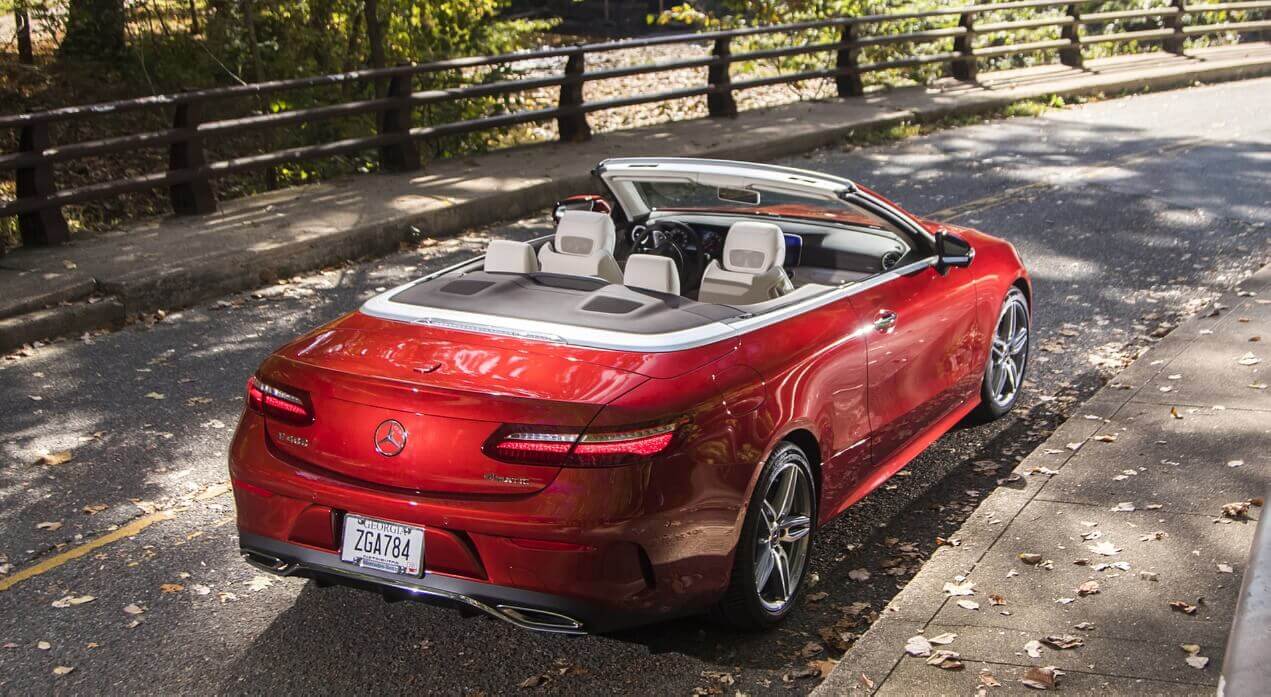
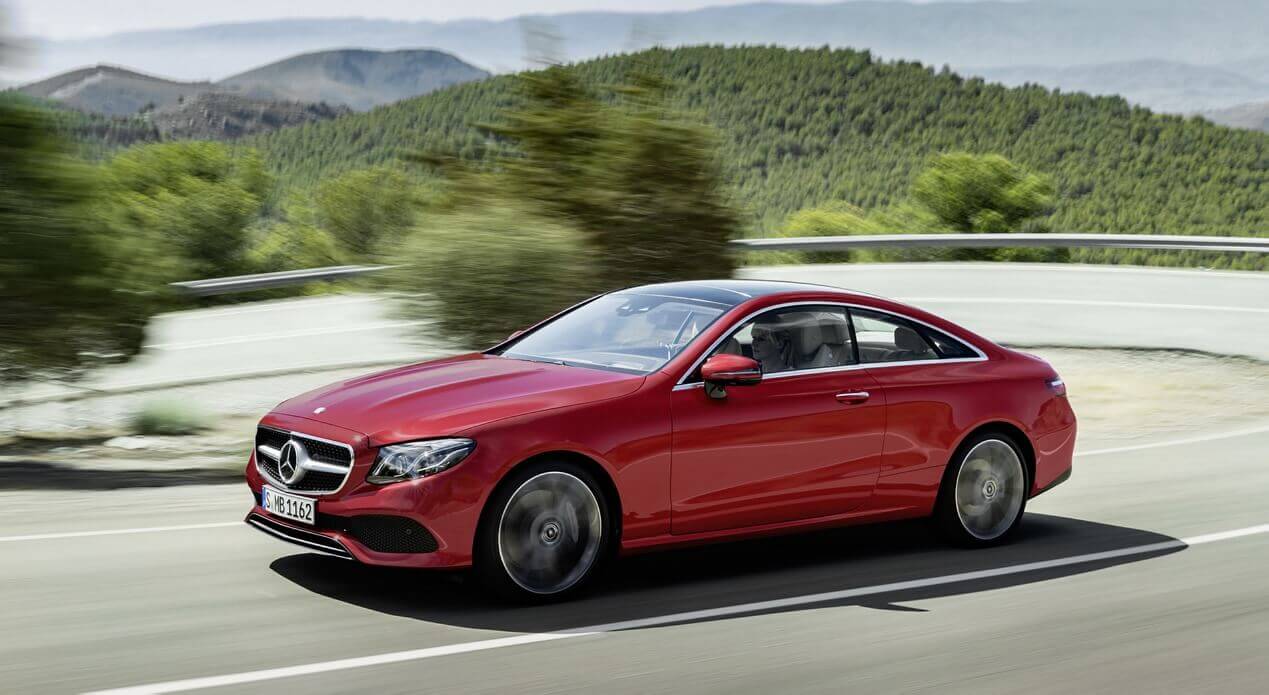
Mercedes-Benz E-Class photos 26




Mercedes-Benz E-Class videos 3

Mercedes-Benz E-Class video 1

Crash test

Test drive
FAQ
When did the E-Class name start?
The name was introduced in 1993, when the W124 received its facelift and Mercedes changed its naming system. Earlier cars such as the 300 E carried an "E" for fuel injection; afterwards the letter marked the class, as in E 300.
How many generations of the E-Class are there?
Six carry the name: W124, W210, W211, W212, W213 and W214. Mercedes also counts the Ponton, Fintail, W114/W115 and W123 saloons as predecessors, which is why it quotes more than 16 million E-Class sales by 2023.
Which E-Class generation is the most reliable?
The W124 is usually regarded as the most durable. The W210 suffered from corrosion, and early W211s had problems with the Sensotronic brake system, which was removed in 2006. Later W212 and W213 cars are generally solid when serviced on time.
Is there an E-Class coupé or convertible today?
No. The W213-based C238 coupé and A238 cabriolet were the last two-door E-Class models. Since 2023 Mercedes sells two-door cars of this size as the CLE, which sits between the C-Class and the E-Class.
Does the E-Class come as a plug-in hybrid?
Yes. The W214 is offered as the E 300 e and E 400 e, with about 100 km of electric range, and as the AMG E 53 Hybrid with 450 kW. The W213 also had diesel and petrol plug-in versions.
Data sources
Data checked by an editor against the sources below.
- The text of this article (1cars archive)
- Wikipedia - Mercedes Benz E Class
- Wikipedia - Mercedes Benz W124
- Wikipedia - Mercedes Benz W210
- Wikipedia - Mercedes Benz E Class (W211)
- Theautochannel
- NHTSA 5-Star Safety Ratings (US NCAP) — U.S. Government work, public domain


