 Mercedes-Benz 450 SEL
Specs, engines and history
Published Sources (1) Report an error
By Felix Hartmann, Automotive Technology & EV Contributor
- Built
- 1973–1980
- Top power
- 210 kW (286 PS)
Which 450 SEL to choose
Our verdict · Felix Hartmann
- For a usable classic: a regular 450 SEL from 1978–80, with 165 kW and the option of ABS.
- For the most performance: the 450 SEL 6.9; only 7,380 were built.
- For simpler maintenance: the 4.5 V8, a wet-sump engine that holds 5 litres of oil against 12 litres in the dry-sump 6.9.
- What came next: the W126 and later the W140 carried the idea of the long V8 S-Class forward. Mercedes-Benz as a company is the subject of our history of Mercedes-Benz, more cars of the decade are in our 1970s classics, and both versions are listed in the Mercedes-Benz catalogue.
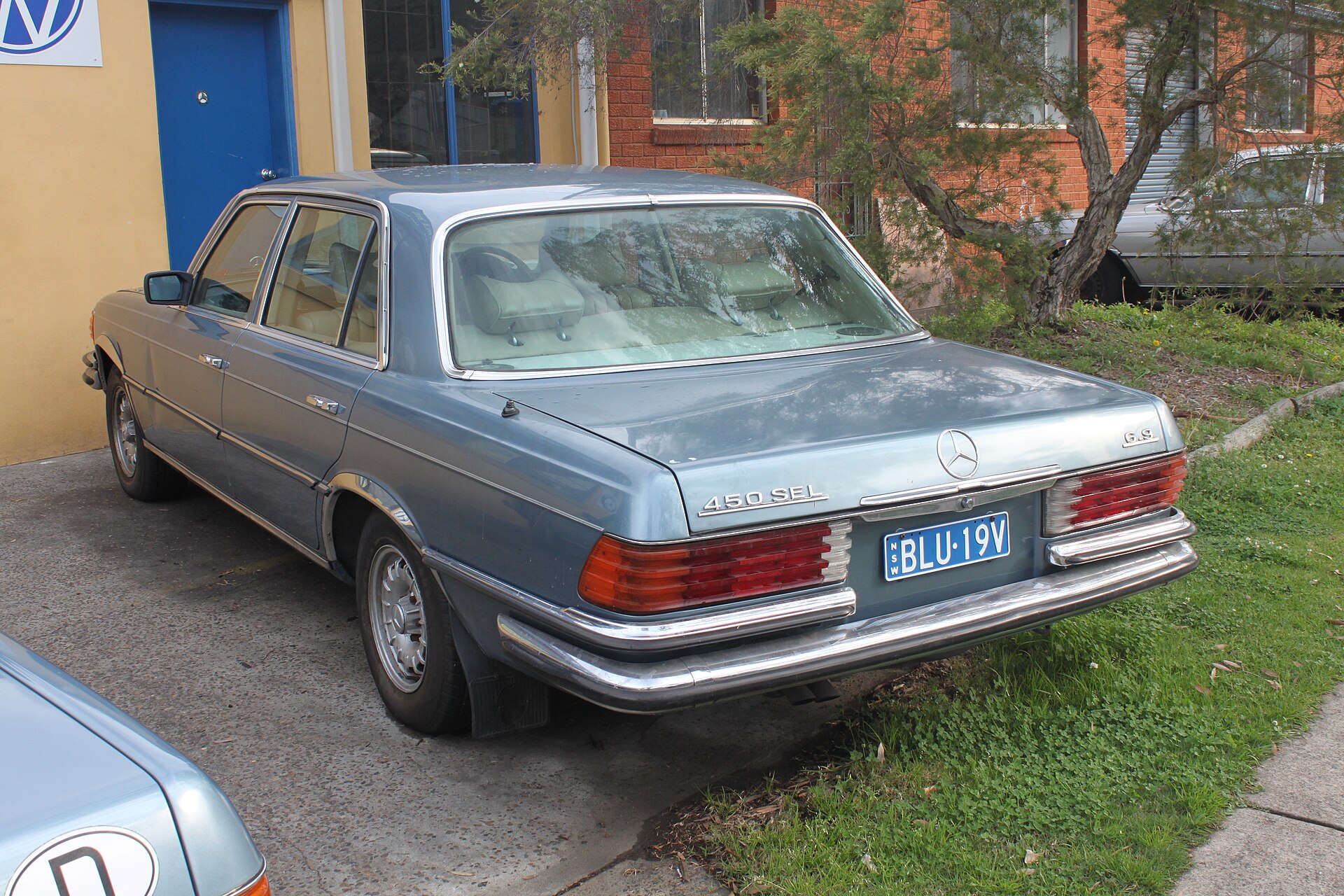
The Mercedes-Benz 450 SEL was the long-wheelbase V8 flagship of the W116, the first car Mercedes officially called the S-Class. It went on sale in 1973 with a 4.5-litre V8, and from 1975 a 6.9-litre version, the 450 SEL 6.9, sat above it with 210 kW and self-levelling hydropneumatic suspension. Both were built until 1980, when the W126 took over.
In short
- 450 SEL: 1973–1980, 59,578 built, 4.5-litre M117 V8 with 160–165 kW, wheelbase 100 mm longer than the 450 SE.
- 450 SEL 6.9: 1975–1980, 7,380 built, 6,834 cc M100 V8 with 210 kW (286 PS) and 550 Nm.
- The 6.9 was the first Mercedes with hydropneumatic suspension on all four wheels; from 1978 the W116 offered Bosch's electronic ABS.
- The 450 SE/SEL was voted European Car of the Year 1974.
Specs by version
Engines
| Version | Engine | Power | Torque | Production years |
|---|---|---|---|---|
| 450 SEL | 4.5 l · 8 cyl · Petrol M117 | 165 kW 224 PS221 hp | 368 Nm271 lb-ft | 1973–1980 |
| 450 SEL 6.9 | 6.8 l · 8 cyl · Petrol M100 | 210 kW 286 PS282 hp | 549 Nm405 lb-ft | 1975–1980 |
Performance
Show all 2 versions
| Version | 0–100 km/h | Top speed |
|---|---|---|
| 450 SEL | 8.9 s 0–62 mph | 210 km/h130 mph |
| 450 SEL 6.9 | 7.4 s 0–62 mph | 225 km/h140 mph |
Dimensions and weight
Show all 2 versions
| Version | Length | Width | Wheelbase |
|---|---|---|---|
| 450 SEL | 5,060 mm199.2 in | 1,870 mm73.6 in | 2,965 mm116.7 in |
| 450 SEL 6.9 | 5,060 mm199.2 in | 1,870 mm73.6 in | 2,965 mm116.7 in |
Verified Manufacturer and type-approval data from our catalog · Sources and methodology
Mercedes-Benz 450 SEL at a glance
| Parameter | 450 SEL | 450 SEL 6.9 |
|---|---|---|
| Production | 1973–1980 | 1975–1980 |
| Built | 59,578 | 7,380 |
| Engine | M117 V8, 4,520 cc | M100 V8, 6,834 cc, dry sump |
| Power | 165 kW (225 PS); 160 kW (217 PS) in 1975–76 | 210 kW (286 PS) at 4,250 rpm |
| Torque | 360–378 Nm | 550 Nm at 3,000 rpm |
| Gearbox | - | 3-speed automatic |
| Wheelbase | 2,960 mm | 2,960 mm |
| Suspension | hydropneumatic self-levelling at the rear | hydropneumatic on all four wheels |
| Top speed | - | 225 km/h (factory) |
| Predecessor / successor | - / W126 (1979) | 300 SEL 6.3 / W126 (1979) |
W116 timeline
| Date | Event |
|---|---|
| December 1969 | Friedrich Geiger's design for the W116 is finalised |
| September 1972 | W116 production begins |
| February–March 1973 | 450 SE and long-wheelbase 450 SEL launched |
| 1974 | the 450 SE/SEL is voted European Car of the Year |
| 1975 | 450 SEL 6.9 enters production; the 4.5 V8 switches to K-Jetronic injection |
| 1977 | 6.9 sales begin in North America |
| 1978 | Bosch four-wheel ABS offered as an option |
| September 1979 | the W126 successor is presented |
| September 1980 | the last W116 leaves the line |
The W116: the first S-Class
Production of the W116 began in September 1972, and it was the first Mercedes officially named S-Class, after earlier saloons had been called "S" for Sonderklasse only informally. Friedrich Geiger, who finalised the design in December 1969, made it his last Mercedes. Safety shaped much of the car. It had crumple zones front and rear, a strengthened passenger cell with reinforced pillars, a padded dashboard and a steering wheel with an impact absorber. The fuel tank moved from the rear end to a place above the rear axle.
In total Mercedes built 473,035 W116s. The six-cylinder 280 S and 280 SE were the volume models with 122,848 and 150,593 cars. The long-wheelbase 450 SEL was the best-selling V8 version, with 59,578 built against 41,604 of the short 450 SE. The range also included a 300 SD diesel, of which 28,634 were made. Our guide to the whole Mercedes-Benz S-Class follows the line from here to the present.

The 450 SEL (1973–1980): the long V8 saloon
The 450 SEL and 450 SE were launched together in spring 1973. The SEL's wheelbase measured 2,960 mm, 100 mm more than the SE's 2,860 mm. All of the extra length went into the rear doors and rear legroom.
The engine was the M117 V8 with 4,520 cc. In its first European form it produced 165 kW (225 PS) at 5,000 rpm and 378 Nm at 3,000 rpm. Emissions rules then cost some power: from 1975 the V8 used Bosch K-Jetronic injection and delivered 160 kW (217 PS) and 360 Nm. For 1978–79 it was back at 165 kW with 368 Nm. North American cars were rated at 142 kW (190 hp) at launch and 121 kW (162 hp) in later years.
The W116 was voted European Car of the Year 1974, an award credited to the 450 SE. From 1978 buyers could order four-wheel anti-lock brakes from Bosch. The W116 thus became the first production car with this electronic multi-channel ABS.
The 450 SEL 6.9 (1975–1980): the largest V8
The 6.9 succeeded the 300 SEL 6.3 of 1968–1972 as the big-engined version of the long saloon and took over its badge style. Its M100 V8 grew from 6.3 to 6,834 cc with a 107.0 mm bore and 95.0 mm stroke. It used Bosch K-Jetronic injection and dry-sump lubrication with 12 litres of oil. Each engine was hand-built and run on a test bench for 265 minutes, 40 of them at full load. Wikipedia describes it as the largest V8 Mercedes has built and the largest from any European maker after the Second World War.
The European engine produced 210 kW (286 PS) at 4,250 rpm and 550 Nm at 3,000 rpm. More striking was the spread of torque: at least 490 Nm was available from 1,000 to 4,200 rpm. A three-speed automatic transmitted the power, and the red line sat at 5,300 rpm. To restate these outputs in PS or hp, use our power converter. US cars, with lower compression and a catalytic converter, had 186 kW (250 hp) and 488 Nm.
The 6.9 also introduced hydropneumatic suspension on all four wheels to Mercedes. Other W116s used it only at the rear for self-levelling. The system stayed exclusive to the 6.9 until 1981, when the W126 380 SEL and 500 SEL offered it. Unlike Citroën, Mercedes drove the hydraulic pump with a timing chain. In the United States the ride-height adjustment was disabled to meet bumper rules.
Standard equipment included automatic climate control, central locking, power windows, rear headrests and headlamp washers, all optional on other W116s. Inside, burled walnut replaced the zebrano wood of the smaller models.


Performance and test figures
| Source | 0–100 km/h | Top speed |
|---|---|---|
| Factory figure (Werner Oswald) | - | 225 km/h |
| auto motor und sport, 1975 | - | 234 km/h |
| Automobil Revue, 1976 | 7.8 s | 237 km/h |
| Wikipedia EN | 7.4 s | 225 km/h |
Automobil Revue also measured 33.7 seconds from 0 to 200 km/h. Car and Driver titled its 1977 road test "Fastest European Sedan". Braking from 110 km/h to standstill took 63 metres. The price of that pace was fuel: the US EPA rated the car at 16.0 l/100 km combined. The car weighed 1,935 to 1,985 kg, depending on the source.
Production and prices
| Year | 450 SEL 6.9 built |
|---|---|
| 1975 | 474 |
| 1976 | 1,475 |
| 1977 | 1,798 |
| 1978 | 1,665 |
| 1979 | 1,839 |
| 1980 | 129 |
Mercedes at first did not plan to sell the 6.9 in the United States, but demand from customers and dealers changed that. North America took 1,816 cars from 1977 to 1981.
In Germany the 6.9 cost DM 69,930 when it went on sale in 1975, about €35,800 at the fixed conversion rate. Wikipedia EN puts that price at about €96,500 in January 2026 money. By 1980 the list price had risen to DM 81,247. In the United States the car cost $38,230 for model year 1977 and $52,995 for model year 1980.
In films and music
The 6.9 appears in Claude Lelouch's short film C'était un rendez-vous (1976), in Ronin and in David Lynch's Lost Highway. George Harrison mentioned it in his 1976 song "It's What You Value"; according to Wikipedia he paid drummer Jim Keltner partly with a 450 SEL 6.9.
Photo gallery

Mercedes-Benz 450 SEL in our rankings
- No. 2 of 16 · Fastest cars of the 1970s (225 km/h)
- No. 7 of 131 · Biggest engines: sedans (6,834 cc)
- No. 32 of 420 · Longest cars (5,060 mm · top 8%)
- No. 46 of 557 · Biggest engines: cars (6,834 cc · top 9%)
- No. 16 of 86 · Longest sedans (5,060 mm · top 19%)
- No. 18 of 68 · Most torque: sedans (549 Nm · top 27%)
Bigger engine than 94% of ranked sedans in the 1CARS catalog (No. 7 of 131).
FAQ
What does SEL stand for on the Mercedes 450 SEL?
S for Sonderklasse (S-Class), E for Einspritzung (fuel injection) and L for lang (long wheelbase); the 450 SEL is 100 mm longer between the axles than the 450 SE.
How many Mercedes 450 SEL 6.9 were made?
7,380 between 1975 and 1980; 1,816 of them were sold in North America.
How fast is the 450 SEL 6.9?
The factory figure was 225 km/h; magazines measured 234 km/h (auto motor und sport) and 237 km/h (Automobil Revue).
What engine is in the 450 SEL?
The regular car has the 4.5-litre M117 V8 with 160–165 kW; the 6.9 has the 6,834 cc M100 V8 with 210 kW and 550 Nm.
Was the W116 the first car with ABS?
Yes: from 1978 it was the first series car available with the Bosch electronic multi-channel four-wheel ABS, as an option.
Data sources
Data checked by an editor against the sources below.