
 Mercedes-Benz W140
Specs, engines and history
Updated Published Sources (3) Report an error
By Felix Hartmann, Automotive Technology & EV Contributor Reviewed by Oleksandr Hnatiuk

- Built
- 1991–1998
- Top power
- 300 kW (408 PS)
Verdict: who the W140 suits
Our verdict · Felix Hartmann
The W140 suits a buyer who values engineering depth and quiet over economy. A well-kept straight-six car is the sensible entry; the V12 saloons and coupés are the collectible end. Anyone who needs a cheap daily car should look elsewhere, because a neglected W140 can cost more to put right than it costs to buy.
The Mercedes-Benz W140 is the third generation of the S-Class, the large luxury saloon unveiled at the Geneva motor show in March 1991 and built until September 1998. It brought Mercedes' first passenger-car V12, double glazing and, later, ESP. Mercedes-Benz made 432,732 of them: 406,710 saloons and 26,022 coupés, before the W220 took over.
In short
- Engines: straight-six petrol and diesel units, V8s of 4.2 and 5.0 litres and a 6.0-litre V12, from 110 to 300 kW (150–408 PS).
- Bodies: short and long saloon, the C140 coupé (from 1996 the CL) and a Pullman with a 4,140 mm wheelbase.
- Firsts: double glazing in an S-Class, ESP in 1995, Brake Assist in 1996 and the brand's first satellite navigation.

Size at a glance
| Dimensions | Mercedes-Benz W140 |
|---|---|
| Length | 5,113 mm201.3 in |
| Width | 1,886 mm74.3 in |
| Height | 1,486 mm58.5 in |
| Wheelbase | 3,040 mm119.7 in |
| Boot | 525 L18.5 cu ft |
Specs by version
Engines
| Version | Engine | Power | Torque | Drive |
|---|---|---|---|---|
| 300 SE 2.8 / S 280 | 2.8 l · 6 cyl · Petrol 2,799 cc | 142 kW 193 PS190 hp | 270 Nm199 lb-ft | Rear-wheel drive |
| 300 SE / S 320 | 3.2 l · 6 cyl · Petrol 3,199 cc | 170 kW 231 PS228 hp | 310 Nm229 lb-ft | Rear-wheel drive |
| S 600 (394 PS, 1993–1998) | 6.0 l · 12 cyl · Petrol 5,987 cc | 290 kW 394 PS389 hp | 570 Nm420 lb-ft | Rear-wheel drive |
| 600 SE / 600 SEL (408 PS, 1991–1993) | 6.0 l · 12 cyl · Petrol 5,987 cc | 300 kW 408 PS402 hp | 580 Nm428 lb-ft | Rear-wheel drive |
Performance
Show all 1 versions
| Version | Top speed |
|---|---|
| 600 SE / 600 SEL (408 PS, 1991–1993) | 250 km/h155 mph |
Dimensions and weight
Show all 4 versions
| Version | Length | Width | Height | Wheelbase | Kerb weight | Boot |
|---|---|---|---|---|---|---|
| 300 SE 2.8 / S 280 | 5,113 mm201.3 in | 1,886 mm74.3 in | 1,486 mm58.5 in | 3,040 mm119.7 in | 1,880 kg4,145 lb | 525 l18.5 cu ft |
| 300 SE / S 320 | 5,113 mm201.3 in | 1,886 mm74.3 in | 1,486 mm58.5 in | 3,040 mm119.7 in | 1,890 kg4,167 lb | 525 l18.5 cu ft |
| S 600 (394 PS, 1993–1998) | 5,113 mm201.3 in | 1,886 mm74.3 in | 1,486 mm58.5 in | 3,040 mm119.7 in | - | 525 l18.5 cu ft |
| 600 SE / 600 SEL (408 PS, 1991–1993) | 5,113 mm201.3 in | 1,886 mm74.3 in | 1,486 mm58.5 in | 3,040 mm119.7 in | 2,180 kg4,806 lb | 525 l18.5 cu ft |
Verified Manufacturer and type-approval data from our catalog · Sources and methodology
Mercedes-Benz W140 at a glance

| Item | Detail |
|---|---|
| Series | Third S-Class generation (W140 short, V140 long, C140 coupé, VV140 Pullman) |
| Production | Saloon April 1991 – September 1998; coupé October 1992 – September 1998 |
| Total built | 432,732 (406,710 saloons, 26,022 coupés) |
| Plants | Stuttgart area, Germany; assembly also in Toluca, Mexico |
| Layout | Front engine, rear-wheel drive; no 4MATIC was offered |
| Power | 110–300 kW (150–408 PS) |
| Predecessor / successor | W126 / W220 (saloon) and C215 CL (coupé) |
How the W140 was developed
Work on the car began in 1981. Design proposals were compared from 1982 to 1986, and on 9 December 1986 the board chose a shape drawn by Olivier Boulay under design director Bruno Sacco. Engineering prototypes ran from early 1987 and the exterior was frozen in September 1987. Sacco named the Jaguar XJ40 and the BMW E32 7 Series as the cars he watched most closely.

The BMW mattered for another reason. When BMW revealed the V12-engined 750i in 1986, Mercedes decided its flagship also needed twelve cylinders, and the launch slipped by about 18 months, from September 1989 to 1991. Pilot production ran from June 1990 to January 1991. The overruns cost chief engineer Wolfgang Peter his job, and the finished car reached showrooms in April 1991, with North American sales from 6 August 1991.
Engines and gearboxes
The engine line-up mixed new four-valve petrol units with variable valve timing and one carried-over diesel. Every petrol engine had a catalytic converter from the start.

| Model (1991–93 / from June 1993) | Engine | Capacity | Power | Torque |
|---|---|---|---|---|
| 300 SE 2.8 / S 280 | M104 straight-six | 2,799 cc | 142 kW (193 PS) | 270 Nm |
| 300 SE, 300 SEL / S 320 | M104 straight-six | 3,199 cc | 170 kW (231 PS) | 310–315 Nm |
| 400 SE, 400 SEL / S 420 | M119 V8 | 4,196 cc | 205–210 kW (279–286 PS) | 400–410 Nm |
| 500 SE, 500 SEL / S 500 | M119 V8 | 4,973 cc | 235–240 kW (320–326 PS) | 470–480 Nm |
| 600 SE, 600 SEL / S 600 | M120 V12 | 5,987 cc | 290–300 kW (394–408 PS) | 570–580 Nm |
| 300 SD / S 350 Turbodiesel | OM603 straight-six | 3,449 cc | 110 kW (150 PS) | 310 Nm |
| S 300 Turbodiesel (1996–98) | OM606 straight-six | 2,996 cc | 130 kW (177 PS) | 330 Nm |
The V12 was the first twelve-cylinder engine in a Mercedes passenger car. In Europe it gave 300 kW until 1992; from 1993 it was retuned to 290 kW. By our calculation, a long-wheelbase 600 SEL at up to 2,190 kg carried about 7.3 kg per kW, while an S 280 at 1,890 kg had about 13.3 kg per kW. The 1996 OM606 was the first Mercedes diesel six with four valves per cylinder. AMG also offered an S 500 6.0 with 279 kW, mainly for Japan.
The six-cylinder petrol cars came with a five-speed manual as standard, and a four-speed or, from 1994, five-speed automatic as an option. The V8 and V12 used a four-speed automatic until August 1995 and an electronically controlled five-speed from September 1995. From June 1996 the five-speed automatic was the only gearbox, which makes the W140 the last S-Class sold with a manual. Diesels were automatic only.
Saloon, coupé and Pullman sizes
| Body | Wheelbase | Length | Width | Height | Kerb weight |
|---|---|---|---|---|---|
| Short saloon (W140) | 3,040 mm | 5,113 mm | 1,886 mm | 1,486 mm | 1,890–2,180 kg |
| Long saloon (V140) | 3,140 mm | 5,213 mm | 1,886 mm | – | 1,900–2,190 kg |
| Coupé (C140) | 2,945 mm | 5,065 mm | 1,895 mm | 1,427 mm | 2,060–2,240 kg |
| Pullman (VV140, from 1995) | 4,140 mm | 6,228 mm | – | – | – |
The long saloon adds 100 mm, all of it for rear legroom. The Pullman of 1995 came as S 500 or S 600, and the S 600 Pullman could be ordered with armour. The old 1cars page quoted a 525-litre boot and a drag coefficient of 0.31; we have not found these in a second source.

Technology the W140 introduced
The car arrived on the threshold of networked electronics: it was the first Mercedes to use a CAN bus, with five control units linked. Many features that later became normal appeared here first or early.

| Year | Feature |
|---|---|
| 1991 | Double-glazed side windows; soft-closing doors and boot lid; Adaptive Damping System (standard on V12) |
| 1991 | Rear guide rods that rose when reverse was selected, to judge the car's length |
| 1995 | ESP stability control and GPS navigation, both first on the S 600 Coupé |
| 1995 | Parking sensors ultrasonic sensors replace the guide rods |
| 1996 | Brake Assist; door-mounted side airbags; rain sensor; Linguatronic voice control; self-levelling with ADS |
| 1997 | TELEAID emergency call (US market) |
The double glazing kept the cabin quiet but made each door glass heavy. Long-wheelbase cars had four-zone climate control, and orthopaedic seats with inflatable cushions were an option.
Names, facelifts and the CL split
The first cars used the old badges, such as 300 SE or 500 SEL. In June 1993 Mercedes switched to the new naming system: the 500 SEL became the S 500 and the 600 SEL the S 600, with the letter placed first. A facelift shown at Geneva in March 1994 went on sale the following month. A second round of changes, introduced in Europe in June 1996, brought single-colour paint, xenon low beam and clear rear indicator lenses. The coupé, sold first as 500 SEC and 600 SEC, became the S-Class Coupé in 1993 and a separate CL-Class in 1996.

A few one-offs show how far the platform was stretched. In 1997 Mercedes built an S 500 long landaulet for Pope John Paul II, and AMG built estate versions with a 7.3-litre V12 for the Sultan of Brunei.
Price and reception
The W140 was bigger, heavier and up to 25% dearer than the W126, and it arrived during the early-1990s recession, so sales started slowly. Japan's new luxury brands made the gap obvious. In the United States in 1992 a 300 SE cost 71,500 US dollars, against 44,300 for a Lexus LS 400 and 43,600 for an Infiniti Q45. By our calculation, the Mercedes cost about 61% more than the Lexus. Today many enthusiasts call the W140 the "last true S-Class", because its successor, the W220, drew criticism for its engineering and early reliability.

What to check when buying one
A W140 today is a luxury car between 28 and 35 years old, and its condition matters far more than the badge. Points to look at:
- Electric window regulators: the heavy double glass loads them, and failures are common.
- Wiring and electronics: corrosion and ageing control units cause faults, from throttle sensors to cruise control.
- Hydraulic self-levelling and ADS dampers on V8 and V12 cars: check for leaks and a level stance.
- The V12: parts and labour cost far more than on the six- and eight-cylinder cars.
- Rust at the jacking points, wheel arches and boot floor on cars that lived in winter climates.

For daily use, a late S 320 or S 300 Turbodiesel with the five-speed automatic is the simplest choice. The 500 and 600 models suit buyers who want the full experience and can budget for upkeep. You can set the W140 against other big saloons of the period with the power-to-weight calculator or browse the 1990s classics section.
The W140 among its rivals
| Car | Debut | Largest engine | What it stood for |
|---|---|---|---|
| Mercedes-Benz W140 | March 1991 | 6.0 l V12, 300 kW (408 PS) | maximum engineering, highest price |
| BMW 7 Series E32 | 1986 | 5.0 l V12 | the first German V12 car since the 1930s |
| Lexus LS 400 | January 1989 | 4.0 l V8, 180 kW (242 hp) | Japanese refinement at a lower price |
The BMW 7 Series E23, E32 and E38 page shows the rival the W140 was built to beat, and the Lexus LS guide covers the car that undercut it on price. The comparison tool sets any two models side by side. For the whole family from the W116 to the current model, see the Mercedes-Benz S-Class hub; other models are in the Mercedes-Benz catalogue.

Mercedes-Benz W140 in our rankings
- No. 7 of 61 · Heaviest sedans (2,180 kg)
- No. 10 of 28 · Fastest cars of the 1990s (250 km/h)
- No. 30 of 531 · Longest cars (5,113 mm · top 6%)
- No. 12 of 111 · Most powerful cars of the 1990s (300 kW · top 12%)
- No. 19 of 141 · Biggest engines: sedans (5,987 cc · top 14%)
- No. 15 of 101 · Longest sedans (5,113 mm · top 15%)
Longer than 94% of ranked cars in the 1CARS catalog (No. 30 of 531).
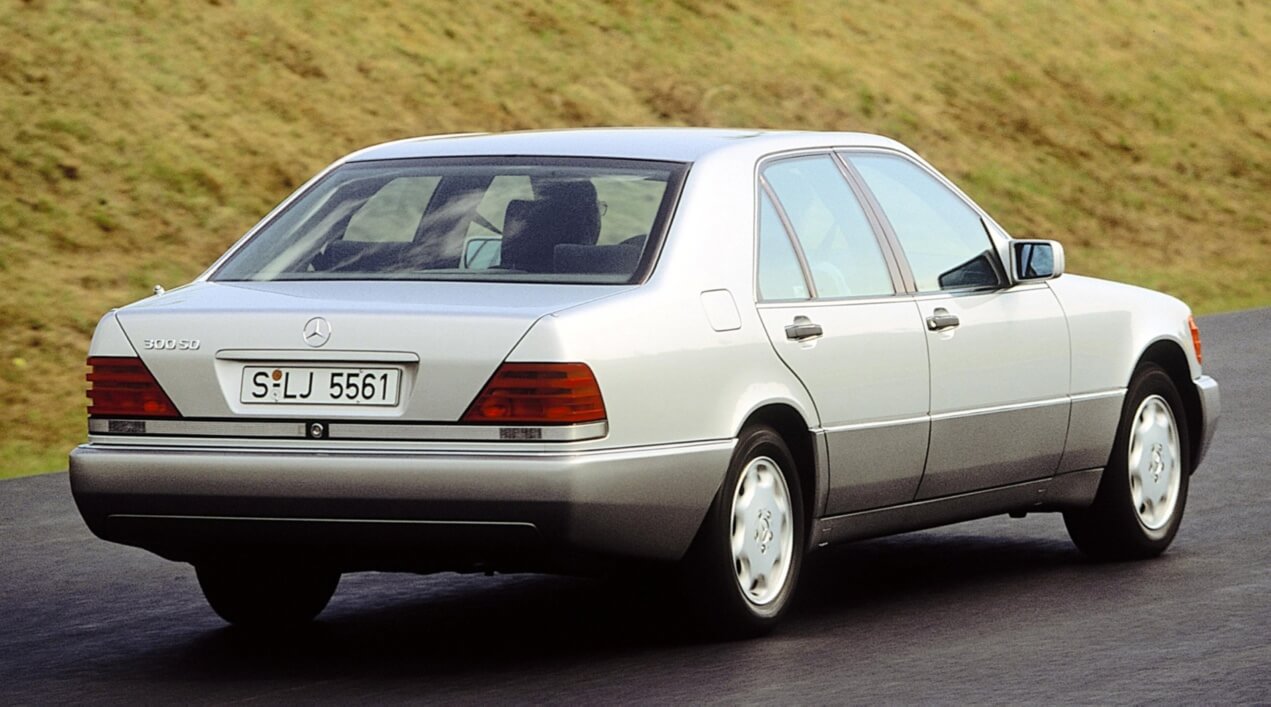
Mercedes-Benz W140 photos 12

Mercedes-Benz W140 videos 3
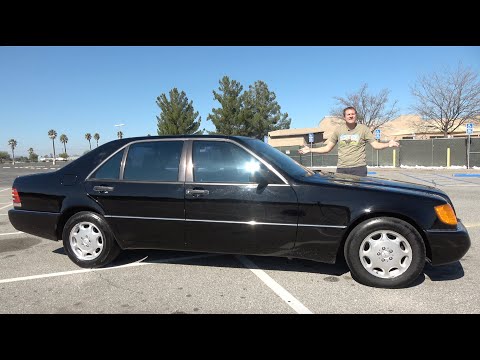
Mercedes-Benz W140 video 1

Mercedes-Benz W140 video 2

Mercedes-Benz W140 video 3
FAQ
How many Mercedes-Benz W140s were built?
Mercedes-Benz built 432,732 cars of the W140 series between 1991 and 1998. Of these, 406,710 were saloons in short and long form and 26,022 were C140 coupés, which were sold from 1996 as the CL-Class.
What engines did the W140 have?
Petrol versions used straight-six engines of 2,799 and 3,199 cc, V8s of 4,196 and 4,973 cc and a 5,987 cc V12 with 290–300 kW. Diesel versions had a 3.5-litre six with 110 kW and, from 1996, a 3.0-litre four-valve six with 130 kW.
Was the W140 the first car with ESP?
It was the first Mercedes with ESP: the stability system arrived in 1995 on the S 600 Coupé and then spread through the range. Brake Assist followed in 1996, also on the W140, before both became standard across Mercedes models.
What is the difference between the SE and SEL?
SE was the short-wheelbase saloon with a 3,040 mm wheelbase; SEL was the long version at 3,140 mm, which gave rear passengers 100 mm more legroom. After the 1993 renaming, both were sold under the S-Class model numbers such as S 320 or S 500.
Is a W140 S-Class expensive to maintain?
Yes, compared with ordinary cars of its age. Window regulators, wiring, sensors, hydraulic suspension parts and V12 ignition components are the usual cost items. A documented service history and a specialist inspection before purchase reduce the risk considerably.
Data sources
Data checked by an editor against the sources below.
- The text of this article (1cars archive)
- Wikipedia - Mercedes Benz W140
- Wikipedia - Mercedes Benz S Class (W140)


