Mercedes-Benz GL-Class — Generations, Specs and History
The Mercedes-Benz GL-Class is a family of full-size premium SUVs. It was the flagship of the brand's SUV range, positioned above the M-Class (later GLE). Two generations were built. The first, coded X164, was unveiled at the North American International Auto Show in Detroit in 2006 and was the first full-size, seven-seat SUV from a German manufacturer. The second, X166, was revealed at the New York motor show in 2012 and went on sale that September; with the 2016 facelift it was renamed GLS. This article focuses on the X166.
Key takeaways
- Two generations: X164 (2006–2012) and X166 (2012–2015), built mainly in Alabama, USA; the successor is the GLS.
- X166 engines: 3.0 V6 diesel with 190 kW (258 PS), 3.0 V6 twin-turbo petrol with 245 kW (333 PS) and 4.7 V8 twin-turbo with 320 kW (435 PS); the GL 63 AMG tops the range.
- 7G-Tronic Plus automatic and 4Matic all-wheel drive on every version; Airmatic air suspension.
- Seven full-size seats and 680–2,300 litres of luggage space.
Mercedes-Benz GL at a glance
Mercedes originally planned the GL mainly for North America, where large cars are popular, but soon added Europe and other markets. The car proved popular, and work on a second generation began. The X166 has a more modern and assertive exterior, a roomy, luxurious and comfortable cabin and revised equipment. More Mercedes-Benz models are listed in our Mercedes-Benz catalogue, and the brand's heritage is covered in Mercedes-Benz: classic German cars.
| Generation | Code | Debut | Years | Notes |
|---|---|---|---|---|
| First | X164 | Detroit, January 2006 | 2006–2012 | V8 petrol and V6/V8 diesel engines, 4Matic |
| Second | X166 | New York, April 2012 | 2012–2015 | New engines, start-stop, GL 63 AMG; renamed GLS in 2016 |
Exterior
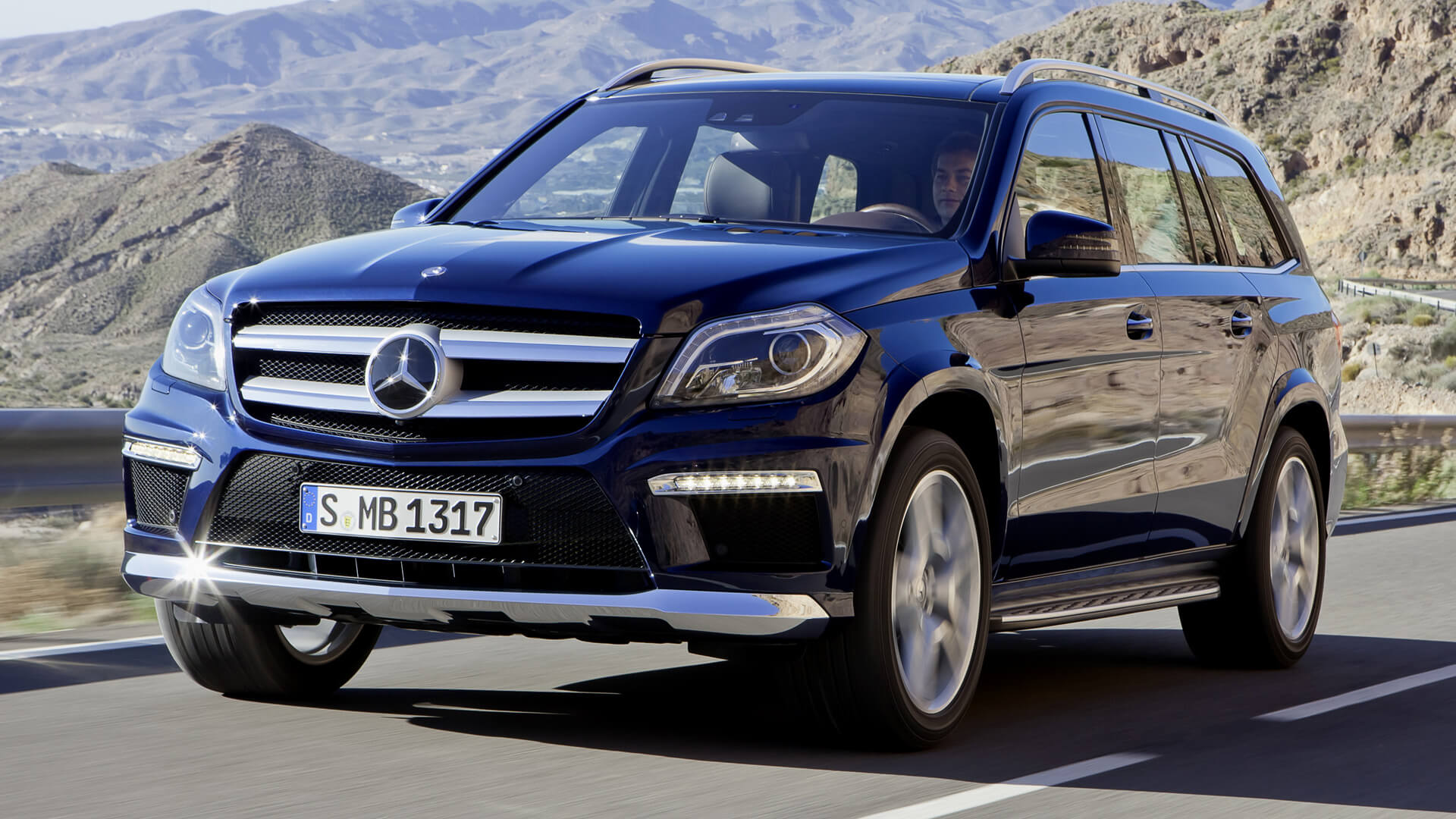
At the front, the second-generation GL has large, attractive headlights with boomerang-shaped LED "eyebrows". The trapezoidal grille has two big chrome bars with the three-pointed star in the centre. The daytime running lights sit higher than usual, directly above the side air intakes. The bumper has several aerodynamic elements and mesh-covered ducts, and an aluminium lower skid plate is both decorative and functional.
In profile the X166 clearly shows that it is a proper off-roader, with a long, flat roof and larger wheel arches than its predecessor. A sturdy running board runs along the side for all passengers, making entry easier and protecting the sills, and chrome roof rails run the length of the body. Large mirrors with integrated indicators provide a good view. Ground clearance is a useful 200 mm in normal mode. The wheel arches house 18- or 19-inch alloys, with 20- and 21-inch wheels optional.
The use of aluminium for the wings, bonnet and some suspension parts cut the weight of the second-generation GL by almost 100 kg compared with its predecessor.
The rear matches the rest of the car. The lights are slimmer and more striking, and the massive tailgate is power-operated. A spoiler with an additional brake light sits at the top, and the large rear bumper has dummy vents and a protective diffuser. Base versions have hidden exhaust pipes; others have visible tailpipes. The X166 is about 5.12 metres long with a 3.08-metre wheelbase.
Interior
Once inside, it is obvious that the GL was designed in Germany: the cabin is immaculate, strict and restrained rather than flashy, and everything is aimed at comfort, convenience and function. Build quality is excellent, with every part precisely fitted, and the materials match the car's status: Exclusive nappa leather, classic leather and breathable ARTICO man-made leather, with real wood or metal trim throughout. The GL seats seven full-size adults.
The driver has a comfortable four-spoke multifunction steering wheel trimmed in leather and wood and an easy-to-read instrument panel with two traditional dials and a trip-computer display between them. All switches are within easy reach. The front seats offer many electric adjustments, memory and a massage function, and there is plenty of space in every row.
The dashboard and centre console are borrowed from the closely related M-Class of the same period. The console has a large screen for the COMAND infotainment system, flanked by vertical air vents. Below it are the infotainment buttons, then the Thermotronic climate controls with two rotary knobs for the three-zone system. The console flows smoothly into the tunnel, which has a double armrest and the controls for the air suspension and off-road functions. Music lovers can choose a Harman Kardon Logic 7 system or an optional Bang & Olufsen BeoSound system. The two illuminated cupholders have a stylish cover.
The second and third rows each seat three, and even tall adults are reasonably comfortable in the back row. A mechanism slides the middle row forward for easier access to the third row, and rear passengers have their own climate controls. The luggage compartment is huge: 680 litres with all seven seats in use and up to 2,300 litres with the second and third rows folded.
Engines and transmission
Mercedes did not design completely new engines for the X166, but it reworked the units of the first generation, which increased power and reduced fuel consumption.
| Version | Engine | Power (kW / PS) | Torque | 0–100 km/h | Top speed |
|---|---|---|---|---|---|
| GL 350 BlueTEC | 3.0 V6 turbodiesel (OM642) | 190 kW / 258 PS | 620 Nm | 7.9 s | 220 km/h |
| GL 400 | 3.0 V6 twin-turbo petrol (M276) | 245 kW / 333 PS | 480 Nm | 6.3 s | 240 km/h |
| GL 500 BlueEFFICIENCY | 4.7 V8 twin-turbo petrol (M278) | 320 kW / 435 PS | 700 Nm | 5.6 s | 250 km/h |
| GL 63 AMG | 5.5 V8 twin-turbo petrol (M157) | 410 kW / 557 PS | 760 Nm | — | — |
The diesel was the entry-level engine. The GL 400 uses about 9.6 l/100 km on the combined cycle, and fuel consumption across the petrol range is 9.3–14.5 l/100 km. In some markets the diesel was also offered in a lower-rated version.
Every GL uses the seven-speed 7G-Tronic Plus automatic, which was improved to eliminate the overheating and torque-converter failures that had affected earlier versions. All-wheel drive is 4Matic, and a centre differential lock is available for off-road use.
Chassis
The suspension is fully independent, with double wishbones at the front and a multi-link rear axle. Airmatic air suspension is fitted, and the optional ON&OFFROAD package provides six driving programs and raises the maximum ground clearance to 285 mm. Electromechanical power steering makes this large SUV easy to drive, and there are plenty of electronic driver aids.
Safety
Mercedes-Benz has always taken safety seriously, and with seven seats the GL was clearly designed for families. Its equipment includes ABS, ESP and traction control, a driver drowsiness monitor, adaptive cruise control, PRE-SAFE Brake that can brake the car automatically to a standstill in an emergency, lane, blind-spot and traffic-sign assistants, night-vision camera, Crosswind Stabilization and a parking assistant.
Even the entry-level version has leather upholstery, electric seats, heated front and rear seats, hill-start assist, a collision-prevention system, climate control, front and rear parking sensors, surround-view cameras, cruise control, tyre-pressure monitoring and rain and light sensors. More expensive versions add seat memory, a panoramic sunroof, ventilated seats, keyless entry and start and a premium sound system. Options included blind-spot and lane assistants, navigation, 20- and 21-inch wheels and automatic parking.
What owners say
Owners praise the build quality and cabin materials, high comfort and good performance, as well as the high ground clearance and an all-wheel-drive system that copes well with poor roads. Many say the diesels are more economical. Status, safety and space are other strong points, and the huge boot takes everything a family needs. On the other hand, the GL is expensive to buy, even used, and parts are costly. By today's standards the second generation looks a little dated, a failed air suspension is expensive to repair and the petrol engines are thirsty.
Rivals
The GL competed with the Audi Q7, BMW X5, Range Rover, Lexus LX, Infiniti QX80 and Volvo XC90.
Verdict
Mercedes-Benz engineers did a great deal of work: the second-generation GL is better than its predecessor in every respect. It has a more assertive, modern exterior, an excellent seven-seat cabin and a big boot that adds to its practicality. Upgraded engines, all-wheel drive and adjustable ground clearance make it feel confident on almost any surface. The price is high, and so are running costs and fuel consumption, but true fans of the brand will not be deterred.
FAQ
What does GL stand for at Mercedes-Benz?
The G refers to Geländewagen, German for off-road vehicle; the GL was positioned as the SUV counterpart of the S-Class and was renamed GLS in 2016.
How many seats does the Mercedes-Benz GL have?
Seven full-size seats in three rows.
What engines are available in the X166 GL?
A 3.0 V6 diesel with 190 kW (258 PS), a 3.0 V6 petrol with 245 kW (333 PS), a 4.7 V8 with 320 kW (435 PS) and the GL 63 AMG's 5.5 V8 with 410 kW (557 PS).
How big is the Mercedes-Benz GL boot?
680 litres with seven seats in use and up to 2,300 litres with two rows folded.