The History of Mercedes-Benz: From the First Car to a Global Brand
Mercedes-Benz traces its roots to two pioneers: Carl Benz, who patented the first petrol-powered car in January 1886, and Gottlieb Daimler, whose company sold its cars under the Mercedes name from 1901. The two firms merged into Daimler-Benz on 28 June 1926. Today the brand belongs to Mercedes-Benz Group AG of Stuttgart, which sold 2.16 million cars and vans in 2025.

Key takeaways
- Benz Patent-Motorwagen patented on 29 January 1886; Daimler-Motoren-Gesellschaft (DMG) founded in 1890; the Mercedes name used from 1901.
- Safety pioneer: crumple-zone body (patented 1951, in production from 1959), ABS on the S-Class from 1978, the driver airbag in 1981 and ESP in 1995.
- Owners: Daimler-Benz (1926–1998), DaimlerChrysler (1998–2007), Daimler AG (2007–2022) and Mercedes-Benz Group AG since February 2022.
- Formula 1: eight constructors' titles in a row as a works team from 2014 to 2021.

Mercedes-Benz at a glance

| Fact | Value |
|---|---|
| Roots | Benz & Cie. (1883) and Daimler-Motoren-Gesellschaft (1890) |
| Merger | 28 June 1926, Daimler-Benz AG |
| Headquarters | Stuttgart, Germany |
| Parent company | Mercedes-Benz Group AG (since 1 February 2022) |
| Chief executive | Ola Källenius (since 2019) |
| Sub-brands | Mercedes-AMG, Mercedes-Maybach, Mercedes-EQ, G-Class |
| Emblem | Three-pointed star, registered in June 1909 |
| Sales 2025 | 2.16 million cars and vans |
Origins: Carl Benz, Gottlieb Daimler and Emil Jellinek
Carl Benz built his three-wheeled Patent-Motorwagen in Mannheim and received German patent 37435 for it on 29 January 1886, the date usually given as the birth of the car. In 1888 his wife Bertha Benz drove it about 100 km from Mannheim to Pforzheim, the first long-distance trip by car, and proved the invention worked. Benz & Cie. became one of the world's largest car makers of its time and built the record-breaking Blitzen-Benz of 1909, with a 21.5-litre engine of about 147 kW (200 hp).

Gottlieb Daimler and Wilhelm Maybach worked in parallel near Stuttgart and founded Daimler-Motoren-Gesellschaft in 1890. The Mercedes name came from Emil Jellinek, an Austrian businessman and diplomat who sold DMG cars on the Côte d'Azur and raced them under the name of his daughter, Mercédès. He ordered a new, lighter and lower car from Maybach, and the resulting Mercedes 35 HP of 1901 set the pattern for the modern car. DMG registered the name worldwide, and in June 1909 it registered the three-pointed star, which stood for motorisation on land, on water and in the air.
Daimler-Benz from 1926 to 1945
Post-war inflation forced the two rivals together, and on 28 June 1926 they merged into Daimler-Benz AG; the cars were now called Mercedes-Benz. Ferdinand Porsche, technical director in the 1920s, developed the supercharged S, SS and SSK sports cars. In 1934 the W25 racing car began the "Silver Arrows" era in Grand Prix racing.
During the Second World War Daimler-Benz built trucks, aero engines and military vehicles and, like other German industrial companies, used forced labour. By 1945 its factories were so badly damaged that the board declared the company had practically ceased to exist, and it took more than a year to restart production.
Recovery and the safety era (1946–1990)
Recovery began with the pre-war 170 V. In the 1950s the 300 "Adenauer" saloon, the new "Ponton" 180, 190 and 220 models and the Mercedes-Benz 300 SL "Gullwing" of 1954, with a fuel-injected six of 158 kW (215 PS), rebuilt the brand. The 300 SL succeeded in North America, while the cheaper 190 SL served buyers in Europe. Engineer Béla Barényi's 1951 patent for a rigid passenger cell with crumple zones reached production in the W111 "Fintail" saloon of 1959.

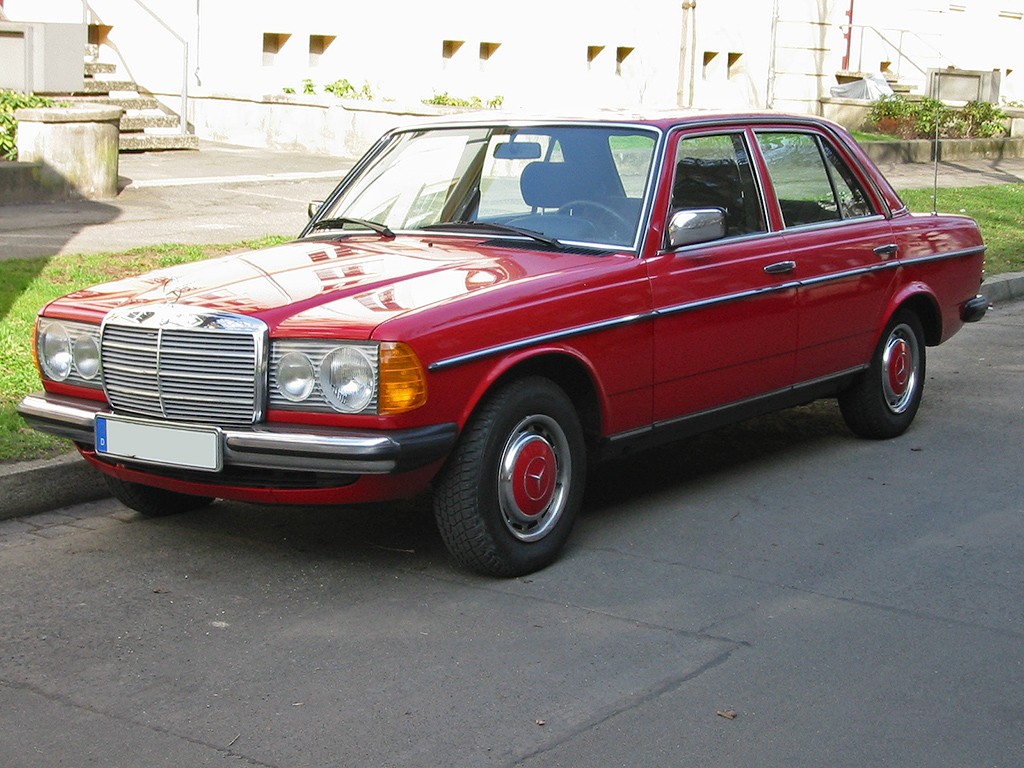
The 600 (W100) of 1963–1981 was the company's limousine for heads of state, with a 6.3-litre V8 of 184 kW (250 PS) and a length of up to 6.2 metres in Pullman form. In the middle class, the W114/W115 and then the W123 of 1976 sold in huge numbers and became famous for durability. The W126 S-Class of 1979 was built for 12 years and more than 800,000 times. The G-Class arrived in 1979, the compact 190 (W201) in 1982 and the W124 in 1984.
| Year | Event |
|---|---|
| 1886 | Benz patent, 29 January |
| 1890 | Daimler-Motoren-Gesellschaft founded |
| 1901 | First car named Mercedes |
| 1909 | Three-pointed star registered |
| 1926 | Merger into Daimler-Benz |
| 1934 | W25 "Silver Arrow" |
| 1954 | 300 SL Gullwing |
| 1959 | W111 with crumple zones |
| 1978 | ABS offered on the S-Class |
| 1981 | Driver airbag on the S-Class |
| 1995 | ESP on the S-Class Coupé |
| 1998 | DaimlerChrysler formed |
| 2007 | Chrysler sold; Daimler AG |
| 2021 | Daimler Truck spun off |
| 2022 | Renamed Mercedes-Benz Group AG |
Landmark models that defined Mercedes-Benz

| Model | Years | Why it matters |
|---|---|---|
| Benz Patent-Motorwagen | 1886 | First petrol-engined car |
| First Mercedes (1901) | 1901 | Template of the modern car; origin of the name |
| SSK | 1928–1932 | Porsche-designed supercharged sports car |
| 300 SL | 1954–1963 | Gullwing doors, direct fuel injection |
| W111 "Fintail" | 1959–1968 | First production car with crumple zones |
| W123 | 1976–1986 | Durable mid-size saloon sold worldwide |
| W126 S-Class | 1979–1991 | Over 800,000 built; ABS and airbags |
| G-Class | 1979– | Off-roader still in production |
| A-Class | 1997– | First compact front-wheel-drive Mercedes |
Engineering firsts and motorsport
Mercedes-Benz introduced many safety systems to series cars. ABS, developed with Bosch, was offered on the W116 S-Class from 1978; the driver airbag followed in 1981 and the ESP stability system in 1995. Electronic stability control of the ESP type has been mandatory on every new car in the EU since November 2014. Today's S-Class remains the brand's technology flagship.

In motorsport the Silver Arrows dominated Grand Prix racing in the 1930s and in 1954–1955 with Juan Manuel Fangio. After returning as an engine supplier, Mercedes won drivers' titles with Mika Häkkinen in 1998 and 1999 and Lewis Hamilton in 2008. As a works team it then won eight consecutive constructors' championships from 2014 to 2021.
Chrysler, Daimler AG and the Mercedes-Benz Group
In 1993 Mercedes introduced its letter classes, starting with the C-, E-, S- and SL-Class; the range later grew to more than ten families of models. In 1998 Daimler-Benz merged with Chrysler to form DaimlerChrysler, but the partnership failed and Chrysler was sold in 2007, when the company became Daimler AG. During the 1990s and 2000s the brand's reputation for quality suffered as models became more complex and costs were cut.

Mercedes-AMG became a wholly owned performance division, Maybach returned in 2002 and has been part of the range as Mercedes-Maybach since 2014; the Mercedes-Maybach S600 was the first of the new generation. The truck business was spun off as Daimler Truck at the end of 2021, and on 1 February 2022 Daimler AG became Mercedes-Benz Group AG. In 2025 the group sold 2.16 million cars and vans, with AMG deliveries up 7% and the best G-Class sales ever.
Factories and line-up today
Mercedes-Benz builds cars in Germany at Sindelfingen, Bremen and Rastatt, in Kecskemét in Hungary, in Tuscaloosa in the USA and in Beijing through a joint venture, among other plants. Its range covers the A-, C-, E- and S-Class saloons and their electric counterparts, the GLA to GLS SUVs, the G-Class, AMG sports cars and Mercedes-Maybach limousines, plus vans such as the Sprinter.

| Model | Segment | Body | Years |
|---|---|---|---|
| A-Class | Compact | Hatchback, saloon | 1997– |
| C-Class | Compact executive | Saloon, estate | 1993– |
| E-Class | Executive | Saloon, estate | 1993– |
| S-Class | Luxury | Saloon | 1972– |
| G-Class | Off-roader | SUV | 1979– |
| GLC | Mid-size SUV | SUV, coupé | 2015– |
Compare any of them with rivals in the 1cars comparison tool, see the fastest AMG models among the most powerful saloons, or browse every model in the Mercedes-Benz catalogue.
Verdict: which Mercedes to choose
For classic buyers the W123, W124 and W126 combine durability with affordable prices, while the 300 SL and 600 belong to serious collectors. Among recent cars, the C- and E-Class offer the widest choice of engines, the S-Class the most technology and the G-Class the strongest values.
FAQ
Who owns Mercedes-Benz today?
Mercedes-Benz belongs to Mercedes-Benz Group AG, based in Stuttgart. The company took that name on 1 February 2022, after the truck business was spun off as Daimler Truck. Its chief executive since 2019 has been Ola Källenius.
When was Mercedes-Benz founded and by whom?
The brand dates from the merger of Benz & Cie., founded by Carl Benz, and Gottlieb Daimler's Daimler-Motoren-Gesellschaft on 28 June 1926. Benz patented the first petrol-powered car on 29 January 1886.
Where does the name Mercedes come from?
It comes from Mercédès Jellinek, the daughter of Emil Jellinek, who sold and raced Daimler cars. The first car to carry the name appeared in 1901, and DMG then registered it as a trademark.
What does the Mercedes-Benz star mean?
The three-pointed star, registered by DMG in June 1909, stands for Daimler's goal of motorisation on land, on water and in the air. It has been surrounded by a ring since the 1920s.
What is the most famous Mercedes-Benz model?
The 300 SL Gullwing of 1954 is the most famous classic, while the S-Class has been the brand's best-known luxury saloon since 1972. The G-Class, built since 1979, recorded its best-ever sales in 2025.
Photos (1)

Videos 4

Video 1
Video 2

Video 3

Video 4