Infiniti QX80 — History, Specs and the Flagship V8
The Infiniti QX80 is a full-size luxury SUV and the flagship of the Infiniti range. It combines striking looks with an expensive, roomy cabin, rich equipment and genuine off-road ability. Known as the QX56 until 2013, it shares its body and much of its engineering with the Nissan Patrol.
Key takeaways
- First generation: Infiniti QX56 from the 2004 model year, built in the USA on the F-Alpha platform of the Nissan Armada and Titan.
- Second generation (Z62): revealed in New York in 2010, based on the Nissan Patrol Y62, renamed QX80 for the 2014 model year and facelifted in 2014 and 2017.
- 5.6-litre VK56VD V8 with 298 kW (400 hp) and 560 Nm, seven-speed automatic and All-Mode 4x4 with low range.
- Seven or eight seats, 470 litres of luggage space behind the third row and up to 3,856 kg of towing capacity.
Infiniti QX80 at a glance
More Infiniti models are listed in our Infiniti catalogue, and the Patrol and other Nissan models are found in our Nissan catalogue.
| Generation | Code | Years | Platform | Engine |
|---|---|---|---|---|
| First (QX56) | JA60 | 2004–2010 | F-Alpha (Nissan Armada, Titan) | 5.6 V8 |
| Second (QX56, QX80 from 2014 MY) | Z62 | 2010–2024 | Nissan Patrol Y62 | 5.6 V8 VK56VD |
| Third | Z63 | 2024 onwards | New | 3.5 twin-turbo V6 |
History
The full-size SUV arrived as the QX56 for the 2004 model year. The second generation was revealed at the New York International Auto Show on 31 March 2010 and, when Infiniti renamed its whole range, became the QX80 for the 2014 model year. A mild facelift followed for the 2015 model year. A second, more significant update was shown at the Dubai International Motor Show on 14 November 2017, with a new grille, bonnet and LED lighting, a slightly revised interior and an upgraded infotainment system. Further interior updates came for the 2021 and 2022 model years. The QX80 sells well in many countries — in the United States alone around 15,000 a year. In March 2024 Infiniti revealed the third generation.
Exterior
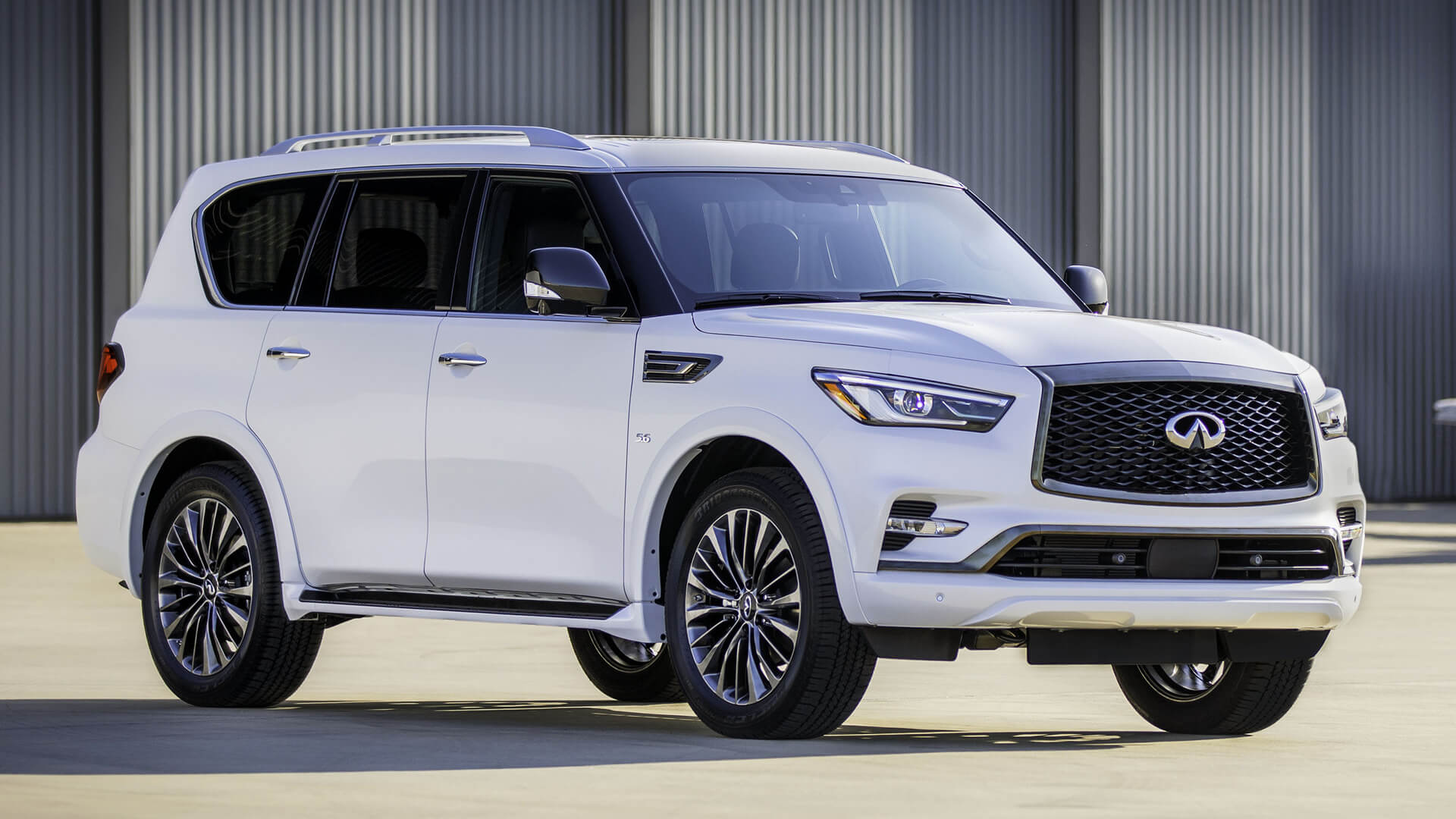
The facelifted second-generation QX80 looks imposing and modern, yet it is not as flashy as some rivals. Its whole appearance signals that it belongs to the luxury class and is built to give its owner the highest level of comfort.
The front is the most aggressive part. It is tall and long, which limits the view forward: not every driver will feel at ease, and neither seat-height adjustment nor the slight slope of the nose fully solves the problem. The bonnet is heavily sculpted, with stepped and wave-like surfaces and pronounced side ridges. Below them are large, aggressive LED headlights in every version, topped by a chrome line that continues onto the side. The massive, almost rectangular grille is set slightly into the body, with a large gloss-black mesh and a thick chrome surround. The bumper has numerous air intakes separated by body-coloured bars, chrome strips, plenty of sculpting and a metal skid plate in the centre at the bottom.
The side is more restrained but still has gentle wave-like changes in height. The highlight is the long window line, with gloss-black pillars that blend into the glass and a thin chrome surround. Lower down there are slightly flared wheel arches and sculpted sills with running boards for easier access. The QX80 rides on 22-inch wheels of a unique design. The mirrors are almost square with integrated indicators, and the rear of each front wing carries a chrome vent. Ground clearance is an impressive 234 mm.
The rear is just as bold. A large, upright tailgate carries a big rounded spoiler with a brake light, and the lower edge of the rear window has an unusual wave shape. The LED tail lights repeat the lines seen at the front; a chrome strip between them continues into the lights and incorporates the reversing lamps. The massive, smooth rear bumper has rectangular fog lamps at the sides and large exhaust tips.
According to J.D. Power, the QX80 was the most dependable new large premium SUV in its 2014 and 2015 studies, and it received the AutoPacific Vehicle Satisfaction Award in the luxury large SUV category three years in a row.
Interior
The cabin leaves mixed impressions. Diamond-quilted seats and high-quality materials make it clear that this is a luxury SUV, but compared with its rivals it is not the most modern or technologically advanced: there is no fully digital instrument display and no screen that rises out of the dashboard. On the other hand, everything has been thought through, and the ergonomics are excellent.
The driver faces a four-spoke steering wheel with neatly arranged buttons and a traditional instrument panel with two large dials and a small trip-computer display between them. The top of the dashboard has a wave-shaped step whose ends flow into the door panels. Two leather-trimmed pillars frame the centre console, with vertical air vents at the top, the 8-inch infotainment screen and the audio controls below, then a panel with an analogue oval clock and the climate controls. The tunnel has wood trim, a covered storage area, a large gear lever and the infotainment controller.
The seats are huge and look luxurious, with heating, ventilation and electric adjustment, but they lack lumbar support and side bolstering, so long trips are not as comfortable as they could be. The second row has two captain's chairs as standard, separated by a large console with various controls, and screens are built into the front head restraints; a three-seat bench is optional. The third row is less luxurious, and three people will be cramped, but it has almost everything needed for a comfortable journey. Upholstery is black, beige or brown leather.
Despite the three rows, the QX80 has a roomy luggage compartment: 470 litres behind the third row, 1,400 litres with the third row folded and 2,690 litres with both rear rows folded. A full-size spare wheel is stored under the floor.
Interior updates
The 2021 model-year update made the cabin more modern and comfortable. The revised Infiniti InTouch system has two screens one above the other — 8 inches at the top and 7 inches below — with navigation, Apple CarPlay and Android Auto, plus 3D maps, street images and destination data from Google. A premium Bose audio system has 13 speakers and two subwoofers, and the instrument cluster replaced its monochrome screen with a 7-inch colour display. Rear passengers get two sets of wireless headphones, two headphone jacks, an HDMI port, two 8-inch screens and a wireless remote. The driver's seat gained two-way electric lumbar support, and there is an automatically dimming mirror with HomeLink and an intelligent key with push-button start. For the 2022 model year the dual screens gave way to a 12.3-inch touchscreen.
Practical touches include a lockable glovebox, map pockets in the front seatbacks, door pockets front and rear, nine cupholders and four bottle holders and a second-row armrest with two more cupholders.
Engine and transmission
The QX80 is powered by the VK56VD, an aluminium 5.6-litre V8 petrol engine with direct injection, 32 valves, chain-driven double overhead camshafts and VVEL variable valve lift. It produces 298 kW (400 hp) and 560 Nm, enough to tow heavy trailers across a wide rev range — up to 3,856 kg. It takes this very heavy SUV to 100 km/h in 7.5 seconds and on to a top speed of about 210 km/h. Combined fuel consumption is about 14.5 l/100 km, and in town it can exceed 20 l/100 km.
A seven-speed automatic with a manual mode sends power to all four wheels. Its adaptive electronic control learns each driver's style. The All-Mode 4x4 system has an electromagnetic clutch in the front-axle drive and three settings:
- Auto — up to 50% of the torque goes to the front wheels, depending on rear-wheel slip;
- 4H — torque is split equally between the axles with the clutch locked;
- 4L — engages the low range.
Snow and Tow modes change throttle response and shift patterns. The QX80's size means its approach and departure angles are not the best, but it can certainly be used on poor roads.
Chassis
The QX80 is based on the Nissan Patrol, with a frame integrated into the body structure, front and rear crumple zones and a longitudinal engine. The suspension is fully independent, with double wishbones front and rear. Hydraulic Body Motion Control (HBMC) reduces body roll and pitch by hydraulically linking the front and rear anti-roll bars during cornering. Despite its size the QX80 handles well, helped by hydraulic power steering. The brakes are 350 mm ventilated discs with ABS, EBD, brake assist and other electronic aids.
Safety
Equipment includes EBD, brake assist, four-channel ABS, Vehicle Dynamic Control and traction control, tyre-pressure monitoring for every wheel, central locking, an alarm and key immobiliser, dual-stage front airbags, side and curtain airbags, pedestrian and stationary-object detection, pre-tensioning seat belts, active head restraints, a collapsible pedal assembly and propshaft, ISOFIX mounts, cruise control, LED headlights, a rain sensor, parking assistance and blind-spot monitoring, adaptive front lighting, front and rear fog lamps and the Around View Monitor with 360-degree cameras.
The body has crumple zones that absorb energy in frontal and side impacts, and high-strength steel is used throughout. As the QX80 is often used for towing, it has trailer brake assistance and trailer sway control, plus an integrated tow hitch with four- and seven-pin sockets. ProPILOT Assist, which recognises lane markings and monitors blind spots, is available on the facelifted car.
Rivals
The QX80's main rivals are the Lexus LX, Nissan Patrol, Cadillac Escalade, Mercedes-Benz GLS, Chevrolet Tahoe and Range Rover.
Verdict
The QX80 arrived at the right time, as SUVs are more popular than ever. It is thoroughly practical and can handle almost any task, with big wheels, a spacious cabin, generous ground clearance, all-wheel drive with low range and a powerful V8. It suits buyers who want comfort and status and occasionally head off the beaten track.
FAQ
Is the Infiniti QX80 the same as the QX56?
Yes. The QX56 was renamed QX80 from the 2014 model year.
Is the Infiniti QX80 based on the Nissan Patrol?
The second generation, launched in 2010, shares its body and engineering with the Nissan Patrol Y62.
What engine does the Infiniti QX80 have?
The second generation uses a 5.6-litre V8 with 298 kW (400 hp) and 560 Nm; the third generation of 2024 switched to a 3.5-litre twin-turbo V6.
How much can the Infiniti QX80 tow?
Up to 3,856 kg.