 Infiniti Q50
Specs, engines and history
Published Sources (5) Report an error
By Felix Hartmann, Automotive Technology & EV Contributor
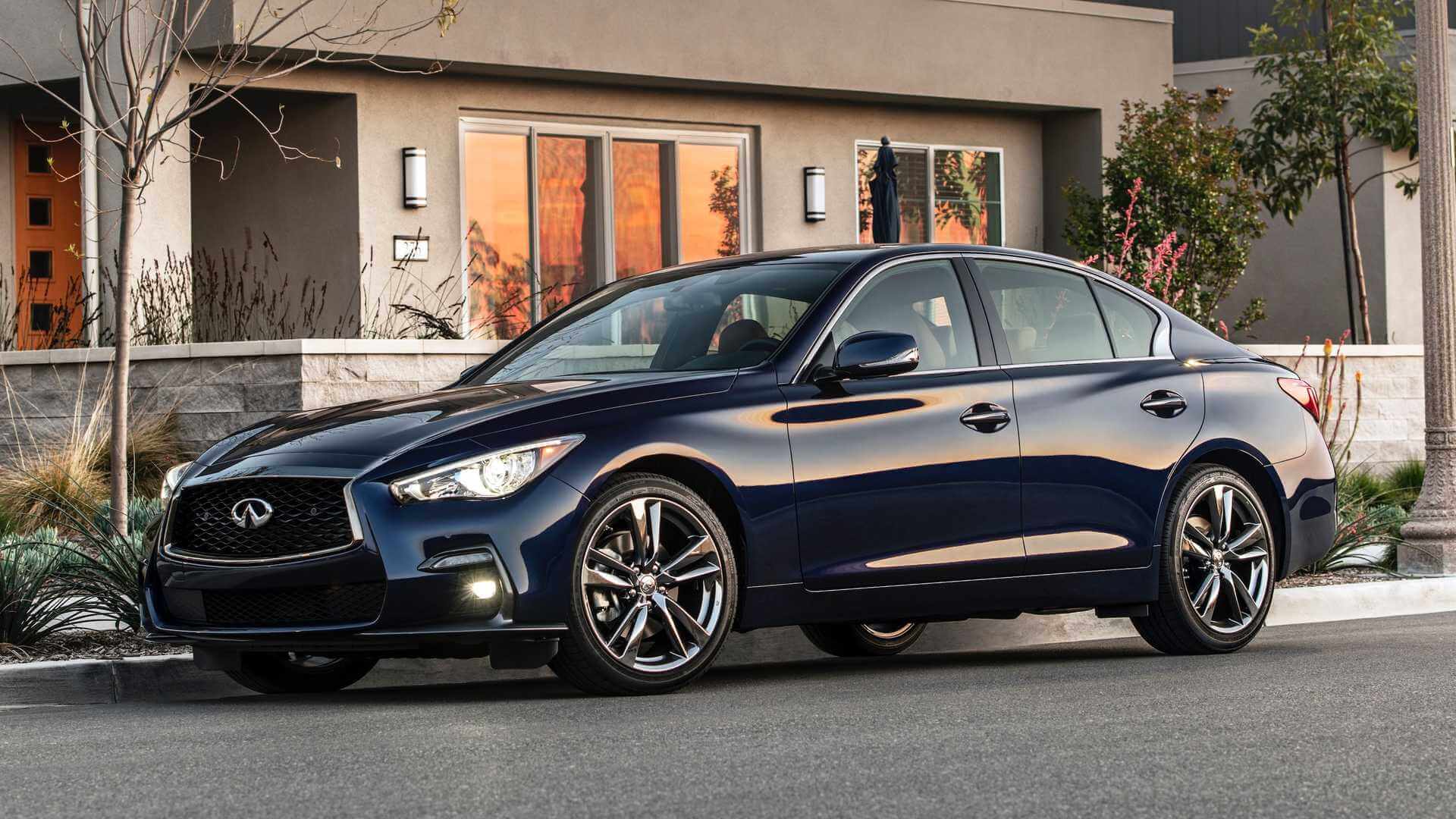
The Infiniti Q50 is a mid-size premium sports sedan - a D-segment car by European standards - with rear- or all-wheel drive. It replaced the Infiniti G sedan and combined a comfortable, well-equipped cabin with sporty performance and some unusual technology, most famously steer-by-wire steering. The Q50 was built at Nissan's Tochigi plant in Japan from 2013 until the end of the 2024 model year.
In short
- Revealed at the North American International Auto Show in Detroit in January 2013; built 2013–2024 on Nissan's FM rear-drive platform.
- Engines ranged from a 155 kW (211 PS) 2.0 turbo to the 298 kW (405 PS) 3.0 twin-turbo V6 of the Red Sport 400.
- A seven-speed automatic was standard on petrol versions; all-wheel drive uses a multi-plate clutch.
- It was one of the first production cars with Direct Adaptive Steering, a steer-by-wire system.
Specs by version
Engines
| Version | Engine | Gearbox | Drive | Production years |
|---|---|---|---|---|
| 2 L 4 cyl Automatic (S7) · 2019 (EPA) | 2.0 l · 4 cyl 2,000 cc | 7-sp Automatic | Rear-wheel drive | 2019 |
| 2 L 4 cyl Automatic (S7) · 2018 (EPA) | 2.0 l · 4 cyl 2,000 cc | 7-sp Automatic | Rear-wheel drive | 2018 |
| 2 L 4 cyl Automatic (S7) · 2017 (EPA) | 2.0 l · 4 cyl 2,000 cc | 7-sp Automatic | Rear-wheel drive | 2017 |
| 3 L 6 cyl Automatic (S7) · 2024 (EPA) | 3.0 l · 6 cyl 3,000 cc | 7-sp Automatic | Rear-wheel drive | 2024 |
| 3 L 6 cyl Automatic (S7) · 2023 (EPA) | 3.0 l · 6 cyl 3,000 cc | 7-sp Automatic | Rear-wheel drive | 2023 |
| 3 L 6 cyl Automatic (S7) · 2022 (EPA) | 3.0 l · 6 cyl 3,000 cc | 7-sp Automatic | Rear-wheel drive | 2022 |
| 3 L 6 cyl Automatic (S7) · 2021 (EPA) | 3.0 l · 6 cyl 3,000 cc | 7-sp Automatic | Rear-wheel drive | 2021 |
| 3 L 6 cyl Automatic (S7) · 2020 (EPA) | 3.0 l · 6 cyl 3,000 cc | 7-sp Automatic | Rear-wheel drive | 2020 |
| 3 L 6 cyl Automatic (S7) · 2019 (EPA) | 3.0 l · 6 cyl 3,000 cc | 7-sp Automatic | Rear-wheel drive | 2019 |
| 3 L 6 cyl Automatic (S7) · 2018 (EPA) | 3.0 l · 6 cyl 3,000 cc | 7-sp Automatic | Rear-wheel drive | 2018 |
| 3 L 6 cyl Automatic (S7) · 2017 (EPA) | 3.0 l · 6 cyl 3,000 cc | 7-sp Automatic | Rear-wheel drive | 2017 |
Performance
Show all 11 versions
| Version | Fuel consumption |
|---|---|
| 2 L 4 cyl Automatic (S7) · 2019 (EPA) | 9.4 l/100 km25.0 mpg US · 30.1 mpg UK |
| 2 L 4 cyl Automatic (S7) · 2018 (EPA) | 9.4 l/100 km25.0 mpg US · 30.1 mpg UK |
| 2 L 4 cyl Automatic (S7) · 2017 (EPA) | 9.0 l/100 km26.1 mpg US · 31.4 mpg UK |
| 3 L 6 cyl Automatic (S7) · 2024 (EPA) | 10.2 l/100 km23.1 mpg US · 27.7 mpg UK |
| 3 L 6 cyl Automatic (S7) · 2023 (EPA) | 10.2 l/100 km23.1 mpg US · 27.7 mpg UK |
| 3 L 6 cyl Automatic (S7) · 2022 (EPA) | 10.2 l/100 km23.1 mpg US · 27.7 mpg UK |
| 3 L 6 cyl Automatic (S7) · 2021 (EPA) | 10.2 l/100 km23.1 mpg US · 27.7 mpg UK |
| 3 L 6 cyl Automatic (S7) · 2020 (EPA) | 10.2 l/100 km23.1 mpg US · 27.7 mpg UK |
| 3 L 6 cyl Automatic (S7) · 2019 (EPA) | 10.2 l/100 km23.1 mpg US · 27.7 mpg UK |
| 3 L 6 cyl Automatic (S7) · 2018 (EPA) | 10.2 l/100 km23.1 mpg US · 27.7 mpg UK |
| 3 L 6 cyl Automatic (S7) · 2017 (EPA) | 10.2 l/100 km23.1 mpg US · 27.7 mpg UK |
Verified Manufacturer and type-approval data from our catalog · Sources and methodology
Infiniti Q50 at a glance
The three-box Q50 arrived in 2013 as the successor to the G-series sedan and was the first model to carry Infiniti's new "Q" naming for cars. Its world debut took place at the Detroit motor show. A significant technical update followed for the 2016 model year, bringing new turbocharged engines and a second-generation steering system, and a styling facelift was unveiled at the Geneva motor show in March 2017. The changes were evolutionary: sharper lights, revised bumpers and a fresher cabin rather than a new body. More of the brand's range is in our Infiniti catalogue, and its background is covered in the history of Infiniti.
Exterior and the 2017 facelift
The facelift kept the familiar Infiniti face but refreshed many details. The front gained new LED headlights with crisper lenses, while low and high beam are LED as well. The grille has a chrome surround and a dark mesh insert, with the brand badge in the centre; a camera sits above it and sensors for the driver-assistance systems sit beside and below it. The redesigned front bumper improves aerodynamics, and depending on the version it carries a C-shaped insert in black plastic, chrome or black chrome, plus LED fog lights and daytime running lights. A new splitter adds a sportier look, but the bonnet was left unchanged.
In profile, the Q50 has a wider chrome window surround and crisper character lines, one running from the headlights to the tail lights and another from the middle of the doors to the rear. Sculpted sills replace old-fashioned mouldings. The mirrors include indicator repeaters, heating, electric adjustment and power folding, and higher trims add a memory with three positions. Standard alloy wheels are 17 inches, with 18- and 19-inch wheels optional; the hybrid came with 19-inch wheels as standard. Published figures give ground clearance of 130 mm.
The rear changed more than the front, mainly through new LED tail lights split between the boot lid and the body, with an LED third brake light at the base of the rear window. A chrome strip below the Infiniti badge, a more sculpted bumper, a sport-style diffuser and round exhaust tips complete the look.
Interior and practicality
The cabin uses quality leather and wood inserts on the centre console. The driver faces a three-spoke leather multifunction steering wheel and a classic instrument cluster with a large rev counter and speedometer, with a trip-computer screen between them that also shows navigation prompts. The InTouch infotainment system uses two touchscreens stacked in the centre console - an 8-inch upper display and a 7-inch lower one - so that navigation and media can be shown at the same time. A rotary controller on the tunnel offers an alternative to the touchscreens. Higher trims have a 16-speaker Bose Performance Series sound system.
The front leather seats offer good lateral support and can be had with electric adjustment, heating and memory; ventilation was not available. Infiniti developed the seat design using research from NASA into neutral body posture. Owners praise the well-judged ergonomics, logical controls, quality materials and generous equipment.
The rear bench seats three, but two adults travel more comfortably; the centre armrest folds down, and legroom is only average. The boot holds about 500 litres, but intrusive wheel arches and a narrow through-load opening (the rear seat splits 60/40) limit bulky items. There is no spare wheel, because the car runs on run-flat tyres.
Engines and transmissions
| Engine | Years | Power (kW / PS) | Torque | Gearbox | Drive |
|---|---|---|---|---|---|
| 2.0t (inline-4 turbo) | 2016–2019 | 155 kW / 211 PS | 350 Nm | 7-speed automatic | RWD |
| 2.2d (inline-4 diesel) | 2014–2016 | 125 kW / 170 PS | 400 Nm | 6-speed manual or 7-speed automatic | RWD |
| 3.0t (V6 twin-turbo) | 2016–2024 | 224 kW / 304 PS | 400 Nm | 7-speed automatic | RWD or AWD |
| 3.0t Red Sport 400 | 2016–2024 | 298 kW / 405 PS | 475 Nm | 7-speed automatic | RWD or AWD |
| 3.5 Hybrid (V6 + electric motor) | 2014–2018 | 268 kW / 364 PS combined | 546 Nm combined | 7-speed automatic | RWD or AWD |
The entry-level petrol engine is a 2.0-litre four-cylinder with direct injection and a turbocharger. According to published figures, it takes the Q50 from 0 to 100 km/h in 7.3 seconds, reaches a limited 245 km/h and uses about 7 l/100 km on the combined cycle.
The flagship is the 3.0-litre VR-series twin-turbo V6, with direct injection, exhaust manifolds integrated into the cylinder head and fast electrically actuated variable valve timing. In Red Sport 400 form it produces 298 kW (405 PS) and 475 Nm, enough for 0–100 km/h in 5.4 seconds and a top speed of 250 km/h, with combined consumption of about 9.3 l/100 km.
The petrol engines drive through a seven-speed automatic with a manual mode. The 2.0t versions are rear-wheel drive, while the V6 can be combined with an all-wheel-drive system whose multi-plate clutch sends torque to the front wheels when needed.
Chassis and steering
The Q50 is based on Nissan's FM (Front Midship) rear-drive platform, which also underpinned the G-series, in modernised form. It has double-wishbone front and multi-link rear suspension, and V6 versions have an adaptive chassis with electronically controlled dampers. The body makes extensive use of aluminium and high-strength steel, and published figures put kerb weight at up to 1,640 kg. The handling is good, though the ride is on the firm side.
Brakes are ventilated discs with four-channel ABS, EBD and brake assist. Base versions use electromechanical power steering, while higher versions offered Direct Adaptive Steering. With this system the steering wheel has no permanent mechanical link to the front wheels: three electronic control units process data from numerous sensors and command two electric motors that steer the wheels. If the system fails, an electromagnetic clutch reconnects the steering column mechanically. The second generation of Direct Adaptive Steering arrived with the 2016 update.
Safety and equipment
The Q50 has front airbags, a driver's knee airbag, side airbags and curtain airbags. Electronic aids include ABS with EBD, brake assist, Vehicle Dynamic Control, traction control and tyre-pressure monitoring. Depending on the version, it adds:
- Back-up Collision Intervention and Predictive Forward Collision Warning;
- blind-spot warning and an around-view camera system;
- parking sensors and an automatic parking assistant;
- Lane Departure Warning and Lane Departure Prevention;
- intelligent cruise control and emergency braking.
Keyless entry, an immobiliser and remote functions via a key fob or smartphone add convenience. Depending on the market, base versions have six airbags, heated seats, dual-zone climate control, cruise control, a reversing camera and a USB/Bluetooth audio system; higher trims add leather, blind-spot and lane monitoring, the around-view monitor, navigation, keyless entry, a rain and light sensor, memory seats and a sunroof.
Strengths and weaknesses
The Q50 appeals with its distinctive sporty styling, a high-quality and comfortable cabin, strong engines, available all-wheel drive, generous equipment and a long list of safety systems. Its weak points are low ground clearance, a firm ride and a boot whose shape limits bulky luggage. Its main rivals are the Audi A4, BMW 3 Series, Mercedes-Benz C-Class, Volvo S60, Lexus IS, Cadillac ATS and Jaguar XE.
Infiniti Q50 in our rankings
- No. 340 of 912 · Longest-running car nameplates (11 years · top 39%)
- No. 55 of 131 · Biggest engines: sedans (3,000 cc · top 46%)
- No. 268 of 557 · Biggest engines: cars (3,000 cc · top 51%)
- No. 139 of 256 · Most economical cars (9.0 l/100 km · top 56%)
- No. 31 of 49 · Most economical sedans (9.0 l/100 km · top 64%)
In production longer than 61% of ranked nameplates in the 1CARS catalog (No. 340 of 912).
FAQ
When was the Infiniti Q50 built?
From 2013, after its debut at the Detroit motor show in January 2013, until the 2024 model year, which Infiniti confirmed as the last.
What is the most powerful Infiniti Q50?
The Red Sport 400, with a 3.0-litre twin-turbo V6 producing 298 kW (405 PS) and 475 Nm.
What is Direct Adaptive Steering?
A steer-by-wire system in which electronic control units and electric motors steer the front wheels with no permanent mechanical link to the steering wheel; a clutch restores the mechanical connection if the system fails.
How big is the Infiniti Q50 boot?
About 500 litres. The rear seat folds 60/40, but the through-load opening is fairly narrow.
Does the Infiniti Q50 have a spare wheel?
No. It is fitted with run-flat tyres instead.
Data sources
Data checked by an editor against the sources below.
- Wikipedia - Infiniti Q50
- US EPA fueleconomy.gov - 47573.shtml
- US EPA fueleconomy.gov - 45609.shtml
- US EPA fueleconomy.gov - 44541.shtml
- US EPA fueleconomy.gov - 43048.shtml