The History of Infiniti: From the Q45 to an SUV-Only Brand
Infiniti is the luxury car brand of Nissan, launched in North America on 8 November 1989 with the Q45 saloon and the M30 coupé. It grew into a global brand selling 246,492 cars in its best year, 2017, then left Western Europe in 2020. Since the Q50 ended in August 2024, Infiniti has sold only SUVs.

Key takeaways
- Created by Nissan to compete with Lexus and Acura in the United States; headquarters in Yokohama, with a 2012–2020 spell in Hong Kong.
- Landmark models: the 1989 Q45, the G35 (Motor Trend Car of the Year 2003), the FX crossover and the QX56/QX80.
- Since 2013 all cars are named Q (saloons and coupés) or QX (crossovers and SUVs).
- Today's range centres on the QX60 and QX80; the QX50 and QX55 ended in December 2025.

Infiniti at a glance
| Fact | Value |
|---|---|
| Founded | 1989, launched in the US on 8 November 1989 |
| Parent company | Nissan Motor Co. |
| Headquarters | Yokohama, Japan (Hong Kong 2012–2020) |
| Logo | A stylised road running to the horizon, read as Mount Fuji |
| Best sales year | 2017: 246,492 cars worldwide |
Infiniti was always closely tied to Nissan engineering. Most of its cars share platforms and engines with Nissan models, and for years many were sold in Japan as Nissans: the G as the Skyline, the M as the Fuga and the Q45 as the Cima. The full story of the parent company is in the history of Nissan.

Origins: Nissan's answer to Lexus and Acura
In the late 1980s, Japanese makers wanted a share of the profitable US luxury market dominated by German brands and Cadillac and Lincoln. Honda had opened Acura in 1986, and Toyota launched Lexus in 1989. Nissan followed with Infiniti, a separate dealer network with its own showrooms and a strong focus on customer service.

The brand's first cars reached dealers on 8 November 1989. The flagship Infiniti Q45 was based on the Nissan President and had a 4.5-litre V8 with 207 kW (278 hp). Some versions had active suspension, and the car could have four-wheel steering. Beside it stood the M30, a two-door coupé with a 3.0-litre VG30E V6 of 121 kW (162 hp). Its weight dulled performance, and it stayed on sale for only three years.
Infiniti also gave its cars a simple naming system: the number showed engine size and the letter showed the car's place in the range. The early advertising campaign was famous for showing rocks, trees and water instead of the cars.
Four eras of the brand
1990s: building a range
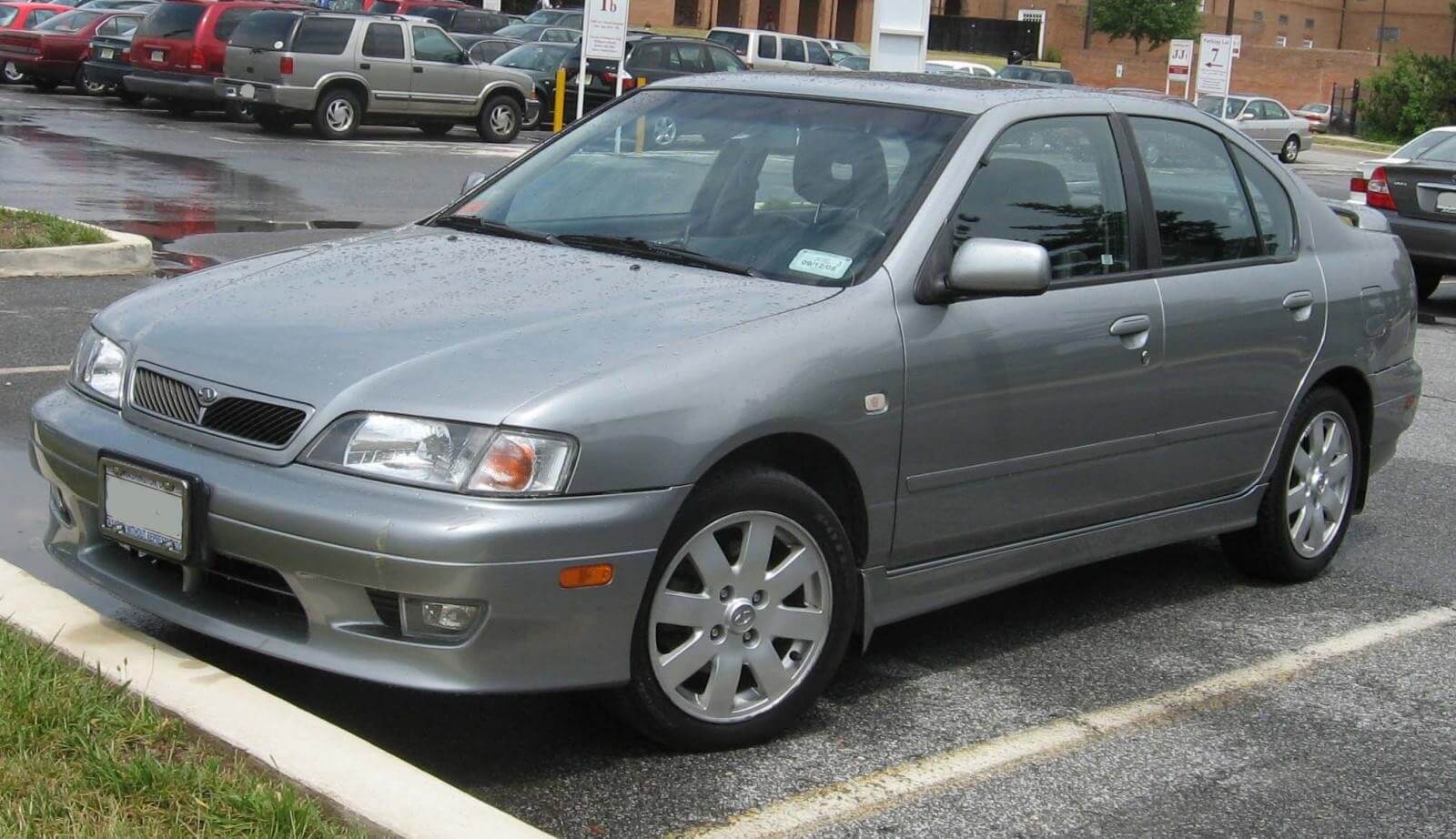
The G20, derived from the Nissan Primera, arrived in September 1990 as an entry model. The J30 saloon of the 1993 model year, with a 157 kW (210 hp) VG30DE V6, sold poorly. In 1996 the front-wheel-drive I30 replaced it, and at the end of the same year the brand released the QX4, based on the Nissan Pathfinder and one of the first luxury SUVs. A second-generation G20 followed in the summer of 1998.
2000s: the G35 and the FX change the brand
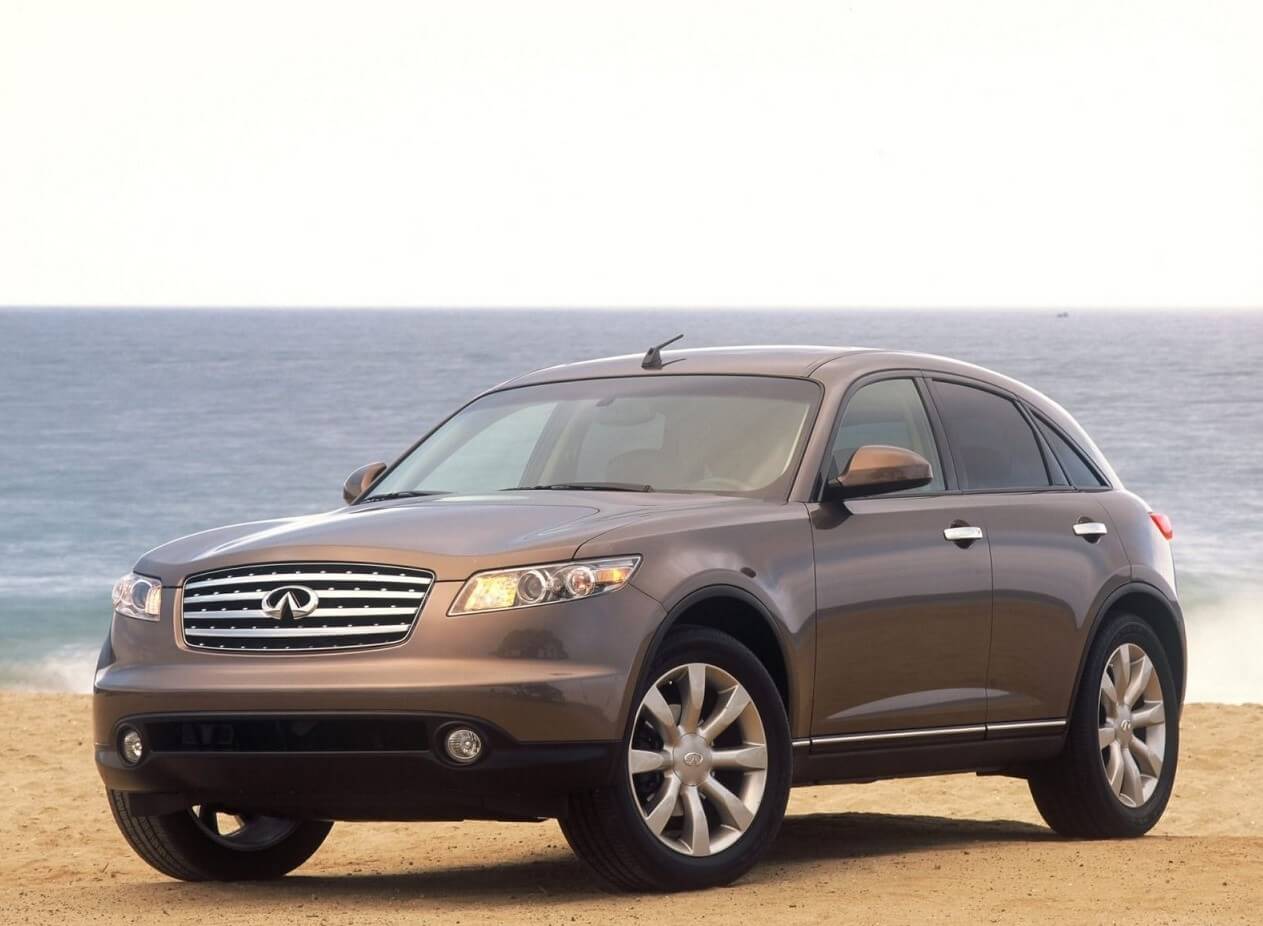
For 2001 the I30 became the I35 with a 193 kW (259 hp) VQ35DE V6. A redesigned Q45 arrived for the 2002 model year. The turning point was the G35 of 2003, closely related to the Nissan Skyline: Motor Trend named it Car of the Year 2003, and it lifted the brand's sales. The same year brought the FX, a sporty crossover built on G35 components. The large QX56, based on the US Nissan Armada, followed in 2004, and the compact EX crossover in December 2007.
2010s: global expansion and new names
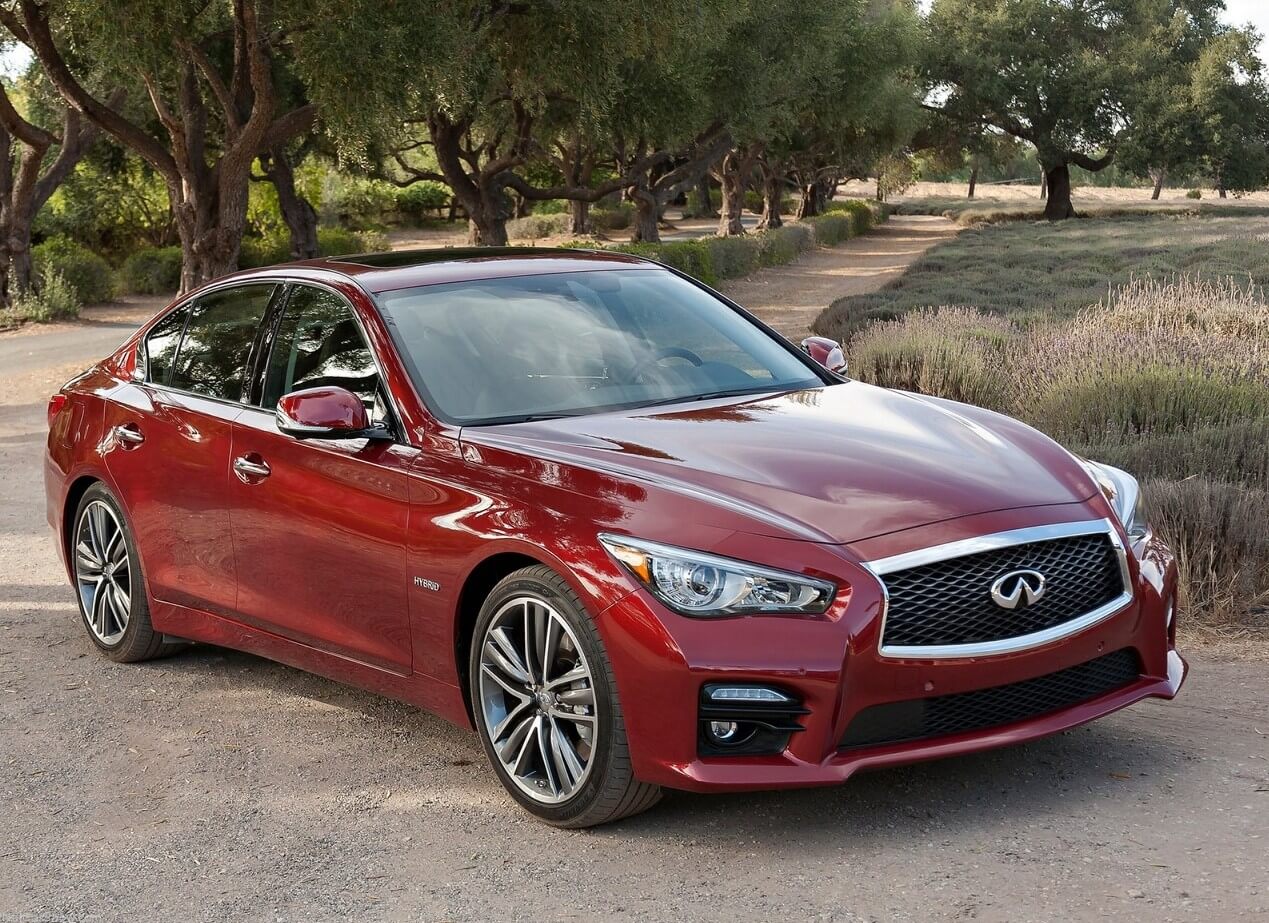
A new M debuted at the 2010 Geneva show, also with a hybrid version. In 2012 the brand moved its headquarters from Yokohama to Hong Kong as Infiniti Global Limited, and on 17 December 2012 it announced new names. Saloons and coupés became Q models and crossovers became QX: the G saloon became the Q50, the G coupé the Q60, the M the Q70, the EX the QX50, the FX the QX70, the JX the QX60 and the QX56 the QX80.
The brand spread to Europe and China. In 2014 the joint venture with Dongfeng began building two models in Xiangyang, China, and in 2015 the Infiniti Q30 compact went into production at Nissan's plant in Sunderland, England. In Japan, the Skyline carried Infiniti badges from 2014.
The partnership between Renault, Nissan and Daimler shaped this period. The Q30 and its raised twin, the QX30, used the platform of the Mercedes-Benz A-Class, and from 2017 the second-generation QX50 was built at a Nissan–Daimler joint-venture plant in Mexico, alongside the Mercedes-Benz GLB. The Q50 and Q60 used Mercedes four-cylinder turbo engines in some markets, while the larger models kept Nissan's VQ V6 and VK V8 engines.
2019 to today: retreat and electrification
Sales peaked in 2017 and then fell. In 2019 the company announced its exit from Western Europe, citing weak sales and uncertainty over Brexit. Sunderland stopped building Infiniti models in mid-2019, the brand left European markets in 2020, and exits from Australia and New Zealand followed. In 2020 the headquarters returned to Yokohama.
In January 2018 the brand said every new model from 2021 would be hybrid or electric, and in November 2021 it set the goal of a fully electric range by 2030. The Q50 saloon ended in August 2024, leaving only SUVs. In January 2025 the company confirmed that the QX50 and QX55 would end production in December 2025, with a coupé-styled QX65 planned as their replacement.
Models that shaped the brand

| Model | Years | Why it matters |
|---|---|---|
| Q45 | 1989–2006 | Launch flagship with a 207 kW V8 |
| G20 | 1990–2002 | First entry-level model, from the Nissan Primera |
| QX4 | 1996–2003 | One of the first luxury SUVs |
| G35 | 2002–2007 | Motor Trend Car of the Year 2003, turned the brand around |
| FX | 2003–2017 | Sporty crossover, later QX70; see the FX37S |
| QX56 / QX80 | 2004– | Full-size SUV and today's flagship |
| Q50 | 2013–2024 | First model under the new names; last Infiniti saloon |
Motorsport and engineering
From 2011 Infiniti sponsored the Red Bull Racing Formula One team, which won the drivers' and constructors' titles with Sebastian Vettel in 2011, 2012 and 2013. Vettel became the brand's first global ambassador in 2011. The sponsorship ended after the 2015 season, and from 2016 the brand worked with the Renault F1 team on engineering projects such as the energy recovery system.

On the road, the brand's best-known engineering feature is the variable-compression VC-Turbo engine, which went into series production in the Infiniti QX50 for the 2019 model year.
Infiniti compared with Lexus and Acura
All three Japanese luxury brands began in the United States between 1986 and 1989. Lexus has grown into the largest of them, while Infiniti stayed the smallest and closest to its parent's engineering. Compared with its 2017 peak of 246,492 sales, Infiniti sold 58,070 cars in the US in 2024, while the QX60 remained its best-seller with 27,808. Rival models can be checked side by side in the 1cars comparison tool.
Sales figures since 2016

| Year | Worldwide sales |
|---|---|
| 2016 | 230,366 |
| 2017 | 246,492 |
| Year | US sales | Note |
|---|---|---|
| 2017 | 153,415 | Peak year |
| 2024 | 58,070 | QX60: 27,808; QX50: 10,722; QX55: 3,721 |
The SUV-only range of 2026
| Model | Segment | Body | Years |
|---|---|---|---|
| QX60 | Mid-size luxury SUV | Three-row SUV | 2013– (second generation from 2021) |
| QX80 | Full-size luxury SUV | Three-row SUV | 2004– as QX56/QX80 |
| QX65 | Mid-size luxury SUV | Coupé-styled SUV | Announced as the QX50/QX55 successor |
| QX50 | Compact luxury SUV | SUV | 2013–2025 under this name |
All models, including past ones such as the Q60 coupé, are listed in the Infiniti catalogue.

Which Infiniti to choose today
For a new car, the choice is between SUVs. The three-row QX60 is the family pick and the brand's best-seller, and the QX80 suits buyers who need full-size space and a high towing capacity. On the used market, the G35 and G37 and the early Q50 remain the drivers' cars, with rear-wheel drive and V6 power; in Europe, the Q30 and QX30 are the most common, sharing much of their engineering with the Mercedes-Benz A-Class. Parts and servicing for Nissan-based models are widely available, while European-only versions need more care in sourcing parts.

FAQ
Who owns Infiniti today?
Infiniti is owned by Nissan Motor Co. and has been its luxury division since the brand's launch in 1989. Its headquarters are in Yokohama, Japan, close to Nissan, after a spell in Hong Kong from 2012 to 2020.
When was Infiniti founded and by whom?
Nissan created Infiniti and launched it in North America on 8 November 1989, with the Q45 saloon and the M30 coupé. The aim was to compete with Lexus, Acura and the established European luxury brands.
Where are Infiniti cars made?
Most Infinitis come from Nissan plants in Japan and North America. Some were built in Sunderland, England, from 2015 to 2019 and by the Dongfeng joint venture in Xiangyang, China, from 2014.
What does the Infiniti logo mean?
According to Nissan, the logo shows a stylised road stretching to the horizon, which also reads as Mount Fuji, a reference to the brand's Japanese origins. Japan itself only received Infiniti-badged cars from 2014.
What is the most famous Infiniti model?
The G35 is the best-known: it was Motor Trend Car of the Year in 2003 and turned the brand around. The Q45 launch car and the FX crossover are also landmark models, while the QX60 is the best-seller today.
Photos (10)