Tatra Cars: Every Passenger Model from Präsident to T700
Tatra built passenger cars in Kopřivnice from the 1897 Präsident until the T700 ended in 1999. The best-selling models were the T603 (20,422 built), the T613 and the small T12. The most famous are the streamlined T77 and T87 of the 1930s. All the later cars had air-cooled engines, most of them mounted at the rear.

Key takeaways
- 1897–1919: the Präsident and the early Nesselsdorf cars, sold under the Tatra name from 1919.
- 1923–1949: Hans Ledwinka's backbone-chassis cars, T11, T12 and T57, plus large six- and twelve-cylinder models.
- 1934–1950: the rear-engined streamliners T77, T87 and T97; the T87 had 3,056 cars built.
- 1948–1999: Tatraplan, T603, T613 and T700, mostly official cars, until production ended.

This page is a guide to the cars, model by model. The company story, including trucks, wartime events and today's owners, is in our history of Tatra.
Tatra car facts
| Fact | Value |
|---|---|
| Factory | Kopřivnice (Nesselsdorf), Moravia, Czech Republic |
| First car | Präsident, 1897 |
| Tatra name on cars | from 1919 |
| Key designer | Hans Ledwinka, chief designer 1921–1937 |
| Typical layout | central backbone tube, swing axles, air-cooled engine |
| Best-selling car | T603, 20,422 built (1956–1975) |
| Last car | T700, production ended in 1999 |
Präsident and the Nesselsdorf cars (1897–1919)
The company began in 1850 as Ignác Šustala's carriage works and later built railway wagons. In 1897 it produced the Präsident, one of the first cars made in Central Europe. It had a two-cylinder Benz engine driving the rear wheels by belts and reached about 30 km/h, according to the old 1cars text.
The first car of the factory's own design followed in 1900. The old 1cars text calls it the Type A, with a 2.7-litre engine and a top speed of about 40 km/h, and the encyclopedia account of the company counts 22 built. Until 1919 the cars carried the Nesselsdorf name; the Tatra badge followed in 1919, after Czechoslovakia was founded.
Ledwinka's backbone cars: T11, T12 and T57
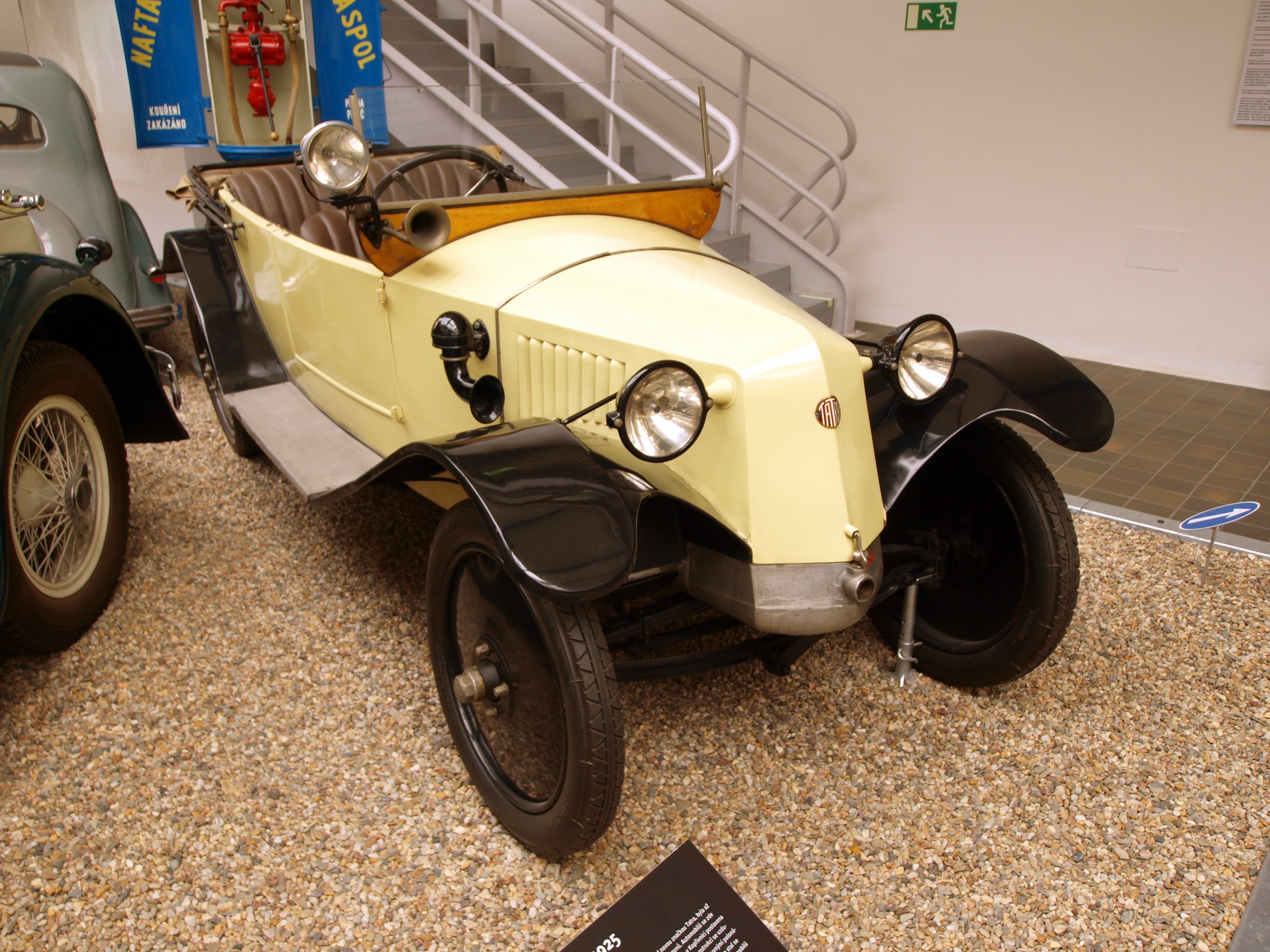
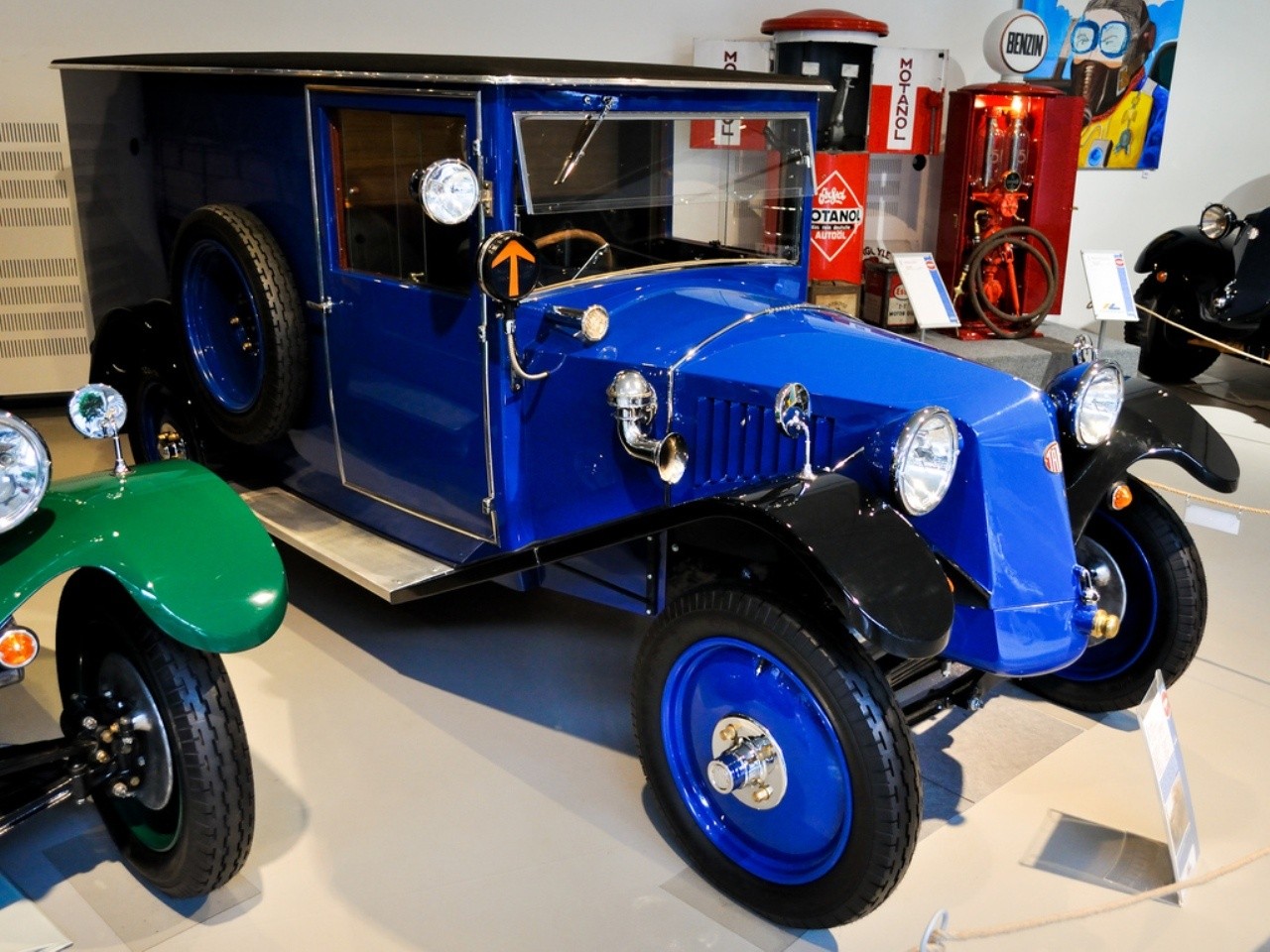
Hans Ledwinka designed the T11 while he was still working for Steyr, and Tatra launched it in 1923. Its frame was a single central tube with the propeller shaft running inside. The rear wheels hung on swing half-axles, so no flexible drive joints were needed. The air-cooled flat-twin engine had 1,057 cc and overhead valves. From 1923 to 1927, 3,847 were built.

The T12 replaced it and stayed in production until 1936. With 7,222 cars, it was the best-selling pre-war Tatra. The T57, nicknamed "Hadimrška", kept the closed nose of the T11 and T12 but used a four-cylinder engine.
| Model | Years | Engine | Power | Built |
|---|---|---|---|---|
| T11 | 1923–1927 | 1,057 cc flat-twin | not published | 3,847 |
| T12 | to 1936 | flat-twin | not published | 7,222 |
| T57 | 1932–1936 | 1,155 cc flat-four | 13 kW (18 PS) | no total published |
| T57A | 1936–1938 | 1,155 cc flat-four | 15 kW (20 PS) | – |
| T57B | 1938–1949 | 1,256 cc flat-four | 18 kW (25 PS) | – |
| T57K | 1941–1947 | 1,256 cc, military | 17 kW (23 PS) | 5,415 (1941–1945) |
The 57K was an open military car built during the occupation. Its production is the one T57 figure the encyclopedia gives in full.
Large Tatras of the 1920s and 1930s
The backbone idea also went into larger cars. The old 1cars text describes the T17 as a two-litre six-cylinder car with independent suspension on all four wheels. In 1931 Tatra fitted a six-litre V12 with overhead valves to its largest model, the T80, which the old text describes as a luxury car. These cars were built in small numbers for wealthy buyers and the state. Exact production totals are not published in the sources we used.

The streamliners: T77, T87 and T97
The T77 of 1934 was the first series car designed for low air resistance. Its body had a long tail, a steerable third headlamp and a rear-mounted, air-cooled V8 of about 3.0 litres. A 1:5 model of the shape later measured a drag coefficient of 0.2455, an extraordinary figure for the period. The T77a version reached about 160 km/h.

The T87 of 1936 refined the same layout. Its 2,969 cc V8 gave 85 hp (63 kW), and its kerb weight was 1,370 kg. It reached nearly 160 km/h and used about 12.5 l/100 km. Comparable cars of its class needed about 20 l/100 km, so by our calculation the T87 used roughly 37 % less fuel. Our fuel economy converter turns such figures into mpg. A full-size T87 measured 0.36 in a wind tunnel in 1979; the 0.244 figure comes from a 1941 scale model. Hans Ledwinka designed it with Erich Übelacker, and 3,056 were built until 1950.
The T97 of 1936–1939 was the small member of the family, with a rear flat-four engine. Its shape and layout were close to those of the later Volkswagen Beetle. Tatra's claim against Volkswagen was settled after the war; the history page gives the details.
| Model | Years | Engine | Notable figure |
|---|---|---|---|
| T77 / T77a | 1934–1938 | rear V8, about 3.0 l | first aerodynamic series car |
| T87 | 1936–1950 | rear V8, 2,969 cc, 63 kW | 3,056 built, 12.5 l/100 km |
| T97 | 1936–1939 | rear flat-four | smaller streamliner |
Tatraplan and the T603: the post-war cars
After the war, Tatra launched the T600 Tatraplan, finished as a prototype in 1946. It had a rear flat-four of 1,952 cc and a drag coefficient of 0.32. Production ran from 1948 to 1952, and 6,342 were made. In 1951 the state planners moved car production to Škoda in Mladá Boleslav, which built 2,100 of the total, and told Tatra to concentrate on trucks.

Tatra returned to cars with the T603 in 1956. It had a 2.5-litre air-cooled V8 at the rear and weighed about 1,400 kg. The first version had three headlamps behind one glass cover; the middle lamp turned with the steering. The 2-603 of 1962 switched to four headlamps. With 20,422 built until 1975, the T603 is the best-selling Tatra car. Most went to senior officials, and about a third were exported.
T613, T700 and the MTX: the last Tatra cars
The T613 was styled by Vignale in 1968 and entered production in 1974. Its 3,495 cc V8 had twin overhead camshafts and sat behind the rear axle. The carburettor version gave 124 kW (168 PS) and reached 190 km/h. The fuel-injected 613-4 gave 147 kW (200 PS).
| Version | Years | Built |
|---|---|---|
| Tatra 613 | 1974–1980 | 4,581 |
| 613-2 | 1980–1984 | 1,045 |
| 613-3 | 1985–1991 | 903 |
| 613-4 | 1991–1996 | 191 |
| 613-5 | 1993–1994 | 4 prototypes |
By our calculation, the version figures add up to about 6,720 cars. The encyclopedia overview, and our history page, give about 11,000. The difference may come from special versions not listed by series, so we show both figures.
The T700 replaced the T613 in 1996 as an updated car with a revised front. Only about 70 were made before car production stopped in 1999. The MTX V8 sports car of the early 1990s was a separate small project: the history page lists five cars with 225 kW and 265 km/h.
Tatra car models at a glance
| Model | Years | Engine layout | Built |
|---|---|---|---|
| Präsident | 1897 | Benz twin | not published |
| T11 | 1923–1927 | front flat-twin, backbone | 3,847 |
| T12 | to 1936 | front flat-twin, backbone | 7,222 |
| T57 family | 1932–1949 | front flat-four, backbone | 5,415 (57K only) |
| T87 | 1936–1950 | rear V8 | 3,056 |
| T600 Tatraplan | 1948–1952 | rear flat-four | 6,342 |
| T603 | 1956–1975 | rear V8 | 20,422 |
| T613 | 1974–1996 | rear V8 | 6,720–11,000 |
| T700 | 1996–1999 | rear V8 | about 70 |
Which classic Tatra to look for: our view
- For the design story: a T87. It is the best-known streamliner, with 3,056 built, and its fuel figures still impress.
- For everyday classic use: a T603 or 2-603. It is the most common Tatra car, and its V8 and cabin suit long journeys.
- For a 1970s–90s classic: a T613. It is far more common than the streamliners, and the later versions have better equipment.
- For early technology: a T11 or T12, the first cars with the backbone chassis and swing axles.
Air-cooled rear-mounted V8s need specialist care, so check for a full service history and a mechanic who knows the engines. Period power figures in PS or hp can be turned into kW with our power converter. More cars from the region are in our Czech cars list, and the current Tatra trucks are in the Tatra catalogue.
FAQ
What was the first Tatra car?
The first car from the Kopřivnice works was the Präsident of 1897, built under the Nesselsdorf name with a two-cylinder Benz engine. The Tatra name was used on the cars from 1919, and the T11 of 1923 was the first car with Ledwinka's backbone chassis.
How many Tatra 87s were made?
Tatra built 3,056 T87s between 1936 and 1950. The car had a rear-mounted 2,969 cc air-cooled V8 with 63 kW (85 hp), a kerb weight of 1,370 kg and a top speed of nearly 160 km/h.
Which Tatra car was built in the largest numbers?
The T603, with 20,422 cars built from 1956 to 1975. It had a rear-mounted air-cooled V8 of about 2.5 litres and was used mainly by senior officials. About a third of production was exported.
When did Tatra stop making cars?
Car production ended in 1999 with the T700, a reworked T613 of which only about 70 were built. Since then Tatra has built only trucks, such as the Tatra 815 family.
Why did Tatra cars have the engine at the back?
Hans Ledwinka and his team wanted a smooth, low-drag body, and a rear engine freed the nose for a streamlined shape. From the T77 of 1934 to the T700, almost every Tatra car used an air-cooled engine mounted at the rear.