
 Tatra 815
Specs, engines and history
Updated Published Sources (1) Report an error
By Oleksandr Hnatiuk, Automotive Editor & Used Car Specialist Reviewed by Felix Hartmann

- Built
- 1983–2025
- Top power
- 440 kW (598 PS)
Who the Tatra 815 suits: verdict
Our verdict · Oleksandr Hnatiuk
The 815 suits operators who work off road: quarries and mines, oil and gas fields, forestry, expeditions and emergency services. Its strengths are traction, ground clearance, durability and an engine range that includes air-cooled units for extreme climates. Its drawbacks are higher purchase cost, a heavier chassis than a road truck and the need for workshops that know the backbone design.
When buying a used truck, check the swinging half-axles and their bushes, the oil levels and seals in the backbone tube, the condition of the air-cooled engine's cooling fan and fins, and the transfer case. Later 815-2 and TerrNo1 trucks with synchronised gearboxes and ABS are easier to drive. Other Tatra models are listed in the Tatra catalogue.
The Tatra 815 is a heavy truck built by Tatra in Kopřivnice, Czech Republic, from the early 1980s until 25 February 2025. It is known for its central backbone tube with independently sprung swinging half-axles and for air-cooled V8, V10 and V12 diesels, later joined by water-cooled engines. Offered from 4x4 up to 12x12, it reached about 158,000 units.
In short
- Series production from 1982–1983 (sources differ) to February 2025, replacing the Tatra 148 and 813; about 158,000 built.
- Chassis: central load-carrying tube with swinging half-axles, torsion bars at the front and leaf or air springs at the rear.
- Engines: air-cooled T3 family from 170 kW (12.7-litre V8) to 265 kW (19.0-litre V12 turbo), later V8 turbos up to 300 kW; water-cooled Deutz and Cummins options of 260–440 kW.
- Karel Loprais won the Dakar Rally six times in a T815; successors are the Tatra 158 Phoenix and the military 817 Force.

Tatra 815 at a glance
Tatra, founded in Moravia and one of the oldest vehicle makers in the world, has used the backbone-tube concept since the 1920s. The 815 brought it into the age of tilting forward-control cabs and turbocharged diesels. It was built for construction, mining, oil and gas work, forestry, municipal services, rallies and military use, and was exported across Europe and to the Americas, Asia, Africa and Australia. The company's story is in the history of Tatra.

| Fact | Value |
|---|---|
| Maker | Tatra, Kopřivnice, Czech Republic |
| Production | 1982/1983 – 25 February 2025 |
| Units built | About 158,000 |
| Predecessors | Tatra 148 and Tatra 813 |
| Chassis | Central backbone tube, swinging half-axles |
| Configurations | 4x4, 6x6, 8x8, 10x8, 10x10, 12x8, 12x12 |
| Engines | Air-cooled Tatra V8/V10/V12; water-cooled Deutz, Cummins |
| Gross weight | Up to 35,500 kg |
| Successors | Tatra 158 Phoenix (civil), Tatra 817 Force (military) |
Development and timeline
Work on the 815 began in the early 1970s. A first prototype was running by 1974 at the latest, with further prototypes in 1976 and 1977. A pre-series of four to five trucks a month started in 1981, and full series production followed when the Tatra 148 and 813 ended. Updates kept the truck current for more than four decades.

| Year | Change |
|---|---|
| 1974–1977 | Prototypes |
| 1981 | Pre-series production |
| 1982–1983 | Series production begins |
| 1989 | Tatra 815-2 introduced |
| 1994 | 815-2 upgrade |
| 1997 | TerrNo1 cab and model family |
| 2000 | New instrument panel and cab mounting; liquid-cooled engine option |
| 2003 | T3C V8 for Euro III |
| 2006 | T3D engine with SCR for Euro IV |
| July 2010 | Latest cab facelift |
| 25 February 2025 | End of production |
The backbone chassis and swinging half-axles
Instead of a ladder frame, the Tatra 815 uses a central tube that carries the drivetrain inside it. The gearbox, transfer case and differentials are bolted together into this backbone, and each wheel hangs on a swinging half-axle. The differentials use two opposing spiral bevel gears, which lets Tatra build trucks with any number of axles from the same modules.

The result is a chassis that is very stiff in torsion, keeps all wheels in contact with uneven ground and protects the driveshafts inside the tube. Front axles use torsion bars; rear axles have leaf springs or air suspension. Axle load capacity runs from 8 tonnes per axle with torsion bars up to 16.5 tonnes with the heaviest suspension. Steering is mechanical with hydraulic assistance, and trucks with two front axles steer both. The brakes are dual-circuit pneumatic with drums and ABS, which is now standard.
Air-cooled V8, V10 and V12 engines
The classic 815 engines are Tatra's own air-cooled diesels of the T3 series, all with a bore of 120 mm and a stroke of 140 mm. Air cooling removes the radiator and coolant, which helps in extreme heat and cold.

| Engine | Layout | Displacement | Power | Torque |
|---|---|---|---|---|
| T3-928 | V8, naturally aspirated | 12,667 cc | 170 kW (231 PS) | 840 Nm |
| T3-929 | V10, naturally aspirated | 15,825 cc | 208 kW (283 PS) | 1,010 Nm |
| T3-930-30 | V12, naturally aspirated | 19,001 cc | 235 kW (320 PS) | 1,130 Nm |
| T3-930-53 | V12, turbocharged | 19,001 cc | 265 kW (360 PS) | 1,295 Nm |
| T3B-928-50 | V8, turbo, Euro II | 12,667 cc | 230 kW (313 PS) | 1,400 Nm |
| T3B-928-60 | V8, turbo, Euro II | 12,667 cc | 255 kW (347 PS) | 1,570 Nm |
| T3B-928-70 | V8, turbo, Euro II | 12,667 cc | 300 kW (408 PS) | 1,830 Nm |
Later V8 engines with turbocharging and charge-air cooling cover 230–325 kW and 1,400–2,100 Nm. For buyers who preferred water-cooled engines, Tatra offered Deutz and Cummins units, among others, from 260 to 440 kW with 1,550–2,750 Nm. The engine is mated to a single-plate dry clutch and a five-speed gearbox with a range group; heavy tractors and special trucks add a two-speed transfer case for 20 forward gears. Most versions are all-wheel drive, some with a front axle that can be disconnected, and the rear and transfer differentials can be locked.
Cabs and body types
The 815 introduced Tatra's tilting forward-control cab, offered in short, medium and double-cab versions. In 1997 the TerrNo1 family brought a new cab and a modernised design, and the cab was facelifted again in July 2010. The old 1cars text describes cold-climate trucks with an extra cab heater, engine and oil pre-heaters, an air-sprung driver's seat and air conditioning on some versions.

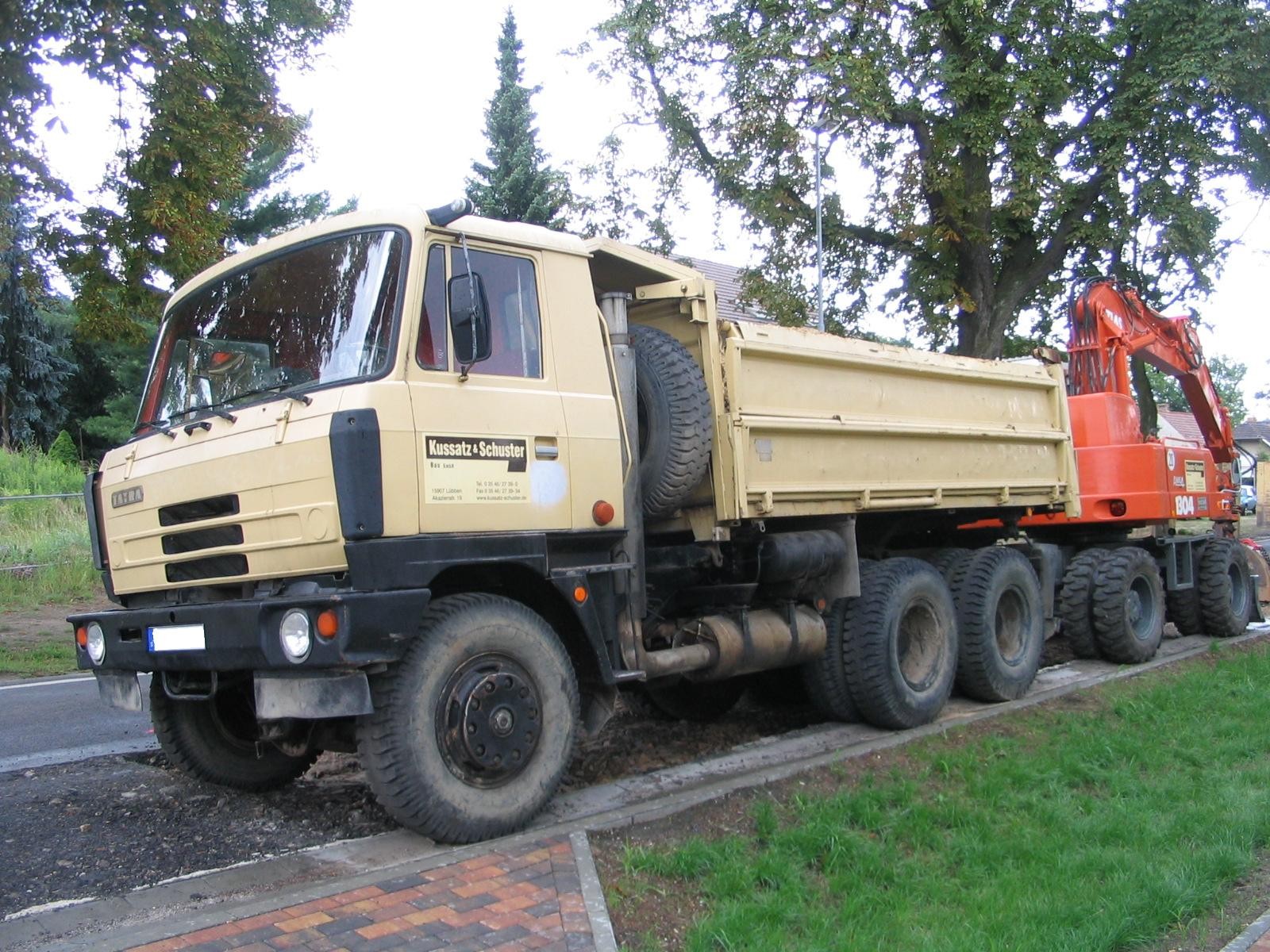
Body types include three-way tippers, rear tippers, flatbeds, semi-trailer tractors, tractors with a flatbed, truck cranes on five-axle and longer chassis, and special bodies. According to the old 1cars text, a typical tipper version has a cargo platform about 2,400 mm wide and 4,310 mm long, carries close to 17 tonnes and has a gross weight of 28,500 kg, with up to 44 tonnes as a road train.
Racing: six Dakar wins
The Tatra 815 made its name far beyond building sites. Czech driver Karel Loprais won the Dakar Rally six times in the truck class with a T815, which made the backbone chassis famous among rally fans. Its ability to keep all wheels on the ground at speed over rough terrain suited desert racing well.

Tatra 815 compared with other heavy trucks
| Model | Chassis | Engines | Power | Axles |
|---|---|---|---|---|
| Tatra 815 | Backbone tube, swinging half-axles | Air-cooled Tatra V8–V12; Deutz, Cummins | 170–440 kW | 4x4 to 12x12 |
| Ural-4320 | Ladder frame | KamAZ and YaMZ diesels | 132–177 kW | 6x6 |
| MAN TGS | Ladder frame | MAN D20 and D26 | 235–397 kW | 4x2 to 8x8 |
The Tatra has the widest spread of axle layouts and power of the three, and its chassis concept is unique among series trucks. On paved roads a European road truck such as the MAN or the Volvo FH is more comfortable and economical; off road and in heavy mining work, the Tatra's independent wheel travel is its advantage. The most powerful trucks ranking shows where its strongest engines sit, and the KamAZ-4310 versus Ural-4320 comparison covers two conventional 6x6 rivals.


Rivals
Compare with…
Compare Tatra 815 with
- Ural-Next quick spec comparison
- KamAZ Arctic quick spec comparison
- KrAZ-260 quick spec comparison


Tatra 815 in our rankings
More powerful than 91% of ranked trucks in the 1CARS catalog (No. 5 of 56).
Tatra 815 photos 14



FAQ
When was the Tatra 815 produced?
Prototypes ran from 1974, a pre-series started in 1981 and series production began in 1982–1983, depending on the source. Production ended on 25 February 2025 after about 158,000 trucks.
What engine does the Tatra 815 have?
Most trucks use Tatra's air-cooled T3 diesels: a 12.7-litre V8, a 15.8-litre V10 or a 19.0-litre V12, from 170 to 300 kW. Water-cooled Deutz and Cummins engines of 260–440 kW were also offered.
What is special about the Tatra 815 chassis?
It uses a central backbone tube that houses the drivetrain, with each wheel on a swinging half-axle. This gives high torsional stiffness, independent wheel travel and modular construction from 4x4 up to 12x12.
How many times did the Tatra 815 win the Dakar Rally?
Karel Loprais won the Dakar Rally truck class six times driving a Tatra T815. These results, on some of the hardest terrain in motorsport, made the truck known to rally fans worldwide.
What replaced the Tatra 815?
The civilian Tatra 158 Phoenix and the military Tatra 817 Force are its successors. The 815 itself remained in production alongside them for several years, until the last truck was built in February 2025.
Data sources
Data checked by an editor against the sources below.
- Wikipedia - Tatra 815


