Tatra: The Czech Maker of Streamliners and Trucks
Tatra is a Czech vehicle maker based in Kopřivnice, founded in 1850 as a coach-building firm. It built the Präsident, Central Europe's first factory-made petrol car, in 1897, became famous in the 1930s for Hans Ledwinka's streamlined T77 and T87, stopped making cars in 1999 and today builds off-road trucks.

Key takeaways
- Founder Ignác Šustala (Ignaz Schustala) began with horse-drawn carriages in 1850; the Tatra badge, named after the Tatra Mountains, arrived in 1919.
- Engineer Hans Ledwinka created the backbone-tube chassis with swing axles (T11, 1923) and the rear-engined aerodynamic cars T77 (1934) and T87 (1936).
- After the war Tatra built the T600 Tatraplan, the T603 and the T613; the last car, the T700, ended production in 1999.
- The trucks, led by the T815, won the Dakar Rally six times with Karel Loprais; the company is now majority-owned by Czechoslovak Group.

Tatra at a glance
| Fact | Value |
|---|---|
| Founded | 1850, Kopřivnice (then Nesselsdorf, Moravia) |
| Founder | Ignác Šustala |
| First car | Präsident, 1897 |
| Brand name | Tatra, used from 1919 |
| Headquarters | Kopřivnice, Czech Republic |
| Owners | Czechoslovak Group (65%) and Promet Group (35%), since 2013 |
| Products today | heavy off-road and military trucks (T158 Phoenix, T815 family, Force) |
| Known for | backbone-tube chassis, air-cooled engines, streamlined rear-engined cars |
The company is often described as the third-oldest vehicle maker with an unbroken history, after Peugeot and Daimler's predecessor companies. It changed its name many times, but it stayed in the same town for more than 170 years.

Origins: carriages, railway cars and the Präsident
Ignác Šustala founded his business in Kopřivnice, which was then known by its German name Nesselsdorf, in 1850. It made horse-drawn carriages and, from the 1880s, railway cars. In 1890 it became a joint-stock company, Nesselsdorfer Wagenbau-Fabriks-Gesellschaft, with Hugo Fischer von Röslerstamm as technical director. Šustala died in 1891.
In 1897 the works built the Präsident, using a Benz engine. It was the first factory-built car with a petrol engine in Central and Eastern Europe, and nine improved versions followed up to 1900. The first truck came in 1898, with two 2.7-litre engines and a 2.5-tonne payload.
The young Hans Ledwinka, born in 1878 near Vienna, joined the works and designed his first complete car, the Nesselsdorf type A, in 1900; 22 were built. The type S of 1905 had a 3.3-litre four-cylinder engine, and the first bus, the Omnibus SO, appeared in 1910.
Hans Ledwinka and the backbone chassis
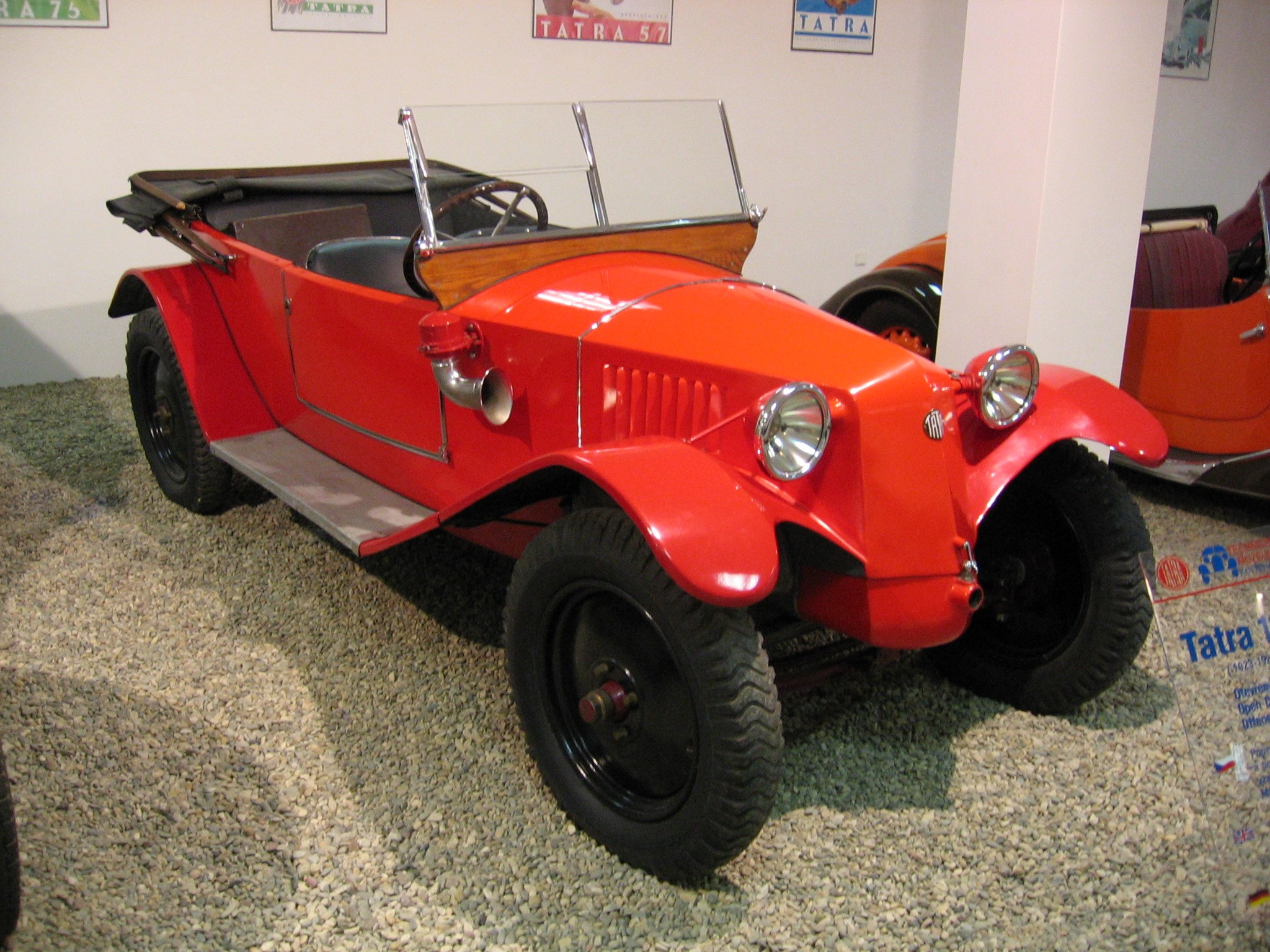
Ledwinka left for Steyr in Austria in 1916 and came back in 1921 to run the passenger car division, where he was chief designer until 1937. His key idea was the Tatra 11 of 1923: a central backbone tube carrying the drivetrain, swing half-axles and an air-cooled two-cylinder engine at the front. The design was light, stiff and simple to repair, and it suited bad roads.

The same concept moved into trucks and stayed there. The T111 heavy truck of 1942 used it, and every modern truck from Kopřivnice still rides on a central tube with independent swing axles. Ledwinka's son Erich later used the idea in the Steyr-Puch Haflinger and Pinzgauer.
The old 1cars text said the brand name came from a test drive through the Tatra Mountains. The company adopted the Tatra badge in 1919, named after the mountains, after its cars had proved themselves on the steep roads there.
Streamlined cars of the 1930s: T77, T87 and T97
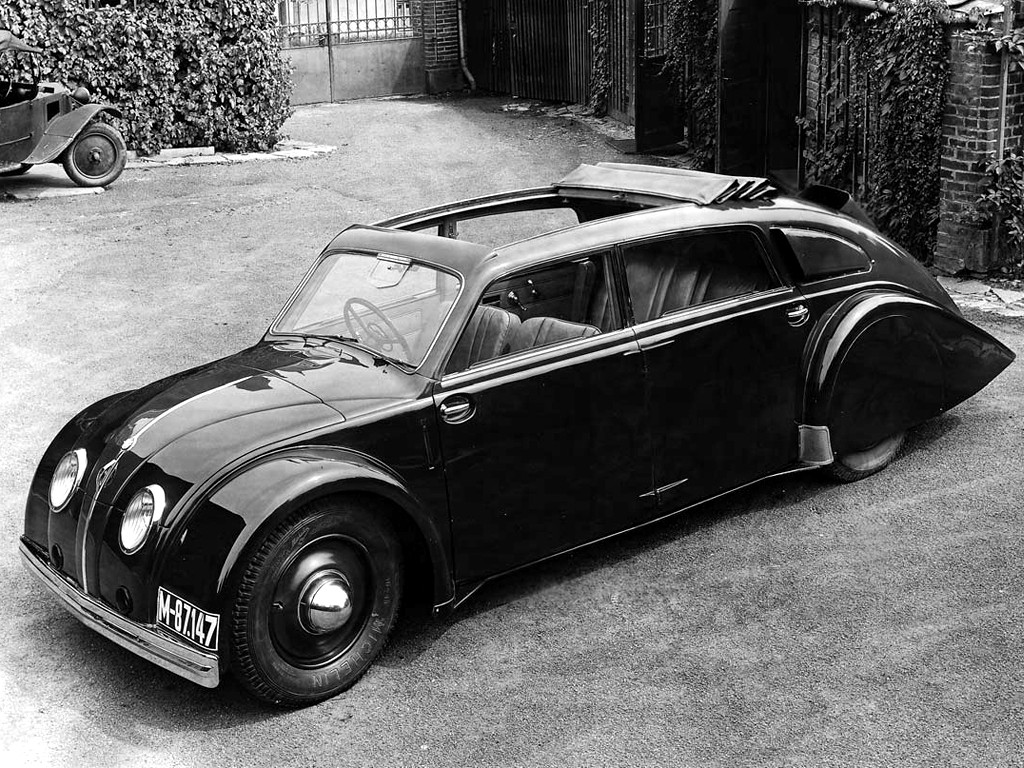
In the 1930s Ledwinka, his son Erich and engineer Erich Übelacker turned the passenger car into a rear-engined streamliner. The T77 of 1934 is regarded as the first production car designed around aerodynamics: a 1:5 model measured a drag coefficient of 0.2455. It had an air-cooled V8 at the back of a long, smooth body.
The T87 (1936–1950) refined the idea with a 3.0-litre air-cooled V8 and a dorsal fin, and the smaller T97 (1936–1939) used a flat-four. The T97 looked close enough to Ferdinand Porsche's KdF-Wagen, the future Volkswagen Beetle, that Tatra sued. After the war, in 1965, Volkswagen paid the Ringhoffer family one million Deutsche Mark to settle the patent dispute.
The brand's small cars of the period, such as the T57 (from 1932), sold steadily, while the T80 (1931–1935) with a V12 was the luxury flagship.
War, nationalisation and Ledwinka's trial
Germany occupied the Czech lands in 1938–1939, and the factory's production was directed to military trucks for the occupying forces; the T87 became a favourite car of German officers. In 1945 the works was nationalised, and from January 1946 it traded as Tatra národní podnik.
Ledwinka was arrested in 1945 and accused of collaboration. In 1948 he was sentenced to six years in prison (the old 1cars article said five), and he was released in 1951 because of his age and health. He refused to work for Tatra again, moved to Vienna and then to Munich, and died there on 2 March 1967. In 1992 the Czechoslovak Supreme Court cleared his name.
Post-war cars: Tatraplan, T603, T613 and T700
Under the planned economy the company kept building large, rear-engined cars, mostly for officials and state organisations:
- T600 Tatraplan (1948–1952): a streamlined four-cylinder saloon; in 1951 its production was moved to Škoda in Mladá Boleslav.
- T603 (1956–1975): a rear air-cooled V8 saloon with three headlamps behind a glass panel in early versions, nicknamed the "flying saucer on wheels" by some admirers.
- T613 (1974–1996): a squarer V8 saloon styled with Vignale; more than 11,000 were built, and the fastest versions reached about 190 km/h.
- T700 (1996–1999): a final update of the T613, with only 69 to 72 cars built. Its end in 1999 closed the passenger car history of Kopřivnice.

The MTX Tatra V8 of 1991 was a mid-engined sports car built by a small firm around the factory's V8: five were built, with 225 kW, 0–100 km/h in 5.6 seconds and 265 km/h. The old 1cars text called it the fastest car of its time, which is not supported; a Ferrari F40 was far faster.
| Model | Years | Why it matters |
|---|---|---|
| Präsident | 1897 | first factory-made petrol car in Central Europe |
| T11 | 1923–1927 | backbone-tube chassis with swing axles |
| T77 | 1934 | first series car designed for low drag |
| T87 | 1936–1950 | 3.0 V8 streamliner, the brand's best-known car |
| T111 | 1942–1962 | heavy truck, 33,690 built |
| T603 | 1956–1975 | air-cooled V8 saloon for officials |
| T613 | 1974–1996 | last volume car, over 11,000 built |
| T815 | 1983– | off-road truck family, six Dakar wins |
The truck era: T138 to T815, Phoenix and Force
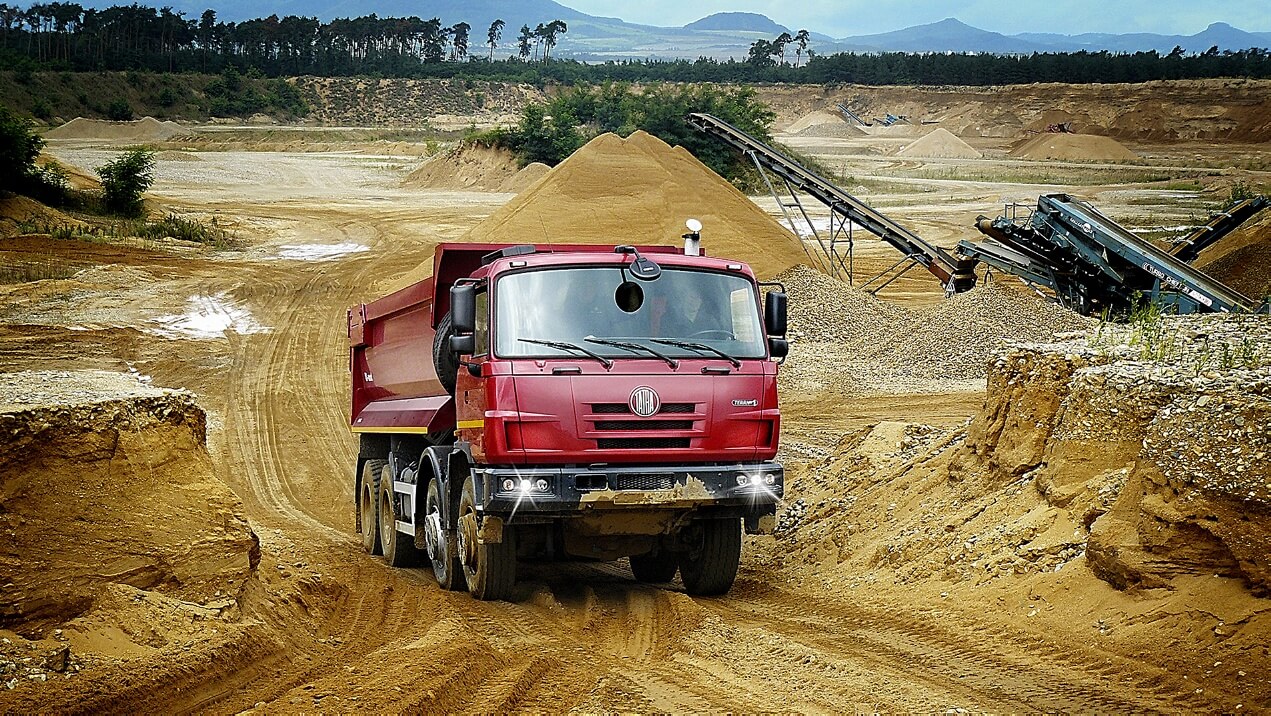
After 1950 trucks became the main business in Kopřivnice. The T138 (1956) and T148 (1972) were six-wheel tippers used across Eastern Europe. The T813 of 1967 was an eight-wheel tractor able to haul up to 100 tonnes. The Tatra 815, introduced in 1982 and built from 1983, became the base of almost all later models, from tippers to military and fire trucks. In the 1cars data its most powerful version, with 434 kW (590 PS), ranks fourth among the most powerful trucks in the catalogue (October 2026).

The 1990s and 2000s brought new lines and air-cooled engines that met Euro 3 (2003), Euro 4 (2006) and Euro 5 (2008) rules. The Force and 816 Armax military trucks followed a large contract with the United Arab Emirates in 1993. The T158 Phoenix combined the Tatra chassis with a DAF cab and a Paccar engine, in line with the partnership that gave DAF Trucks a 19% stake in August 2011.
Dakar Rally record
Karel Loprais, nicknamed "Monsieur Dakar", won the truck category of the Dakar Rally six times with the Tatra 815: in 1988, 1994, 1995, 1998, 1999 and 2001. The old 1cars text gave this record correctly.
Ownership changes and Tatra today
After the fall of communism, the firm became a joint-stock company and changed hands several times:
- 2003: the American Terex group bought about 71%;
- 2006: Tatra Holdings, with Vectra Limited among its members, took about 80.5%;
- 2011: DAF Trucks bought 19%;
- March 2013: Czechoslovak Group and Promet Group took control as the company faced the risk of bankruptcy.

The company sold only 722 vehicles in 2013. By 2016 it had revenue of CZK 5.4 billion and 1,658 employees, and in 2023 it planned to build more than 2,000 trucks. Its products serve mining, oil fields, construction, armies and fire services; in 2021, for example, the German Bundeswehr ordered 76 fire engines on the T815-7 chassis.
| Year | Event |
|---|---|
| 1850 | Ignác Šustala founds the firm in Kopřivnice |
| 1897 | Präsident car |
| 1898 | first truck |
| 1919 | Tatra badge adopted |
| 1923 | T11 with backbone chassis |
| 1934 | T77 streamliner |
| 1945 | works nationalised |
| 1983 | T815 production begins |
| 1999 | end of passenger car production (T700) |
| 2013 | Czechoslovak Group and Promet Group take over |
Collecting a Tatra car today
The streamlined cars are now collector's items, and the factory town keeps a large technical museum devoted to them. The T87 and T97 are the most sought-after and are rarely offered for sale. The T603 suits a collector who wants the air-cooled V8 experience in a car that can still be used on the road. The T613 is the most affordable way in and the easiest to find parts for. On any of them, the air-cooled engine needs a specialist: check for overheating, oil leaks and the condition of the cooling fans and belts.

More Czech makes are listed under Czech cars, and the neighbouring story of Mladá Boleslav is in the history of Škoda. The current truck range is in the Tatra catalogue.
FAQ
Who owns Tatra today?
Tatra Trucks belongs to Czechoslovak Group (65%) and Promet Group (35%), which took control in March 2013. Earlier owners after 1990 included the American Terex group from 2003 and a Tatra Holdings consortium from 2006.
When was Tatra founded and by whom?
Ignác Šustala founded the firm in Kopřivnice, Moravia, in 1850 to build horse-drawn carriages. It moved into railway cars in the 1880s and built its first car, the Präsident, in 1897.
Does Tatra still make cars?
No. The company ended passenger car production in 1999 with the T700, an update of the T613, of which only about 70 were built. Since then the company has built only trucks, chiefly off-road, mining and military models.
What does the Tatra name mean?
It comes from the Tatra Mountains on the Slovak–Polish border. The company adopted the badge in 1919, after its cars had proved themselves on steep mountain roads there.
What is the most famous Tatra?
Among cars, the T87 streamliner of 1936 with its rear air-cooled V8 and dorsal fin. Among trucks, the Tatra 815, which Karel Loprais drove to six Dakar Rally wins between 1988 and 2001.
Photos (4)