Updated Mitsubishi ASX: the 2016–2019 Facelifts and What Followed
The first Mitsubishi ASX went on sale in 2010 and was facelifted three times. This page, first written in January 2019, covers the last rounds: the "Dynamic Shield" face of 2016 and the facelift of February 2019. The latter brought a new front, an 8-inch screen and, in many European markets, a 2.0 petrol engine. European sales ended in 2021; a Renault-based ASX followed in 2023.
Key takeaways
- Updates: 2012 (first), late 2015 in the US and 2016 in Europe (Dynamic Shield), September 2017 (refresh), February 2019 (third facelift).
- 2019 changes: new front and rear lights, 8-inch touchscreen with smartphone mirroring, 2.0 MIVEC petrol with 110 kW (150 PS), manual or CVT, front- or all-wheel drive.
- Aftermath: European sales fell to 6,271 cars in 2021 and 29 in 2022; production for other markets continued longer.
- Successor: the second-generation ASX of 2023, built in Spain alongside the Renault Captur.

Why the ASX kept getting updated
The ASX was Mitsubishi's compact SUV for a whole decade. It was built on the GS platform shared with the Lancer and the Outlander of the time, launched in Japan in 2009 and in Europe in June 2010. Instead of a new model, Mitsubishi kept the car fresh with facelifts. In 2018 it was still the company's third-biggest model worldwide, and in Australia alone it sold 19,034 cars that year.
Size at a glance
Nissan Qashqai J11
The Mitsubishi ASX I is 82 mm shorter, 36 mm narrower and 30 mm taller than the Nissan Qashqai J11.
| Dimensions | Mitsubishi ASX I | Nissan Qashqai J11 | Difference |
|---|---|---|---|
| Length | 4,295 mm169.1 in | 4,377 mm172.3 in | −82 mm−3.2 in |
| Width | 1,770 mm69.7 in | 1,806 mm71.1 in | −36 mm−1.4 in |
| Height | 1,625 mm64.0 in | 1,595 mm62.8 in | +30 mm+1.2 in |
| Wheelbase | 2,670 mm105.1 in | 2,646 mm104.2 in | +24 mm+0.9 in |
| Boot | 415 L14.7 cu ft | 430 L15.2 cu ft | −15 L−0.5 cu ft |
Opel Mokka
The Mitsubishi ASX I is 17 mm longer, 7 mm narrower and 21 mm lower than the Opel Mokka.
| Dimensions | Mitsubishi ASX I | Opel Mokka | Difference |
|---|---|---|---|
| Length | 4,295 mm169.1 in | 4,278 mm168.4 in | +17 mm+0.7 in |
| Width | 1,770 mm69.7 in | 1,777 mm70.0 in | −7 mm−0.3 in |
| Height | 1,625 mm64.0 in | 1,646 mm64.8 in | −21 mm−0.8 in |
| Wheelbase | 2,670 mm105.1 in | 2,555 mm100.6 in | +115 mm+4.5 in |
| Boot | 415 L14.7 cu ft | 356 L12.6 cu ft | +59 L+2.1 cu ft |

The model's global output peaked in the 2014 financial year and then declined slowly:
| Financial year | Global production |
|---|---|
| 2010 | 134,004 |
| 2012 | 151,806 |
| 2014 | 228,209 (peak) |
| 2016 | 176,159 |
| 2018 | 142,189 |
By our calculation, output in the 2018 financial year was 38 % below the 2014 peak. The Australian press described the 2019 update as a last refresh to bridge the gap until an all-new model.
Timeline of the updates
| Year | Event |
|---|---|
| 2010 | European launch (June); five Euro NCAP stars (2011 test) |
| 2012 | First facelift: new trapezoid grille and rear bumper |
| 2015 | Second facelift with the "Dynamic Shield" front, shown in Los Angeles (November) |
| 2016 | Dynamic Shield ASX arrives in Europe (Paris Motor Show) |
| 2017 | Refresh in September; more standard safety equipment |
| 2019 | Third facelift revealed on 13 February, shown at Geneva in March |
| 2021 | End of regular sales in Europe |
| 2023 | Second-generation ASX, based on the Renault Captur, on sale from March |
What changed in 2016 and 2017
The Dynamic Shield face gave the ASX the chrome-framed front that Mitsubishi used across its range. In Europe the update also brought LED daytime running lights in the bumper, a decorative diffuser at the rear and a chrome strip on the tailgate, as the old version of this page described. German sources add that head and knee airbags became standard with the 2016–2017 updates and that brake assist became adjustable.
Inside, the 2017–2018 cars kept the original dashboard. The old report described soft-touch plastics, a new steering wheel shape and a reversing camera shown on the central screen, which was not fitted to the base version. The top Instyle trim had aluminium shift paddles, climate control, rain and light sensors and keyless entry, while the base car had only air conditioning.
The 2019 Mitsubishi ASX facelift: the biggest visual change
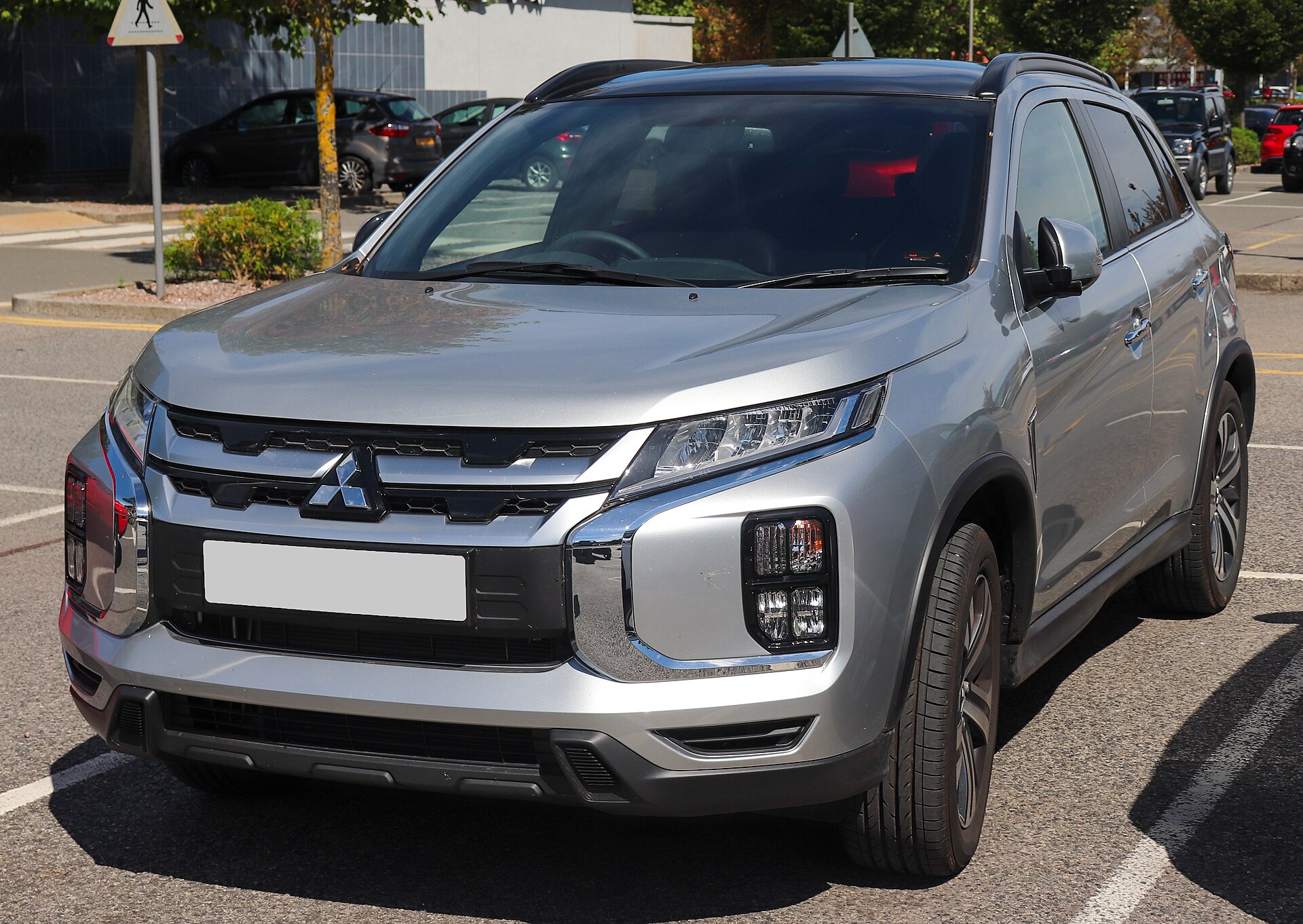
Mitsubishi revealed the third facelift on 13 February 2019 and showed it at the Geneva Motor Show in March. It was the most visible update in the car's life.
- Front: a new bumper, grille and lights in a sharper version of the Dynamic Shield; the indicators and fog lamps moved to the outer ends of the bumper.
- Rear: redesigned lights with LED technology, apart from the indicators, and a protective plate under the bumper.
- Length: 4,365 mm instead of 4,295 mm, on the unchanged 2,670 mm wheelbase.
- Screen: the display grew by one inch to 8 inches, with Apple CarPlay and Android Auto; top trims added TomTom navigation and live traffic information through a smartphone.
- Colours: Red Diamond, Sunshine Orange and Oak Brown were added.
In many markets the cars were sold as the 2020 model year. Australian buyers got them in the third quarter of 2019.
Engines and key specifications after the updates
The 2019 facelift changed the engine line-up in several European countries, including Germany and Belgium. The 1.6-litre petrol with 86 kW (117 PS) was replaced by the 2.0 MIVEC with 110 kW (150 PS). It came with a five-speed manual or a CVT, and with front- or all-wheel drive; before 2019, all-wheel drive in Germany had been reserved for diesel versions. In the United States the facelift kept a 2.0 with 110 kW (148 bhp) and a 2.4 with 124 kW (166 bhp), and the 2.0 became available with all-wheel drive.
| Parameter | Metric | Imperial |
|---|---|---|
| Length (from 2019) | 4,365 mm | 171.9 in |
| Wheelbase | 2,670 mm | 105.1 in |
| 1.6 MIVEC (to 2019) | 1.6 l, 86 kW (117 PS) | 117 hp |
| 2.0 MIVEC | 2.0 l, 110 kW (150 PS) | 148 bhp |
| Top speed (1.6 / 2.0) | 183 / about 188–191 km/h | 114 / 117–119 mph |
| Combined consumption (1.6 / 2.0) | 6.1 / 7.7 l/100 km | 38.6 / 30.5 mpg (US) |
| Euro NCAP | five stars (2011 test) | - |
The top speeds and consumption figures come from the old version of this page and from the 1cars catalogue. By our calculation, the 2.0 4WD uses about 26 % more fuel than the 1.6 for only a few km/h more top speed. The larger engine therefore makes sense mainly for buyers who need all-wheel drive. Our fuel cost calculator shows what that difference costs over a year.
What came next: the end in Europe and the new ASX
The 2019 facelift was the car's last. In Europe sales fell from 45,228 in 2015 to 6,271 in 2021, and to just 29 in 2022, when the new model had not yet arrived. Production for other markets went on longer: the Chinese plant built the car until 2023, the Brazilian plant until 2022, and production in Japan continued.
The second-generation ASX was presented on 20 September 2022 and went on sale in March 2023. It is a Mitsubishi version of the Renault Captur, built in Valladolid, Spain, with Renault petrol, mild-hybrid, full-hybrid and plug-in hybrid drives. All-wheel drive was dropped. A facelift followed in April 2024, and German registrations of both generations reached 105,265 by the end of 2024.
| Version | First ASX after 2019 | Second ASX (from 2023) |
|---|---|---|
| Platform | Mitsubishi GS | Renault–Nissan CMF-B (Captur) |
| Built in | Japan | Valladolid, Spain |
| Drive | front or all-wheel | front-wheel only |
| Engines | 2.0 petrol (Europe), 2.0 and 2.4 (US) | 1.0 and 1.3 turbo, full hybrid, plug-in hybrid |
The full model story is in our main Mitsubishi ASX page, and the case for buying one is made in five good reasons to buy an ASX.
Which updated ASX to choose today
For a used first-generation ASX, the 2019 facelift is the newest and best-equipped version, with the larger screen and smartphone mirroring. Choose the 2.0 4WD if you need traction on snow or gravel, and a 2016–2018 front-wheel-drive 1.6 if you want the lowest running costs. The design of the cabin dates from 2010 even in the last cars, so expect hard plastics and a simple layout.
Check these points on any late ASX:
- CVT: fluid changes on time and smooth take-off without judder.
- 4WD system: that 2WD, 4WD Auto and Lock modes all engage.
- Infotainment: that CarPlay, Android Auto and the reversing camera work.
- Service history: dealer stamps or invoices for each year.
Buyers who want a newer Mitsubishi with all-wheel drive should look at the Eclipse Cross, and our comparison tool helps set the ASX against rivals such as the Opel Mokka.
FAQ
When was the Mitsubishi ASX facelifted?
Three times: in 2012, in late 2015 (Europe in 2016) with the Dynamic Shield front, and in February 2019. A smaller refresh in September 2017 added equipment between the second and third facelifts.
What changed in the 2019 Mitsubishi ASX?
A new front and rear, LED rear lights, a length of 4,365 mm, an 8-inch touchscreen with smartphone mirroring and new colours. In several European markets the 1.6 petrol was replaced by a 2.0 MIVEC with 110 kW.
When did the first Mitsubishi ASX end?
Regular European sales ended in 2021, and only 29 cars were sold in Europe in 2022. Production for other markets, including China and Japan, continued into 2023.
Is the 2023 Mitsubishi ASX based on a Renault?
The second-generation ASX of 2023 is based on the Renault Captur and built alongside it in Valladolid, Spain. It uses Renault engines and hybrid systems and has front-wheel drive only.
Does the updated ASX have four-wheel drive?
Yes, as an option. After the 2019 facelift the 2.0 petrol with CVT could be ordered with all-wheel drive in Europe. Before that, European 4WD versions were mainly diesels.