 Renault Captur
All generations, specs and history
Published Sources (6) Report an error
By Felix Hartmann, Automotive Technology & EV Contributor
- Built
- 2013–present
- Generations
- 2
- Top power
- 116 kW (158 PS)
Timeline
Captur generations
Click a generation for its own page


- Captur J87 2013–2019 · Crossover · 66–115 kW (90–156 PS)
- Captur II Current 2019–now · Crossover
Newest first · 2 generations since 2013
All generations by year: Captur II (2019–now) · Captur J87 (2013–2019)
Which one is mine?
Pick the year of first registration to see which generation it is.
Check by VINWhich Captur to choose
Our verdict · Felix Hartmann
- For low running costs: the 107 kW full hybrid, chosen by more than a third of German buyers in 2024.
- For the lowest price: the TCe 90 with a manual gearbox, or the TCe 100 LPG where autogas is cheap.
- For an automatic petrol: the mild hybrid 160 with the EDC gearbox.
- For a used first-generation car: the dCi 90 or dCi 110 diesel for high mileage, or the TCe 120 EDC for an automatic.
The Renault Captur is a small crossover built on the Clio's platform since 2013. Two generations have been sold in Europe: the first from 2013 to 2019 and the second since 2019, facelifted in 2024. Engines range from 66 to 118 kW, and the current car is offered with petrol, LPG, mild-hybrid and E-Tech full-hybrid drives. In April 2024 German prices ran from €22,950 to €29,950.
In short
- First generation (2013–2019) on the Clio IV platform; about 1.2 million sold worldwide.
- Second generation since 2019 on CMF-B, about 110 mm longer; facelift presented in April 2024.
- E-Tech plug-in hybrid from 2020 and a 107 kW E-Tech full hybrid from 2022.
- Euro NCAP: five stars in 2013; 96 % for adult occupants in 2019.
Size at a glance
Renault Captur J87
The Renault Captur II is 117 mm longer, 19 mm wider and 8 mm taller than the Renault Captur J87.
| Dimensions | Renault Captur II | Renault Captur J87 | Difference |
|---|---|---|---|
| Length | 4,239 mm166.9 in | 4,122 mm162.3 in | +117 mm+4.6 in |
| Width | 1,797 mm70.7 in | 1,778 mm70.0 in | +19 mm+0.7 in |
| Height | 1,575 mm62.0 in | 1,567 mm61.7 in | +8 mm+0.3 in |
| Wheelbase | 2,639 mm103.9 in | 2,606 mm102.6 in | +33 mm+1.3 in |
| Boot | 422 L14.9 cu ft | 377 L13.3 cu ft | +45 L+1.6 cu ft |
Running cost
Fuel · Captur mild hybrid 140
about 1,550 EUR fuel a year at 15,000 km
5.9 l/100 km · petrol at 1.75 EUR/l · change mileage, fuel price or version
Specs by version
Engines
| Version | Engine | Power | Torque | Gearbox | Drive | Production years |
|---|---|---|---|---|---|---|
| Hybrid · 1 version | ||||||
| Captur II · E-Tech full hybrid 145 | 4 cyl · Hybrid | 105 kW 143 PS141 hp | 205 Nm151 lb-ft | Automatic | Front-wheel drive | 2024 |
| Diesel · 2 versions | ||||||
| J87 · dCi 90 | 1.5 l · 4 cyl · Diesel 1,461 cc | 66 kW 90 PS89 hp | 220 Nm162 lb-ft | - | Front-wheel drive | 2013 |
| J87 · dCi 110 | 1.5 l · 4 cyl · Diesel 1,461 cc | 81 kW 110 PS109 hp | 260 Nm192 lb-ft | - | Front-wheel drive | 2015 |
| Petrol · 6 versions | ||||||
| J87 · TCe 90 | 0.9 l · 3 cyl · Petrol 898 cc | 66 kW 90 PS89 hp | 135 Nm100 lb-ft | 5-sp Manual | Front-wheel drive | 2013 |
| J87 · TCe 120 EDC | 1.2 l · 4 cyl · Petrol 1,197 cc | 87 kW 118 PS117 hp | 190 Nm140 lb-ft | 6-sp Dual-clutch | Front-wheel drive | 2013 |
| J87 · TCe 150 | 1.3 l · 4 cyl · Petrol 1,330 cc | 110 kW 150 PS148 hp | 250 Nm184 lb-ft | - | Front-wheel drive | 2018 |
| Captur II · TCe 90 | 3 cyl · Petrol | 67 kW 91 PS90 hp | 160 Nm118 lb-ft | 6-sp Manual | Front-wheel drive | 2024 |
| Captur II · mild hybrid 140 | 4 cyl · Petrol | 103 kW 140 PS138 hp | 260 Nm192 lb-ft | 6-sp Manual | Front-wheel drive | 2024 |
| Captur II · mild hybrid 160 EDC | 4 cyl · Petrol | 116 kW 158 PS156 hp | 270 Nm199 lb-ft | Dual-clutch | Front-wheel drive | 2024 |
| LPG / CNG · 1 version | ||||||
| Captur II · TCe 100 LPG | 3 cyl · LPG / CNG | 74 kW 101 PS99 hp | 170 Nm125 lb-ft | 6-sp Manual | Front-wheel drive | 2024 |
Performance
Show all 9 versions
| Version | 0–100 km/h | Top speed | Fuel consumption | CO₂ |
|---|---|---|---|---|
| Diesel · 2 versions | ||||
| J87 · dCi 90 | 13.1 s 0–62 mph | 171 km/h106 mph | 3.7 l/100 km63.6 mpg US · 76.3 mpg UK | 95 g/km |
| J87 · dCi 110 | 11.4 s 0–62 mph | 180 km/h112 mph | 3.9 l/100 km60.3 mpg US · 72.4 mpg UK | 98 g/km |
| Petrol · 6 versions | ||||
| J87 · TCe 90 | 13.0 s 0–62 mph | 171 km/h106 mph | 5.0 l/100 km47.0 mpg US · 56.5 mpg UK | 115 g/km |
| J87 · TCe 120 EDC | 10.9 s 0–62 mph | 192 km/h119 mph | 5.5 l/100 km42.8 mpg US · 51.4 mpg UK | 125 g/km |
| J87 · TCe 150 | 9.8 s 0–62 mph | - | 5.4 l/100 km43.6 mpg US · 52.3 mpg UK | 121 g/km |
| Captur II · TCe 90 | 14.3 s 0–62 mph | 168 km/h104 mph | 5.9 l/100 km39.9 mpg US · 47.9 mpg UK | 133 g/km |
| Captur II · mild hybrid 140 | - | - | 5.9 l/100 km39.9 mpg US · 47.9 mpg UK | 133 g/km |
| Captur II · mild hybrid 160 EDC | - | - | 5.9 l/100 km39.9 mpg US · 47.9 mpg UK | 134 g/km |
| LPG / CNG · 1 version | ||||
| Captur II · TCe 100 LPG | - | - | 6.6 l/100 km35.6 mpg US · 42.8 mpg UK | 118 g/km |
Dimensions and weight
Show all 9 versions
| Version | Length | Width | Height | Wheelbase | Kerb weight | Boot | Fuel tank |
|---|---|---|---|---|---|---|---|
| Hybrid · 1 version | |||||||
| Captur II · E-Tech full hybrid 145 | 4,239 mm166.9 in | 1,797 mm70.7 in | 1,575 mm62.0 in | 2,639 mm103.9 in | - | - | - |
| Diesel · 2 versions | |||||||
| J87 · dCi 90 | - | - | - | - | 1,245 kg2,745 lb | 377 l13.3 cu ft | 45 l11.9 gal US |
| J87 · dCi 110 | - | - | - | - | 1,265 kg2,789 lb | 377 l13.3 cu ft | 45 l11.9 gal US |
| Petrol · 5 versions | |||||||
| J87 · TCe 90 | 4,122 mm162.3 in | 1,778 mm70.0 in | 1,567 mm61.7 in | 2,606 mm102.6 in | 1,181 kg2,604 lb | 377 l13.3 cu ft | 45 l11.9 gal US |
| J87 · TCe 120 EDC | - | - | - | - | 1,259 kg2,776 lb | 377 l13.3 cu ft | 45 l11.9 gal US |
| Captur II · TCe 90 | 4,239 mm166.9 in | 1,797 mm70.7 in | 1,575 mm62.0 in | 2,639 mm103.9 in | 1,293 kg2,851 lb | 422 l14.9 cu ft | 48 l12.7 gal US |
| Captur II · mild hybrid 140 | 4,239 mm166.9 in | 1,797 mm70.7 in | 1,575 mm62.0 in | 2,639 mm103.9 in | 1,341 kg2,956 lb | - | - |
| Captur II · mild hybrid 160 EDC | 4,239 mm166.9 in | 1,797 mm70.7 in | 1,575 mm62.0 in | 2,639 mm103.9 in | 1,372 kg3,025 lb | - | - |
| LPG / CNG · 1 version | |||||||
| Captur II · TCe 100 LPG | 4,239 mm166.9 in | 1,797 mm70.7 in | 1,575 mm62.0 in | 2,639 mm103.9 in | 1,353 kg2,983 lb | - | - |
Verified Manufacturer and type-approval data from our catalog · Sources and methodology
Renault Captur at a glance
| Parameter | Value |
|---|---|
| Production | since 2013 (two generations) |
| Body | five-door crossover, front-wheel drive |
| Platforms | B platform of the Clio IV (2013–2019); CMF-B (since 2019) |
| Length (2024) | 4,239 mm; wheelbase 2,639 mm |
| Engines | 0.9–1.3 l petrol, 1.5 l diesel, LPG, mild hybrid, E-Tech hybrid and plug-in hybrid |
| Power | 66–115 kW (first generation); 67–118 kW (2024 range) |
| Boot (2024) | up to 616 litres with the rear bench forward; 1,596 litres folded |
| Predecessor | Renault Modus |
| Related models | Clio, Nissan Juke, Arkana; Mitsubishi ASX (rebadge since 2023) |
Concept and origins
Renault previewed the car with the Captur Concept at the Geneva Motor Show in 2011. The production car appeared at the same show in March 2013 and reached French dealers in April. German sales began in June 2013. In the Renault range it took over from the Modus, a small MPV sold from 2004 to 2012. Instead of a tall van body, the Captur had the raised stance of a crossover. In 2013 it already ranked third among Europe's small crossovers, behind the Nissan Juke and the Dacia Duster. Renault's wider story is in our history of Renault.

First generation (2013–2019): a Clio on stilts
The first Captur, code J87, was based on the fourth-generation Clio and its B platform. It was front-wheel drive only. Special trims such as Signature (December 2013) and S-Edition (2018) followed.
A facelift in summer 2017 added C-shaped LED daytime running lights and new tail-light graphics. German Wikipedia also notes better interior materials and build quality, while the engines stayed the same.
| Engine | Displacement | Power | Torque | 0–100 km/h | Combined | CO₂ |
|---|---|---|---|---|---|---|
| TCe 90 | 898 cc, 3 cyl | 66 kW (90 PS) | 135 Nm | 13.0 s | 5.0 l/100 km | 115 g/km |
| TCe 120 EDC | 1,197 cc, 4 cyl | 87 kW (118 PS) | 190 Nm | 10.9 s | 5.5 l/100 km | 125 g/km |
| TCe 150 (2018) | 1,330 cc, 4 cyl | 115 kW (156 PS) | 250 Nm | 9.8 s | 5.4 l/100 km | 121 g/km |
| dCi 90 | 1,461 cc diesel | 66 kW (90 PS) | 220 Nm | 13.1 s | 3.7 l/100 km | 95 g/km |
| dCi 110 (2015) | 1,461 cc diesel | 81 kW (110 PS) | 260 Nm | 11.4 s | 3.9 l/100 km | 98 g/km |
The EDC dual-clutch automatic was available with the dCi 90, TCe 120 and TCe 150. Euro NCAP awarded five stars in 2013, with 88 % for adult occupants, 79 % for children, 61 % for pedestrians and 81 % for safety assistance. The car was named Voiture de l'Année 2013 in France and What Car?'s Best Small SUV under £16,000 in 2014.

Captur variants for other markets
South Korea sold the first generation as the Renault Samsung QM3 from December 2013. Built in Valladolid, Spain, with the dCi 90 diesel and a dual-clutch gearbox, it sold out its first 1,000 cars in seven minutes. In 2015 it was South Korea's best-selling imported car, with 24,560 registrations.
A different car with the same name went on sale in Brazil and India in 2017. It rode on a stretched version of the Duster's B0 platform, with more ground clearance. That Duster-based model is covered in our separate Renault Kaptur article.
Second generation (since 2019): CMF-B and more space
Renault presented the second Captur on 3 July 2019, and the public saw it at the IAA in Frankfurt in September. Sales started on 11 January 2020. It moved to the CMF-B platform shared with the fifth Clio, the second Nissan Juke and the Arkana. The body grew by about 110 mm and the wheelbase by 20 mm.
At launch the range included 1.0 and 1.3-litre turbo petrol engines with 74 to 114 kW. Diesel customers could choose the 1.5 dCi with 70 kW (95 PS) or 85 kW (115 PS), and the base petrol engine was also offered for LPG. Top trims had a 9.3-inch vertical touchscreen and a 10.2-inch digital instrument cluster. European buyers could combine 11 body colours, 4 roof colours and 3 packs into 90 versions.
The diesel was dropped in Germany in summer 2020. Euro NCAP tested the 1.0 TCe in 2019 and gave 96 % for adult occupants, 83 % for children, 75 % for vulnerable road users and 74 % for safety assistance. The R.S. Line trim followed in February 2021.
E-Tech hybrid and plug-in hybrid
The E-Tech plug-in hybrid arrived in 2020 with about 45 km of electric range in mixed use. A full hybrid without a charging socket followed in summer 2022. Both use a 1.6-litre petrol engine with two electric motors and a clutchless multi-mode gearbox. German Wikipedia describes the gearbox as simulating eight gears.
The full hybrid is listed as the E-Tech Full Hybrid 145, with 107 kW (145 PS) and 205 Nm. In Germany it became popular: more than 35 per cent of Captur buyers chose it, according to automobile.at in 2024. The plug-in hybrid did not appear in the German facelift price list of April 2024.

The 2024 facelift: new face and Esprit Alpine
Renault revealed the facelift on 4 April 2024, and it reached the market in June. It brought a new front end, revised tail lights, a larger touchscreen and a bigger instrument display. Esprit Alpine replaced R.S. Line as the top trim.
| Engine (2024) | Power | Torque | Gearbox | Price in Germany (April 2024) |
|---|---|---|---|---|
| TCe 90 | 67 kW (91 PS) | 160 Nm | 6-speed manual | from €22,950 |
| TCe 100 LPG | 74 kW (100 PS) | 160 Nm (170 Nm on LPG) | 6-speed manual | from €23,550 |
| mild hybrid 140 | 103 kW (140 PS) | 260 Nm | 6-speed manual | from €26,950 |
| mild hybrid 160 | 118 kW (160 PS) | 270 Nm | EDC automatic | from €26,950 |
| E-Tech full hybrid 145 | 107 kW (145 PS) | 205 Nm | multi-mode automatic | from €29,950 |
The facelifted car measures 4,239 × 1,797 × 1,575 mm. Its rear bench slides by 16 cm, which gives 616 litres of boot space with the seats forward and 1,596 litres with them folded. The OpenR Link touchscreen measures 10.4 inches, and the driver's display up to 10.25 inches.

Sales
| Year | Europe (first generation) | Year | Europe (second generation) |
|---|---|---|---|
| 2013 | 84,085 | 2020 | 178,724 |
| 2014 | 164,801 | 2021 | 162,138 |
| 2015 | 194,847 | 2022 | 135,284 |
| 2016 | 215,493 | ||
| 2017 | 211,321 | ||
| 2018 | 211,092 | ||
| 2019 | 222,540 |
European sales reached 222,540 in 2019, the changeover year between the generations. In Germany the Captur overtook the Clio in 2017 as the most-registered Renault, with 23,700 cars. German registrations from launch to December 2024 total 205,144.
Related models
Since March 2023 Mitsubishi has sold the second Captur as the ASX in Europe. The larger Renault Symbioz, launched in 2024, is a sister model. Small crossovers from other brands, such as the Opel Crossland X, can be compared with the car comparison tool. The full model list is in the Renault catalogue.
Photo gallery


Renault Captur: first vs latest generation
| Spec | Captur J87 | Captur II | Change |
|---|---|---|---|
| Years | 2013–2019 | 2019–present | 6 years apart |
| Most powerful version | 115 kW (156 PS) | 116 kW (158 PS) | +1 kW (+1%) |
| Length | 4,122 mm | 4,239 mm | +117 mm |
| Width | 1,778 mm | 1,797 mm | +19 mm |
| Wheelbase | 2,606 mm | 2,639 mm | +33 mm |
| Lightest kerb weight | 1,181 kg | 1,293 kg | +112 kg |
| Best 0–100 km/h | 9.8 s | 14.3 s | +4.5 s |
| Top speed | 192 km/h | 168 km/h | −24 km/h |
Oldest and newest generation in the 1cars catalog. Power is the strongest version of each; other rows are shown only when both generations have the figure.
Image credits · Photos from Wikimedia Commons under free licences
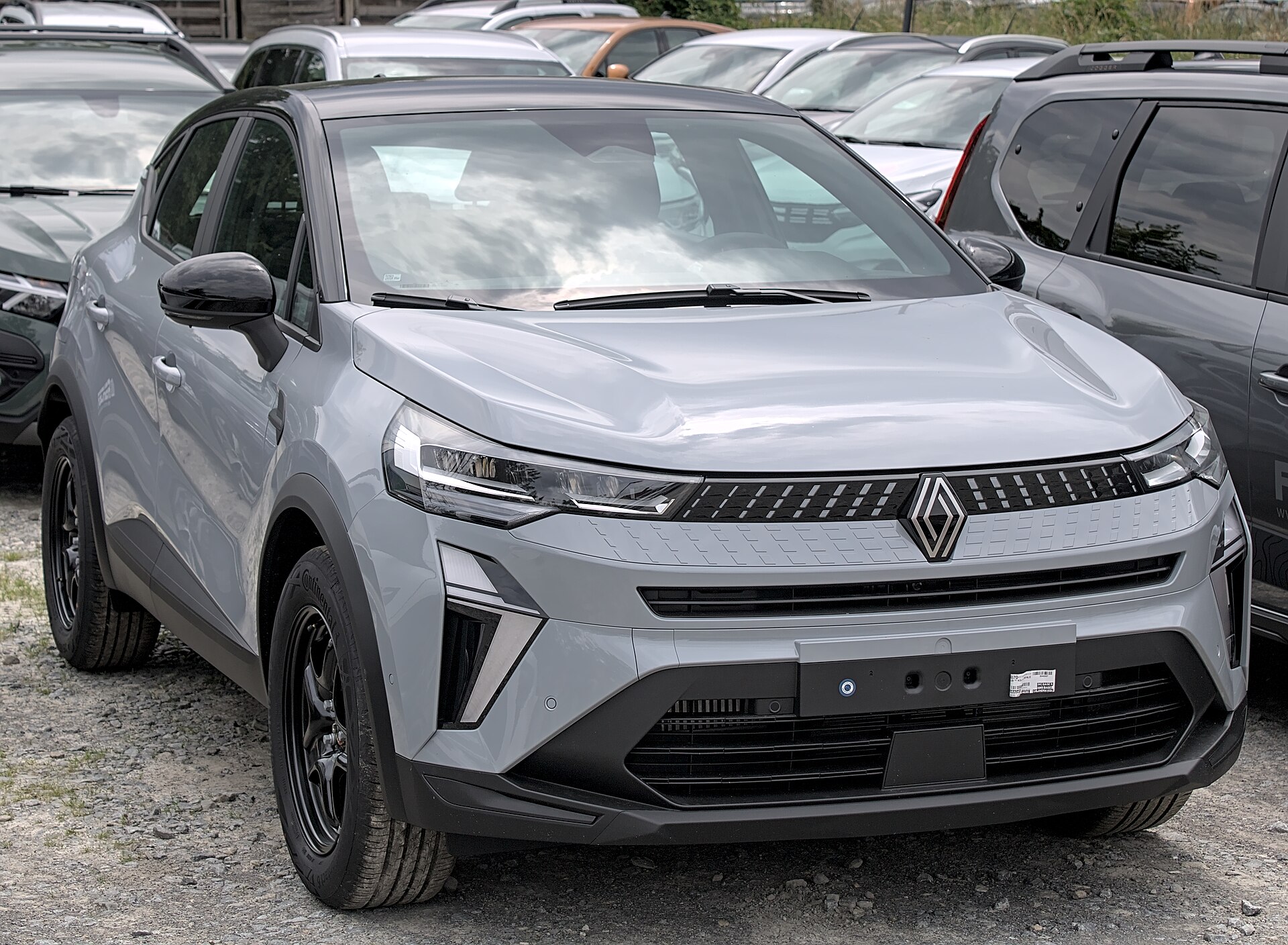
- Renault Captur II · Photo: Alexander-93 / Wikimedia Commons, CC BY-SA 4.0
Popular comparisons
Renault Captur in our rankings
- No. 3 of 77 · Most economical SUVs and crossovers (3.7 l/100 km)
- No. 9 of 146 · Smallest SUVs and crossovers (4,122 mm)
- No. 9 of 99 · Lightest SUVs and crossovers (1,181 kg)
- No. 9 of 256 · Most economical cars (3.7 l/100 km)
- No. 65 of 420 · Smallest cars (4,122 mm · top 16%)
- No. 56 of 304 · Lightest cars (1,181 kg · top 19%)
More economical than 96% of ranked SUVs and crossovers in the 1CARS catalog (No. 3 of 77).
FAQ
Is the Renault Captur based on the Clio?
Yes. The first generation uses the Clio IV platform, and the second shares CMF-B with the Clio V.
Is there a diesel Captur?
The first generation had the 1.5 dCi with 66 or 81 kW. The second generation started with a 1.5 dCi of 70 or 85 kW, which left the German range in summer 2020.
What is the Captur E-Tech hybrid?
A full hybrid with a 1.6-litre petrol engine, two electric motors and a multi-mode gearbox, giving 107 kW (145 PS).
How big is the Captur's boot?
Up to 616 litres with the sliding rear bench pushed forward, and 1,596 litres with the seats folded (2024 car).
Is the Mitsubishi ASX a Renault Captur?
Yes. The second-generation ASX, on sale since March 2023, is a rebadged Captur.
Data sources
Data checked by an editor against the sources below.
- Wikipedia - Renault Captur
- Wikipedia - Renault Kaptur
- ADAC
- Euro NCAP - Best In Class Battle Heats Up In Latest Batch Of Results
- Automobile
- EEA CO₂ monitoring (European Environment Agency, CC BY 4.0)