
 Renault 16
Specs, engines and history
Published Sources (2) Report an error
By Oleksandr Hnatiuk, Automotive Editor & Used Car Specialist
- Built
- 1965–1980
- Top power
- 68 kW (92 PS)
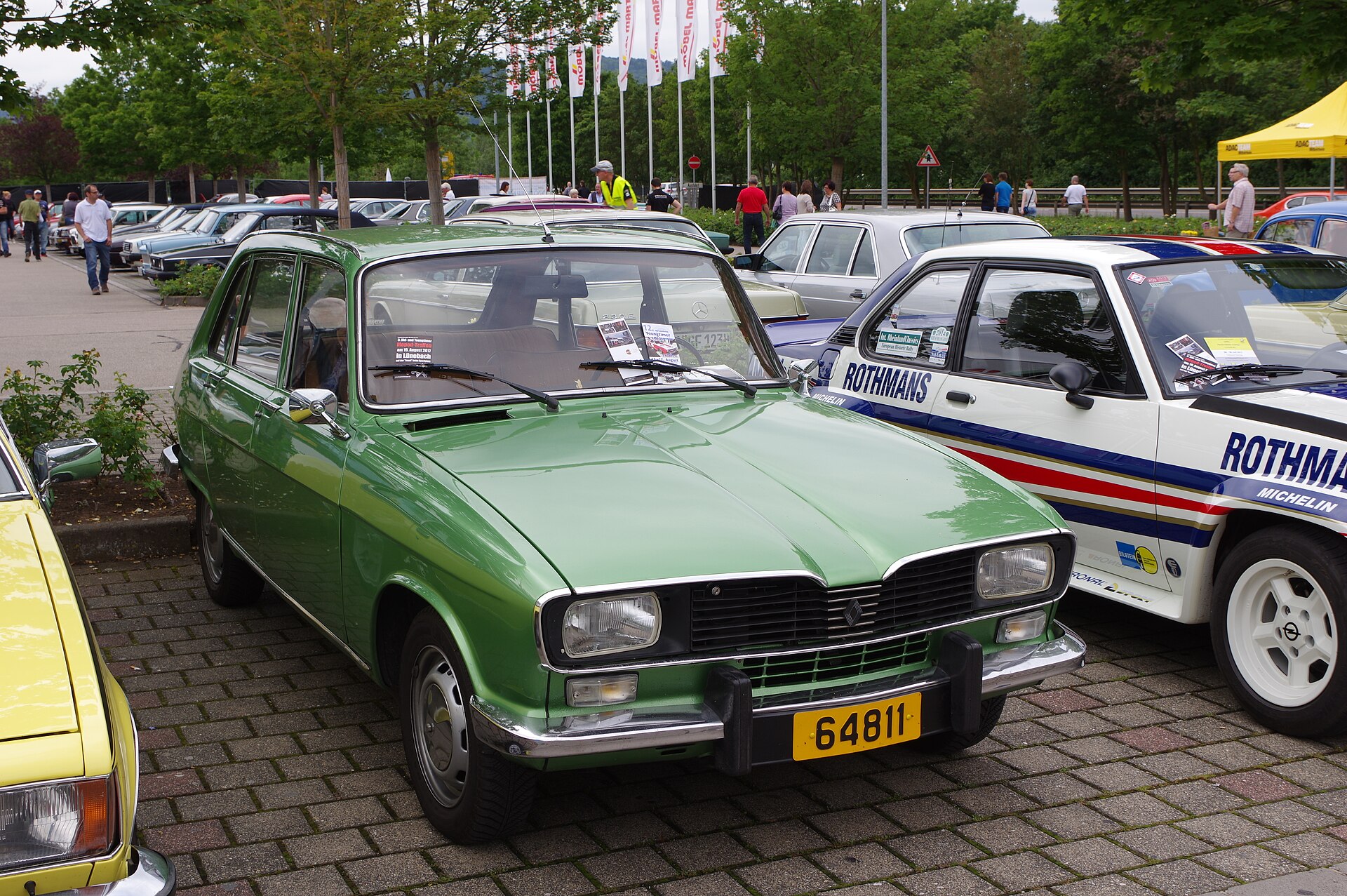
The Renault 16 is the five-door family hatchback that Renault built from 1965 to January 1980, mainly at Sandouville in Normandy. It combined a saloon body with a tailgate and a folding rear seat, front-wheel drive and an aluminium Cléon-Alu engine of 1.5 to 1.65 litres. In late 1965 it was voted European Car of the Year, the first French winner of the award.
In short
- Production: January 1965 to January 1980, 1,851,502 cars according to the French makers' association CCFA (Wikipedia EN gives 1,845,959).
- Engines: four-cylinder Cléon-Alu units of 1,470, 1,565 and 1,647 cc, from 40 kW (55 PS) to 68 kW (93 PS).
- Layout: front-wheel drive, torsion-bar suspension and a wheelbase 70 mm longer on the left than on the right.
- Replaced in stages by the Renault 20 and 30 (1975) and the Renault 18 (1978).
Size at a glance
| Dimensions | Renault 16 I |
|---|---|
| Length | 4,240 mm166.9 in |
| Width | 1,628 mm64.1 in |
| Height | 1,450 mm57.1 in |
Specs by version
Engines
| Version | Engine | Power | Torque | Gearbox | Drive | Production years |
|---|---|---|---|---|---|---|
| 1.5 (GL, Super, L) | 1.5 l · 4 cyl · Petrol 1,470 cc | 40 kW 54 PS54 hp | 106 Nm78 lb-ft | 4-sp Manual | Front-wheel drive | 1965–1976 |
| 1.65 TL | 1.6 l · 4 cyl · Petrol 1,647 cc | 49 kW 67 PS66 hp | - | 4-sp Manual | Front-wheel drive | 1976–1980 |
| 1.6 TS | 1.6 l · 4 cyl · Petrol 1,565 cc | 62 kW 84 PS83 hp | - | 4-sp Manual | Front-wheel drive | 1968–1976 |
| 1.65 TX | 1.6 l · 4 cyl · Petrol 1,647 cc | 68 kW 92 PS91 hp | 128 Nm94 lb-ft | 5-sp Manual | Front-wheel drive | 1973–1980 |
Performance
Show all 4 versions
| Version | 0–100 km/h | Top speed |
|---|---|---|
| 1.5 (GL, Super, L) | 18.0 s 0–62 mph | 146 km/h91 mph |
| 1.65 TL | 18.5 s 0–62 mph | 152 km/h94 mph |
| 1.6 TS | - | 165 km/h103 mph |
| 1.65 TX | 12.0 s 0–62 mph | 175 km/h109 mph |
Dimensions and weight
Show all 2 versions
| Version | Length | Width | Height | Kerb weight |
|---|---|---|---|---|
| 1.5 (GL, Super, L) | 4,240 mm166.9 in | 1,628 mm64.1 in | 1,450 mm57.1 in | - |
| 1.65 TL | - | - | - | 1,020 kg2,249 lb |
Verified Manufacturer and type-approval data from our catalog · Sources and methodology
Renault 16 at a glance
| Item | Renault 16 |
|---|---|
| Years | 1965-1980 (press launch January 1965, last cars January 1980) |
| Production total | 1,851,502 (CCFA); 1,845,959 in other sources |
| Plants | Sandouville and Flins (France); also Australia, Canada, Morocco, Yugoslavia |
| Body style | five-door hatchback |
| Design | Gaston Juchet, with Philippe Charbonneaux credited in French sources |
| Layout | longitudinal front engine behind the front axle, front-wheel drive |
| Engines | 1.5, 1.6 and 1.65-litre Cléon-Alu four-cylinders |
| Power | 40-68 kW (55-93 PS) |
| Kerb weight | 980-1,060 kg |
| Top speed | 146 km/h (1.5) to 175 km/h (TX) |
| 0-100 km/h | 18.5 s (TL, Classic Cars 07/2020 data table); about 12 s (TX, French sources) |
| Price new | DM 8,350 in 1970 (16 TL, West Germany) |
The 16 sits in the Renault catalogue with the rest of the range, and the wider company story is in our history of Renault.
A big Renault built around a tailgate
Renault had left the large-car market when the Frégate ended in 1960 after 163,383 cars, and the company needed something to sit above the Dauphine and the new Renault 4. Development of what became the 16 began in 1958. An earlier large-car study, Projet 114, ran to 14 prototypes before it was cancelled in 1961, and from 1963 a fleet of 32 prototypes of the new car was tested around the world.
The concept borrowed from the Renault 4 of 1961, which already had a rear door and a flat load floor, and moved it up a class. The journalist Jean-Francis Held called the result "a synthesis of a station wagon with a saloon". Renault built a new plant at Sandouville, near Le Havre, for the car. Pre-series production started on 2 December 1964, the press saw the car on the Côte d'Azur in the first days of January 1965, and the public debut followed at the Geneva Motor Show in March. Before sales opened in summer 1965, about 500 pre-series cars were handed out to selected drivers.
The jury of European Car of the Year voted for the 16 at the end of 1965 with 98 points. It was the award's third winner and the first car from outside Britain to take it; the Rolls-Royce Silver Shadow finished second.
Torsion bars, an uneven wheelbase and seven seat positions
Under the body the 16 was laid out for space. The engine sat lengthways behind the front axle with the gearbox ahead of it, which pushed the front wheels forward and kept the cabin long. Suspension was by torsion bars all round. Because the rear transverse bars ran one behind the other, the wheelbase measured 2,720 mm on the left side and 2,650 mm on the right.
The cabin used the same thinking. The rear seat could be set in seven positions, folded, tipped forward or removed, and the load space grew from 346 litres to 1,600 litres according to German sources (Classic and Sports Car gives 1,200 litres as the maximum). Suspension travel of 200 mm at the front and 300 mm at the rear gave a soft ride on poor roads. It also had a column-mounted gear change and an electric cooling fan.
Right-hand-drive cars reached Britain in autumn 1965. In 1970 Stirling Moss called the 16 "the most intelligently engineered automobile I have ever encountered".
Cléon-Alu engines from GL to TX
All 16s used the Cléon-Alu four, an aluminium-block engine built at Renault's Cléon plant near Rouen, which had opened in 1958. The same engine family also powered the Renault 12 Gordini and the Alpine A110 rally car. Power grew in three steps.
| Version | Years | Displacement | Power | Top speed |
|---|---|---|---|---|
| GL, Super, L | 1965-1976 | 1,470 cc | 40 kW (55 PS) | 146 km/h |
| TS | 1968-1976 | 1,565 cc | about 62 kW (83-85 PS) | 165 km/h |
| TA automatic | 1969-1971 | 1,565 cc | 49 kW (67 PS) | not published |
| TL (1.65) | 1976-1980 | 1,647 cc | 49 kW (66 PS) | 152 km/h |
| TX (five-speed) | 1973-1980 | 1,647 cc | 68 kW (93 PS) | 175 km/h |
| TX automatic | 1973-1980 | 1,647 cc | 66 kW (90 PS) | 161 km/h |
With the TS of 1968, Renault claimed a top speed above 160 km/h for the first time. The TA of 1969 brought a three-speed automatic. The TX arrived in autumn 1973 with 1,647 cc, a five-speed manual gearbox and electric front windows. Figures for the TS vary between sources from 61 to 63 kW (83 to 85 PS), which is why the table gives a range.
Selling a French hatchback abroad
Peak output came in 1970 with 196,253 cars. The same year brought the first revision, with larger tail lights, and in 1974 the grille changed to black plastic on all versions except the TX. Assembly outside France took place in Australia (Heidelberg, Victoria), Canada (SOMA in Quebec, until 1974), Morocco and Yugoslavia, where IMV in Novo Mesto built 342 cars between 1974 and 1976.
Exports to the United States began in 1968. American rules did not allow rectangular headlamps, so US cars wore two round lamps per side, and the US engine was rated at 46 kW (62 PS DIN). Sales stayed small: in those years Renault rarely sold more than 20,000 cars of all types in the US in a year. Canada took the car more readily.
In Europe the 16 had no direct rival at first. The British Austin Maxi of 1969 copied the five-door idea but did not sell strongly outside the UK. Larger French rivals such as the Citroën DS were saloons with conventional boots.
Replaced twice: Renault 20, 30 and 18
Renault did not replace the 16 with a single model. In 1975 it launched the Renault 20 and Renault 30, larger five-door hatchbacks, and the 16 carried on below them. The automatic and utility versions were dropped in 1975 and the L and TS in 1976, leaving the TL and TX. The Renault 18 saloon of 1978 then took over the middle of the range, and the last 16s were built in January 1980.
Renault 16 today: what to check when buying
Rust is the main problem. Buying guides in Classic Cars (UK) and Auto Zeitung point to the inner wings in the engine bay, the inner and outer sills, the A-posts and jacking points, the base of the front wings, door bottoms, valances and the tailgate. Look closely at the rear suspension mounts and rear inner arches, because the torsion-bar mountings carry the load. Auto Zeitung also warns that the scuttle drains tend to clog.
The Cléon-Alu engines are durable, and many cars covered 200,000 miles (about 320,000 km) without major work. A failed thermostatic switch for the electric fan can lead to overheating and a blown head gasket, so check for oil in the coolant. Crunching gear changes suggest worn synchromesh. Sensitivity to side winds can come from a worn universal joint in the steering column, a part shared with the Renault 5.
Renault dealers supply very little now, but clubs and specialists in France, Germany and the UK remake trim, bumpers and bushes. Cloth seats and small interior parts are harder to find than mechanical items.
Values: the Classic Trader market overview for 2022 to March 2026 puts most German and Dutch listings at about EUR 12,000-19,900 in 2026, with TS and TX cars around EUR 16,000 in 2022. The 16 appears among the cars in our list of the best classic cars of the 1960s, and more French and European classics are in the classic cars section.
Photo gallery

Renault 16 in our rankings
- No. 35 of 413 · Lightest cars (1,020 kg · top 9%)
- No. 14 of 78 · Lightest hatchbacks (1,020 kg · top 18%)
- No. 127 of 551 · Smallest cars (4,240 mm · top 24%)
- No. 293 of 1135 · Longest-running car nameplates (15 years · top 28%)
- No. 45 of 97 · Biggest engines: hatchbacks (1,647 cc · top 47%)
- No. 45 of 97 · Longest hatchbacks (4,240 mm · top 47%)
Lighter than 91% of ranked cars in the 1CARS catalog (No. 35 of 413).
FAQ
When was the Renault 16 built?
The press launch took place in January 1965, the public debut at the Geneva Motor Show in March 1965, and production ended in January 1980. Sales in France began in June 1965 and right-hand-drive cars reached Britain that autumn.
How many Renault 16s were made?
About 1.85 million. The French makers' association CCFA records 1,851,502 cars, while Wikipedia EN gives 1,845,959. Most were built at Sandouville, with more at Flins and smaller numbers assembled abroad.
Was the Renault 16 the first hatchback?
Smaller cars such as the Renault 4 already had a rear door. The 16 brought the five-door hatchback to a large family car and became the first car of that type to be voted European Car of the Year, in late 1965.
Which Renault 16 is the fastest?
The TX, sold from 1973 to 1980. Its 1,647 cc engine gave 68 kW (93 PS), it had a five-speed gearbox, and French sources quote 175 km/h and about 12 seconds from 0 to 100 km/h.
Data sources
Data checked by an editor against the sources below.
- Wikipedia - Renault 16
- Autozeitung - Kaufberatung Renault 16 Tl Bilder Technische Daten 66693


