
 Renault Dauphine
Specs, engines and history
Published Sources (1) Report an error
By Sarah Whitmore, Senior Automotive Writer
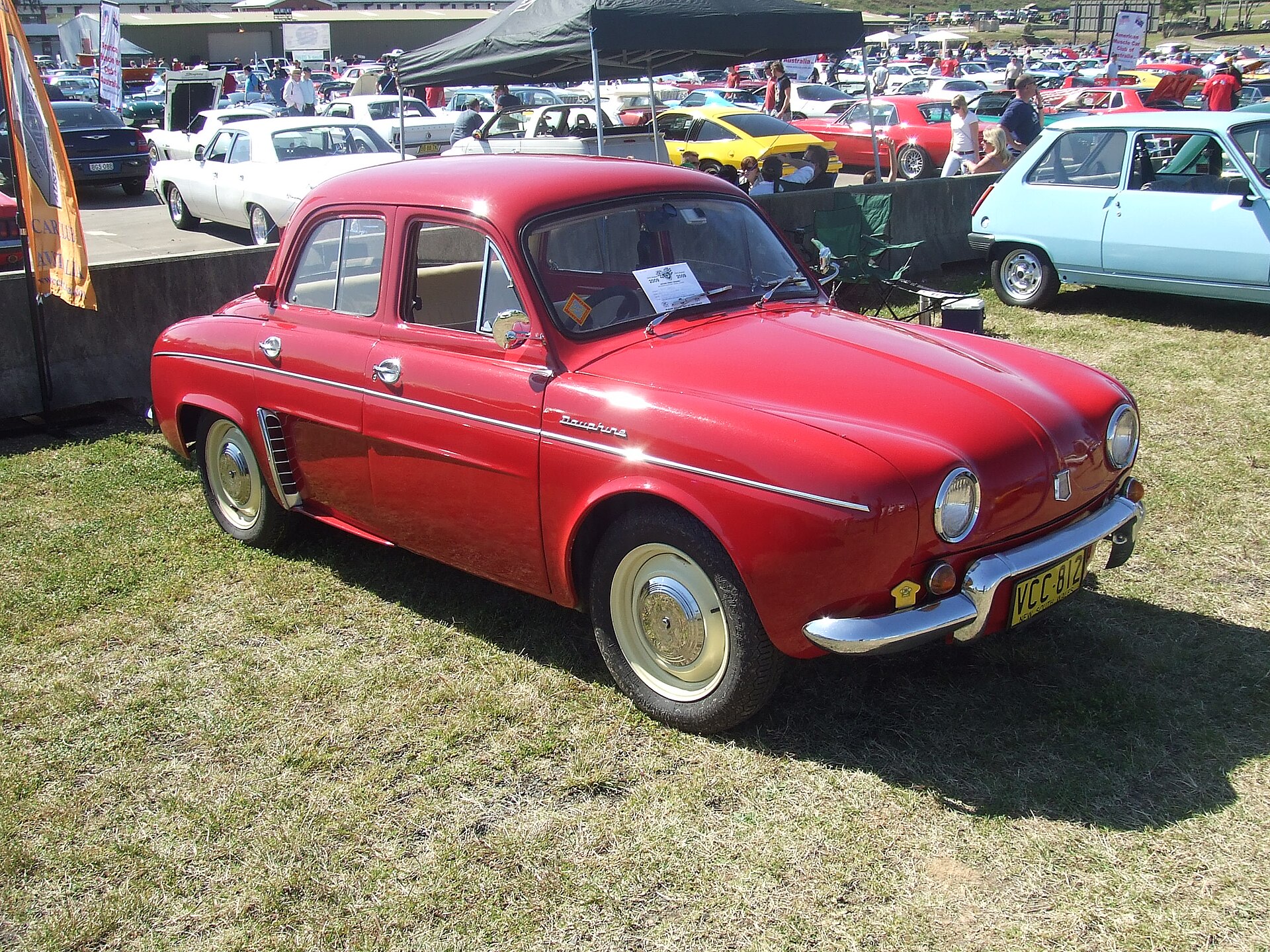
- Built
- 1956–1967
- Top power
- 36 kW (49 PS)
The Renault Dauphine is the rear-engined four-door saloon that Renault built from 1956 to 1967 as a roomier successor to the 4CV. An 845 cc Ventoux four of 19-21 kW (26-28 ch DIN) sat behind the rear axle, and Gordini and 1093 versions added speed. With 2,150,738 made, it was the first French car to pass two million, and for three years it sold strongly in the USA.
In short
- Launched on 6 March 1956 at the Palais de Chaillot in Paris; the last Gordini left the line in December 1967.
- 2,150,738 built, including licensed assembly by Alfa Romeo in Milan, FASA in Spain, IKA in Argentina and Willys in Brazil.
- US sales rose from 28,000 in 1957 to about 91,000-102,000 in 1959, then collapsed.
- The 1093 of 1961-1963 was a homologation special with 36 kW (49 ch DIN) and 140 km/h, of which 2,140 were built.
Size at a glance
| Dimensions | Renault Dauphine I |
|---|---|
| Length | 3,937 mm155.0 in |
| Width | 1,524 mm60.0 in |
| Height | 1,441 mm56.7 in |
| Wheelbase | 2,267 mm89.3 in |
Specs by version
Engines
| Version | Engine | Power | Torque | Gearbox | Drive | Production years |
|---|---|---|---|---|---|---|
| Dauphine 845 | 0.8 l · 4 cyl · Petrol Ventoux 670-1 | 19 kW 26 PS25 hp | 66 Nm49 lb-ft | 3-sp Manual | Rear-wheel drive | 1956–1966 |
| Dauphine Gordini | 0.8 l · 4 cyl · Petrol Ventoux 670-5 | 26 kW 35 PS35 hp | 65 Nm48 lb-ft | 4-sp Manual | Rear-wheel drive | 1957–1967 |
| Dauphine 1093 | 0.8 l · 4 cyl · Petrol 845 cc | 36 kW 49 PS48 hp | - | 4-sp Manual | Rear-wheel drive | 1962–1963 |
Performance
Show all 3 versions
| Version | Top speed |
|---|---|
| Dauphine 845 | 111 km/h69 mph |
| Dauphine Gordini | 126 km/h78 mph |
| Dauphine 1093 | 140 km/h87 mph |
Dimensions and weight
Show all 1 versions
| Version | Length | Width | Height | Wheelbase | Kerb weight |
|---|---|---|---|---|---|
| Dauphine 845 | 3,937 mm155.0 in | 1,524 mm60.0 in | 1,441 mm56.7 in | 2,267 mm89.3 in | 650 kg1,433 lb |
Verified Manufacturer and type-approval data from our catalog · Sources and methodology
Renault Dauphine at a glance
| Specification | Renault Dauphine |
|---|---|
| Years | March 1956 to December 1967 (last Gordini) |
| Production total | 2,150,738 |
| Plants | Flins (bodies and assembly), Billancourt (engines); licensed or CKD plants in Italy, Spain, Argentina, Brazil, Mexico, Ireland, Australia, New Zealand, UK and others |
| Body style | four-door saloon |
| Design | Fernand Picard (engineering), with Robert Barthaud and Jacques Ousset; Luigi Segre of Ghia consulted |
| Layout | rear engine, rear-wheel drive, swing-axle rear suspension |
| Engine | 845 cc Ventoux four, overhead valves |
| Power | 19-21 kW (26-28 ch DIN); Gordini 24-26 kW (33-36 ch DIN); 1093 36 kW (49 ch DIN) |
| Kerb weight | about 650 kg |
| Top speed | 111-115 km/h; Gordini 126 km/h; 1093 140 km/h |
| 0-97 km/h (60 mph) | 22.3 s Gordini (Road & Track, 1962) |
| Price new | 554,000 francs in France in 1956; GBP 769 in the UK in 1956 |
Project 109 and a bigger 4CV
Engineering work on project 109 began in 1949, when Renault's chief executive Pierre Lefaucheux could see that buyers of the 4CV wanted more space and comfort. Engineers led by Fernand Picard kept the rear-engine layout of the 4CV, enlarged its 760 cc engine to 845 cc and drew a longer, softer four-door body; Luigi Segre of Carrozzeria Ghia advised on the shape. Test prototypes covered more than two million kilometres before launch. Lefaucheux died in February 1955, so Pierre Dreyfus launched the car.
The name, the feminine form of the French title for the heir to the throne, cast it as the successor to the 4CV. About 20,000 guests saw it at the Palais de Chaillot on 6 March 1956, and the Geneva show followed two days later. The French price was 554,000 francs, with a sunroof at 20,000 francs extra. Flins built the cars and Billancourt the engines; at its peak the Flins line released a car every 20 to 30 seconds. It was France's best-selling car from 1957 to 1961, and the millionth example was completed on 22 February 1960.
Gordini, Ondine, 1093 and Aérostable
The standard engine gave 26 ch DIN at first and 28 ch from 1963. Amédée Gordini worked on the car from 1957, and his version with a four-speed gearbox reached 33 and later 36 ch DIN and 126 km/h. The Ondine of 1961 added better trim and the four-speed gearbox. A semi-automatic Ferlec electromagnetic clutch was offered, and a Jaeger automatic followed for the 1963 model year.
| Version | Years | Power | Gearbox | Top speed |
|---|---|---|---|---|
| Dauphine | 1956-1966 | 19-21 kW (26-28 ch DIN) | 3-speed, later 4 | 111-115 km/h |
| Dauphine Gordini | 1957-1967 | 24-26 kW (33-36 ch DIN) | 4-speed | 126 km/h |
| Ondine | 1961-1965 | standard engine | 4-speed | about 120 km/h |
| Dauphine 1093 | 1961-1963 | 36 kW (49 ch DIN) | 4-speed | 140 km/h |
Figures come from the French Wikipedia article and Car & Classic; English sources quote 41 kW (55 hp) for the 1093, a gross rating. Two chassis changes answered criticism of the handling. The Aérostable suspension, introduced for the 1960 model year, added rubber springs at the front and air cushions at the rear that gave the rear wheels slight negative camber. Disc brakes on all four wheels arrived on the Dauphine Export for the 1964 model year, although Lancaster Insurance dates them to 1963.
How the Dauphine boomed and crashed in America
The Dauphine was Renault's attempt to win the USA, and for three years it worked. Sales rose from 28,000 in 1957 to 57,000 in 1958. In 1958 Time counted 16 US distributors and 410 dealers, and Renault ran its own fleet of six freighters across the Atlantic. 1959 was the peak: Wikipedia and Motor1 give 102,000 cars, while French Wikipedia and Lancaster Insurance give 91,073 through 900 dealers.
Then the market turned. American compacts arrived for 1960, US sales of French cars halved between July and August 1960, and thousands of unsold Dauphines waited in ports until Renault shipped many back in 1961. Owners reported rust and fragility in harsh winters, and by 1966 sales were down to 12,106. The car's US reputation never recovered: Car Talk listeners voted it the ninth worst car of the millennium in 2000, and Time put it among the 50 worst cars of all time in 2007.
Built under licence from Milan to São Paulo
Production abroad lasted longer than the American adventure. Alfa Romeo assembled about 73,000 at Portello in Milan from 1959, with 12-volt Magneti Marelli electrics in place of the French 6-volt system. FASA in Valladolid, IKA in Argentina and Willys-Overland in Brazil built their own versions. Willys made 74,627, including 41,052 Gordinis and the stripped-out Teimoso of 1965. Further assembly took place in Mexico, Ireland, Australia, New Zealand, Israel and at Acton in London, where Dauphines also became minicabs in 1961.
Mille Miglia, Monte Carlo and Tour de Corse
A five-car factory team took the first four places in its class on the 1956 Mille Miglia, and Gilberte Thirion and Nadège Ferrier won the first Tour de Corse the same year. In 1958 Guy Monraisse and Jacques Féret won the Monte Carlo Rally outright in a Dauphine. The 1093 won the 1962 Tour de Corse with Pierre Orsini and Jean Canonicci, and in Argentina Dauphines won their Turismo Nacional class from 1963 to 1971.
From Dauphine to Renault 8
The cheaper front-drive Renault 4 arrived in 1961, and the Renault 8 of 1962 took the rear-engine formula into a squarer, disc-braked body. The base Dauphine ended in December 1966. Brissonneau and Lotz at Creil assembled the last cars, and the final Gordini came off the line in December 1967. The wider story is in our history of Renault, and the car sits with its successors in the Renault catalogue.
Renault Dauphine today: what to check when buying
The thin steel rots quickly, and Classic & Sports Car and Car & Classic single out cars built from 1959 to 1963, when steel quality was poor. Check the floors, sills and the floor of the front luggage compartment, lift the carpets and look for blocked drain holes. Uneven panel gaps suggest accident repairs.
The 845 cc engine is simple. Look for cracks on the left side of the block about 8 cm above the sump, a noisy fibre camshaft gear and oil from the rear crankshaft seal reaching the clutch. Early three-speed cars lack synchromesh on first, and four-speed cars are easier to drive. Swing-axle bushes wear and make the car feel nervous, and Aérostable rubber cones are hard to find. Gordini trim is increasingly rare, while some panels come from Argentina.
Values: Classic & Sports Car quoted, in December 2019, GBP 5,000 for an average standard car and GBP 10,000 for a show car, GBP 7,000-15,000 for a Gordini and GBP 25,000-40,000 for a 1093. At about EUR 1.15 to the pound that is EUR 5,750-11,500, EUR 8,000-17,250 and EUR 28,750-46,000 in December 2019. A Fiat Nuova 500 of the same era is the obvious Italian alternative.

Photo gallery

Renault Dauphine in our rankings
- No. 1 of 89 · Lightest sedans (650 kg)
- No. 6 of 133 · Smallest sedans (3,937 mm)
- No. 6 of 529 · Lightest cars (650 kg)
- No. 60 of 672 · Smallest cars (3,937 mm · top 9%)
- No. 422 of 1271 · Longest-running car nameplates (11 years · top 37%)
- No. 46 of 54 · Fastest cars of the 1960s (140 km/h · top 86%)
Lighter than 98% of ranked sedans in the 1CARS catalog (No. 1 of 89).
FAQ
How many Renault Dauphines were built?
2,150,738, according to Wikipedia, Motor1 and Classic & Sports Car. That figure includes the Gordini, Ondine and 1093 and licensed production by Alfa Romeo, FASA, IKA and Willys. It made the Dauphine the first French car to pass two million.
How fast is a Renault Dauphine?
A standard Dauphine reaches 111-115 km/h. The Gordini manages about 126 km/h, and the 1093 competition model was sold with a top speed of 140 km/h. Road & Track timed a 1962 Gordini at 22.3 seconds from 0-60 mph.
Why did the Dauphine fail in America?
Sales collapsed after 1959 because American compact cars arrived, the dealer network was overstocked and the car suffered from rust and fragility in North American winters. From about 100,000 sales in 1959, the US total fell to 12,106 in 1966.
How much is a Renault Dauphine worth?
In December 2019 Classic & Sports Car valued an average standard Dauphine at GBP 5,000 and a show car at GBP 10,000, about EUR 5,750-11,500 at that time. A Gordini was quoted at GBP 7,000-15,000 and the rare 1093 at GBP 25,000-40,000.
What replaced the Renault Dauphine?
The Renault 8 of 1962 took over the rear-engined saloon role, and the Renault 10 followed. The front-drive Renault 4 of 1961 replaced the Dauphine as Renault's cheaper family car. The Gordini version stayed in production until December 1967.
Data sources
Data checked by an editor against the sources below.
- Wikipedia - Renault Dauphine


