
 Renault 12
Specs, engines and history
Published Sources (1) Report an error
By Felix Hartmann, Automotive Technology & EV Contributor
- Built
- 1969–1980
- Top power
- 83 kW (113 PS)
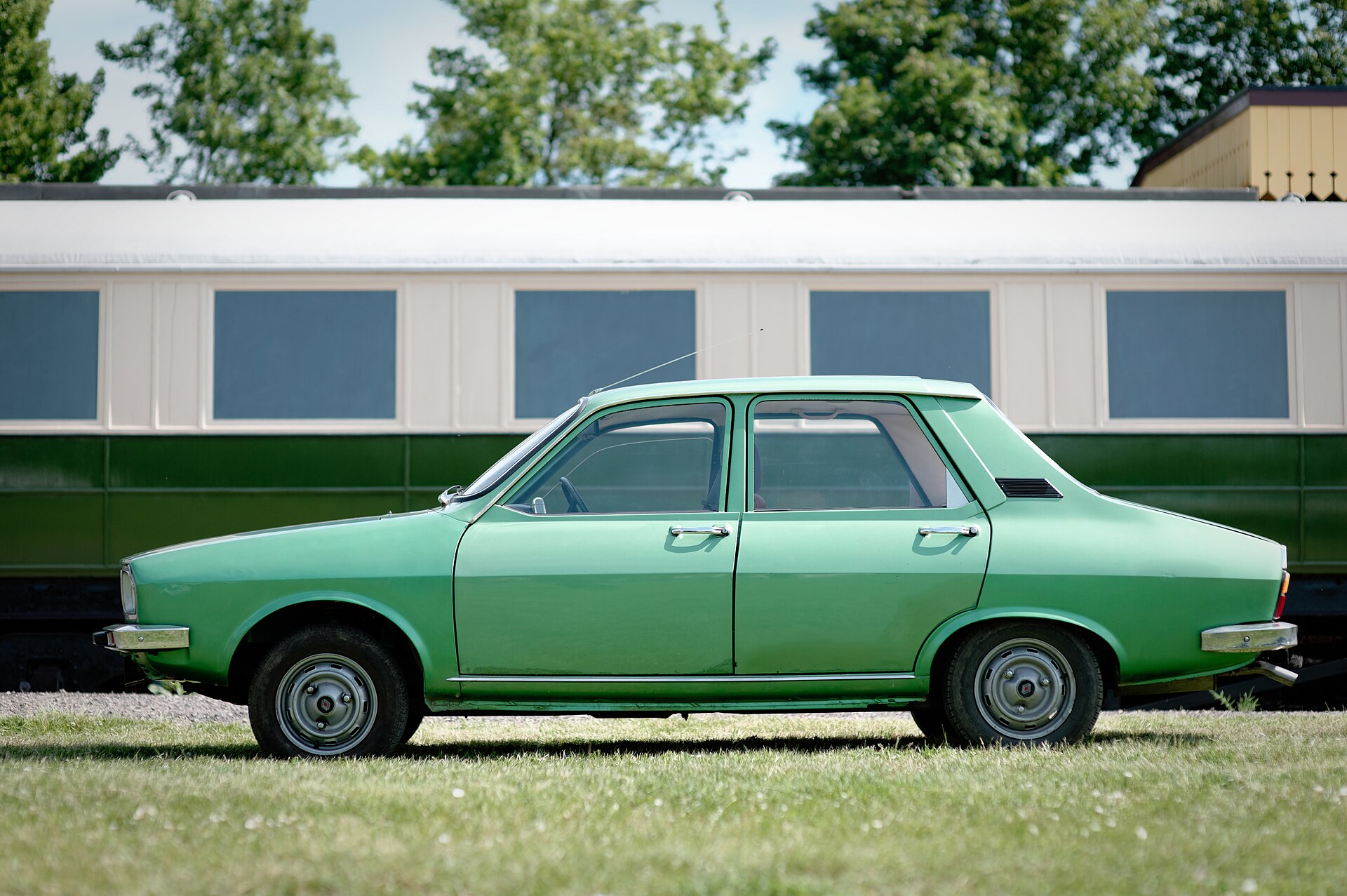
The Renault 12 is a front-wheel-drive family saloon and estate that Renault built in France from 1969 to 1980, mainly at Flins. Developed as Project 117 for rough roads and export markets, it used a 1.3-litre engine of 40 kW (54 PS) in most versions, while the 1970 Gordini had 83 kW (113 PS). Licence plants on five continents kept it in production for decades.
In short
- Shown at the Paris Motor Show in October 1969; French production ended in 1980 after the Renault 18 took over.
- Saloon and Break estate; trims L, TL, TS, TR automatic and the Gordini (5,188 built, 1970-1974).
- Renault's best-selling model in 1973, with 322,793 cars.
- Built under licence in Romania, Turkey, Argentina, Brazil, Australia, Canada and other countries.
Size at a glance
| Dimensions | Renault 12 I |
|---|---|
| Length | 4,345 mm171.1 in |
| Width | 1,616 mm63.6 in |
| Height | 1,435 mm56.5 in |
| Wheelbase | 2,440 mm96.1 in |
Specs by version
Engines
| Version | Engine | Power | Gearbox | Drive | Production years |
|---|---|---|---|---|---|
| 1.3 L/TL (54 PS) | 1.3 l · 4 cyl · Petrol 1,289 cc | 40 kW 54 PS54 hp | 4-sp Manual | Front-wheel drive | 1969 |
| 1.3 Break (54 PS) | 1.3 l · 4 cyl · Petrol 1,289 cc | 40 kW 54 PS54 hp | - | Front-wheel drive | 1970 |
| 1.3 TS (60 PS) | 1.3 l · 4 cyl · Petrol 1,289 cc | 44 kW 60 PS59 hp | - | Front-wheel drive | 1972 |
| 1.6 Gordini (113 PS) | 1.6 l · 4 cyl · Petrol 807 | 83 kW 113 PS111 hp | 5-sp Manual | Front-wheel drive | 1970–1974 |
Performance
Show all 3 versions
| Version | 0–100 km/h | Top speed |
|---|---|---|
| 1.3 L/TL (54 PS) | - | 145 km/h90 mph |
| 1.3 TS (60 PS) | - | 150 km/h93 mph |
| 1.6 Gordini (113 PS) | 9.5 s 0–62 mph | 185 km/h115 mph |
Dimensions and weight
Show all 4 versions
| Version | Length | Width | Height | Wheelbase |
|---|---|---|---|---|
| 1.3 L/TL (54 PS) | 4,345 mm171.1 in | 1,616 mm63.6 in | 1,435 mm56.5 in | 2,440 mm96.1 in |
| 1.3 Break (54 PS) | 4,410 mm173.6 in | 1,616 mm63.6 in | - | 2,440 mm96.1 in |
| 1.3 TS (60 PS) | 4,345 mm171.1 in | 1,616 mm63.6 in | 1,435 mm56.5 in | 2,440 mm96.1 in |
| 1.6 Gordini (113 PS) | 4,345 mm171.1 in | 1,616 mm63.6 in | 1,435 mm56.5 in | 2,440 mm96.1 in |
Verified Manufacturer and type-approval data from our catalog · Sources and methodology
Renault 12 at a glance
| Item | Renault 12 |
|---|---|
| Years | 1969-1980 (France) |
| Production total | about 4 million according to Renault; figures vary between sources |
| Main plant | Flins, France |
| Body styles | 4-door saloon, 5-door Break estate |
| Layout | front-wheel drive, longitudinal engine ahead of the front axle, rigid rear axle |
| Engines | 1,289 cc Cléon-Fonte four; 1,565 cc Cléon-Alu four (Gordini) |
| Power | 37 kW (50 PS) to 83 kW (113 PS) DIN |
| Kerb weight | 880-980 kg |
| Length | 4,345 mm saloon, 4,410 mm estate; wheelbase 2,440 mm |
| Top speed | 145 km/h (1.3 TL) to 185 km/h (Gordini) |
| 0-100 km/h | 9.5 s (Gordini), Planète Renault |
| Price new | FF 18,100 for the Gordini in 1970; FF 23,190 (L) to FF 28,890 (Automatic Break) in 1976 |
Project 117: a saloon for bad roads
Renault's styling centre began Project 117 in January 1964. The brief asked for a roomy cabin, a large boot and a suspension that could cope with the worst roads in Africa. Size placed the car between the rear-engined 8 and the 16 hatchback, and it was intended to sell far beyond France.
Prototypes ran from 1964, early ones with three headlamps per side and a spare wheel on the boot lid. The production car kept the engine mounted lengthways ahead of the front wheels and paired it with a rigid rear axle. Some critics called that axle a step back for Renault. The boot held 415 litres, and the car was longer than a Ford Cortina Mk III at 4,345 mm.
Launch saloons had the 1,289 cc Cléon-Fonte engine with 40 kW (54 PS) DIN, front disc brakes and rear drums. Orders came in immediately, and Renault raised output to 700 cars a day to keep up. The Break estate followed in 1970.
Engines and versions year by year
| Year | Version | Engine | Power | Top speed |
|---|---|---|---|---|
| 1969 | L, TL saloon | 1,289 cc | 40 kW (54 PS) | 145 km/h |
| 1970 | Break estate | 1,289 cc | 40 kW (54 PS) | - |
| 1970 | Gordini (on sale 1971) | 1,565 cc | 83 kW (113 PS) | 185 km/h |
| 1972 | TS | 1,289 cc, twin-choke carburettor | 44 kW (60 PS) | 150 km/h |
| 1973-1974 | TR automatic | 1,289 cc | - | - |
| 1975 | L after facelift | 1,289 cc | 37 kW (50 PS) | - |
The TS of October 1972 used the twin-choke carburettor from the Renault 15 TL. Its output is quoted as 44 kW (60 PS) DIN by Wikipedia FR and 47 kW (64 PS) by Wikipedia EN, so figures vary between sources. The TR brought a three-speed automatic, and the 1972 range also swapped the dynamo for an alternator.
Prices rose steadily through the 1970s. Planète Renault quotes FF 11,640 to FF 13,120 for the 1972 range and FF 23,190 to FF 28,890 for the 1976 range.

The Gordini and the Cape Town record
The 12 Gordini was presented in October 1970 and took over from the rear-engined 8 Gordini. Its all-aluminium 1,565 cc engine came from the 16 TS, with two Weber carburettors, 83 kW (113 PS) DIN at 6,250 rpm and 140 Nm. A five-speed gearbox, ventilated front discs and the blue paint with white stripes completed the package. Top speed was 185 km/h.
The car raced in the one-make Coupe Gordini from 1971 to 1974. In 1971 the Marreau brothers and Yves Garrin drove from Cape Town to Algiers, about 10,000 km, in 8 days, 22 hours and 18 minutes. Sales fell year after year: 1,743 in 1972, 884 in 1973 and 270 in 1974, when production stopped in July with 5,188 built. None were made in right-hand drive.

The 1975 facelift and the end in France
In autumn 1975 the 12 received a new grille in a grey surround, taller bumpers, larger rear lights and a new dashboard on all but the L. Power brakes became standard except on the L, whose engine dropped to 37 kW (50 PS). The Gordini name moved to the 17.
The 1973 sales peak of 322,793 cars, well ahead of the Renault 5 at 207,727, was the high point. The Renault 14 of 1976 and the Renault 18 of 1978 squeezed the range, and from July 1978 only the TL saloon and the estates remained. Production in France ended in 1980. The 12's stablemate for rural buyers, the Renault 4, outlasted it by more than a decade.

Licence builds on five continents
The 12 was assembled or built under licence in Argentina (about 450,000 cars), Turkey (Oyak-Renault, 1971-2000, sold as the Toros after 1989), Australia, Canada, Colombia, Spain, Portugal and Yugoslavia. In Brazil, Ford used the design for the Corcel. Australian buyers made it Wheels Car of the Year in 1970. In Romania it became the Dacia 1300, which stayed in production until 2004; that car's own story is part of our history of Dacia.
Period rivals in Britain included the Peugeot 304, Simca 1301, Fiat 128, Hillman Avenger and the Ford Escort. European testers praised the 12's cabin, styling and economy, while Road & Track criticised engine noise and the heavy unassisted steering.
Renault 12 today: what to check when buying
Classic Trader names rust as the main issue, especially at the front wings, the sills and the rear axle mounts. Engine checks should cover oil seals and the water pump, and the suspension and steering should be inspected for leaks. Wear parts are still reasonably easy to find because the mechanics are simple and shared with other Renaults of the era.
Gordini cars need extra care with originality. The alloy-cased five-speed gearbox could distort when hot in hard competition use, as Renault Australia's rally team found, so a car with a racing past deserves a close look at the transmission.
Public sales data is thin. Classic.com records a 1974 saloon sold for USD 11,000 in August 2022, about EUR 9,500 at an approximate 0.86 rate, and a 1978 TL that failed to sell at a top bid of EUR 6,500 in May 2022. Gordinis sell for several times that. The current range is in our Renault catalogue, and more cars of the period are in the classic cars section.
Renault 12 in our rankings
- No. 3 of 20 · Smallest station wagons (4,410 mm)
- No. 7 of 15 · Quickest cars of the 1970s, 0–100 (9.5 s)
- No. 17 of 104 · Smallest sedans (4,345 mm · top 17%)
- No. 171 of 535 · Smallest cars (4,345 mm · top 32%)
- No. 389 of 1108 · Longest-running car nameplates (11 years · top 38%)
- No. 12 of 21 · Fastest cars of the 1970s (185 km/h · top 58%)
Shorter than 85% of ranked station wagons in the 1CARS catalog (No. 3 of 20).
FAQ
When was the Renault 12 made?
Renault showed the 12 at the Paris Motor Show in October 1969 and built it in France until 1980. Licence production continued much longer, in Turkey until 2000 and in Romania as the Dacia until 2004.
How many Renault 12 Gordinis were built?
Renault built 5,188 Gordinis between 1970 and July 1974, all in left-hand drive. The car had a 1,565 cc engine with 83 kW (113 PS) DIN and a top speed of 185 km/h.
How many Renault 12s were built in total?
Figures vary between sources. Renault and Planète Renault give about 4 million cars, while Wikipedia EN mentions 2.5 million sold; the difference depends largely on how licence production is counted.
What replaced the Renault 12?
The Renault 18, launched in 1978, replaced the 12 in France. Both cars stayed on sale side by side for two years until French production of the 12 ended in 1980.
Data sources
Data checked by an editor against the sources below.
- Wikipedia - Renault 12


