
 Renault 19
All generations, specs and history
Published Sources (1) Report an error
By Sarah Whitmore, Senior Automotive Writer
- Built
- 1988–2002
- Generations
- 2 · X53 to X53 phase 2
- Top power
- 103 kW (140 PS)
Timeline
19 generations
Click a generation for its own page
- 19 X53 1988–1992 · Sedan, Hatchback · 40–103 kW (54–140 PS)
- 19 X53 phase 2 1992–2002 · Sedan, Hatchback · 43–101 kW (58–137 PS)
Newest first · 2 generations since 1988
- 1992 X53 phase 2 1992–2002 · Sedan, Hatchback · 43–101 kW (58–137 PS)
- 1988 X53 1988–1992 · Sedan, Hatchback · 40–103 kW (54–140 PS)
All generations by year: 19 X53 phase 2 (1992–2002) · 19 X53 (1988–1992)
Which one is mine?
Pick the year of first registration to see which generation it is.
- X53 phase 2 1992–2002
- X53 1988–1992
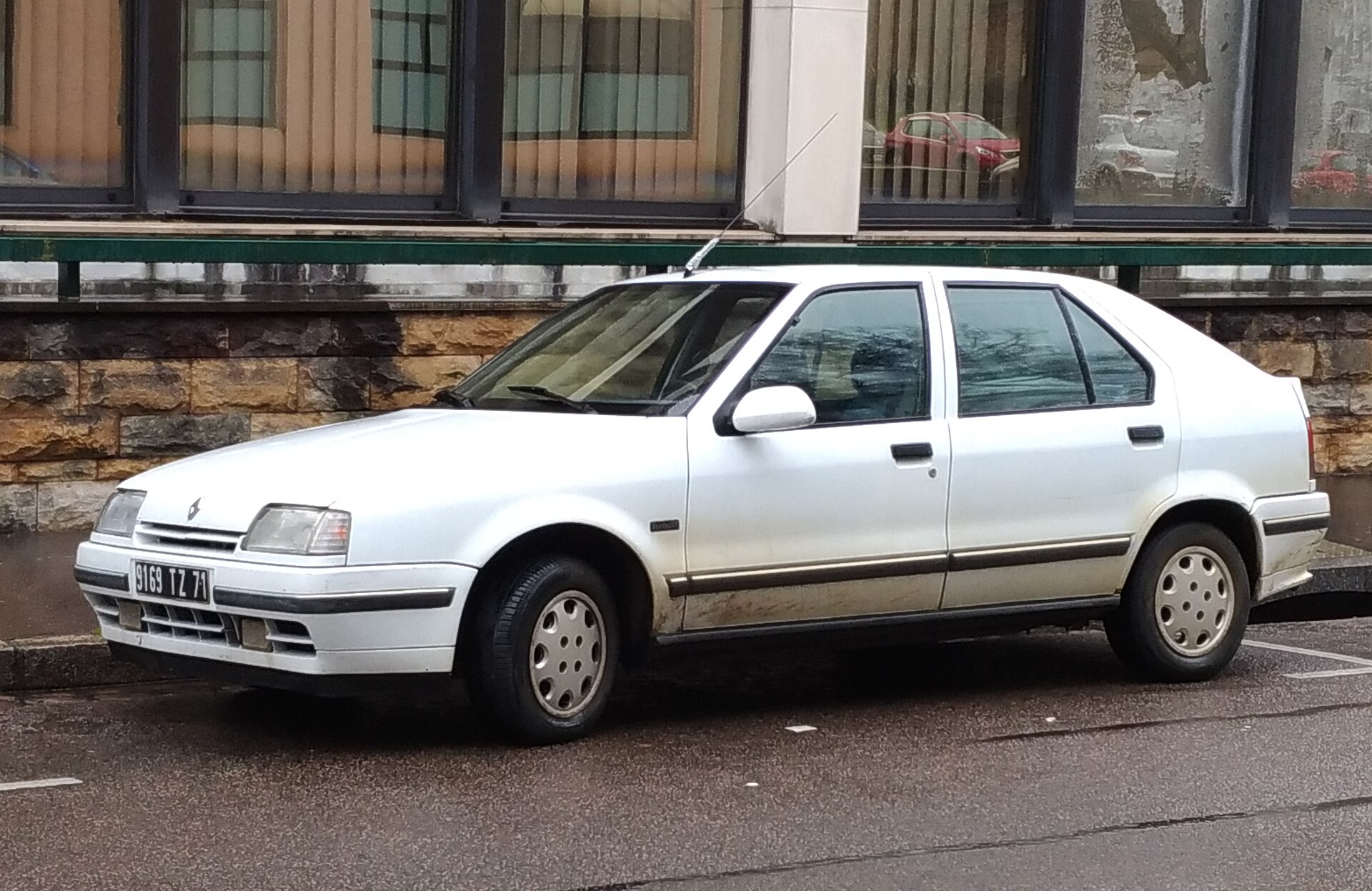
The Renault 19 is the compact family car Renault presented in June 1988 to replace the Renault 9 and 11, styled by Giorgetto Giugiaro at Italdesign. Sold as a three- and five-door hatchback, the Chamade saloon and a Karmann-built cabriolet, it used engines from a 1.2-litre petrol to the 1.8 16-valve of the 16S. Europe stopped building it in the mid-1990s; South American production ran to 2000 and beyond.
In short
- Project X53 started in November 1984; prototypes covered 7.5 million km before launch.
- Engines: 1.2 to 1.8 petrol and 1.9 diesel, from 40 kW (55 PS) in the first 1.2 to 103 kW (140 PS) in the 16S.
- Best-selling imported car in Germany from 1990 to 1994, with 97,262 sold there in 1991 alone.
- Built in ten countries, from Douai in France to Bursa in Turkey, Córdoba in Argentina and Envigado in Colombia.
Size at a glance
| Dimensions | Renault 19 X53 |
|---|---|
| Length | 4,156 mm163.6 in |
| Width | 1,694 mm66.7 in |
| Height | 1,412 mm55.6 in |
| Wheelbase | 2,540 mm100.0 in |
Specs by version
Engines
| Version | Engine | Power | Gearbox | Drive | Production years |
|---|---|---|---|---|---|
| Diesel · 2 versions | |||||
| X53 · 1.9 D (F8Q) | 1.9 l · 4 cyl · Diesel F8Q | 47 kW 64 PS63 hp | Manual | Front-wheel drive | 1988–1992 |
| X53 phase 2 · 1.9 dT turbodiesel (F8Q) | 1.9 l · 4 cyl · Diesel F8Q | 66 kW 90 PS89 hp | Manual | Front-wheel drive | 1992–1995 |
| Petrol · 4 versions | |||||
| X53 · 1.4 (E6J) 80 PS | 1.4 l · 4 cyl · Petrol E6J | 59 kW 80 PS79 hp | Manual | Front-wheel drive | 1988–1992 |
| X53 · 16S 1.8 16V (F7P, no catalyst) | 1.8 l · 4 cyl · Petrol F7P | 103 kW 140 PS138 hp | 5-sp Manual | Front-wheel drive | 1990–1992 |
| X53 phase 2 · 1.4e (E7J) | 1.4 l · 4 cyl · Petrol E7J | 58 kW 79 PS78 hp | Manual | Front-wheel drive | 1992–2000 |
| X53 phase 2 · 1.8i (F3P) | 1.8 l · 4 cyl · Petrol F3P | 80 kW 109 PS107 hp | Manual | Front-wheel drive | 1992–1997 |
Performance
Show all 6 versions
| Version | 0–100 km/h | Top speed |
|---|---|---|
| Diesel · 2 versions | ||
| X53 · 1.9 D (F8Q) | 15.7 s 0–62 mph | 161 km/h100 mph |
| X53 phase 2 · 1.9 dT turbodiesel (F8Q) | 11.4 s 0–62 mph | 183 km/h114 mph |
| Petrol · 4 versions | ||
| X53 · 1.4 (E6J) 80 PS | 13.0 s 0–62 mph | 176 km/h109 mph |
| X53 · 16S 1.8 16V (F7P, no catalyst) | 8.2 s 0–62 mph | 215 km/h134 mph |
| X53 phase 2 · 1.4e (E7J) | 12.2 s 0–62 mph | 173 km/h107 mph |
| X53 phase 2 · 1.8i (F3P) | 8.7 s 0–62 mph | 198 km/h123 mph |
Dimensions and weight
Show all 1 versions
| Version | Length | Width | Height | Wheelbase |
|---|---|---|---|---|
| X53 · 1988–1992 | ||||
| X53 · 16S 1.8 16V (F7P, no catalyst) | 4,156 mm163.6 in | 1,694 mm66.7 in | 1,412 mm55.6 in | 2,540 mm100.0 in |
Verified Manufacturer and type-approval data from our catalog · Sources and methodology
Renault 19 at a glance
| Specification | Renault 19 |
|---|---|
| Years | June 1988 to 1996 in Europe; to 2000 in Argentina and Turkey, 2001-2002 in Colombia |
| Project and codes | X53; B53 five-door, C53 three-door, L53 Chamade, D53 cabriolet |
| Design | Giorgetto Giugiaro, Italdesign |
| Body styles | 3- and 5-door hatchback, 4-door Chamade saloon, 2-door cabriolet by Karmann |
| Layout | front engine, front-wheel drive |
| Engines | 1.2, 1.4, 1.6, 1.7 and 1.8 petrol; 1.9 diesel and turbodiesel |
| Power | 40 kW (55 PS) to 103 kW (140 PS) |
| Dimensions | 4,156 mm (hatchback) or 4,248 mm (Chamade) long; 2,540 mm wheelbase |
| Kerb weight | 886-1,175 kg |
| Top speed | 155 km/h (1.2) to 215 km/h (16S, no catalyst) |
| 0-100 km/h | 8.2 s (16S, Renault claim) to 15.7 s (1.9 diesel) |
| Drag coefficient | 0.30 (Italian Wikipedia) |
Project X53 and why Renault built the 19
Renault began project X53 in November 1984 to replace the Renault 9 and 11 with a reliable, comfortable compact car that used the same platform. French Wikipedia credits computer-aided design and numerically controlled machines with letting engineers test and modify parts before any were made, and the X53 prototypes covered 7.5 million km at the Lardy and Aubevoye test centres. It was the last Renault named with a number.
The Renault 19 was presented in June 1988 and went on sale in France in September; right-hand-drive cars reached the UK in February 1989. Italian Wikipedia says it was priced about 10% below the Renault 11 at launch, and 121,089 were built in the last months of 1988.
Body styles from hatchback to Karmann cabriolet
The hatchback came first, with three or five doors, followed by the four-door Chamade saloon. In 1989, 125,785 Chamades were sold, compared with nearly 400,000 hatchbacks built that year. Chamade buyers were more often older, married, rural men. After the facelift the saloon was sold as the Europa in Japan and other markets, and as the Bellevue in some.
Karmann developed the four-seat cabriolet for Renault and built it at Rheine in Germany from mid-1991. It came only with the most powerful engines: at first the 1.7 and the 1.8 16V, after 1992 the 1.8 and the 16V. The cabriolet outlived the hatchback in Europe and stayed in production until early 1997, when the Mégane Cabriolet took over.
Engines, phases and the 16S
The phase 2 facelift of 1992 brought a new front and rear, a new dashboard (right-hand-drive cars kept the old one) and smaller Energy engines in place of the older pushrod units. German Wikipedia lists the following figures for the German market:
| Engine | Code | Power | 0-100 km/h | Top speed |
|---|---|---|---|---|
| 1.2 injection | E7F | 43 kW (58 PS) | - | 155 km/h |
| 1.4 carburettor | E6J | 59 kW (80 PS) | 13.0 s | 176 km/h |
| 1.7 injection | F3N | 79 kW (107 PS) | 10.9 s | 190 km/h |
| 1.8i | F3P | 80 kW (109 PS) | 8.7 s | 198 km/h |
| 1.8 16V | F7P | 99 kW (135 PS) | 8.5 s | 208 km/h |
| 1.9 diesel | F8Q | 47 kW (64 PS) | 15.7 s | 161 km/h |
| 1.9 turbodiesel | F8Q turbo | 66 kW (90 PS) | 11.4 s | 183 km/h |
The sporting 16S, sold as the 16V in some markets, arrived in autumn 1990 with the F7P: 1,764 cc and 103 kW (140 PS) without a catalyst, or 101 kW (137 PS) with one. Renault claimed 215 km/h and 8.2 seconds to 100 km/h for the uncatalysed car. It had 15-inch Speedline wheels, Recaro seats and ABS, and French sources name the Peugeot 309 GTI 16 and the 16-valve Volkswagen Golf GTI as its rivals. Gearboxes were four- or five-speed manuals and a three-speed automatic, replaced on the injected cars by a four-speed automatic in 1990-1991.


Plants, markets and awards
Wikipedia lists plants at Douai and Maubeuge (France), Vilvoorde (Belgium), Osnabrück (Germany), Valladolid and Palencia (Spain), Setúbal (Portugal), Bursa (Turkey), Envigado (Colombia), Mariara (Venezuela), Santa Isabel in Córdoba (Argentina) and Taichung (Taiwan), where San Fu Motors started production in early 1990 with a target of 1,000 cars a month. In Japan the importer Yanase sold small numbers.
| Market | Built | Versions and notes |
|---|---|---|
| Germany | imported | best-selling import 1990-1994; 97,262 sold in 1991 and 97,086 in 1992 |
| Argentina | Santa Isabel, 1993-2000 | RL and RN with a 1.6, RT and RTi with the 1.8, RND diesel 1997-1999, RE from 1998, 16S |
| Colombia | SOFASA, Envigado, 1994-2002 | 1.7 F2N, later 1.6 and 1.8i, finally the 1.4 Energy |
| Italy | imported | seven trims at launch; sold until early 1996 |
The 19 was Car of the Year in Germany and Spain in 1989, in Ireland in 1990 and in Argentina in 1993, and German Wikipedia adds Das Goldene Lenkrad in 1992. Renault Sport entered it in the 1993 British Touring Car Championship for Alain Menu and Tim Harvey; it was competitive only in the wet and gave way to the Renault Laguna in 1994.

Safety in period tests
The Renault 19 predates Euro NCAP. In a 1992 offset crash test by auto motor und sport at 55 km/h and 50% overlap, it did worse than the Volkswagen Golf III and the Opel Astra F but better than the Citroën ZX, Seat Toledo, Ford Escort and Fiat Tipo. In 2007 TU Berlin crashed a phase 2 car without airbags or belt tensioners against a Mégane II at 50 km/h to show how much protection had improved.
Why the Renault 19 ended
The first-generation Renault Mégane replaced it in Europe from 1995, using the 19's platform and running gear. Sources date the end of European production between autumn 1995 and 1996, with the cabriolet continuing to early 1997. Argentina and Turkey built the car until about 2000 and Colombia into 2001-2002, and Italian Wikipedia counts 3,690 cars produced in the final year, 2001. The current range is in the Renault catalogue.
Renault 19 today: what to check when buying
French Wikipedia lists the 19's strengths as reliability, comfort, handling and low running costs, and singles out the 1.4 Energy, the Cléon-Fonte blocks and the 1.9 dT turbodiesel, which can reach 350,000 km. The same source names the problems to look for:
- rust on the sills and rear wheel arches;
- head gasket trouble on the naturally aspirated 1.9 diesel;
- carburettor overheating from the nearby exhaust on 1.7 cars before 1992;
- a hard brake pedal on phase 1 cars other than the 16S;
- a stiff clutch and cold-start noise on diesels.
A genuine 16S or 16V has the F7P engine code; the early cars have no bonnet vent, which appeared on later 16-valve models. Cabriolets were sold only with the 1.7, 1.8 and 16-valve engines, so a convertible with a smaller engine has been modified.
Renault 19: first vs latest generation
| Spec | 19 X53 | 19 X53 phase 2 | Change |
|---|---|---|---|
| Years | 1988–1992 | 1992–2002 | 4 years apart |
| Most powerful version | 103 kW (140 PS) | 101 kW (137 PS) | −2 kW (−2%) |
| Best 0–100 km/h | 8.2 s | 8.7 s | +0.5 s |
| Top speed | 215 km/h | 198 km/h | −17 km/h |
Oldest and newest generation in the 1cars catalog. Power is the strongest version of each; other rows are shown only when both generations have the figure.
Renault 19 in our rankings
- No. 144 of 745 · Smallest cars (4,156 mm · top 20%)
- No. 356 of 1358 · Longest-running car nameplates (14 years · top 28%)
- No. 34 of 106 · Fastest hatchbacks (215 km/h · top 33%)
- No. 19 of 58 · Fastest French cars (215 km/h · top 33%)
- No. 224 of 554 · Fastest cars (215 km/h · top 41%)
- No. 53 of 124 · Biggest engines: hatchbacks (1,870 cc · top 43%)
Shorter than 80% of ranked cars in the 1CARS catalog (No. 144 of 745).
FAQ
When was the Renault 19 made?
Renault presented the 19 in June 1988 and built it in Europe until 1995-1996, with the cabriolet continuing to early 1997. Production carried on in Argentina and Turkey until about 2000 and in Colombia into 2001-2002.
Who designed the Renault 19?
Giorgetto Giugiaro at Italdesign styled the Renault 19, which Renault developed as project X53 from November 1984. The cabriolet was developed and built by Karmann in Germany.
How fast is the Renault 19 16S?
Renault claimed 215 km/h and 8.2 seconds from 0-100 km/h for the 103 kW (140 PS) 16S without a catalyst, and 212 km/h for the 101 kW (137 PS) catalysed version.
What replaced the Renault 19?
The first-generation Renault Mégane, launched in 1995, which reused the platform and running gear of the 19. The Mégane Cabriolet replaced the Karmann-built 19 cabriolet, while South American plants kept building the 19 for several more years.
Is the Renault 19 reliable?
French sources rate its reliability well, especially the 1.4 Energy petrol and the 1.9 dT turbodiesel, which can exceed 350,000 km. Weak points are rust on the sills and rear arches and head gasket failures on the non-turbo 1.9 diesel.
Data sources
Data checked by an editor against the sources below.
- Wikipedia - Renault 19


