
 Renault 5 Turbo
All generations, specs and history
Published Sources (1) Report an error
By Felix Hartmann, Automotive Technology & EV Contributor
- Built
- 1980–1986
- Generations
- 2 · 822 to 822 Turbo 2
- Top power
- 257 kW (349 PS)
Timeline
5 Turbo generations
Click a generation for its own page
- 5 Turbo 822 1980–1982 · Hatchback · 118 kW (160 PS)
- 5 Turbo 822 Turbo 2 1982–1986 · Hatchback · 118 kW (160 PS)
Newest first · 2 generations since 1980
- 1982 822 Turbo 2 1982–1986 · Hatchback · 118 kW (160 PS)
- 1980 822 1980–1982 · Hatchback · 118 kW (160 PS)
All generations by year: 5 Turbo 822 Turbo 2 (1982–1986) · 5 Turbo 822 (1980–1982)
Which one is mine?
Pick the year of first registration to see which generation it is.
- 822 Turbo 2 1982–1986
- 822 1980–1982
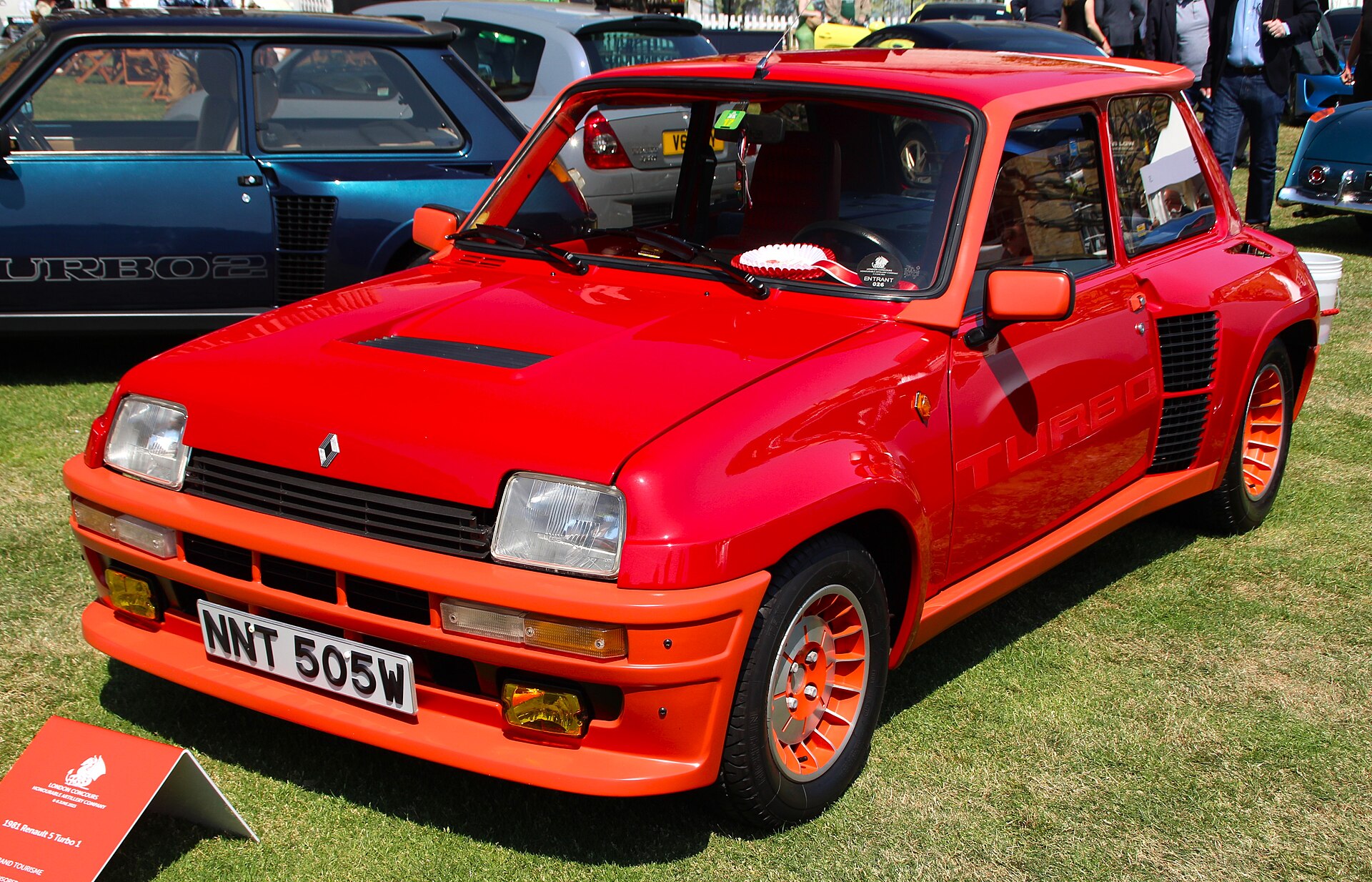
The Renault 5 Turbo is the mid-engined, rear-wheel-drive rally version of the Renault 5 that Renault showed at the Brussels Motor Show in January 1980 and built at Alpine's Dieppe plant into the mid-1980s. A 1.4-litre turbocharged four behind the seats gave 118 kW (160 PS), and Jean Ragnotti won the 1981 Monte Carlo Rally with it. In 2025 Renault announced an electric successor, the Turbo 3E.
In short
- Two road versions: the aluminium-panelled Turbo 1 and the cheaper Turbo 2 with steel panels; about 4,900 built in total.
- Engine: 1,397 cc Cléon-Fonte four with a Garrett T3 turbo and Bosch K-Jetronic injection, 118 kW (160 PS).
- 0-100 km/h in 6.9 seconds and a top speed of 200-205 km/h, depending on the source.
- Three World Rally Championship wins, all with Ragnotti: Monte Carlo 1981 and Tour de Corse 1982 and 1985.
Specs by version
Engines
| Version | Engine | Power | Torque | Gearbox | Drive | Production years |
|---|---|---|---|---|---|---|
| 822 · 1980–1982 | ||||||
| 822 · 5 Turbo 1.4 (Turbo 1) | 1.4 l · 4 cyl · Petrol Cléon-Fonte | 118 kW 160 PS158 hp | 221 Nm163 lb-ft | 5-sp Manual | Rear-wheel drive | 1980–1982 |
| 822 · 5 Turbo Cévennes | 1.4 l · 4 cyl · Petrol 1,397 cc | 132 kW 179 PS177 hp | - | 5-sp Manual | Rear-wheel drive | 1980 |
| 822 Turbo 2 · 1982–1986 | ||||||
| 822 Turbo 2 · 5 Turbo 2 1.4 | 1.4 l · 4 cyl · Petrol Cléon-Fonte | 118 kW 160 PS158 hp | 221 Nm163 lb-ft | 5-sp Manual | Rear-wheel drive | 1982–1986 |
| 822 Turbo 2 · Maxi 5 Turbo | 1.5 l · 4 cyl · Petrol 1,527 cc | 257 kW 349 PS345 hp | - | Manual | Rear-wheel drive | 1984–1985 |
Performance
Show all 2 versions
| Version | 0–100 km/h | Top speed |
|---|---|---|
| 822 · 1980–1982 | ||
| 822 · 5 Turbo 1.4 (Turbo 1) | 6.9 s 0–62 mph | 205 km/h127 mph |
| 822 Turbo 2 · 1982–1986 | ||
| 822 Turbo 2 · 5 Turbo 2 1.4 | 6.9 s 0–62 mph | 200 km/h124 mph |
Dimensions and weight
Show all 3 versions
| Version | Kerb weight |
|---|---|
| 822 · 1980–1982 | |
| 822 · 5 Turbo 1.4 (Turbo 1) | 980 kg2,161 lb |
| 822 Turbo 2 · 1982–1986 | |
| 822 Turbo 2 · 5 Turbo 2 1.4 | 970 kg2,138 lb |
| 822 Turbo 2 · Maxi 5 Turbo | 905 kg1,995 lb |
Verified Manufacturer and type-approval data from our catalog · Sources and methodology
Renault 5 Turbo at a glance
| Specification | Renault 5 Turbo |
|---|---|
| Years | 1980 to 1982 (Turbo 1); 1982 to 1985-1986 (Turbo 2) |
| Production | 4,857-4,987 depending on the source, plus competition cars |
| Plant | Alpine, Dieppe, France |
| Body | two-seat hatchback based on the Renault 5 |
| Layout | mid-engine behind the seats, rear-wheel drive |
| Engine | 1,397 cc Cléon-Fonte four, Garrett T3 turbo, 0.86 bar |
| Power and torque | 118 kW (160 PS) at 6,000 rpm; 210-221 Nm at 3,250 rpm |
| Gearbox | five-speed manual from the Renault 30 TX, turned through 180 degrees |
| Kerb weight | 970-980 kg |
| Top speed | 200-205 km/h |
| 0-100 km/h | 6.9 s |
| Price new | DM 44,600 in Germany in 1980; FRF 125,000 (Turbo 1) and FRF 95,000 (Turbo 2) in France |
Project 822, a rally car built from a supermini
The idea came from Jean Terramorsi, Renault's vice-president of production, who wanted an answer to Lancia's rally success with the Lancia Stratos. Project 822 started in 1977 under Terramorsi and Henry Lherm at Alpine's Dieppe factory, with the car planned from the start for road sales and for FIA Group 3 and Group 4. Sources credit the style differently: English Wikipedia names Marc Deschamps at Bertone, where Marcello Gandini was chief designer, for the rear bodywork, while French Wikipedia credits Yves Legal. The engine was the work of Serge Masset and Philippe Chasselut, the chassis of Joël Michel.
The Renault 5 Turbo was presented at Brussels in January 1980, and the final version was shown at the Paris Motor Show the same year. The first 400 cars, built at Dieppe, covered Group 4 homologation. In Germany it cost DM 44,600 in 1980, when an ordinary Renault 5 cost less than DM 10,000.
Engine, gearbox and chassis
The 1,397 cc Cléon-Fonte four sat behind the two seats, driving the rear wheels. A Garrett T3 turbocharger blew at up to 0.86 bar (0.85 bar in German Wikipedia), Bosch K-Jetronic injection fed it, and compression was cut from 8.6:1 to 7:1. Output was 118 kW (160 PS) at 6,000 rpm with 221 Nm at 3,250 rpm according to English Wikipedia; German Wikipedia gives 210 Nm. A competition kit raised power to about 147 kW (200 PS).
The five-speed gearbox, type 369 from the Renault 30 TX, was turned through 180 degrees to fit the mid-engined layout, with a 190 mm twin-plate clutch. The car weighed 970-980 kg, and German Wikipedia puts its 0-100 km/h time of 6.9 seconds just 0.1 seconds behind a contemporary Porsche 911 SC.

Turbo 1 and Turbo 2 production by version
| Version | Years | Body panels and trim | Price in France | Built |
|---|---|---|---|---|
| Turbo 1 | 1980-1982 | aluminium doors and roof, Bertone interior | FRF 125,000 | 1,690 (FR, DE) or 1,820 (EN) |
| Turbo 2 | 1982-1985/86 | steel panels, Renault 5 Alpine Turbo parts | FRF 95,000 | 3,167 (EN, FR) or 3,180 (DE) |
| Group B homologation Turbo 2 | late 1984 | 1,430 cc C7K-700 engine, VIN with "8221" | - | about 200 |
The Turbo 2 appeared at the 1982 Paris show. It used more standard Renault 5 parts, cost about 25% less and kept almost the same performance. The total depends on the source: 4,857 in French Wikipedia, 4,870 in German Wikipedia and 4,987 in English Wikipedia, before counting the competition cars.

Rally versions and results
Renault built a run of competition models on the road car:
| Version | Year | Power | Notes |
|---|---|---|---|
| Cévennes | 1980 | 132-147 kW (180-200 PS) | 20 cars for the Critérium des Cévennes |
| Maxi-Cévennes | 1980-1982 | 199 kW (270 hp) | factory cars |
| Tour de Corse | from 1982 | 179-213 kW (240-285 hp) | customer car, 930 kg |
| Maxi 5 Turbo | 1984-1985 | about 257 kW (350 PS) | 1,527 cc, 905 kg, 20 built |
Jean Ragnotti and Jean-Marc Andrié won the 1981 Monte Carlo Rally on the car's first World Rally Championship start, and the pair won the Tour de Corse in 1982. In the Maxi 5 Turbo, Ragnotti and Pierre Thimonier won the 1985 Tour de Corse. The Maxi's 1,527 cc engine counted as 2,138 cc under the FISA turbo factor, and on gravel the four-wheel-drive Group B cars soon left the rear-driven Renault behind. Ragnotti took the 1984 French Rally Championship, the European Cup went to Schütz in 1981, Gouhier in 1982 and Lammers in 1983 and 1984, and a 283 kW (385 PS) car won the French Supertouring title in 1987.

Successor and the electric Turbo 3E
In 1985 the front-engined Renault Super 5 GT Turbo took over as the performance Renault 5, and the mid-engined car stayed in French rallying under Group F after Group B was banned at the end of 1986.
Renault showed the electric R5 Turbo 3E as a concept at Chantilly on 25 September 2022 and announced a limited production model on 17 March 2025. It is a two-seater on an aluminium platform with a carbon fibre body, built around the Renault 5 E-Tech theme but longer and lower. Renault's figures:
| Specification | Renault 5 Turbo 3E (announced) |
|---|---|
| Motors | two rear in-wheel motors, 2 x 200 kW, about 400 kW (540 hp) |
| Battery | 70 kWh, 800 volts |
| Charging | up to 350 kW DC, 15-80% in about 15 minutes; 11 kW AC |
| Range | up to 400 km (WLTP pending homologation) |
| Performance | 0-100 km/h under 3.5 s; 270 km/h on a track |
| Size and weight | 4,080 mm long, 2,030 mm wide, 1,380 mm high; about 1,450 kg |
| Production | 1,980 numbered cars, for Europe, the Middle East, Japan and Australia |
| Deliveries | from 2027 |
The March 2025 release gave no price.
Renault 5 Turbo today: what to check when buying
Identity comes first. A Turbo 1 has aluminium doors and roof and the Bertone interior, while a Turbo 2 uses steel panels and Renault 5 Alpine Turbo trim. The roughly 200 Group B homologation cars of late 1984 carry "8221" in the VIN and a 1,430 cc C7K-700 engine. Renault itself calls the 5 Turbo and Turbo 2 sought-after collector cars, and many competition versions were built on road cars, so a car's chassis number and history should match the version claimed. Some Turbo 2s reached the United States as grey-market imports. The history of the Dieppe factory and its own cars is in our history of Alpine, and the current models in the Renault catalogue.
Renault 5 Turbo: first vs latest generation
| Spec | 5 Turbo 822 | 5 Turbo 822 Turbo 2 | Change |
|---|---|---|---|
| Years | 1980–1982 | 1982–1986 | 2 years apart |
| Most powerful version | 118 kW (160 PS) | 118 kW (160 PS) | same (0%) |
| Lightest kerb weight | 980 kg | 905 kg | −75 kg |
| Best 0–100 km/h | 6.9 s | 6.9 s | same |
| Top speed | 205 km/h | 200 km/h | −5 km/h |
Oldest and newest generation in the 1cars catalog. Power is the strongest version of each; other rows are shown only when both generations have the figure.
Renault 5 Turbo in our rankings
- No. 1 of 103 · Power-to-weight: hatchbacks (284 kW/t)
- No. 5 of 15 · Quickest cars of the 1980s, 0–100 (6.9 s)
- No. 7 of 107 · Most powerful cars of the 1980s (257 kW)
- No. 8 of 103 · Lightest hatchbacks (905 kg)
- No. 38 of 558 · Power-to-weight: cars (284 kW/t · top 7%)
- No. 40 of 564 · Lightest cars (905 kg · top 8%)
Better power-to-weight than 99% of ranked hatchbacks in the 1CARS catalog (No. 1 of 103).
FAQ
How many Renault 5 Turbo were made?
Between 4,857 and 4,987 road cars, depending on the source: 1,690-1,820 Turbo 1 and 3,167-3,180 Turbo 2. About 200 more Turbo 2s were built in late 1984 for Group B homologation, plus competition cars.
How much horsepower does a Renault 5 Turbo have?
The road car has 118 kW (160 PS) at 6,000 rpm from a 1,397 cc turbo four. Rally versions gave 132-213 kW (180-285 PS), and the 1985 Maxi 5 Turbo had about 257 kW (350 PS) from 1,527 cc.
How fast is the Renault 5 Turbo?
It reaches 100 km/h in 6.9 seconds and has a top speed of 200-205 km/h, depending on the source. German Wikipedia notes the sprint was only 0.1 seconds slower than a contemporary Porsche 911 SC.
What is the difference between the Turbo 1 and Turbo 2?
The Turbo 1 has aluminium doors and roof and a Bertone interior; the Turbo 2 of 1982 uses steel panels and Renault 5 Alpine Turbo parts. The Turbo 2 cost about 25% less, FRF 95,000 against FRF 125,000, with nearly the same performance.
Is Renault making a new 5 Turbo?
Yes. Renault announced the electric Renault 5 Turbo 3E in March 2025: two rear in-wheel motors with about 400 kW (540 hp), a 70 kWh battery and 1,980 numbered cars, with deliveries from 2027.
Data sources
Data checked by an editor against the sources below.
- Wikipedia - Renault 5 Turbo


