 Renault Kwid
Specs, engines and history
Published Sources (4) Report an error
By Oleksandr Hnatiuk, Automotive Editor & Used Car Specialist
- Built
- 2015–present
- Top power
- 52 kW (71 PS)
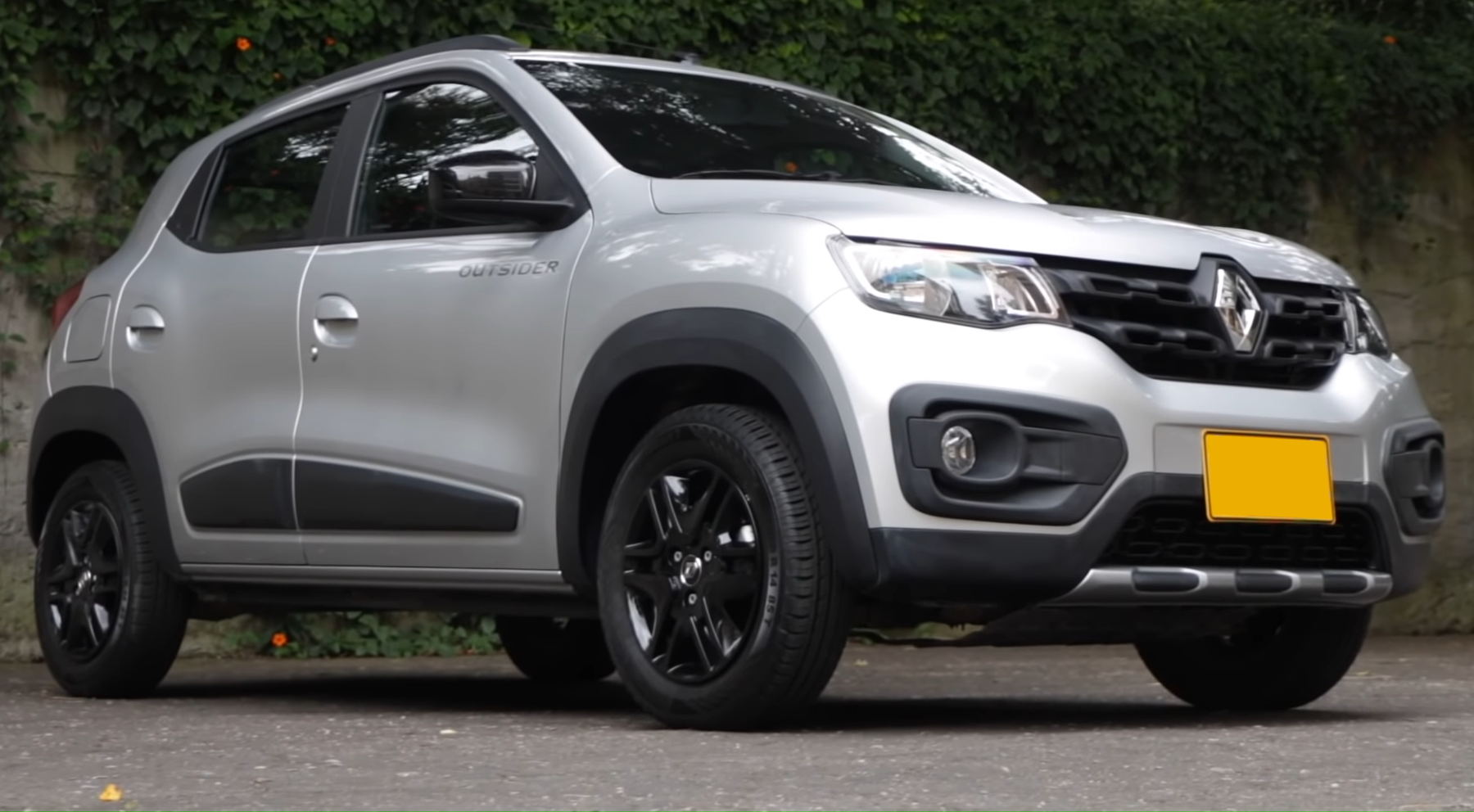
The Renault Kwid is a small five-door hatchback with SUV styling that Renault launched in India in September 2015 as the first car on the CMF-A platform. Built in Chennai, Brazil and, since 2025, Colombia, it uses 0.8- and 1.0-litre three-cylinder petrol engines, and in Latin America it is also sold as the Kwid E-Tech electric.
In short
- Revealed in Chennai on 20 May 2015; Indian sales began at about INR 2.57 lakh (INR 257,000).
- Engines: 0.8 SCe with 40 kW (54 hp), 1.0 SCe with 50 kW (68 hp); Brazilian 1.0 flex with 52 kW (71 PS) on ethanol; E-Tech electric with 48 kW (65 PS).
- India price after the July 2026 facelift: from INR 4.53 lakh ex-showroom; Brazil: from BRL 78,410 (2026 line), E-Tech BRL 99,990.
- Global sales reached 183,989 in 2019; Brazil overtook India as its largest market in 2018.
Size at a glance
| Dimensions | Renault Kwid BBA |
|---|---|
| Length | 3,679 mm144.8 in |
| Width | 1,579 mm62.2 in |
| Height | 1,478 mm58.2 in |
| Wheelbase | 2,422 mm95.4 in |
| Boot | 279 L9.9 cu ft |
Running cost
Fuel · Kwid BBA 1.0 SCe AMT 50 kW
about 1,200 EUR fuel a year at 15,000 km
4.5 l/100 km · petrol at 1.75 EUR/l · change mileage, fuel price or version
Specs by version
Engines
| Version | Engine | Power | Torque | Gearbox | Drive | Production years |
|---|---|---|---|---|---|---|
| Electric · 1 version | ||||||
| E-Tech 48 kW | Electric | 48 kW 65 PS64 hp | - | Single-speed | Front-wheel drive | 2022 |
| Petrol · 4 versions | ||||||
| 0.8 SCe 40 kW | 0.8 l · 3 cyl · Petrol BR08DE | 40 kW 54 PS54 hp | 72 Nm53 lb-ft | 5-sp Manual | Front-wheel drive | 2015 |
| 1.0 SCe 50 kW | 1.0 l · 3 cyl · Petrol BR10DE | 50 kW 68 PS67 hp | 91 Nm67 lb-ft | 5-sp Manual | Front-wheel drive | 2016 |
| 1.0 SCe AMT 50 kW | 1.0 l · 3 cyl · Petrol BR10DE | 50 kW 68 PS67 hp | 91 Nm67 lb-ft | 5-sp Automatic | Front-wheel drive | 2018 |
| 1.0 SCe flex 52 kW | 1.0 l · 3 cyl · Petrol 999 cc | 52 kW 71 PS70 hp | 98 Nm72 lb-ft | 5-sp Manual | Front-wheel drive | 2017 |
Performance
Show all 3 versions
| Version | 0–100 km/h | Top speed | Fuel consumption |
|---|---|---|---|
| 0.8 SCe 40 kW | 16.4 s 0–62 mph | 143 km/h89 mph | 4.1 l/100 km57.4 mpg US · 68.9 mpg UK |
| 1.0 SCe 50 kW | 13.9 s 0–62 mph | 157 km/h98 mph | 4.7 l/100 km50.0 mpg US · 60.1 mpg UK |
| 1.0 SCe AMT 50 kW | - | - | 4.5 l/100 km52.3 mpg US · 62.8 mpg UK |
Dimensions and weight
Show all 5 versions
| Version | Length | Width | Height | Wheelbase | Kerb weight | Boot |
|---|---|---|---|---|---|---|
| Electric · 1 version | ||||||
| E-Tech 48 kW | - | - | - | - | 977 kg2,154 lb | - |
| Petrol · 4 versions | ||||||
| 0.8 SCe 40 kW | 3,679 mm144.8 in | 1,579 mm62.2 in | 1,478 mm58.2 in | 2,422 mm95.4 in | 775 kg1,709 lb | - |
| 1.0 SCe 50 kW | 3,731 mm146.9 in | 1,579 mm62.2 in | 1,474 mm58.0 in | 2,422 mm95.4 in | - | 279 l9.9 cu ft |
| 1.0 SCe AMT 50 kW | - | - | - | 2,422 mm95.4 in | - | 279 l9.9 cu ft |
| 1.0 SCe flex 52 kW | - | - | - | 2,422 mm95.4 in | 818 kg1,803 lb | - |
Verified Manufacturer and type-approval data from our catalog · Sources and methodology
Renault Kwid at a glance
| Specification | Renault Kwid |
|---|---|
| Body | five-door hatchback with crossover styling, five seats |
| Production | since 2015 in Chennai (India); since 2017 in Sao Jose dos Pinhais (Brazil); since 2025 in Envigado (Colombia) |
| Platform | CMF-A, model code BW, development code BBA |
| Engines | 0.8 SCe BR08DE and 1.0 SCe BR10DE, three cylinders; 1.0 SCe flex (Brazil); electric (E-Tech) |
| Power | 40-52 kW (54-71 PS); electric 48 kW (65 PS) |
| Gearboxes | 5-speed manual, 5-speed Easy-R AMT (India, from 2018) |
| Length, width, height | 3,731 mm, 1,579 mm, 1,478 mm (India) |
| Wheelbase and ground clearance | 2,422 mm; 184 mm (India) |
| Boot | 279 litres, 620 litres with the rear seat folded (India) |
| Kerb weight | 775 kg (India), 818 kg (Brazil), 977 kg (E-Tech) |
| Consumption | ARAI 21.46-22.3 km/l (4.7-4.5 L/100 km) for the Indian 1.0 |
| Safety | Latin NCAP 3 stars adult (2017, four airbags); Global NCAP 0-1 star (2016, India) |
Renault Kwid origins: CMF-A and the Chennai launch
Renault designed the Kwid for India under Gerard Detourbet, who had led the first Dacia Logan, with 98% of parts localised in India; Serge Cosenza is listed as its designer. Carlos Ghosn presented the production car in Chennai on 20 May 2015, and Renault India took about 25,000 bookings within two weeks of the launch.
The Kwid was the first car on the low-cost CMF-A platform, which later carried the Renault Triber. Its high driving position, 184 mm of ground clearance and plastic wheel-arch cladding gave a city car the look of a small SUV. Electric versions include the Renault City K-ZE in China and the Dacia Spring in Europe.

Renault Kwid engines and gearboxes
| Version | Engine | Power | Torque | 0-100 km/h | Top speed |
|---|---|---|---|---|---|
| 0.8 SCe (India, 2015-) | 799 cc I3 BR08DE | 40 kW (54 hp) | 72 Nm | 16.4 s | 143 km/h |
| 1.0 SCe (India, 2016-) | 999 cc I3 BR10DE | 50 kW (68 hp) | 91 Nm | 13.9 s | 157 km/h |
| 1.0 SCe flex (Brazil, 2017-) | 999 cc I3 | 52 kW (71 PS) ethanol, 50 kW (68 PS) petrol | 98 Nm ethanol, 92 Nm petrol | - | - |
| E-Tech (Brazil, 2022-) | electric motor, 26.8 kWh battery | 48 kW (65 PS) | - | - | - |
The 0.8-litre engine launched the car in 2015, and the 1.0-litre arrived in August 2016. The current Indian range uses only the 1.0, with a five-speed manual or the five-speed Easy-R automated manual added in the July 2018 update; the AMT is operated by a dial on the centre console.
The Kwid E-Tech, on sale in Brazil since 2022 and exported to most of Latin America from 2023, has a 26.8 kWh battery and an INMETRO range of 180 km.

Renault Kwid in India: 2026 facelift, prices and mileage
India received a facelift with LED split headlamps, an 8-inch touchscreen with Apple CarPlay and Android Auto and an optional passenger airbag in October 2019, and a further update on 3 July 2026. The 2026 car has the new Renault badge and new wheel covers, the Authentic and Techno trims were dropped, and a factory-backed CNG kit became available for manual cars as a retrofit.
| Variant (Delhi ex-showroom, November 2026) | Gearbox | Price |
|---|---|---|
| Evolution | 5-speed manual | INR 4.53 lakh (INR 453,000) |
| Evolution AMT | 5-speed AMT | INR 4.90 lakh |
| Evolution CNG | 5-speed manual | INR 5.23 lakh |
| Climber | 5-speed manual | INR 5.15 lakh |
| Climber AMT | 5-speed AMT | INR 5.61 lakh |
| Climber CNG | 5-speed manual | INR 5.85 lakh |
ARAI rates the 1.0 manual at 21.46 km/l (4.7 L/100 km) and the AMT at 22.3 km/l (4.5 L/100 km). The Kwid has lost ground in India: Renault sold only 5,293 units in the 2025-26 financial year, against 105,745 in calendar year 2016.
Renault Kwid in Brazil and Latin America
Renault Brazil redesigned the Kwid for 2017 with structural reinforcements and four airbags and fitted only the 1.0 engine. A Latin American facelift followed in early 2022, and Sofasa began building the car in Envigado, Colombia, in 2025. In Mexico it has been sold since 2019.
For the 2026 line, announced in April 2025, the Brazilian Kwid costs BRL 78,410 as the Zen, BRL 81,620 as the Intense with an 8-inch screen and reversing camera, BRL 85,020 for a new two-tone trim and BRL 85,140 as the Outsider. Four airbags, stability control, hill start assist and tyre pressure monitoring are standard. On petrol it averages 14.6 km/l in town and 15.5 km/l on the highway, or 6.8 and 6.5 L/100 km.
The Kwid E-Tech got the front design of the Dacia Spring for 2026, a 10-inch screen, a 7-inch digital cluster, six airbags and autonomous emergency braking, at an unchanged BRL 99,990 in October 2025.
| Year | India | Brazil | Mexico | Global |
|---|---|---|---|---|
| 2016 | 105,745 | - | - | 111,688 |
| 2018 | 66,815 | 67,320 | - | 171,088 |
| 2019 | 53,438 | 85,117 | 7,196 | 183,989 |
| 2022 | 23,127 | 57,019 | 13,809 | 123,364 |

Renault Kwid safety rating
The Kwid's crash results depend on the market version. Global NCAP tested Indian cars in 2016 and gave 0 stars for adult protection to a version without airbags; a version with a driver airbag scored 1 star (8.28 of 17 points). The two-airbag version for Africa scored 2 stars for adults and children in 2020.
The reinforced Brazilian car with four airbags received 3 stars for adults (22.85 of 34) and 3 stars for children from Latin NCAP in 2017. In Europe, the related Dacia Spring got 1 star from Euro NCAP in December 2021.
Renault Kwid: which version to buy and what to check
The 1.0 is the better engine: it reaches 100 km/h in 13.9 seconds against 16.4 seconds for the 0.8, for an official 4.7 L/100 km against 4.1 L/100 km. In India, a car built after the October 2019 facelift brings the 8-inch touchscreen and an optional passenger airbag. On a used AMT, check that gear changes are smooth.
In Latin America, the Brazilian-built car is the stronger choice for safety because of its four airbags and stability control. The E-Tech suits short city trips, but its 180 km range is about 100 km less than the BYD Dolphin Mini.
Renault Kwid vs Maruti Suzuki Alto K10 and S-Presso
In India the Kwid competes with the Maruti Suzuki S-Presso (INR 3.50-5.27 lakh), the Alto K10 (INR 3.70-5.45 lakh) and the Celerio, all ex-showroom in November 2026. Inside Renault, the Triber seven-seater shares the CMF-A platform, and in Brazil the Kwid sits below the Renault Sandero; the full range is in the Renault catalogue.
Photo gallery

Renault Kwid in our rankings
- No. 2 of 101 · Lightest hatchbacks (775 kg)
- No. 18 of 557 · Lightest cars (775 kg · top 4%)
- No. 34 of 710 · Smallest cars (3,679 mm · top 5%)
- No. 24 of 369 · Most economical cars (4.1 l/100 km · top 7%)
- No. 22 of 123 · Smallest hatchbacks (3,679 mm · top 18%)
- No. 16 of 67 · Most economical hatchbacks (4.1 l/100 km · top 24%)
Lighter than 98% of ranked hatchbacks in the 1CARS catalog (No. 2 of 101).
FAQ
Is the Renault Kwid discontinued?
No. The Kwid is still built in India, Brazil and Colombia. India received a facelift on 3 July 2026 with prices from INR 4.53 lakh, and Brazil sells the 2026 line from BRL 78,410 plus the Kwid E-Tech electric.
What is the mileage of the Renault Kwid?
In India, ARAI rates the 1.0 at 21.46 km/l (4.7 L/100 km) with the manual and 22.3 km/l (4.5 L/100 km) with the AMT. In Brazil, the 1.0 flex averages 14.6 km/l in town on petrol.
Is the Renault Kwid safe?
It depends on the version. Indian cars scored 0-1 star with Global NCAP in 2016, while the Brazilian version with four airbags received 3 stars for adults from Latin NCAP in 2017. The current E-Tech has six airbags.
Does the Renault Kwid have an automatic?
Yes. In India the 1.0 is offered with a five-speed Easy-R AMT, introduced in 2018 and operated by a rotary dial. The Evolution AMT costs INR 4.90 lakh and the Climber AMT INR 5.61 lakh.
Is the Dacia Spring a Renault Kwid?
The Dacia Spring is the European electric derivative of the Kwid, derived from the Chinese City K-ZE, itself a Kwid-based electric car, with a reinforced structure and six airbags. It went on sale in March 2021.
Data sources
Data checked by an editor against the sources below.
- Wikipedia - Renault Kwid
- Cardekho - Renault KWID
- Com - Renault Kwid Ganha Linha 2026 Saiba O Que Mudou No Compacto
- Com - Renault Kwid E Tech 2026 Chega Por R 99990 E Busca Reacao Ao Byd Dolphin Mini