 Renault Boreal
Specs, engines and history
Published Sources (3) Report an error
By Sarah Whitmore, Senior Automotive Writer
- Built
- 2025–present
- Top power
- 120 kW (163 PS)
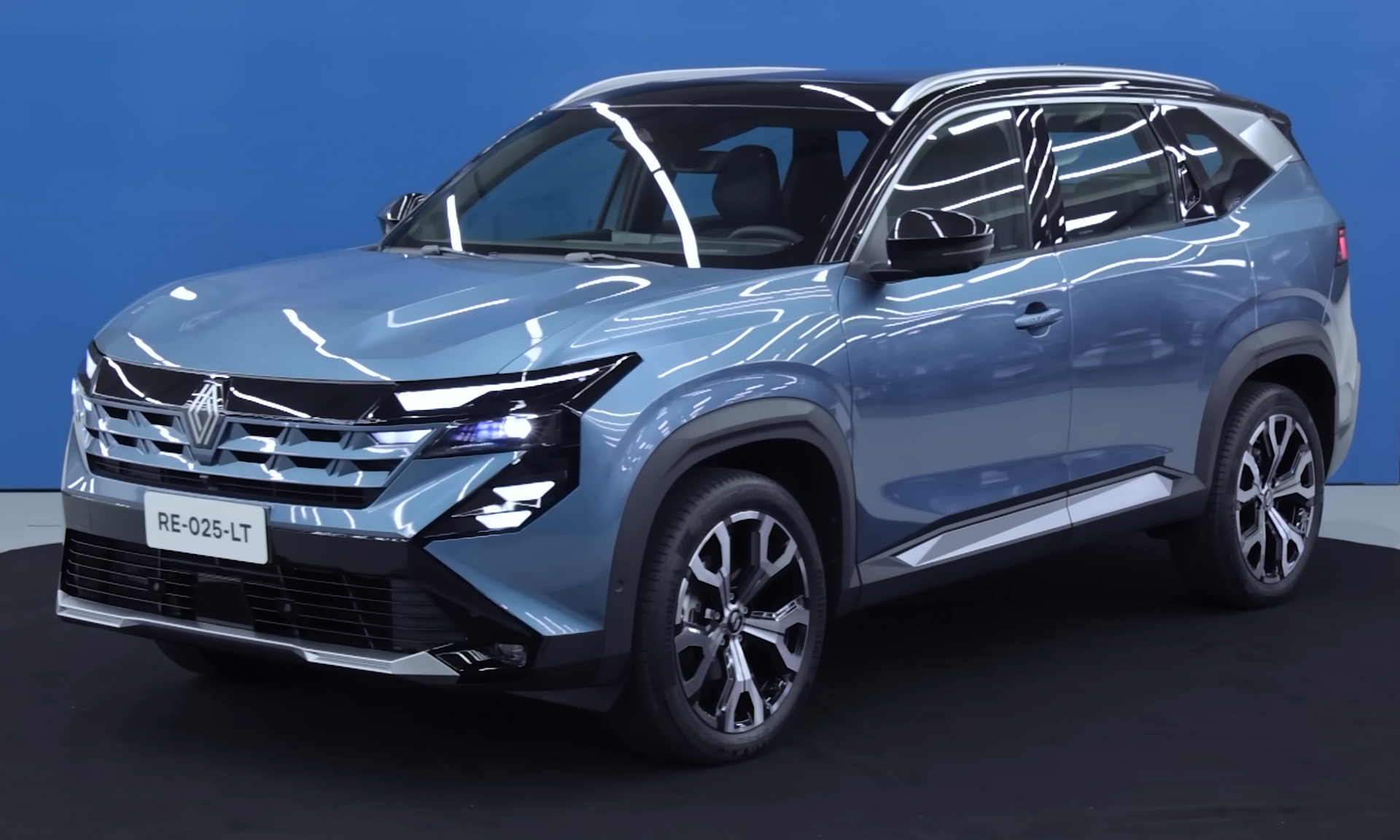
The Renault Boreal is a five-seat C-segment SUV that Renault builds in Curitiba, Brazil, since October 2025 and in Bursa, Turkey, for 71 markets outside the European Union. Derived from the Dacia Bigster, it uses a 1.3-litre TCe turbo with a six-speed dual-clutch gearbox, flex-fuel in Latin America, and from 2026 a 116 kW (160 PS) E-Tech full hybrid.
In short
- Revealed in July 2025; Brazilian pre-sales began in October 2025 at BRL 179,990 to BRL 214,990.
- 1.3 TCe flex: 120 kW (163 PS) and 270 Nm on ethanol; Turkish TCe: 106 kW (145 PS); E-Tech hybrid: 116 kW (160 PS).
- 4,556 mm long on a 2,702 mm wheelbase, 586-litre boot, up to 24 driver assistance systems.
- Not sold in the EU, not tested by Latin NCAP so far; South Africa expects it at the end of 2026 or early 2027.
Size at a glance
| Dimensions | Renault Boreal I |
|---|---|
| Length | 4,556 mm179.4 in |
| Width | 1,841 mm72.5 in |
| Height | 1,650 mm65.0 in |
| Wheelbase | 2,702 mm106.4 in |
| Boot | 586 L20.7 cu ft |
Specs by version
Engines
| Version | Engine | Power | Torque | Gearbox | Drive | Production years |
|---|---|---|---|---|---|---|
| Hybrid · 1 version | ||||||
| Full Hybrid E-Tech 160 116 kW | 1.8 l · 4 cyl · Hybrid 1,789 cc | 116 kW 158 PS156 hp | 270 Nm199 lb-ft | Automatic | Front-wheel drive | 2026 |
| Petrol · 2 versions | ||||||
| TCe 145 106 kW EDC | 1.3 l · 4 cyl · Petrol 1,332 cc | 106 kW 144 PS142 hp | 245 Nm181 lb-ft | 6-sp Dual-clutch | Front-wheel drive | 2025 |
| 1.3 TCe flex 120 kW EDC | 1.3 l · 4 cyl · Petrol H5Ht | 120 kW 163 PS161 hp | 270 Nm199 lb-ft | 6-sp Dual-clutch | Front-wheel drive | 2025 |
Performance
Show all 3 versions
| Version | 0–100 km/h | Top speed |
|---|---|---|
| Hybrid · 1 version | ||
| Full Hybrid E-Tech 160 116 kW | 10.2 s 0–62 mph | 180 km/h112 mph |
| Petrol · 2 versions | ||
| TCe 145 106 kW EDC | 9.6 s 0–62 mph | 180 km/h112 mph |
| 1.3 TCe flex 120 kW EDC | - | 180 km/h112 mph |
Dimensions and weight
Show all 3 versions
| Version | Length | Width | Height | Wheelbase | Kerb weight | Boot | Fuel tank |
|---|---|---|---|---|---|---|---|
| Hybrid · 1 version | |||||||
| Full Hybrid E-Tech 160 116 kW | - | - | - | - | 1,520 kg3,351 lb | - | 50 l13.2 gal US |
| Petrol · 2 versions | |||||||
| TCe 145 106 kW EDC | - | - | - | - | 1,435 kg3,164 lb | - | 50 l13.2 gal US |
| 1.3 TCe flex 120 kW EDC | 4,556 mm179.4 in | 1,841 mm72.5 in | 1,650 mm65.0 in | 2,702 mm106.4 in | 1,438 kg3,170 lb | 586 l20.7 cu ft | 50 l13.2 gal US |
Verified Manufacturer and type-approval data from our catalog · Sources and methodology
Renault Boreal at a glance
| Specification | Renault Boreal |
|---|---|
| Body and segment | five-door, five-seat C-segment SUV |
| Production | since October 2025 in Curitiba (Brazil); also Bursa (Turkey) |
| Platform | RGMP modular platform (CMF-B family), related to the Dacia Bigster |
| Engines | 1.3 TCe turbo petrol or flex-fuel; 1.8 E-Tech full hybrid (Turkey, 2026) |
| Power | 106-120 kW (145-163 PS); hybrid 116 kW (160 PS) |
| Gearbox and drive | 6-speed EDC wet dual-clutch or multi-mode hybrid automatic, front-wheel drive |
| Length, width, height | 4,556 mm, 1,841 mm, 1,650 mm |
| Wheelbase | 2,702 mm |
| Boot | 586 litres, 1,770 litres with the rear seats folded |
| Consumption | WLTP 5.7-8.2 L/100 km (TCe), 3.7-5.7 L/100 km (hybrid) |
| Price from | BRL 179,990 in Brazil in 2025 |
Where the Renault Boreal is built and sold
The Boreal is the fourth launch in Renault's International Game Plan, the brand's programme of cars for markets outside Europe. Renault presented it in July 2025, and the name comes from Boreas, the Greek god of the wind.
Two plants share the work. The Ayrton Senna complex at Sao Jose dos Pinhais, near Curitiba, builds the Boreal for Brazil and 16 more Latin American countries; Colombian sales were due in the first quarter of 2026. Oyak-Renault in Bursa supplies 54 markets, including Turkey, Renault's second-largest market, and countries of non-EU Eastern Europe, the Middle East, Africa and the Mediterranean. In 2025 Curitiba built 6,632 cars and Bursa 54 as production there started. Renault South Africa has confirmed the car for late 2026 or early 2027, without a price, and Wikipedia lists Chennai in India as a planned plant, although Renault has not announced an Indian launch.
Renault Boreal and the Dacia Bigster
Under the skin the Boreal is closely related to the Dacia Bigster, the large Dacia SUV sold in Europe. Both use Renault Group's modular platform, from the CMF-B family that also carries the Duster. The Boreal has its own body, with a long bonnet and front LEDs taken from the Niagara concept and the new diamond-shaped Renault badge.
Inside, the Boreal has a 10-inch touchscreen and, on the two upper trims, a 10-inch digital cluster and openR link multimedia with Google built-in. The top trim adds a Harman Kardon sound system tuned with Jean-Michel Jarre, a panoramic sunroof, a powered tailgate and a massaging driver's seat. Compared with the Renault Duster, the Boreal is larger in every dimension except height.

Renault Boreal engines: TCe flex, TCe 145 and E-Tech hybrid
| Version | Market | Engine | Power | Torque | Gearbox | 0-100 km/h |
|---|---|---|---|---|---|---|
| 1.3 TCe flex, ethanol | Latin America | 1,333 cc I4 turbo H5Ht | 120 kW (163 PS) | 270 Nm | 6-speed EDC | 9.26 s (claimed) |
| 1.3 TCe flex, petrol | Latin America | same | 115 kW (156 PS) | 250 Nm | 6-speed EDC | - |
| TCe 145 EDC | Turkey | 1,332 cc I4 turbo | 106 kW (145 PS) | 245 Nm | 6-speed EDC | 9.6 s |
| Full Hybrid E-Tech 160 | Turkey, 2026 | 1,789 cc I4 hybrid | 116 kW (160 PS) | 270 Nm | multi-mode automatic | 10.2 s |
The 1.3 TCe is coded H5Ht. In Brazil it runs on petrol or ethanol and drives the front wheels through a wet six-speed EDC dual-clutch gearbox with paddle shifters and an e-Shifter selector.
The E-Tech hybrid, listed in the Turkish technical brochure of August 2026, pairs a 1.8-litre petrol engine of 80 kW (110 PS) and 172 Nm with electric motors and a 1.4 kWh, 260-volt lithium-ion battery. It weighs 1,520 kg against 1,435 kg for the TCe, and its braked towing limit drops from 1,500 kg to 1,015 kg.

Renault Boreal fuel consumption
The Brazilian INMETRO cycle gives the flex-fuel Boreal 11.2 km/l in town and 13.6 km/l on the highway on petrol, which is 8.9 and 7.4 L/100 km. On ethanol the figures are 7.8 and 9.4 km/l, or 12.8 and 10.6 L/100 km. Webmotors averaged 9.7 km/l (10.3 L/100 km) on ethanol in mixed driving with a Techno, close to the official figure.
In Turkey, WLTP figures range from 5.7 to 8.2 L/100 km for the TCe 145 and from 3.7 to 5.7 L/100 km for the E-Tech hybrid, with CO2 emissions of 130-187 g/km and 103-130 g/km. Both versions have a 50-litre tank.
Renault Boreal price and trims in Brazil
Renault Brazil opened pre-sales in October 2025 with three trims and launched the car the following month.
| Trim | Price in Brazil, 2025 | Driver assistance systems | Key equipment |
|---|---|---|---|
| Evolution | BRL 179,990 | 13 | 18-inch wheels, 10-inch screen, 7-inch digital cluster, dual-zone climate, six airbags |
| Techno | BRL 199,990 | 19 | Google built-in, 10-inch cluster with maps, adaptive cruise, powered seats, 40-colour ambient light |
| Top trim | BRL 214,990 | 24 | 19-inch wheels, Harman Kardon, panoramic roof, powered tailgate, massage seat, 360-degree camera |
Every Brazilian Boreal comes with a five-year warranty without a mileage limit. Services are due every 10,000 km or 12 months, and the first five cost BRL 5,623 in total up to 50,000 km, according to Webmotors in June 2026.
Renault Boreal safety and driver assistance
Six airbags are standard. The top trim has 24 driver assistance systems, including adaptive cruise control, active lane centring, autonomous emergency braking, a 360-degree camera and front and rear parking sensors; the Techno gets 19 and the Evolution 13. Latin NCAP had not published a test of the Boreal by November 2026, and no other independent crash rating has been published for it.
Renault Boreal vs Jeep Compass and Toyota Corolla Cross
In Brazil the Boreal competes with the Jeep Compass, the Toyota Corolla Cross and the Volkswagen Taos. In a Webmotors comparison with the Compass and the Corolla Cross, the Boreal was the largest of the three in every dimension, with a wheelbase up to 7 cm longer, and had the best INMETRO consumption. It also had the least power of the three, though more torque than the Toyota. In South Africa it will meet the Chery Tiggo 7 Pro, the Corolla Cross and the Kia Seltos.
The Evolution already has the full engine, six airbags and dual-zone climate control, so it suits buyers who want space at the lowest price. The Techno at BRL 199,990 is the best balance for most families because it adds adaptive cruise, emergency braking and Google built-in. The top trim makes sense only if the panoramic roof and the Harman Kardon system matter. Where the E-Tech hybrid is offered, it is the choice for city driving; the TCe tows more. The rest of the range is in the Renault catalogue.
Renault Boreal in our rankings
- No. 49 of 413 · Biggest boot: cars (586 l · top 12%)
- No. 38 of 198 · Biggest boot: SUVs and crossovers (586 l · top 20%)
- No. 42 of 203 · Lightest SUVs and crossovers (1,435 kg · top 21%)
- No. 234 of 557 · Lightest cars (1,435 kg · top 43%)
- No. 41 of 95 · Most powerful French cars (120 kW · top 45%)
- No. 123 of 273 · Smallest SUVs and crossovers (4,556 mm · top 46%)
Bigger boot than 88% of ranked cars in the 1CARS catalog (No. 49 of 413).
FAQ
Is the Renault Boreal sold in Europe?
No. The Boreal is built in Brazil and Turkey for 71 markets outside the European Union, including Latin America, Turkey, the Middle East and Africa. In the EU, Renault Group sells the related Dacia Bigster instead.
How much does the Renault Boreal cost?
In Brazil the Boreal launched in 2025 at BRL 179,990 for the Evolution, BRL 199,990 for the Techno and BRL 214,990 for the top trim. South African and Colombian prices had not been announced at launch.
What engine does the Renault Boreal have?
Most versions use the 1.3-litre TCe turbo with a six-speed dual-clutch gearbox: 120 kW (163 PS) on ethanol in Brazil and 106 kW (145 PS) in Turkey. A 1.8-litre E-Tech full hybrid with 116 kW (160 PS) joined in Turkey in 2026.
Is the Renault Boreal bigger than the Duster?
Yes. At 4,556 mm long with a 2,702 mm wheelbase, the Boreal is larger than the Duster in every dimension except height, and its boot holds 586 litres, or 1,770 litres with the rear seats folded.
Where is the Renault Boreal made?
Renault builds the Boreal at its Curitiba complex in Brazil for 17 Latin American countries and at Oyak-Renault in Bursa, Turkey, for 54 markets including Turkey, Eastern Europe, the Middle East and the Mediterranean.
Data sources
Data checked by an editor against the sources below.
- Wikipedia - Renault Boreal
- Com - Renault Boreal R 179 990 Confira Versoes
- Renault - 1eea6dbc09