
 Renault Mégane E-Tech Electric
Specs, engines and history
Published Sources (2) Report an error
By Oleksandr Hnatiuk, Automotive Editor & Used Car Specialist
- Built
- 2022–present
- Top power
- 160 kW (218 PS)
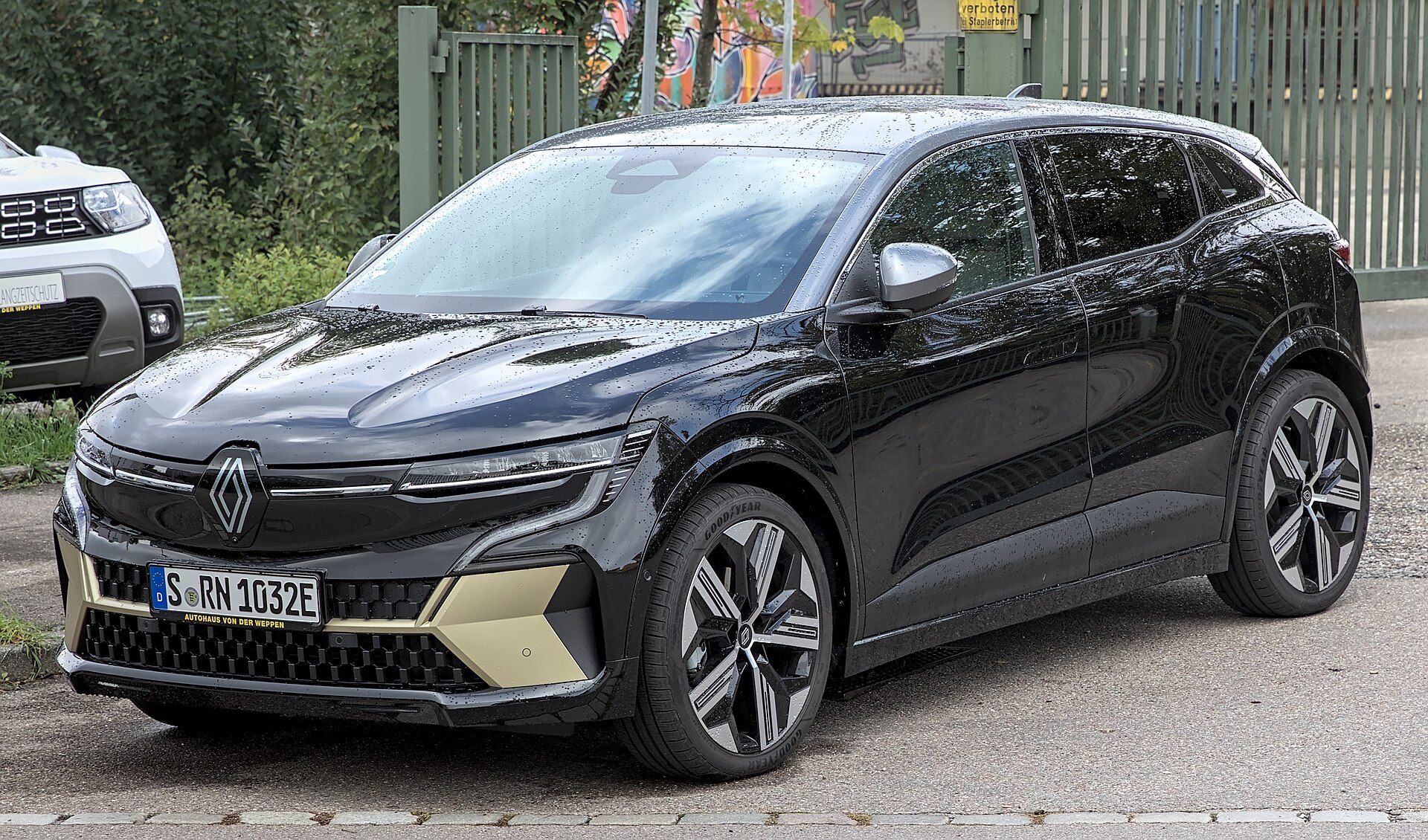
The Renault Mégane E-Tech Electric is a compact electric hatchback-crossover built at Douai in northern France since 2022. It was the first Renault on the CMF-EV platform, now called AmpR Medium, and launched with 40 or 60 kWh batteries and 96 or 160 kW. A 2026 facelift switched it to a single 67 kWh LFP battery with faster DC charging.
In short
- Revealed at the IAA in Munich in September 2021, on sale in Europe since February 2022; one generation, front-wheel drive only.
- 4,199 mm (165.3 in) long, 1,505 mm high, 440-litre boot; five Euro NCAP stars in 2022.
- Before the facelift: up to 470 km WLTP with 60 kWh and 160 kW (218 PS); German prices from EUR 35,200 in December 2021.
- From September 2026 in Germany: 67 kWh LFP, 165 kW DC peak, 481 km WLTP, from EUR 35,250.
Size at a glance
| Dimensions | Renault Mégane E-Tech Electric I |
|---|---|
| Length | 4,199 mm165.3 in |
| Width | 1,768 mm69.6 in |
| Height | 1,505 mm59.3 in |
| Wheelbase | 2,685 mm105.7 in |
| Boot | 440 L15.5 cu ft |
Specs by version
Engines
| Version | Engine | Power | Torque | Gearbox | Drive | Production years |
|---|---|---|---|---|---|---|
| EV40 130 hp 40 kWh | Electric | 96 kW 131 PS129 hp | 250 Nm184 lb-ft | 1-sp Single-speed | Front-wheel drive | 2022–2026 |
| EV60 130 hp 60 kWh | Electric | 96 kW 131 PS129 hp | 250 Nm184 lb-ft | 1-sp Single-speed | Front-wheel drive | 2022–2026 |
| EV60 220 hp 60 kWh | Electric | 160 kW 218 PS215 hp | 300 Nm221 lb-ft | 1-sp Single-speed | Front-wheel drive | 2022–2026 |
| 220 Comfort Range 67 kWh LFP | Electric | 160 kW 218 PS215 hp | 300 Nm221 lb-ft | 1-sp Single-speed | Front-wheel drive | 2026 |
Performance
Show all 4 versions
| Version | 0–100 km/h | Range |
|---|---|---|
| EV40 130 hp 40 kWh | - | 300 km186 mi |
| EV60 130 hp 60 kWh | - | 450 km280 mi |
| EV60 220 hp 60 kWh | 7.5 s 0–62 mph | 470 km292 mi |
| 220 Comfort Range 67 kWh LFP | 7.6 s 0–62 mph | 481 km299 mi |
Dimensions and weight
Show all 4 versions
| Version | Length | Width | Height | Wheelbase | Boot | Battery |
|---|---|---|---|---|---|---|
| EV40 130 hp 40 kWh | - | - | - | - | - | 40 kWh |
| EV60 130 hp 60 kWh | - | - | - | - | - | 60 kWh |
| EV60 220 hp 60 kWh | 4,199 mm165.3 in | 1,768 mm69.6 in | 1,505 mm59.3 in | 2,685 mm105.7 in | 440 l15.5 cu ft | 60 kWh |
| 220 Comfort Range 67 kWh LFP | 4,200 mm165.4 in | 1,782 mm70.2 in | 1,522 mm59.9 in | 2,685 mm105.7 in | 389 l13.7 cu ft | 67 kWh |
Verified Manufacturer and type-approval data from our catalog · Sources and methodology
Renault Mégane E-Tech Electric at a glance
| Specification | Renault Mégane E-Tech Electric |
|---|---|
| Body and segment | five-door compact hatchback-crossover, C segment |
| Production | since 2022, Douai, France |
| Platform | CMF-EV (AmpR Medium), shared with the Nissan Ariya |
| Drive | front-wheel drive, wound-rotor (EESM) motor |
| Power | 96 kW (130 PS) or 160 kW (218 PS) |
| Battery | 40 or 60 kWh NMC (2022-2026); 67 kWh LFP (2026 facelift) |
| WLTP range | 300 km (40 kWh) to 470 km (60 kWh); 481 km after the facelift (ADAC) |
| Charging | 85, 130 or 165 kW DC; 7.4 to 22 kW AC |
| Length / wheelbase | 4,199 mm / 2,685 mm |
| Boot | 440 l (Renault); 389-1,332 l in ADAC measurement for the facelift |
| Euro NCAP | 5 stars (2022) |
| Price from | EUR 35,250 in Germany (ADAC list price, from 09/2026) |
From the eVision concept to Douai
Renault previewed the car with the Mégane eVision concept in October 2020, showed a near-production prototype in June 2021 and presented the production version at the Munich IAA in September 2021. The combustion Mégane IV, covered in the Renault Mégane hub, stayed on sale alongside it, which is why the electric car carries the full E-Tech Electric name and counts as a separate model.
The two cars come from different places. The petrol and diesel Mégane was built at Palencia in Spain from 1994, later also as a plug-in hybrid, while the electric car has come from Douai in northern France from the start. Palencia now builds the Austral, Espace and Rafale. In February 2026 Renault chief executive François Provost called it "likely and logical" that Palencia would build C-segment electric cars, but a Spanish trade paper reported that a Mégane successor was unlikely to go there; no move of the current car had been announced by November 2026.
CMF-EV platform, motor and dimensions
The CMF-EV floor carries a thin battery, which let Renault keep the roof low while the cabin sits about 50 mm higher than in the Mégane IV. The car is 4,199 mm long, 1,768 mm wide and 1,505 mm high on a 2,685 mm (105.7 in) wheelbase. Its motor uses a wound rotor instead of rare-earth permanent magnets, and the car offers 26 driver-assistance functions for Level 2 assisted driving. The same platform went on to carry the Nissan Ariya and the larger Scenic E-Tech.
Versions and powertrains 2022-2026
| Version | Battery | Power | WLTP range | 0-100 km/h |
|---|---|---|---|---|
| EV40, 96 kW | 40 kWh | 96 kW (130 PS), 250 Nm | 300 km | - |
| EV60, 96 kW | 60 kWh | 96 kW (130 PS), 250 Nm | 450 km | - |
| EV60, 160 kW | 60 kWh | 160 kW (218 PS), 300 Nm | 470 km | 7.5 s (claimed) |
| 220 Comfort Range (2026) | 67 kWh LFP | 160 kW (218 PS), 300 Nm | 481 km (ADAC) | 7.6 s |
Several magazines timed the 160 kW car at 6.9 seconds to 100 km/h, quicker than Renault's claim. The 40 kWh car charged at up to 85 kW DC and the 60 kWh car at 130 kW, which gave the larger pack about 200 km of range in 30 minutes. In Germany the base Equilibre came with a 7.4 kW on-board charger, while better-equipped cars got 22 kW AC.
The sales curve shows how quickly the car rose and then faded. Wikipedia lists 609 cars in 2021, 25,680 in 2022 and a peak of 54,629 in 2023, followed by 30,260 in 2024 and 17,660 in 2025. Renault answered with an Esprit Alpine trim and a light facelift in 2025, then with the bigger technical update a year later.

The 2026 LFP facelift
Orders for the revised car opened in early July 2026 and deliveries were planned for October. The 40 and 60 kWh NMC packs gave way to one 67 kWh lithium iron phosphate battery with 232 LG pouch cells made in Poland, assembled in a cell-to-pack design at Douai; the motor comes from Cléon. Renault quotes 501 km WLTP, 33 km more than the old 60 kWh car, while ADAC lists 481 km and 16.5 kWh/100 km for the German version, so figures vary between sources.
DC charging improved from 130 to 165 kW peak, and ADAC gives 24 minutes from 15 to 80 percent. The new battery adds about 70 kg, taking the EU kerb weight to 1,772 kg, and lifts the roof to 1,522 mm. Visually the facelift brings a black band in place of the grille, vertical daytime running lights and a 3D-effect light bar at the rear. Inside, the OpenR Link system built with Google gains a Gemini-based voice assistant, and both screens, 12.3 and 12 inches, are standard. Renault reduced the range to two trims, Techno and Esprit Alpine; a heat pump and vehicle-to-load and vehicle-to-grid capability come with every car.
Boot space, towing and Euro NCAP rating
Renault quotes a 440-litre boot for the hatchback, and there is no front storage under the bonnet. ADAC's own measurement for the facelift is 389 litres below the parcel shelf and 1,332 litres to the roof with the rear seats folded. Braked towing is limited to 750 kg (1,653 lb) for the 2026 car. Kerb weight was 1,624 to 1,650 kg before the battery change.
Euro NCAP awarded five stars in March 2022 with 85 percent for adult occupants, 88 percent for children, 65 percent for vulnerable road users and 79 percent for safety assistance. ANCAP adopted the same rating for Australia.
Mégane E-Tech Electric prices in Germany, 2021 and 2026
| Version (Germany) | Battery | List price | Date |
|---|---|---|---|
| Equilibre EV40, 96 kW | 40 kWh | EUR 35,200 | 12/2021 |
| EV40 with 22 kW AC | 40 kWh | EUR 37,100 | 12/2021 |
| Techno EV60, 160 kW | 60 kWh | EUR 44,700 | 12/2021 |
| 220 Comfort Range Techno | 67 kWh LFP | EUR 35,250 | from 09/2026 |
| 220 Comfort Range Esprit Alpine | 67 kWh LFP | EUR 38,250 | from 09/2026 |
In 2026 the most powerful car costs EUR 9,450 less than the 2021 Techno, with a bigger battery and faster charging. ADAC's detail page shows a base price of EUR 34,990 for the Techno, slightly below the list figure.
Rivals and which Mégane to buy
Renault's own Scenic E-Tech is the family-sized alternative on the same platform. Built in Douai as well, it measures 4,470 mm on a 2,785 mm wheelbase, offers 60 or 87 kWh and passes 620 km WLTP with the larger battery; it was European Car of the Year 2024. Outside the group, launch coverage of the facelift names the MG4, the Škoda Elroq and the Volkswagen ID.3 as the main targets.
For a new car the 2026 Techno is the logical buy: 481 to 501 km, 165 kW charging and a lower price than the 60 kWh car had at launch. On the used market, the 160 kW EV60 gives the best balance of range and performance; the 40 kWh cars suit short commutes only, at 300 km WLTP and 85 kW DC. All electric Renaults are listed in the Renault catalogue. Against the Volkswagen it competes with most often, see Renault Mégane E-Tech vs VW ID.3.
Photo gallery

Popular comparisons
Renault Mégane E-Tech Electric in our rankings
- No. 14 of 97 · Heaviest hatchbacks (1,772 kg · top 15%)
- No. 15 of 84 · Biggest boot: hatchbacks (440 l · top 18%)
- No. 145 of 650 · Smallest cars (4,199 mm · top 23%)
- No. 13 of 46 · Quickest French cars, 0–100 (7.5 s · top 29%)
- No. 50 of 171 · Most powerful hatchbacks (160 kW · top 30%)
- No. 26 of 88 · Most powerful French cars (160 kW · top 30%)
Heavier than 85% of ranked hatchbacks in the 1CARS catalog (No. 14 of 97).
FAQ
Where is the Mégane E-Tech Electric built?
At Renault's Douai plant in northern France, where production started in 2022. The 2026 battery packs are also assembled there from LG cells made in Poland; Palencia in Spain built the combustion Mégane.
What range does the Mégane E-Tech Electric have?
The 2026 facelift with the 67 kWh LFP battery is rated at 501 km WLTP by Renault and 481 km in ADAC's German data. Earlier cars reached 300 km with 40 kWh and 450 to 470 km with 60 kWh.
Is the Mégane E-Tech Electric the same car as the Mégane IV?
No. It is a separate model on the dedicated CMF-EV electric platform with its own body, built in Douai. The combustion Mégane IV continued alongside it, and the two share only the name.
How safe is the Mégane E-Tech Electric?
It earned five Euro NCAP stars in 2022 with 85 percent for adult occupants, 88 percent for child occupants, 65 percent for vulnerable road users and 79 percent for safety assistance.
Data sources
Data checked by an editor against the sources below.
- Wikipedia - Renault Megane E Tech Electric
- ADAC


