
Renault Mégane E-Tech vs VW ID.3: 2026 LFP hatchbacks
Updated Report an error By Felix Hartmann

Renault · 2022–present
Mégane E-Tech Electric I
- Power
- 160 kW218 PS
- 0–100 km/h
- 7.6 s
- Top speed
- 160 km/h
- Kerb mass
- 1,772 kg

Volkswagen · 2019–present
ID.3 I
Price from €31,495 (2020)
- Power
- 140 kW190 PS
- 0–100 km/h
- -
- Top speed
- -
- Kerb mass
- -
At a glance
Who suits what, worked out from the catalog figures of the versions above.
Categories won: Mégane E-Tech Electric I 1 ID.3 I 0
- Family Too close to call Boot: 389 l vs 385 l
- City Too close to call Length: 4,200 mm vs 4,262 mm
- Off-road Mégane E-Tech Electric I Drive and body: Front-wheel drive · Hatchback vs Rear-wheel drive · Hatchback
Verdict Opinion
The Mégane gives more for the money: more power, faster DC charging and a lower price than the comparable ID.3, with a boot of the same size. The ID.3 answers with better efficiency, a slightly longer WLTP range from a smaller battery, more cabin length and a 79 kWh option for long distances.
The ID.3 Neo 50 kWh Trend at EUR 33,995 is the cheapest way into either range. For frequent motorway trips the Renault's 165 kW peak shortens stops, unless the 630 km of the 79 kWh ID.3 matters more.
- Felix Hartmann
The Volkswagen ID.3 was the first car on the MEB platform, built in Zwickau since November 2019. Renault answered with the Mégane E-Tech Electric, presented at the Munich IAA in September 2021 and on sale since February 2022. It is built at Douai in France on the CMF-EV platform and is a separate model from the combustion Renault Mégane. The Renault drives its front wheels, the Volkswagen its rear wheels.
In 2026 both cars were reworked around lithium iron phosphate batteries. Volkswagen presented the ID.3 Neo in April 2026, with Zwickau production from May; Renault opened orders for the facelifted Mégane in July. The figures below compare the German versions listed by ADAC from July and September 2026.
Renault Mégane E-Tech vs VW ID.3: batteries, charging and prices
Batteries and motors
Renault now offers one drivetrain: a 67 kWh LFP battery and a 160 kW (218 PS) motor with 300 Nm, which reaches 100 km/h in 7.6 seconds. The ID.3 Neo comes with 50, 58 or 79 kWh. The closest match to the Renault is the 58 kWh version, an LFP pack of 61 kWh gross, with 140 kW (190 PS) and 350 Nm; it needs 8.0 seconds to 100 km/h and is limited to 160 km/h.
Range and efficiency
The Volkswagen uses less energy. ADAC lists the ID.3 Neo 58 kWh at 492 km WLTP and 13.9 kWh/100 km, against 481 km and 16.5 kWh/100 km for the Mégane. Renault's own figure for the Mégane is 501 km. The ID.3 Neo with 79 kWh is quoted at up to 630 km, which no Mégane version matches.
DC charging
Here the Renault is clearly ahead. The Mégane peaks at 165 kW and charges from 15 to 80 percent in 24 minutes. The ID.3 Neo 58 kWh peaks at 105 kW and needs 26 minutes from 10 to 80 percent.
Size, boot and weight
The ID.3 is the bigger car: 4,265 mm long on a 2,769 mm wheelbase, against 4,199 mm and 2,685 mm for the Mégane, and 1,561 mm high against 1,522 mm. Inside the boot the difference disappears. ADAC measured 389 litres for the Mégane and 383 litres for the ID.3 below the parcel shelf, and 1,332 against 1,336 litres with the rear seats folded; Renault itself quotes 440 litres. The Mégane weighs 1,772 kg and the ID.3 Neo 58 kWh 1,888 kg. Renault allows 750 kg (1,653 lb) of braked towing; for the ID.3 ADAC lists a detachable towbar as a EUR 415 option without a towing figure.
Euro NCAP
Both have five stars, the ID.3 from 2020 and the Mégane from March 2022. The Renault scored 85 percent for adult occupants, 88 for children, 65 for vulnerable road users and 79 for safety assistance. The ID.3 scored 87, 89, 71 and 88 percent in 2020, and 86, 87, 78 and 76 percent in a 2025 retest under the stricter protocol.
Prices in Germany in 2026
The Mégane 220 Comfort Range costs EUR 35,250 as a Techno and EUR 38,250 as an Esprit Alpine from September 2026. The ID.3 Neo starts at EUR 33,995 as a 50 kWh Trend, but the 58 kWh Life costs EUR 39,195 and the 79 kWh Life EUR 44,995 from July 2026. Against the 58 kWh Life, the Mégane Techno is EUR 3,945 cheaper with 20 kW more power.
Size and weight
Side view to scale, all cars from the front bumper.
| Mégane E-Tech Electric I | ID.3 I | |
|---|---|---|
| Length | 4,200 mm165.4 in | 4,262 mm167.8 in † +62 mm +2.4 in +1.5% |
| Width | 1,782 mm70.2 in | 1,809 mm71.2 in † +27 mm +1.1 in +1.5% |
| Height | 1,522 mm59.9 in | 1,552 mm61.1 in † +30 mm +1.2 in +2.0% |
| Wheelbase | 2,685 mm105.7 in | 2,770 mm109.1 in † +85 mm +3.3 in +3.2% |
| Boot | 389 l13.7 cu ft | 385 l13.6 cu ft † −4 l −0.1 cu ft −1.0% |
| Fits a standard garage? | Yes | Yes |
Difference vs Mégane E-Tech Electric I (±). Garage check: a standard single garage takes a car up to about 5.0 m (16 ft 5 in) long and 1.9 m (6 ft 3 in) wide (width as listed in the catalog; some makers include the mirrors). Leave about 0.6 m (2 ft) to open the doors. † from another version of this generation.
Full specifications
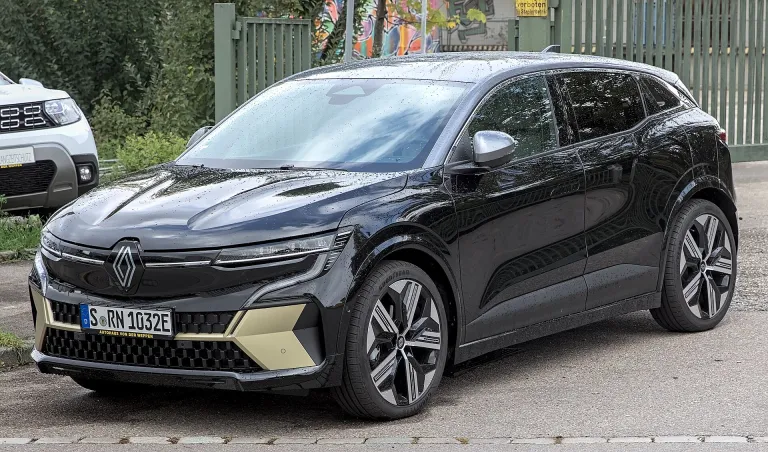
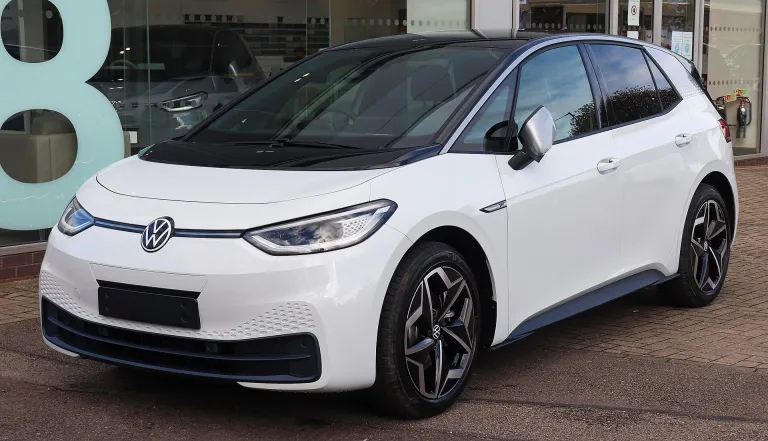
| Renault Mégane E-Tech Electric | Volkswagen ID.3 | |
|---|---|---|
| General | ||
| Version | 220 Comfort Range 67 kWh LFP · electric · 160 kW (218 PS) | Neo 58 kWh · electric · 140 kW (190 PS) |
| Production years | 2022–present | 2019–present |
| Body | Hatchback | Hatchback |
| Class | C-segment (compact) | No data |
| Country | France | Germany |
| Performance | ||
| Power Why it matters: More power means stronger acceleration and easier overtaking, especially with a full load. | 160 kW (218 PS) 215 hp Better | 140 kW (190 PS) 188 hp |
| Power, all versions | 96–160 kW (131–218 PS) 129–215 hp | 110–240 kW (150–326 PS) 148–322 hp |
| Torque Why it matters: Torque is the pulling force you feel when accelerating from low revs, towing or climbing hills. | 300 Nm 221 lb-ft | No data |
| 0–100 km/h Why it matters: A shorter 0–100 km/h time means quicker getaways and safer merging onto fast roads. | 7.6 s | No data |
| Top speed Why it matters: Top speed hints at how relaxed the car is at motorway speeds, even if you never reach it. | 160 km/h 99 mph | No data |
| Power per tonne | 90 kW/t 110 hp/ton calculated | No data |
| Engine and transmission | ||
| Fuel | Electric | Electric |
| Gearbox | 1-speed single-speed | 1-speed single-speed |
| Drive | Front-wheel drive | Rear-wheel drive |
| Dimensions and weight | ||
| Length | 4,200 mm 165.4 in | 4,262 mm 167.8 in † |
| Width | 1,782 mm 70.2 in | 1,809 mm 71.2 in † |
| Height | 1,522 mm 59.9 in | 1,552 mm 61.1 in † |
| Wheelbase | 2,685 mm 105.7 in | 2,770 mm 109.1 in † |
| Kerb weight Why it matters: A lighter car is usually more agile and uses less energy. | 1,772 kg 3,907 lb | No data |
| Boot Why it matters: A bigger boot fits more luggage, shopping or a pram. | 389 l 13.7 cu ft | 385 l 13.6 cu ft † |
| Economy and running costs | ||
| Fuel cost per year | €740/year estimated | No data |
| Electric | ||
| Battery Why it matters: A bigger battery usually gives more range, but takes longer to charge fully. | 67 kWh Better | 58 kWh |
| Electric range Why it matters: A longer range means fewer charging stops on long journeys. | 481 km 299 mi | No data |
| Energy use | 16.5 kWh/100 km | No data |
| Safety | ||
| Euro NCAP | ★★★★★ (2022) | ★★★★★ (2020) |
| Price | ||
| Price | No data | from €31,495 (2020) |
These cars do not differ in the data we have.
Equal rows hidden (3): Body, Fuel, Gearbox.
Better marks the stronger figure - only for measurable specs (power, torque, 0–100 km/h, consumption, boot, weight).
Estimated at 15,000 km a year with fuel at €0.30/kWh electricity. † from another version of this generation.
In plain words
Renault Mégane E-Tech Electric has more power: 160 kW (218 PS) against 140 kW (190 PS) for Volkswagen ID.3. Volkswagen ID.3 is 62 mm longer than Renault Mégane E-Tech Electric (4,262 mm vs 4,200 mm). Renault Mégane E-Tech Electric has the bigger boot: 389 l against 385 l. Volkswagen ID.3 is the older design (from 2019); Renault Mégane E-Tech Electric arrived in 2022. On the catalog figures, the Renault Mégane E-Tech Electric is the pick for off-road. Our catalog has no 0–100 km/h for the Volkswagen ID.3 yet, so some checks above leave it out.
Which one to choose
Choose the Renault Mégane E-Tech Electric if you want 160 kW for EUR 35,250, faster DC charging, front-wheel drive and a 750 kg towing limit.
Choose the Volkswagen ID.3 if you value low consumption, want a choice of three batteries including the 79 kWh version, or prefer rear-wheel drive.
The ID.3 is also compared in Tesla Model 3 vs Volkswagen ID.3 and BYD Dolphin vs Volkswagen ID.3.
Frequently asked questions
Which has the longer range, the Mégane E-Tech or the ID.3?
In ADAC's German data the ID.3 Neo 58 kWh reaches 492 km WLTP and the Mégane 481 km; Renault quotes 501 km. The ID.3 Neo 79 kWh goes furthest, at up to 630 km.
Which charges faster?
The Mégane, with a 165 kW DC peak and 24 minutes from 15 to 80 percent. The ID.3 Neo 58 kWh charges at up to 105 kW and needs 26 minutes from 10 to 80 percent.
Which is cheaper in Germany?
The cheapest of the two is the ID.3 Neo 50 kWh Trend at EUR 33,995 in 2026. With comparable batteries, the Mégane Techno at EUR 35,250 costs EUR 3,945 less than the ID.3 Neo 58 kWh Life.
Do both use LFP batteries?
Yes, since 2026. The facelifted Mégane has a single 67 kWh LFP pack with LG cells, assembled at Douai. ADAC lists the 58 kWh ID.3 Neo with LFP cells of 61 kWh gross.