
MG MGA vs Triumph TR3: British roadsters of 1955
Updated Report an error By Sarah Whitmore

MG · 1955–1962
MGA I
- Power
- 67 kW91 PS
- Top speed
- 164 km/h
- Kerb mass
- 927 kg

Triumph · 1955–1962
TR3, TR3A, TR3B
- Power
- 75 kW102 PS
- Top speed
- 169 km/h
- Kerb mass
- 948 kg
At a glance
Who suits what, worked out from the catalog figures of the versions above.
Categories won: MGA I 0 TR3, TR3A, TR3B 2
- City TR3, TR3A, TR3B Length: 3,835 mm vs 3,962 mm
- Performance TR3, TR3A, TR3B Power per tonne: 79 kW/t vs 72 kW/t
- Off-road Too close to call Drive and body: Rear-wheel drive · Roadster vs Rear-wheel drive · Roadster
Verdict Opinion
The TR3 is the faster and stronger car, with about 16 kW more than an MGA 1600, overdrive and front disc brakes three years earlier. It also has the tougher engine: Classics World describes it as tough, while the MGA's high-performance Twin Cam was its weak point.
The MGA is the better-looking and better-steering car, with a closed coupé option and a lower, smoother body. Values in the dated sources above sit close together, so the choice comes down to the driving style you prefer.
- Sarah Whitmore
The MG MGA and the Triumph TR3 went on sale within weeks of each other. MG announced the MGA on 26 September 1955, and the TR3 replaced the TR2 in October 1955. Both were two-seat roadsters with a separate chassis, a four-cylinder engine and rear-wheel drive, built in England and sold mainly in the USA. Wikipedia counts only 5,869 MGAs on the British market, and of 13,377 early TR3s just 1,286 stayed at home.
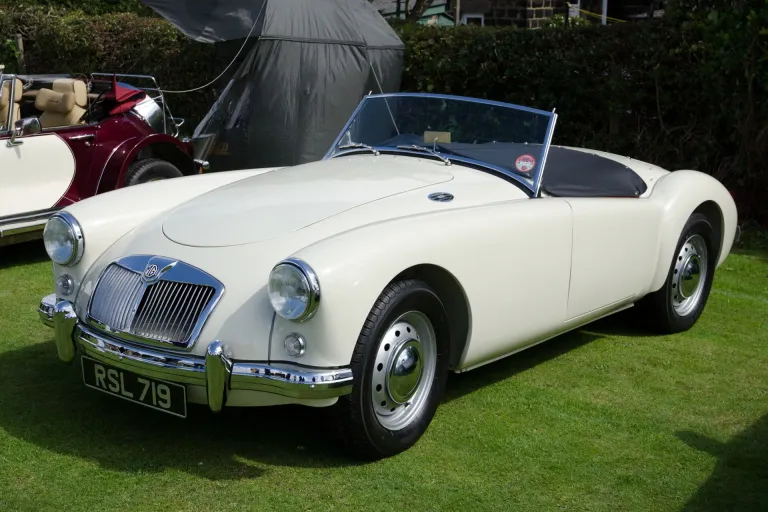
The two cars took different routes to the same buyer. Abingdon wrapped a modest 1.5-litre engine in a low, streamlined body derived from a 1951 Le Mans special. Coventry used a larger four from the Standard Vanguard saloon in a plainer body on a ladder frame. MG built about 101,000 MGAs from 1955 to 1962; Triumph made about 74,800 TR3, TR3A and TR3B cars in the same years. Background on both makers is in the history of MG and the history of Triumph.
MG MGA vs Triumph TR3: engines, brakes and prices
Engines and power
The MGA used BMC's B-series pushrod four. The 1500 had 1,489 cc and 51 kW (68 hp), raised to 54 kW (72 hp) in 1957; the 1600 of May 1959 had 1,588 cc and 59 kW (79.5 bhp); the 1600 Mk II of 1961 reached 1,622 cc and 67 kW (90 bhp). The TR3 had a 1,991 cc wet-liner four with twin SU carburettors and 71 kW (95 bhp) at first, then 75 kW (100 bhp) and 159 Nm. The TR3B of 1962 with 2,138 cc gave 78 kW (105 bhp). MG's answer to that torque was the 1,588 cc Twin Cam of 1958 with 81 kW (108 hp), but it burnt pistons and only 2,111 were built.
Performance in period tests
The Motor timed an MGA 1500 at 157.4 km/h and 0-60 mph in 16.0 seconds in 1955, and a 1600 at 154.7 km/h and 13.3 seconds in 1959. Its 1956 test of a TR3 hardtop with overdrive gave 169.5 km/h and 10.8 seconds. Overdrive, switched from the dashboard, was a TR3 option; Wikipedia lists only a four-speed gearbox for the MGA.
Disc brakes
The TR3 moved first. From car number 4,409 in 1956 it had Girling front discs as standard, recorded as the first British series-production car with them. The MGA got Lockheed front discs with the 1600 in 1959, and the Twin Cam and De Luxe had Dunlop discs on all four wheels.
Chassis, size and weight
The MGA rides on a 2,388 mm wheelbase, measures 3,962 mm long and weighs 902 kg, with coil-and-wishbone front suspension, a leaf-sprung live axle and rack-and-pinion steering. The TR2 that the TR3 grew from used a shorter 2,235 mm wheelbase and was 3,835 mm long; the TR3A weighs 948 kg. Triumph kept a ladder chassis with cruciform bracing, and rack-and-pinion steering arrived only with the TR4.
Bodies
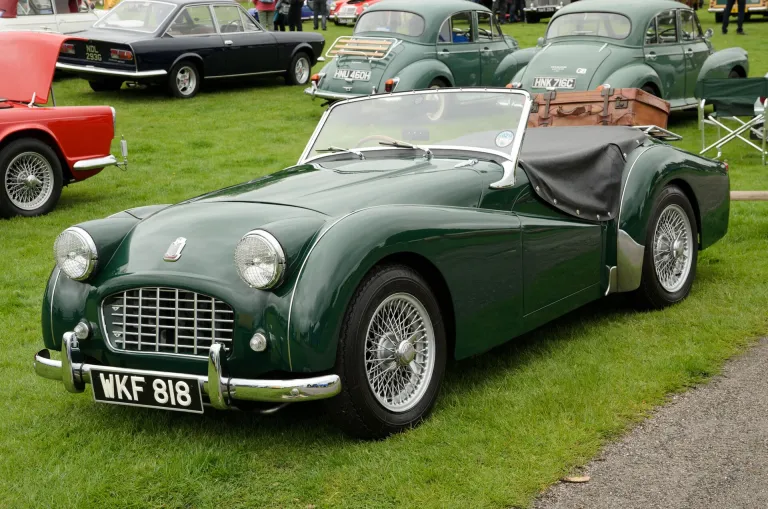
MG offered a roadster from 1955 and a fixed-head coupé with wind-up windows from late 1956. The TR3 stayed an open car with sidescreens, plus a steel hardtop. The TR3A of 1957 added a full-width grille and exterior door handles.
Prices new and in 2026
The Motor's MGA 1500 cost GBP 844 including tax in 1955, and the 1600 roadster listed at GBP 940 in 1959. The TR3 hardtop with overdrive tested in 1956 cost GBP 1,103. For values, Classic & Sports Car put an average MGA 1500 or 1600 roadster at GBP 18,000 in April 2019, and Hagerty gave a median of USD 22,200 across all MGAs in May 2021. Classics World reported a 1960 TR3 offered by a US dealer at USD 21,750 in early 2026.
Race Stats side by side
Each figure is a 0–100 score from the catalog numbers, the same as on the 1CARS Race cards. PI is the overall performance index (100–999) and its class D–S.
| Stat | MGA I | TR3, TR3A, TR3B |
|---|---|---|
| PI | B · 511 | B · 525 |
| Power | 40 | 43 |
| Grip | 43 | 43 |
| Handling | 84 | 84 |
| Top speed | 25 | 27 |
| Launch | 36 | 38 |
| Reliability | 46 | 46 |
Grip and handling are estimates from drive type, weight, height and body (hover a figure to see where it comes from). 1CARS Race
Who wins a race?
Quarter-mile (402 m) drag from a standing start, dry road, no reaction time - the 1CARS Race physics on the catalog figures of these versions.
- 1 TR3, TR3A, TR3BTR3, TR3A, TR3B · TR3A · petrol · 75 kW (102 PS) 16.17 sat 134 km/h
- 2 MGA I1600 Mk II · petrol · 67 kW (91 PS) 16.47 sat 131 km/h · +0.30 s
Size and weight
Side view to scale, all cars from the front bumper.
| MGA I | TR3, TR3A, TR3B | |
|---|---|---|
| Length | 3,962 mm156.0 in | 3,835 mm151.0 in −127 mm −5.0 in −3.2% |
| Height | 1,270 mm50.0 in | 1,270 mm50.0 in |
| Wheelbase | 2,388 mm94.0 in | 2,235 mm88.0 in −153 mm −6.0 in −6.4% |
| Kerb weight | 927 kg2,044 lb | 948 kg2,090 lb +21 kg +46 lb +2.3% |
| Fits a standard garage? | Yes | No data |
Difference vs MGA I (±). Garage check: a standard single garage takes a car up to about 5.0 m (16 ft 5 in) long and 1.9 m (6 ft 3 in) wide (width as listed in the catalog; some makers include the mirrors). Leave about 0.6 m (2 ft) to open the doors.
Full specifications
| MG MGA | Triumph TR3 | |
|---|---|---|
| General | ||
| Version | 1600 Mk II · petrol · 67 kW (91 PS) | TR3, TR3A, TR3B · TR3A · petrol · 75 kW (102 PS) |
| Production years | 1955–1962 | 1955–1962 |
| Body | Roadster | Roadster |
| Class | Sports car | Sports car |
| Country | United Kingdom | United Kingdom |
| Performance | ||
| Power Why it matters: More power means stronger acceleration and easier overtaking, especially with a full load. | 67 kW (91 PS) 90 hp | 75 kW (102 PS) 101 hp Better |
| Power, all versions | 51–81 kW (69–110 PS) 68–109 hp | 67–78 kW (91–106 PS) 90–105 hp |
| Torque Why it matters: Torque is the pulling force you feel when accelerating from low revs, towing or climbing hills. | 132 Nm 97 lb-ft | No data |
| Top speed Why it matters: Top speed hints at how relaxed the car is at motorway speeds, even if you never reach it. | 164 km/h 102 mph | 169 km/h 105 mph Better |
| Power per tonne | 72 kW/t 88 hp/ton calculated | 79 kW/t 96 hp/ton calculated Better |
| Engine and transmission | ||
| Fuel | Petrol | Petrol |
| Engine | 1,622 cc · 4 cyl 1.6 l | 1,991 cc · 4 cyl 2.0 l |
| Gearbox | 4-speed manual | 4-speed manual |
| Drive | Rear-wheel drive | Rear-wheel drive |
| Dimensions and weight | ||
| Length | 3,962 mm 156.0 in | 3,835 mm 151.0 in |
| Width | 1,473 mm 58.0 in | No data |
| Height | 1,270 mm 50.0 in | 1,270 mm 50.0 in |
| Wheelbase | 2,388 mm 94.0 in | 2,235 mm 88.0 in |
| Kerb weight Why it matters: A lighter car is usually more agile and uses less energy. | 927 kg 2,044 lb Better | 948 kg 2,090 lb |
These cars do not differ in the data we have.
Equal rows hidden (8): Production years, Body, Class, Country, Fuel, Gearbox, Drive, Height.
Better marks the stronger figure - only for measurable specs (power, torque, 0–100 km/h, consumption, boot, weight).
In plain words
Triumph TR3 has more power: 75 kW (102 PS) against 67 kW (91 PS) for MG MGA. MG MGA is 127 mm longer than Triumph TR3 (3,962 mm vs 3,835 mm). MG MGA is lighter by 21 kg (927 kg vs 948 kg). Triumph TR3 is the older design (from 1953); MG MGA arrived in 1955. On the catalog figures, the Triumph TR3 is the pick for city and performance.
Which one to choose
Choose the MG MGA if you value the streamlined shape, rack-and-pinion steering, a coupé body, or the rare Twin Cam and De Luxe versions.
Choose the Triumph TR3 if you want more torque, overdrive, earlier disc brakes and a car with six Coupes des Alpes in its rally record. The MG catalogue and Triumph catalogue list the later MGB and TR models.
Frequently asked questions
Which is faster, the MGA or the Triumph TR3?
The TR3. The Motor recorded 169.5 km/h and 0-60 mph in 10.8 seconds for a TR3 hardtop with overdrive in 1956, against 154.7 km/h and 13.3 seconds for an MGA 1600 in 1959. Only the MGA Twin Cam came close.
Did the MGA and TR3 have disc brakes?
Yes. The TR3 got front discs as standard in 1956, the first British series-production car to do so. The MGA followed with front discs on the 1600 of 1959, and the Twin Cam had discs on all four wheels.
How many MGAs and TR3s were built?
About 101,000 MGAs between 1955 and 1962 (101,082 according to Classic & Sports Car). Triumph built about 74,800 TR3, TR3A and TR3B cars, plus 8,636 earlier TR2s.
Which was cheaper new?
The MGA. The Motor's 1955 MGA 1500 cost GBP 844 including tax and the 1600 roadster listed at GBP 940 in 1959, while the 1956 TR3 hardtop with overdrive cost GBP 1,103.