
 Triumph TR3
All generations, specs and history
Published Sources (2) Report an error
By Sarah Whitmore, Senior Automotive Writer
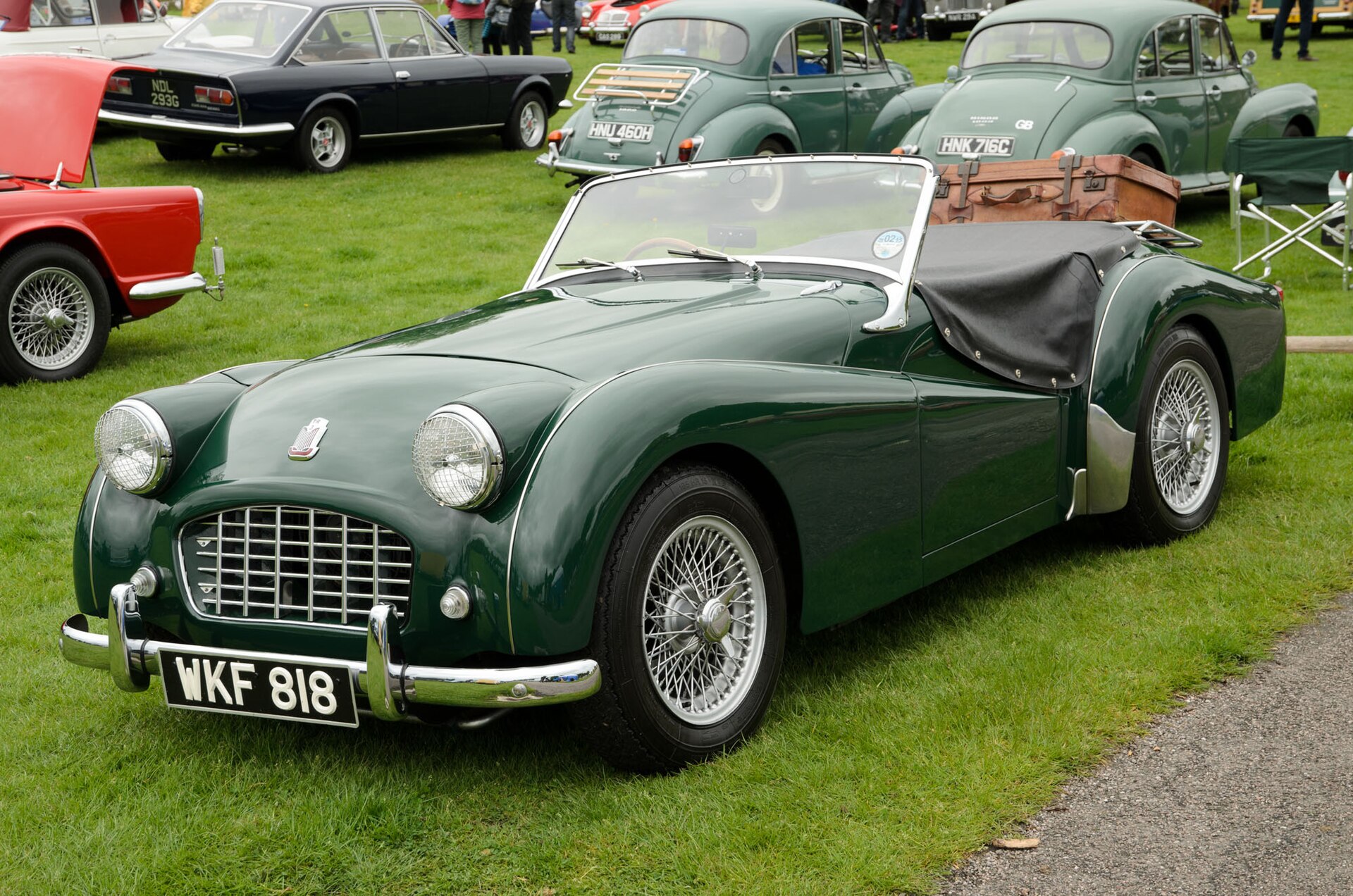
- Built
- 1953–1962
- Generations
- 2
- Top power
- 78 kW (106 PS)
Timeline
TR3 generations
Click a generation for its own page
- TR2 1953–1955 · Roadster · 67 kW (91 PS)
- TR3, TR3A, TR3B 1955–1962 · Roadster · 71–78 kW (97–106 PS)
Newest first · 2 generations since 1953
- 1955 , TR3A, TR3B 1955–1962 · Roadster · 71–78 kW (97–106 PS)
- 1953 TR2 1953–1955 · Roadster · 67 kW (91 PS)
All generations by year: TR3, TR3A, TR3B (1955–1962) · TR2 (1953–1955)
Which one is mine?
Pick the year of first registration to see which generation it is.
- TR3, TR3A, TR3B 1955–1962
- TR2 1953–1955
The Triumph TR3 is the open two-seater that Standard-Triumph built in Coventry from 1955 to 1962, together with its 1953 forerunner, the TR2. All of these sidescreen TRs use a ladder chassis and a wet-liner four-cylinder of 1,991 cc, later 2,138 cc, giving 67 to 78 kW (90 to 105 bhp). In 1956 the TR3 became the first British series-production car with front disc brakes.
In short
- TR2 1953-1955 (8,636 built), TR3 1955-1957 (13,377), TR3A 1957-1962 (58,236), TR3B 1962 (3,334).
- The TR3 family totals about 74,800 cars, making it the third most-built TR after the TR7 and TR6.
- A lightly modified TR2 reached 201 km/h (124.889 mph) on the Jabbeke motorway in Belgium in May 1953.
- Front discs became standard from car number 4,409 in 1956, a first for a British series-production car.
Size at a glance
Triumph TR2
| Dimensions | Triumph TR3, TR3A, TR3B | Triumph TR2 | Difference |
|---|---|---|---|
| Length | 3,835 mm151.0 in | 3,835 mm151.0 in | Same |
| Width | - | 1,397 mm55.0 in | - |
| Height | 1,270 mm50.0 in | 1,270 mm50.0 in | Same |
| Wheelbase | 2,235 mm88.0 in | 2,235 mm88.0 in | Same |
Specs by version
Engines
| Version | Engine | Power | Torque | Gearbox | Drive | Production years |
|---|---|---|---|---|---|---|
| TR2 | 2.0 l · 4 cyl · Petrol 1,991 cc | 67 kW 91 PS90 hp | - | 4-sp Manual | Rear-wheel drive | 1953–1955 |
| TR3, TR3A, TR3B · TR3 | 2.0 l · 4 cyl · Petrol 1,991 cc | 75 kW 102 PS101 hp | 159 Nm117 lb-ft | 4-sp Manual | Rear-wheel drive | 1955–1957 |
| TR3, TR3A, TR3B · TR3A | 2.0 l · 4 cyl · Petrol 1,991 cc | 75 kW 102 PS101 hp | - | 4-sp Manual | Rear-wheel drive | 1957–1962 |
| TR3, TR3A, TR3B · TR3B 2.2 | 2.1 l · 4 cyl · Petrol 2,138 cc | 78 kW 106 PS105 hp | 172 Nm127 lb-ft | 4-sp Manual | Rear-wheel drive | 1962 |
Performance
Show all 4 versions
| Version | Top speed |
|---|---|
| TR2 | 173 km/h107 mph |
| TR3, TR3A, TR3B · TR3 | 166 km/h103 mph |
| TR3, TR3A, TR3B · TR3A | 169 km/h105 mph |
| TR3, TR3A, TR3B · TR3B 2.2 | 174 km/h108 mph |
Dimensions and weight
Show all 4 versions
| Version | Length | Height | Wheelbase | Kerb weight |
|---|---|---|---|---|
| TR2 | 3,835 mm151.0 in | 1,270 mm50.0 in | 2,235 mm88.0 in | 953 kg2,101 lb |
| TR3, TR3A, TR3B · TR3 | - | 1,270 mm50.0 in | 2,235 mm88.0 in | - |
| TR3, TR3A, TR3B · TR3A | 3,835 mm151.0 in | 1,270 mm50.0 in | 2,235 mm88.0 in | 948 kg2,090 lb |
| TR3, TR3A, TR3B · TR3B 2.2 | - | - | - | 969 kg2,136 lb |
Verified Manufacturer and type-approval data from our catalog · Sources and methodology
Triumph TR3 at a glance
| Specification | Triumph TR2, TR3, TR3A and TR3B |
|---|---|
| Years | 1953-1955 (TR2); October 1955 to 1962 (TR3, TR3A, TR3B) |
| Production | 8,636 TR2; about 74,800 TR3, TR3A and TR3B |
| Plants | Coventry, England; CKD assembly in Belgium, Australia and South Africa |
| Body style | two-seat open roadster with sidescreens, optional steel hardtop |
| Development | Standard Motor Company, with test driver Ken Richardson |
| Layout | front engine, rear-wheel drive, steel ladder chassis with cruciform bracing |
| Engines | 1,991 cc OHV wet-liner four; 2,138 cc in the TR3B (TCF) |
| Power | 67 kW (90 bhp) TR2 to 78 kW (105 bhp) TR3B |
| Kerb weight | 953 kg (TR2); 948 kg (TR3A) |
| Top speed | 172.7 km/h (107.3 mph), TR2 with overdrive, The Motor 1954 |
| 0-60 mph | 10.8 s, TR3 hardtop with overdrive, The Motor 1956 |
| Price new | GBP 900 incl. tax (TR2 test car, 1954); GBP 1,103 (TR3 hardtop with overdrive, 1956) |
From the 20TS prototype to the TR2
Standard-Triumph showed a sports prototype called the 20TS at the 1952 London Motor Show. It sat on a shortened Standard Eight chassis and used the 2-litre four-cylinder of the Standard Vanguard saloon. Ken Richardson, a development engineer and test driver who had worked at BRM, called the prototype a "death trap", and the company reworked it into the TR2 for 1953.
The production car kept the Vanguard-derived engine, tuned with twin SU carburettors to 67 kW (90 bhp). It sat on an 88 in (2,235 mm) wheelbase and measured 151 in (3,835 mm) long. To prove the speed, Triumph took a lightly prepared TR2 to the Jabbeke motorway in Belgium in May 1953 and recorded 124.889 mph (about 201 km/h). The Motor's 1954 road test of an overdrive TR2 gave 172.7 km/h (107.3 mph) and 0-60 mph in 12.0 seconds for GBP 900 including tax, plus GBP 56 for the overdrive.
Customer TR2s took first, second and fifth places on the 1954 RAC Rally, and a works team of three finished 14th, 15th and 19th at Le Mans in 1955. In Belgium, Impéria assembled about 500 TR2s from kits at Nessonvaux near Liège and built around 22 Francorchamps coupés. Triumph made 8,636 TR2s.
TR3 and the first British production disc brakes
The TR3 replaced the TR2 in October 1955. It gained a new grille and an optional GT hardtop package, and under the bonnet it got larger SU H6 carburettors and 71 kW (95 bhp), raised later to 75 kW (100 bhp) at 5,000 rpm with 159 Nm (117 lb-ft) at 3,000 rpm. The chassis, the coil-sprung wishbone front suspension and the leaf-sprung live axle stayed as on the TR2.
The big change came in 1956. The first 4,408 TR3s had 10 in drum brakes all round, but the following cars got front disc brakes as standard, which Wikipedia and Classics World both record as a first for a British series-production car. Overdrive was optional and was switched electrically from the dashboard. After the 1955 Le Mans disaster changed the racing rules, Ken Richardson had steel hardtops bolted to 100 TR3s to homologate the car as a GT, and the same hardtop kit went on sale to customers.
Of 13,377 pre-facelift TR3s, only 1,286 were sold in Britain. The rest went abroad, mainly to the USA.

TR3A and TR3B versions by year
| Version | Years | Engine | Power | Built |
|---|---|---|---|---|
| TR2 | 1953-1955 | 1,991 cc | 67 kW (90 bhp) | 8,636 |
| TR3 | 1955-1957 | 1,991 cc | 71-75 kW (95-100 bhp) | 13,377 |
| TR3A | 1957-1962 | 1,991 cc (2,138 cc optional from 1959) | 75 kW (100 bhp) | 58,236 |
| TR3B (TSF) | 1962 | 1,991 cc | 75 kW (100 bhp) | 530 |
| TR3B (TCF) | 1962 | 2,138 cc | 78 kW (105 bhp) at 4,650 rpm | 2,804 |
TR3A and TR3B were never official names, though both are now used everywhere. The TR3A of 1957 is recognised by its full-width grille, exterior door handles and a lockable boot handle, and a toolkit came as standard. In 1959 the windscreen fittings and rear floor changed, and the 2,138 cc engine became an option.
The TR3B was built alongside the TR4 in 1962 and kept the old body. The first 530 cars (TSF commission numbers) were mechanically TR3As; the 2,804 TCF cars used the TR4's 2,138 cc engine with 172 Nm (127 lb-ft) and its all-synchromesh gearbox. Moss Motoring dates the end of TR3B production to 1963, so sources differ by a few months.

Rallies, Le Mans and the 1959 TR3S
The TR3 and TR3A were rallied across Europe, from the RAC and Monte Carlo to the Alpine, Liège-Rome-Liège, Tulip and Tour de France events, and the cars collected six Coupes des Alpes. TR3s also ran in the 12 Hours of Sebring and the Mille Miglia, and climbed hills at Ollon-Villars and Eberbach.
For the 1959 24 Hours of Le Mans the works built three TR3S cars with glass-fibre bodies six inches longer than standard and a 1,985 cc twin-cam engine from the Sabrina project. The Jopp and Stoop car ran as high as seventh overall before retiring with just over an hour to go. In the USA the TR3A still races in SCCA E-production.
Michelotti, the TR4 and the end of the sidescreen cars
Italian stylist Giovanni Michelotti designed a TR3-based show car, the TR3 Speciale, built by Vignale and shown at Geneva in March 1957. Triumph judged it too costly to build but gave Michelotti the Herald design job, and his later work included the Triumph Spitfire. His TR4, mechanically similar and in production from 1961, replaced the TR3A and adopted the fully synchronised gearbox, rack-and-pinion steering and larger engine tried on two TR3 Beta prototypes. Twenty-nine of the early TSF-series TR3B chassis were built as Triumph Italias.
The TR line continued through the TR4A and TR5 to the six-cylinder Triumph TR6, which still used a separate chassis descended from the TR2's. The history of Triumph covers the company's path from bicycles to the TR7.
Triumph TR3 today: what to check when buying
The TR Register calls the chassis used up to the TR4 the strongest of the TR frames, but every car still needs a full chassis inspection. The front half is often protected by oil leaks yet takes accident damage, while the rear half rusts; look for patches, odd welds and distortion. On the body, blocked scuttle drain holes let water rot the scuttle, A-posts, sills and front wings. Check inner wings, floors, the boot lid and boot floor, the area under the washer bottle and every body-to-chassis mounting.
Mechanically the engine is tough. Classics World expects about 50 psi of oil pressure at 3,000 rpm and treats heavy blue smoke or big-end knock as signs of a rebuild, quoted at GBP 3,500 or more in early 2026. Front trunnions need EP90 oil; neglect leads to play. The gearbox usually lacks synchromesh on first, whines when healthy, and should not jump out of gear. An "O" in the commission number shows factory overdrive. Many cars have TR4 rack-and-pinion conversions or telescopic dampers, and most cars sold new in the USA were left-hand drive, so a right-hand-drive car may be a conversion that the factory records can confirm or rule out.
Classics World cited a 1960 TR3 offered by the Beverly Hills Car Club in early 2026 at USD 21,750 (about GBP 16,285, or roughly EUR 18,700 in 2026), with project cars and scruffier drivers below GBP 20,000. The commission number on the aluminium plate should match the registration document, and the TR Register's registrars can authenticate a car. Specifications of the later TRs and Triumph's saloons are collected in the Triumph catalogue. The TR3 is set against the MGA in MG MGA vs Triumph TR3, and it also appears among the best British classic sports cars.
Photo gallery

Triumph TR3: first vs latest generation
| Spec | TR2 | TR3, TR3A, TR3B | Change |
|---|---|---|---|
| Years | 1953–1955 | 1955–1962 | 2 years apart |
| Most powerful version | 67 kW (91 PS) | 78 kW (106 PS) | +11 kW (+16%) |
| Length | 3,835 mm | 3,835 mm | same |
| Wheelbase | 2,235 mm | 2,235 mm | same |
| Lightest kerb weight | 953 kg | 948 kg | −5 kg |
| Top speed | 173 km/h | 174 km/h | +1 km/h |
Oldest and newest generation in the 1cars catalog. Power is the strongest version of each; other rows are shown only when both generations have the figure.
Popular comparisons
Triumph TR3 in our rankings
- No. 44 of 650 · Smallest cars (3,835 mm · top 7%)
- No. 42 of 508 · Lightest cars (948 kg · top 9%)
- No. 11 of 45 · Smallest convertibles and roadsters (3,835 mm · top 25%)
- No. 11 of 36 · Lightest convertibles and roadsters (948 kg · top 31%)
- No. 22 of 50 · Fastest cars of the 1960s (174 km/h · top 44%)
- No. 520 of 1242 · Longest-running car nameplates (9 years · top 48%)
Shorter than 93% of ranked cars in the 1CARS catalog (No. 44 of 650).
FAQ
What is the difference between the Triumph TR3 and TR3A?
The TR3A of 1957 has a full-width grille, exterior door handles and a lockable boot handle, while the TR3 has a smaller grille set into the front opening. Engine, chassis and front disc brakes are largely the same.
How many Triumph TR3s were built?
About 74,800 of the TR3, TR3A and TR3B between 1955 and 1962: 13,377 TR3, 58,236 TR3A and 3,334 TR3B. The earlier TR2 adds 8,636 cars.
How fast is a Triumph TR3?
The Motor recorded 169.5 km/h (105.3 mph) and 0-60 mph in 10.8 seconds for a TR3 hardtop with overdrive in 1956. Wikipedia lists 174 km/h (108 mph) for the 2,138 cc TR3B.
Did the Triumph TR3 have disc brakes?
Yes, from 1956. The first 4,408 TR3s had drum brakes, and later cars got Girling front disc brakes as standard, the first on a British series-production car.
Data sources
Data checked by an editor against the sources below.
- Wikipedia - Triumph TR3
- Wikipedia - Triumph TR2


