
 Triumph Stag
Specs, engines and history
Published Sources (1) Report an error
By Sarah Whitmore, Senior Automotive Writer
- Built
- 1970–1977
- Top power
- 108 kW (147 PS)
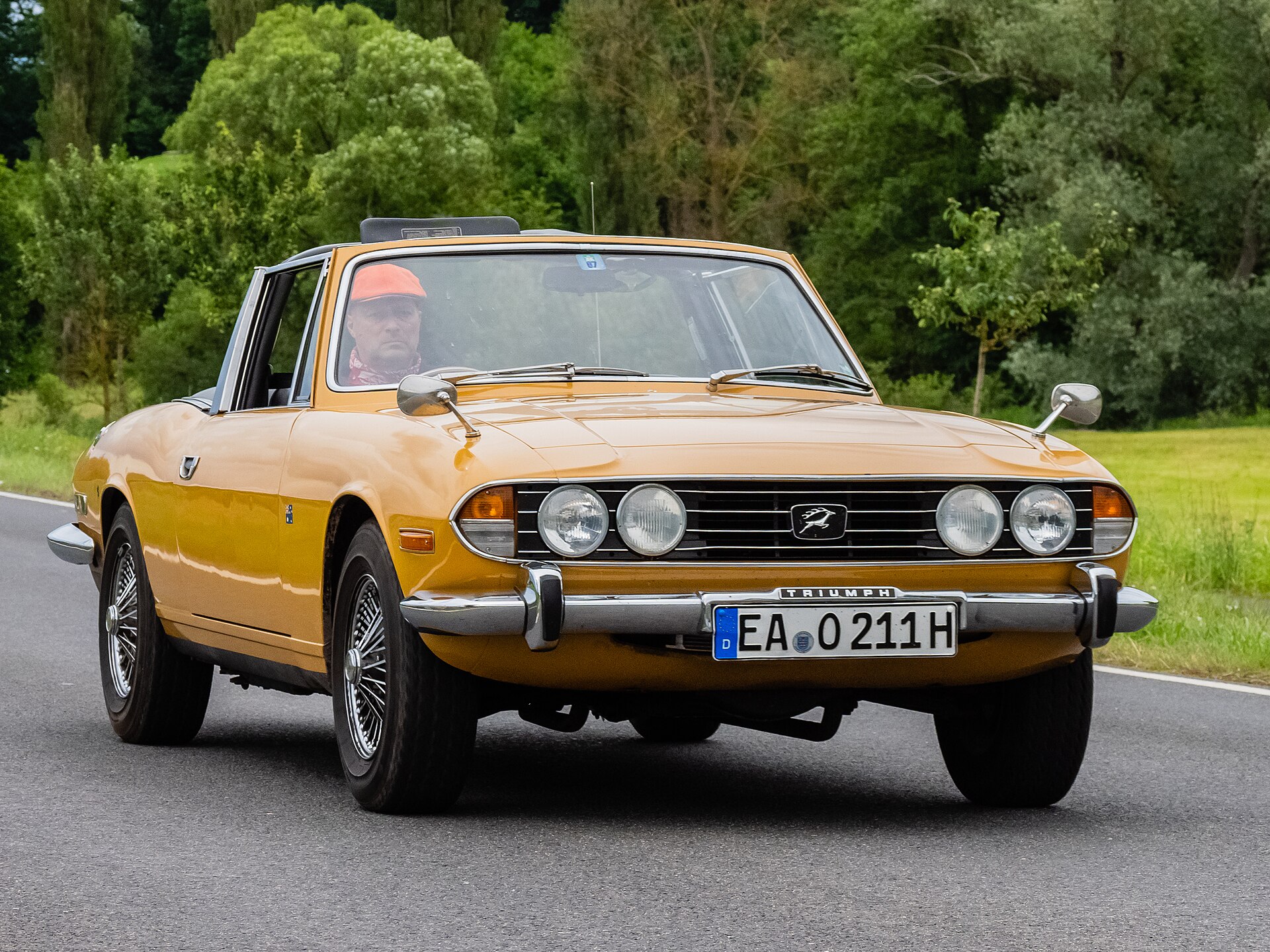
The Triumph Stag is the four-seat convertible grand tourer that Triumph built at Canley, Coventry, from 1970 to 1977. Giovanni Michelotti shaped it on a shortened Triumph 2000 floor, a T-bar braced the open body, and a Triumph-designed 2,997 cc V8 gave 108 kW (145 bhp). Production reached 25,939 cars, about a fifth of them exported.
In short
- Built 1970-1977 at Canley; 25,939 cars according to most sources, 6,780 of them for export.
- 2,997 cc V8 with single overhead camshafts, 108 kW (145 bhp) and 230 Nm in European form.
- Four-speed manual with overdrive or Borg Warner automatic; about half the cars were automatics.
- The V8's cooling and timing-chain problems shaped its reputation and cut short US sales.
Size at a glance
| Dimensions | Triumph Stag I |
|---|---|
| Length | 4,394 mm173.0 in |
| Width | 1,613 mm63.5 in |
| Height | 1,257 mm49.5 in |
| Wheelbase | 2,540 mm100.0 in |
Specs by version
Engines
| Version | Engine | Power | Torque | Gearbox | Drive | Production years |
|---|---|---|---|---|---|---|
| 3.0 V8 (US) | 3.0 l · 8 cyl · Petrol 2,997 cc | 95 kW 129 PS127 hp | - | - | Rear-wheel drive | - |
| 3.0 V8 manual | 3.0 l · 8 cyl · Petrol 2,997 cc | 108 kW 147 PS145 hp | 230 Nm170 lb-ft | 4-sp Manual | Rear-wheel drive | 1970–1977 |
| 3.0 V8 automatic | 3.0 l · 8 cyl · Petrol 2,997 cc | 108 kW 147 PS145 hp | 230 Nm170 lb-ft | 3-sp Automatic | Rear-wheel drive | 1970–1977 |
Dimensions and weight
Show all 1 versions
| Version | Length | Width | Height | Wheelbase | Kerb weight |
|---|---|---|---|---|---|
| 3.0 V8 manual | 4,394 mm173.0 in | 1,613 mm63.5 in | 1,257 mm49.5 in | 2,540 mm100.0 in | 1,300 kg2,866 lb |
Verified Manufacturer and type-approval data from our catalog · Sources and methodology
Triumph Stag at a glance
| Item | Triumph Stag |
|---|---|
| Years | 1970-1977; Mk 2 from February 1973 |
| Production | 25,939 (Wikipedia EN text also gives 25,877) |
| Plant | Canley, Coventry, England |
| Body | 2-door 2+2 convertible with T-bar, optional removable hard top |
| Designer | Giovanni Michelotti |
| Layout | front engine, rear-wheel drive, steel monocoque body |
| Engine | 2,997 cc 90-degree V8, SOHC per bank, two Stromberg carburettors |
| Power and torque | 108 kW (145 bhp) at 5,500 rpm; 230 Nm at 3,500 rpm; US 95 kW (127 bhp) |
| Kerb weight | 1,300 kg |
| Dimensions | 4,394 mm long, 1,613 mm wide, wheelbase 2,540 mm |
| Top speed | about 190 km/h (118 mph); figures vary between tests |
| Price new | GBP 1,996 in 1970 (soft top), GBP 2,094 with both tops |
A Michelotti show car that Triumph bought
The Stag began outside Triumph. In late 1964 Giovanni Michelotti, who already styled Triumph's saloons, designed a 2+2 convertible on the Triumph 2000 platform on his own initiative. The prototype was ready in summer 1965, and Triumph bought the design rights in early 1966. Michelotti also drew the roll bar and the hard top.
Development was led by Harry Webster, who described the target buyer as a young executive wanting "something sporty, but with creature comforts". When Webster moved to Austin-Morris in 1968, Spen King from Rover took over. The floor pan and suspension of the 2000 saloon were shortened by 12 cm, and in the end the Stag shared few parts with it. The B-pillar hoop linked to the windscreen frame by a T-bar added stiffness and was meant to meet proposed US rollover standards.
The 3.0-litre V8 and its weak points
The V8 was Triumph's own design. It was based on the PE104S slant-four, first developed in 1963 as a 1.7-litre unit for Saab, and early prototypes ran at 2.5 litres. The production engine had a cast-iron block, aluminium heads, bore and stroke of 86 x 64.5 mm and one chain-driven overhead camshaft per bank. Fuel injection was planned, then dropped in favour of two Stromberg carburettors.
The engine became the car's weak point. The water pump sat high in the block, so a low coolant level could stop circulation, and its drive gears wore early. The mix of iron and aluminium needed corrosion-inhibiting coolant all year, which owners and dealers often neglected; sludge, blocked radiators and failed head gaskets followed. Single-row timing chains stretched and often failed before 25,000 miles, damaging valves and pistons. Mixed vertical and angled head studs, casting sand left in coolant passages and the softer crankshaft added to the list. Time magazine later put the Stag on its list of the 50 worst cars ever made.
Mk 1 and Mk 2 changes
Triumph never officially separated two series, but owners and clubs use the split at chassis 20001, from February 1973. The Mk 2 brought new pistons and combustion chambers, with compression raised from 8.8:1 to 9.25:1. Twin coachlines, black sills and tail panel, a smaller steering wheel and instruments with needles pointing upwards marked it from outside and in. The three-quarter windows in the soft top had already gone in 1972, together with a higher-pressure cooling system. From 1976 the tail panel returned to body colour and all cars had stainless steel sill covers.
Overdrive became standard on manual cars in October 1972. Roughly half of all Stags used the three-speed Borg Warner Type 35 automatic, and the last 3,800 cars switched to the Type 65 from October 1976.
| Date | UK price (GBP) | Notes |
|---|---|---|
| June 1970 | 1,996 | soft top, including purchase tax (Autocar test) |
| June 1970 | 2,094 | soft top and hard top |
| October 1972 | 2,471 | |
| July 1975 | 4,089 | |
| July 1976 | 5,177 | |
| final model year | 6,907 |

A cheaper rival to the SL and the E-Type
At launch the Stag cost roughly half as much as a Mercedes-Benz 280 SL, which was listed at GBP 4,655 in autumn 1970, and the Stag Owners Club makes the same comparison with the Jaguar E-Type. The Mercedes-Benz SL-Class offered a similar mix of open roof and hard top with a six-cylinder engine. In Germany the Stag was listed at DM 22,950 in 1971 without the hard top.
Triumph planned for about 12,000 cars a year worldwide and never got close. Exports totalled 6,780, including about 1,700 for Australia and 2,871 for the US. Hagerty UK writes that quality problems with the V8 led Triumph to withdraw the car from America early, and Wikipedia DE notes that US sales fell sharply after just under 1,000 in the first year. Production ended in 1977. Triumph's later years are covered in our history of Triumph, and current and past models are in the Triumph catalogue.
Triumph Stag today: what to check when buying
Hagerty UK's buying guide says to look first at the A-posts behind the carpet trim: if they are rotten, the rest of the car usually is too. Quick cosmetic restorations can hide structural rust. Hagerty UK quotes the view that Stags do not go wrong unless they are badly maintained, so the service history matters more than the mileage. Ask whether the timing chains have been changed, whether the coolant has been kept to the right inhibitor mix and whether the cylinder heads have ever been off.
Engine choice changes the value. Cars converted to a Ford V6, Rover V8 or other engine are worth about 30 percent less than equivalent cars with the Triumph V8. A good manual car is worth about GBP 1,000 more than an automatic, and a ZF 4HP14 automatic conversion adds about GBP 1,500. Most parts are remanufactured, but engine blocks, gearboxes and differentials can only be found by reconditioning originals. The Stag Owners Club describes itself as the largest single-model club in the world, and more than 3,500 Stags were still registered in the UK in 2015.
For the Stag, britishclassiccars.co.uk supplies sold prices from public auctions, and each pound figure appears here in euros at roughly 1.15, the autumn 2026 rate. In September 2026 its median Stag sold for about EUR 11,200 (GBP 9,735), with typical results between EUR 7,800 and EUR 15,500. The same September 2026 data shows a median of about EUR 9,900 (GBP 8,600) for Mk 1 cars and about EUR 12,100 (GBP 10,500) for the Mk 2. Other open four-seaters of the decade are in our classic cars section.
Triumph Stag in our rankings
- No. 145 of 445 · Lightest cars (1,300 kg · top 33%)
- No. 15 of 39 · Longest convertibles and roadsters (4,394 mm · top 39%)
- No. 227 of 587 · Smallest cars (4,394 mm · top 39%)
- No. 14 of 30 · Lightest convertibles and roadsters (1,300 kg · top 47%)
- No. 346 of 729 · Biggest engines: cars (2,997 cc · top 48%)
- No. 31 of 57 · Biggest engines: convertibles and roadsters (2,997 cc · top 55%)
Lighter than 67% of ranked cars in the 1CARS catalog (No. 145 of 445).
FAQ
How many Triumph Stags were built?
Most sources give 25,939 cars from 1970 to 1977, though Wikipedia EN also quotes 25,877. Exports came to 6,780, including about 1,700 for Australia and 2,871 for the US.
Why did the Triumph Stag overheat?
The water pump sat high in the V8 block, the iron and aluminium engine needed inhibitor coolant all year, and casting sand could block passages. Neglect led to sludge, overheating and failed head gaskets.
What engine does a Triumph Stag have?
A Triumph-designed 2,997 cc V8 with one chain-driven overhead camshaft per bank and two Stromberg carburettors. In European form it gave 108 kW (145 bhp) at 5,500 rpm and 230 Nm.
What is the difference between a Stag Mk 1 and Mk 2?
The Mk 2 started in February 1973 at chassis 20001. It had higher compression, coachlines, black sills, a smaller steering wheel and revised instruments, and it sells for slightly more than a Mk 1 today.
Data sources
Data checked by an editor against the sources below.
- Wikipedia - Triumph Stag


