 Jaguar E-Type
Specs, engines and history
Published Sources (1) Report an error
By Felix Hartmann, Automotive Technology & EV Contributor
- Built
- 1961–1974
- Top power
- 203 kW (276 PS)
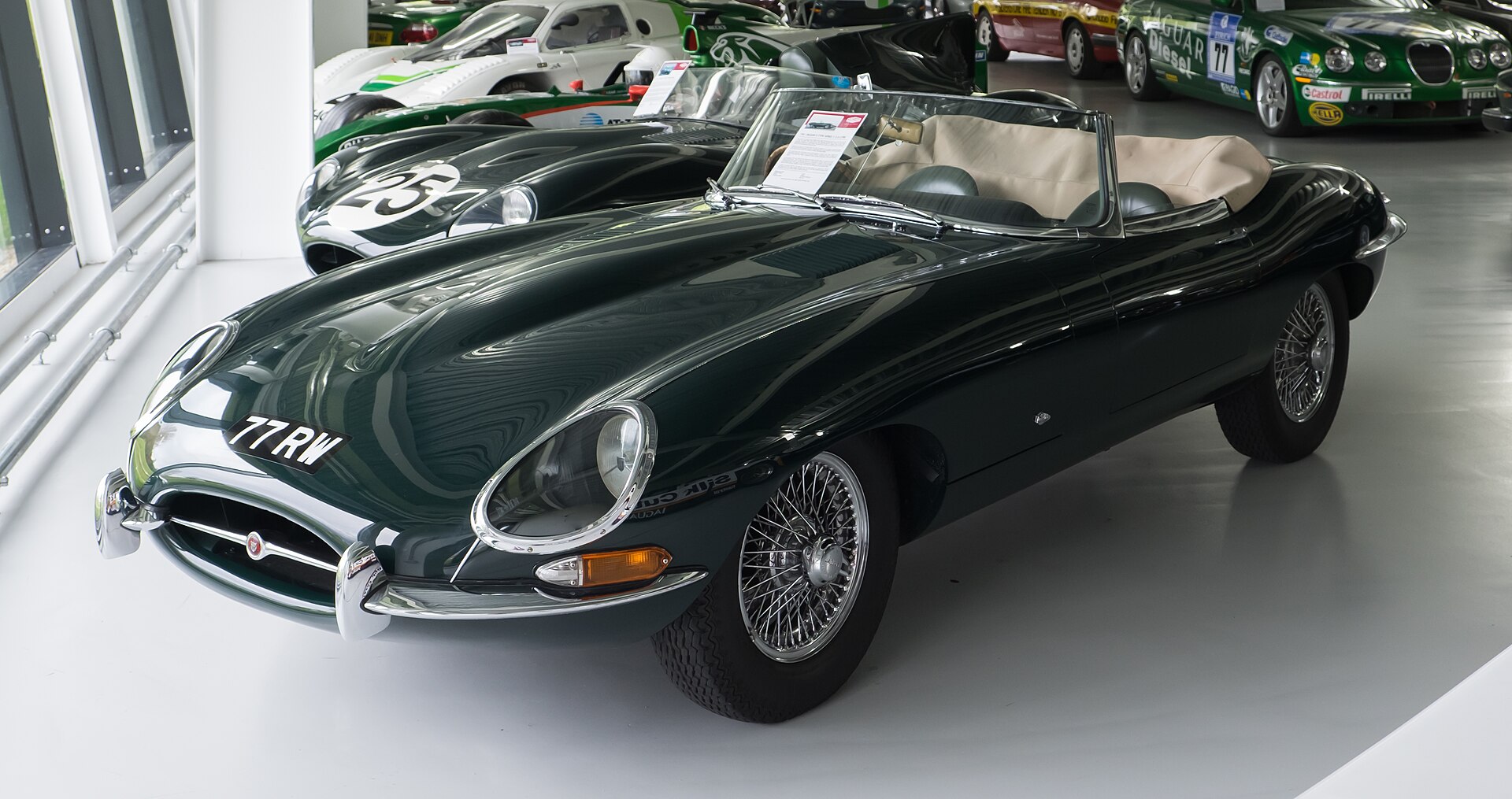
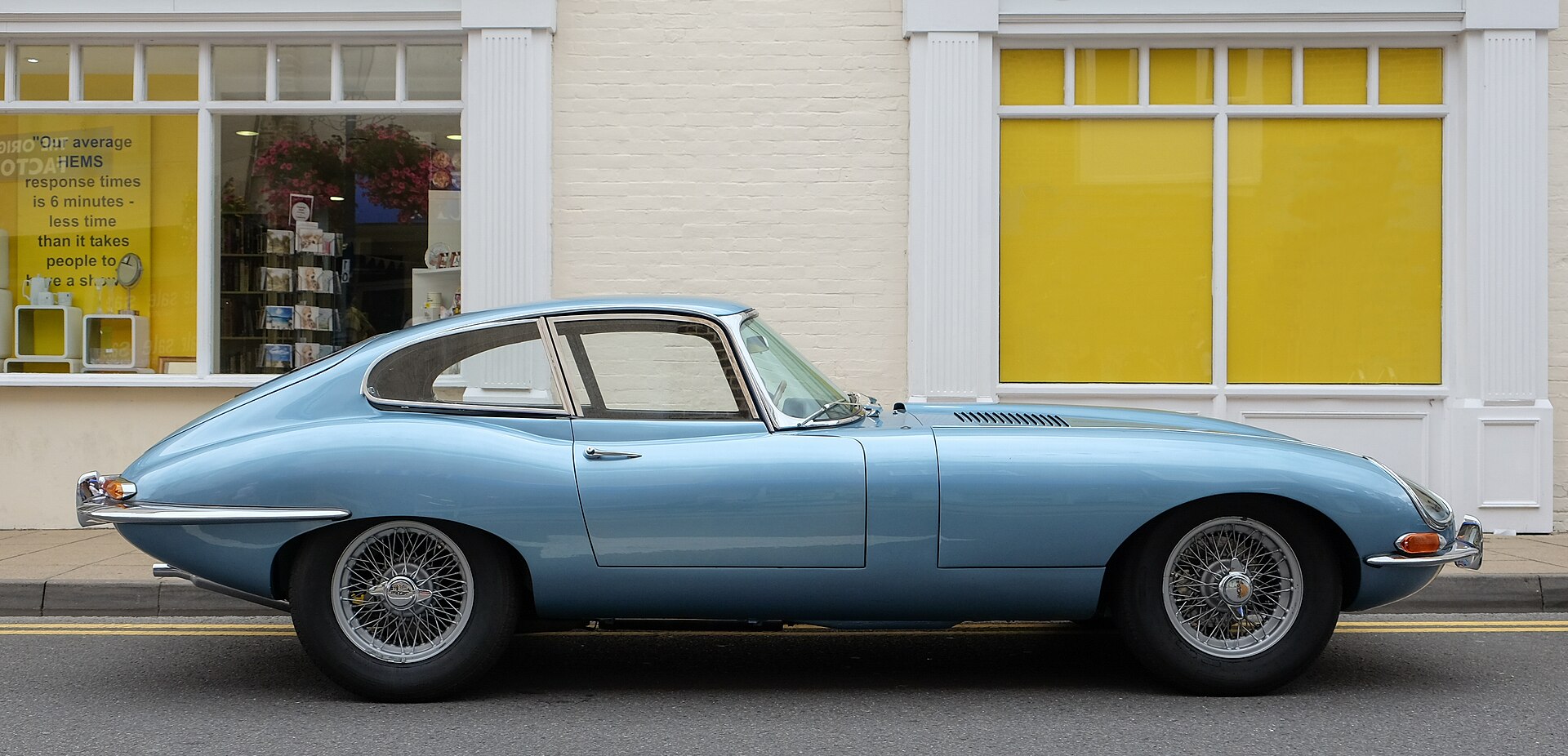
The Jaguar E-Type is the two-seat and 2+2 sports car that Jaguar built in Coventry from 1961 to 1974, sold in North America as the XK-E. It replaced the XK150, took its monocoque construction and much of its shape from the D-Type racing car, and stayed in production through three series with six- and twelve-cylinder engines until the XJ-S took over.
In short
- Debut on 15 March 1961; export sales from March and UK sales from July 1961.
- Engines: 3.8- and 4.2-litre XK straight-six with 198 kW (265 bhp), then a 5.3-litre V12 with 203 kW (272 hp) in the Series 3 of 1971.
- About 72,500 cars by the production table in English Wikipedia (sum of the five series), in coupé, open two-seater and 2+2 form.
- A claimed 240 km/h (150 mph); The Motor measured 149.1 mph (240 km/h) with a 3.8-litre car in 1961.
Size at a glance
| Dimensions | Jaguar E-Type Series 1–3 |
|---|---|
| Length | 4,686 mm184.5 in |
| Width | 1,679 mm66.1 in |
| Height | 1,222 mm48.1 in |
Specs by version
Engines
| Version | Engine | Power | Gearbox | Drive | Production years |
|---|---|---|---|---|---|
| 4.2 Series 2 | 6 cyl · Petrol | 183 kW 249 PS245 hp | 4-sp Manual | Rear-wheel drive | — |
| 3.8 Series 1 | 6 cyl · Petrol | 198 kW 269 PS266 hp | 4-sp Manual | Rear-wheel drive | 1961–1964 |
| 4.2 Series 1 | 6 cyl · Petrol | 198 kW 269 PS266 hp | 4-sp Manual | Rear-wheel drive | 1964–1967 |
| 5.3 V12 Series 3 | 12 cyl · Petrol | 203 kW 276 PS272 hp | — | Rear-wheel drive | 1971–1974 |
Dimensions and weight
Show all 1 versions
| Version | Length | Width | Height | Kerb weight |
|---|---|---|---|---|
| 5.3 V12 Series 3 | 4,686 mm184.5 in | 1,679 mm66.1 in | 1,222 mm48.1 in | 1,533 kg3,380 lb |
Verified Manufacturer and type-approval data from our catalog · Sources and methodology
Jaguar E-Type at a glance
| Parameter | Value |
|---|---|
| Maker | Jaguar Cars, Coventry, England |
| Production | 1961–1974 (Series 1, 1.5, 2 and 3) |
| Body styles | fixed-head coupé (FHC), open two-seater (OTS, roadster), 2+2 coupé |
| Engines | 3.8 l and 4.2 l XK I6; 5.3 l V12 |
| Power | 198 kW (265 bhp) six; 183 kW (246 hp) in US tune; 203 kW (272 hp) V12 |
| Gearbox | Moss four-speed (3.8), all-synchromesh Jaguar four-speed (4.2) |
| Construction | monocoque tub with a bolted-on front subframe |
| Designers | Malcolm Sayer (body), William Heynes (engineering) |
| Predecessor / successor | XK150 / XJ-S |
Development and production history
The E-Type grew out of Jaguar's racing programme. The D-Type, on which it was based, had won the 24 Hours of Le Mans three years in a row from 1955. Under William Heynes a first prototype, E1A, was built in 1957, and the aerodynamicist Malcolm Sayer, credited with the design, shaped the body. A second concept, E2A, followed before the road car reached the public in March 1961.
Its predecessor, the XK120 of 1948, had already made Jaguar famous for speed at a moderate price; that car is described in our Jaguar XK120 article. The E-Type continued the idea. The only price given in English Wikipedia is that of the 1961 Motor road-test car: £2,097 including taxes.
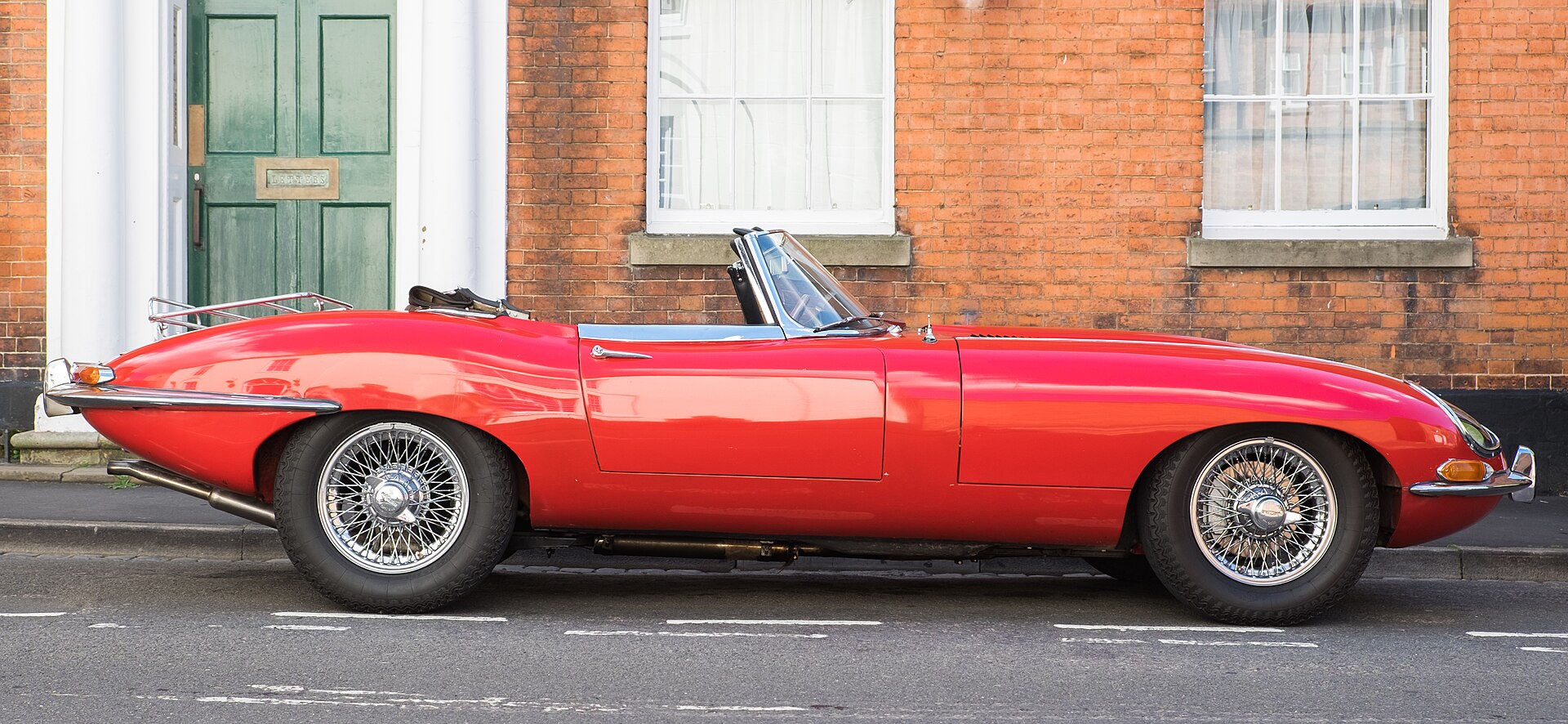
Production ran in three main series. Series 1 had the 3.8-litre engine until 1964, then the 4.2-litre; a 2+2 with a longer roof arrived with the 4.2. Glass-covered headlamps were used up to 1967. The transitional Series 1.5 was built from August 1967 for the 1968 model year; a US federal safety law for 1968 cars was the reason it lost the headlamp covers.
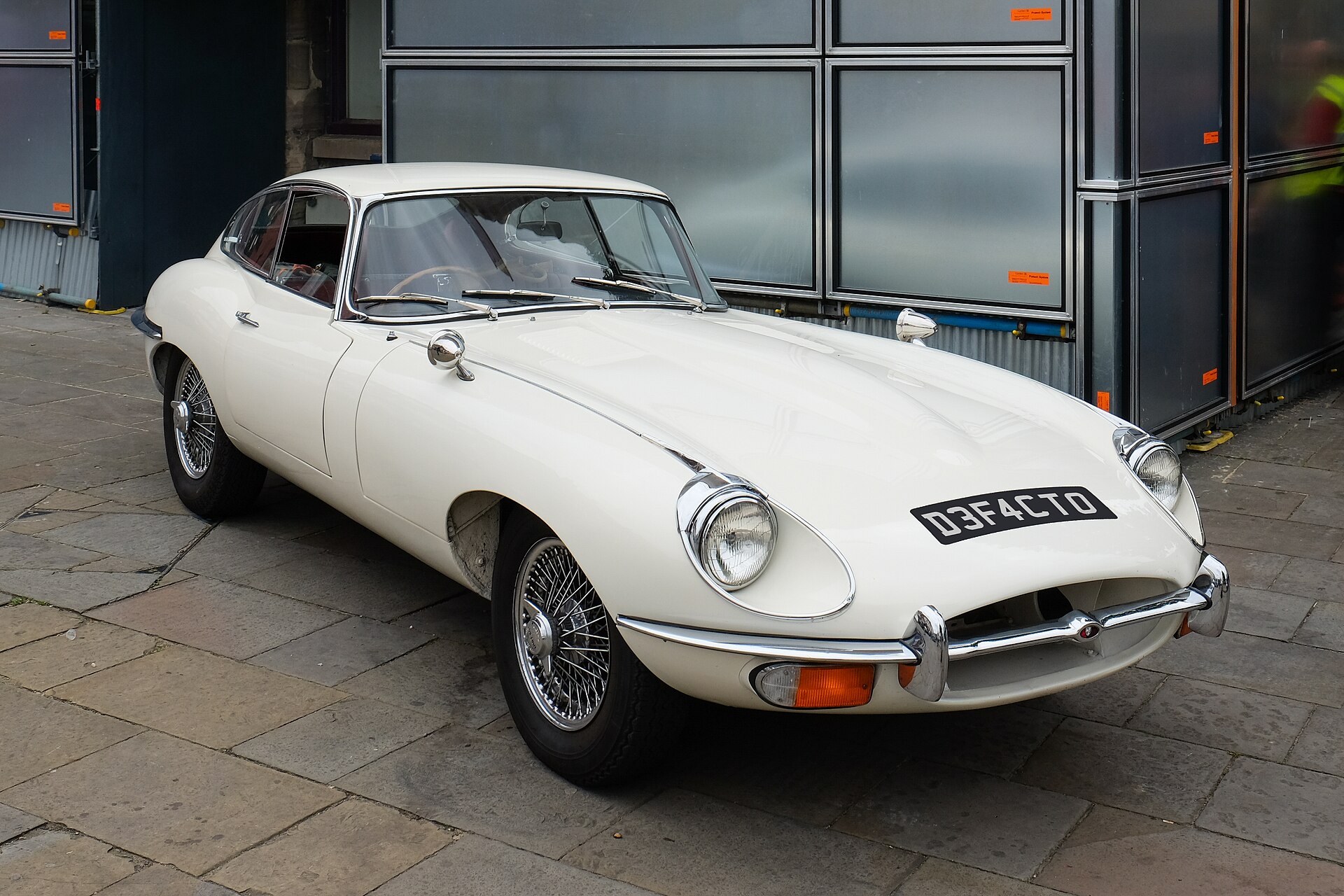
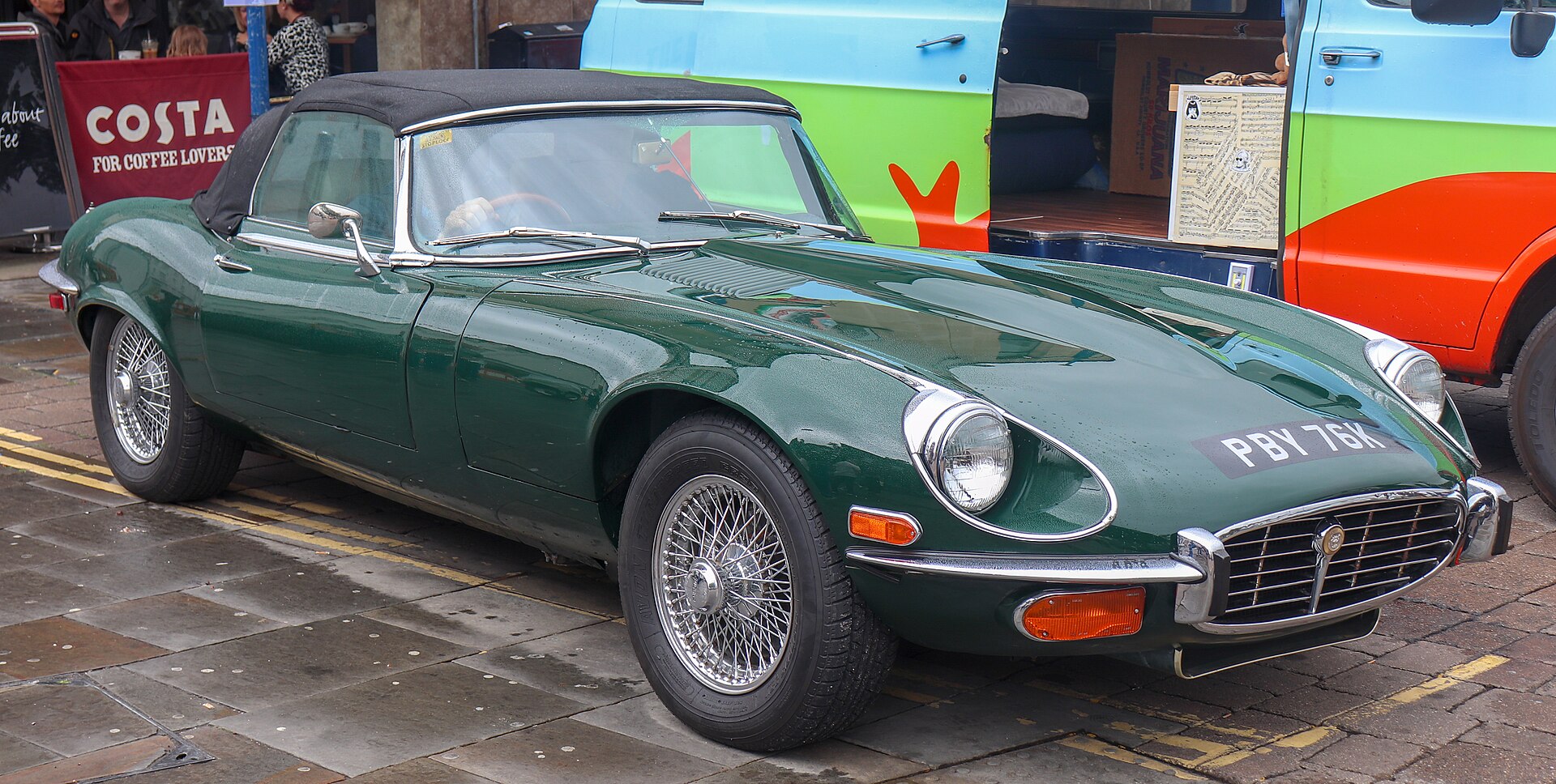
The Series 2 added a wrap-around rear bumper, larger front indicators and tail lights moved below the bumpers. It also gained an enlarged grille with twin electric cooling fans, rocker switches instead of metal toggles, a steering lock and a collapsible steering column. The Series 3 of 1971 brought the V12 and a longer wheelbase with more room, and the short-wheelbase coupé was discontinued; the last open two-seater was built in June 1974.
| Year | Event |
|---|---|
| 1957 | First prototype E1A under William Heynes |
| 15 March 1961 | Public debut; export sales begin |
| July 1961 | UK sales begin |
| 1962 | One-off Low Drag Coupé in aluminium |
| 1963 | 12 Lightweight E-Types built for racing |
| 1964–1965 | 4.2-litre engine and all-synchromesh gearbox; 2+2 added |
| August 1967 | Series 1.5 for the 1968 model year |
| 1971 | Series 3 with the 5.3-litre V12 |
| June 1974 | Last open two-seater built |

Design and engineering
Instead of a separate ladder frame, the E-Type uses a stressed monocoque "tub" for the cabin. A steel front subframe, bolted to it, carries the engine, the front suspension and the front bodywork. The layout followed the D-Type racers on which the car was based.
The suspension was advanced for a road car of 1961. At the front Jaguar used torsion bars; at the rear an independent suspension with coil springs, designed by R. J. Knight. The car had disc brakes on all four wheels with power assistance, the rear discs mounted inboard next to the differential, and rack-and-pinion steering. The first cars weighed 1,315 kg; the Series 1 open two-seater is listed at 1,256 kg and the Series 1 2+2 at 1,402 kg.
The shape is the part most often quoted. Enzo Ferrari is reported to have called it "the most beautiful car ever made", although English Wikipedia notes that the quote is not fully confirmed. In 1996 the Museum of Modern Art in New York added a blue Series 1 roadster to its collection, one of six cars it had honoured in this way. The Victoria and Albert Museum in London holds a Series 1 open two-seater. The Daily Telegraph put the E-Type first in its list of the 100 most beautiful cars in 2008.

Engines and gearbox
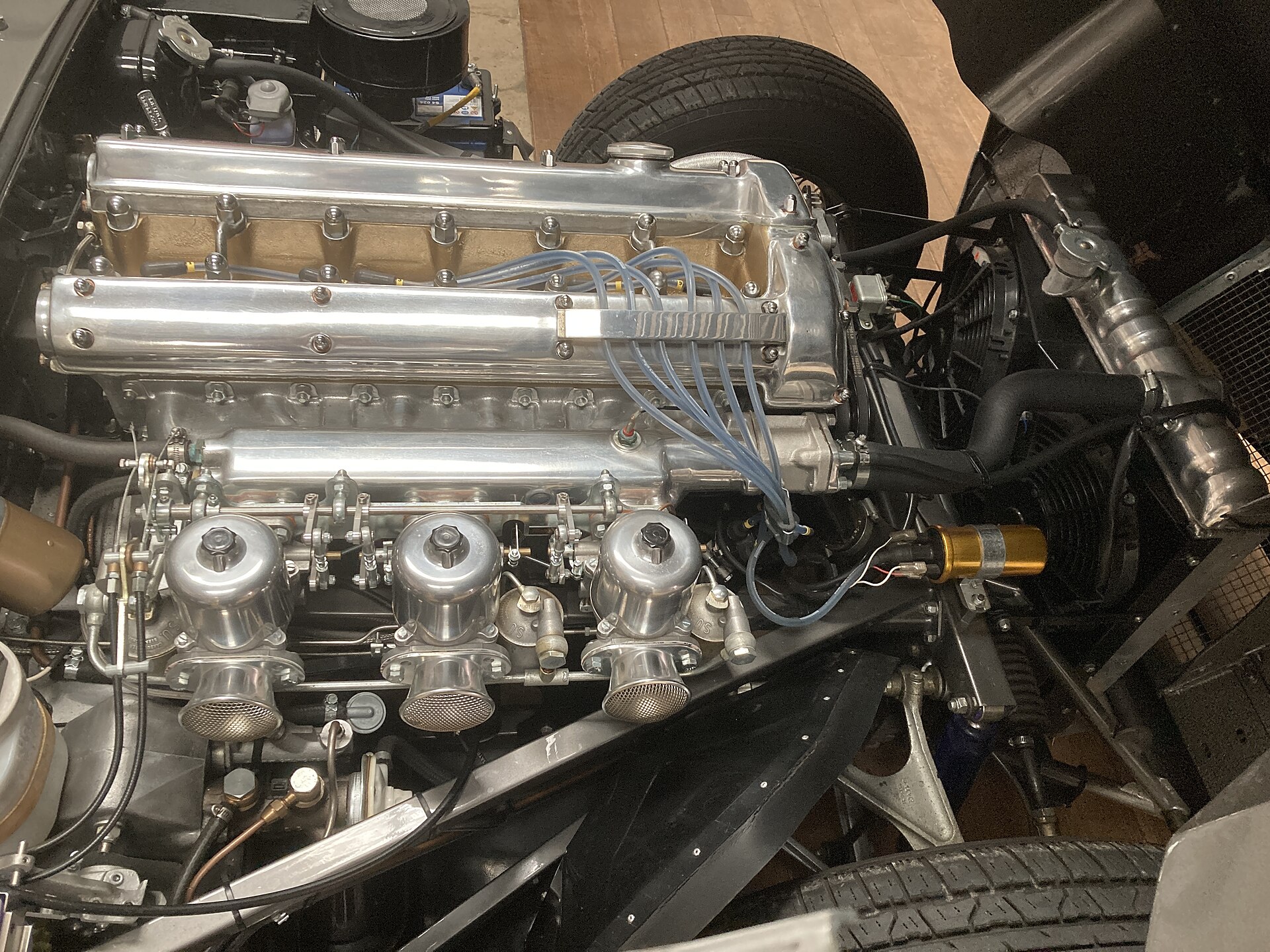
All six-cylinder E-Types used the twin-cam XK straight-six. The 3.8-litre engine was rated at 198 kW (265 bhp) with 240 lb·ft of torque. It came with the Moss four-speed gearbox, which had no synchromesh on first gear in most cars. The 4.2-litre engine from 1964–1965 kept the 198 kW (265 bhp) rating but raised torque to 283 lb·ft, and it was paired with a new all-synchromesh four-speed gearbox designed by Jaguar.
From the Series 1.5, US-market cars used two Zenith-Stromberg carburettors to meet emission rules, and the rating fell to 183 kW (246 hp) with 263 lb·ft. The Series 3 of 1971 replaced the six with the 5.3-litre V12, claimed at 203 kW (272 hp) with more torque than before. Our power converter switches between kW, bhp and PS for comparisons with rivals of the period.
| Version | Years | Engine | Power | Gearbox |
|---|---|---|---|---|
| Series 1 3.8 | 1961–1964 | 3.8 l XK I6 | 198 kW (265 bhp) | Moss 4-speed |
| Series 1 4.2 | 1964–1967 | 4.2 l XK I6 | 198 kW (265 bhp) | Jaguar 4-speed, all-synchromesh |
| Series 1.5 / 2 (US tune) | 1967 on | 4.2 l XK I6, Zenith-Stromberg | 183 kW (246 hp) | 4-speed |
| Series 3 | 1971–1974 | 5.3 l V12 | 203 kW (272 hp) claimed | 4-speed |
| Lightweight (racing) | 1963 | 3.8 l XK I6, racing tune | about 224 kW (300 bhp) | — |

Performance and road tests
Jaguar claimed a top speed of 150 mph (240 km/h) and 0–60 mph in under seven seconds. Contemporary magazines largely confirmed the figures:
| Test | Car | Top speed | 0–60 mph |
|---|---|---|---|
| The Motor, 1961 | 3.8 | 149.1 mph (240 km/h) | 7.1 s |
| The Motor, 1964 | 4.2 FHC | 150 mph (241 km/h) | 7 s |
| Autocar, 1965 | 4.2 FHC | 153 mph (246 km/h) | 7.6 s |
The Motor also recorded 21.3 mpg (imperial) for its 1961 car. The Series 3 V12 is listed at under seven seconds to 60 mph despite its higher weight of 1,533 kg for the open two-seater.
E-Type specifications
| Parameter | Metric | Imperial |
|---|---|---|
| Wheelbase (Series 1 2+2) | 2,667 mm | 105 in |
| Length (Series 1 2+2) | 4,685 mm | 184.4 in |
| Height (Series 1 OTS) | 1,181 mm | 46.5 in |
| Length × width × height (Series 3 OTS) | 4,686 × 1,679 × 1,222 mm | 184.5 × 66.1 × 48.1 in |
| Kerb weight | 1,247–1,533 kg by series and body | 2,750–3,380 lb |
| Front suspension | double wishbones, torsion bars | — |
| Rear suspension | independent, coil springs (R. J. Knight) | — |
| Brakes | four discs, servo-assisted, inboard at the rear | — |
Series and production numbers
English Wikipedia gives the following table; the figures by Jaguar historian Paul Robson differ slightly (for example 15,490 Series 1 3.8 and 15,290 Series 3 cars).
| Series | Coupé (FHC) | Open two-seater | 2+2 | Total |
|---|---|---|---|---|
| Series 1 3.8 | 7,670 | 7,828 | — | 15,498 |
| Series 1 4.2 | 5,830 | 6,749 | 3,616 | 16,195 |
| Series 1.5 | 1,942 | 2,801 | 1,983 | 6,726 |
| Series 2 | 4,855 | 8,628 | 5,326 | 18,809 |
| Series 3 | — | 7,990 | 7,297 | 15,287 |
The open two-seater was the most common body overall. The short-wheelbase coupé was dropped with the Series 3, which was offered only as an open two-seater and a 2+2.

Lightweight cars and racing
For competition Jaguar planned 18 Lightweight E-Types but built 12, plus two spare bodies, with aluminium panels and engines of about 224 kW (300 bhp). The Lightweights did not win at Le Mans or Sebring, but they were successful in national racing: Bob Jane won the 1963 Australian GT Championship in one. The aluminium Low Drag Coupé of 1962 remained a one-off and was sold in 1963 to the racing driver Dick Protheroe. In 2014 Jaguar announced that it would complete the six remaining Lightweight chassis numbers at about £1 million each (2014 announcement).
Later E-Types raced in the United States. Group 44 and Bob Tullius took the 1975 SCCA B-Production championship with a Series 3 V12, and Gran-Turismo Jaguar won the 1980 SCCA C-Production national title with a 4.2-litre coupé.

Legacy and the electric E-Type Zero
Sports Car International named the E-Type the top sports car of the 1960s in 2004. Jaguar returned to the car in September 2017 with the E-Type Zero, a Series 1.5 roadster converted to electric drive. It has a 40 kWh battery, reaches 60 mph in 5.5 seconds and has a range of 270 km (168 miles). Plans to sell conversions were announced in 2018 and stopped in 2019. More of Jaguar's story, from SS Cars to today's models, is in our history of Jaguar, and other cars of the decade are collected under 1960s classics.
Which E-Type to look for
- For the original shape: a Series 1 3.8 of 1961–1964, with covered headlamps and the Moss gearbox.
- For easier driving: a Series 1 4.2 with the all-synchromesh gearbox and the same 198 kW engine.
- For space: a 2+2, available from the 4.2-litre Series 1 to the Series 3.
- For refinement: a Series 3 V12, open two-seater or 2+2, with more room from the longer wheelbase.
Body type, series and engine should match the chassis records. Later Jaguars are in the Jaguar catalogue, and more classic stories are in classic cars.
Photo gallery


Jaguar E-Type in our rankings
- No. 3 of 30 · Longest convertibles and roadsters (4,686 mm)
- No. 8 of 24 · Heaviest convertibles and roadsters (1,533 kg)
- No. 274 of 912 · Longest-running car nameplates (13 years · top 32%)
- No. 34 of 89 · Longest coupes (4,686 mm · top 39%)
- No. 118 of 301 · Power-to-weight: cars (132 kW/t · top 40%)
- No. 170 of 420 · Longest cars (4,686 mm · top 41%)
Longer than 90% of ranked convertibles and roadsters in the 1CARS catalog (No. 3 of 30).
Jaguar E-Type photos 6

FAQ
When was the Jaguar E-Type produced?
From 1961 to 1974. It was presented on 15 March 1961, and the last open two-seater was built in June 1974.
How many Jaguar E-Types were built?
The production table in English Wikipedia adds up to 72,515 cars across Series 1, 1.5, 2 and 3; Paul Robson's figures differ slightly.
What engine does the Jaguar E-Type have?
A 3.8- or 4.2-litre XK straight-six rated at 198 kW (265 bhp), and in the Series 3 a 5.3-litre V12 claimed at 203 kW (272 hp).
How fast is a Jaguar E-Type?
Jaguar claimed 150 mph (240 km/h). The Motor measured 149.1 mph in 1961 and Autocar 153 mph with a 4.2-litre coupé in 1965.
What is the difference between the E-Type series?
Series 1 has glass-covered headlamps. Series 1.5 is the transitional 1968 model without the covers. Series 2 has larger indicators, tail lights below the bumpers and a bigger grille. Series 3 has the V12 and a longer wheelbase.
Data sources
Data checked by an editor against the sources below.