 Jaguar E-Pace
Specs, engines and history
Published Sources (2) Report an error
By Felix Hartmann, Automotive Technology & EV Contributor
- Built
- 2017–2024
- Top power
- 227 kW (309 PS)
- Euro NCAP
- 5 stars · 2017
Which E-Pace to buy
Our verdict · Felix Hartmann
- For high mileage: the D165 or D200 mild-hybrid diesel, both with 380-430 Nm and diesel economy.
- For company car tax: the P300e plug-in hybrid with 32 g/km and up to 61 km of electric range.
- For performance: the P300 petrol with 221 kW (300 PS), available until 2022.
- For a lower price: the front-drive P160 or D150, the simplest versions.
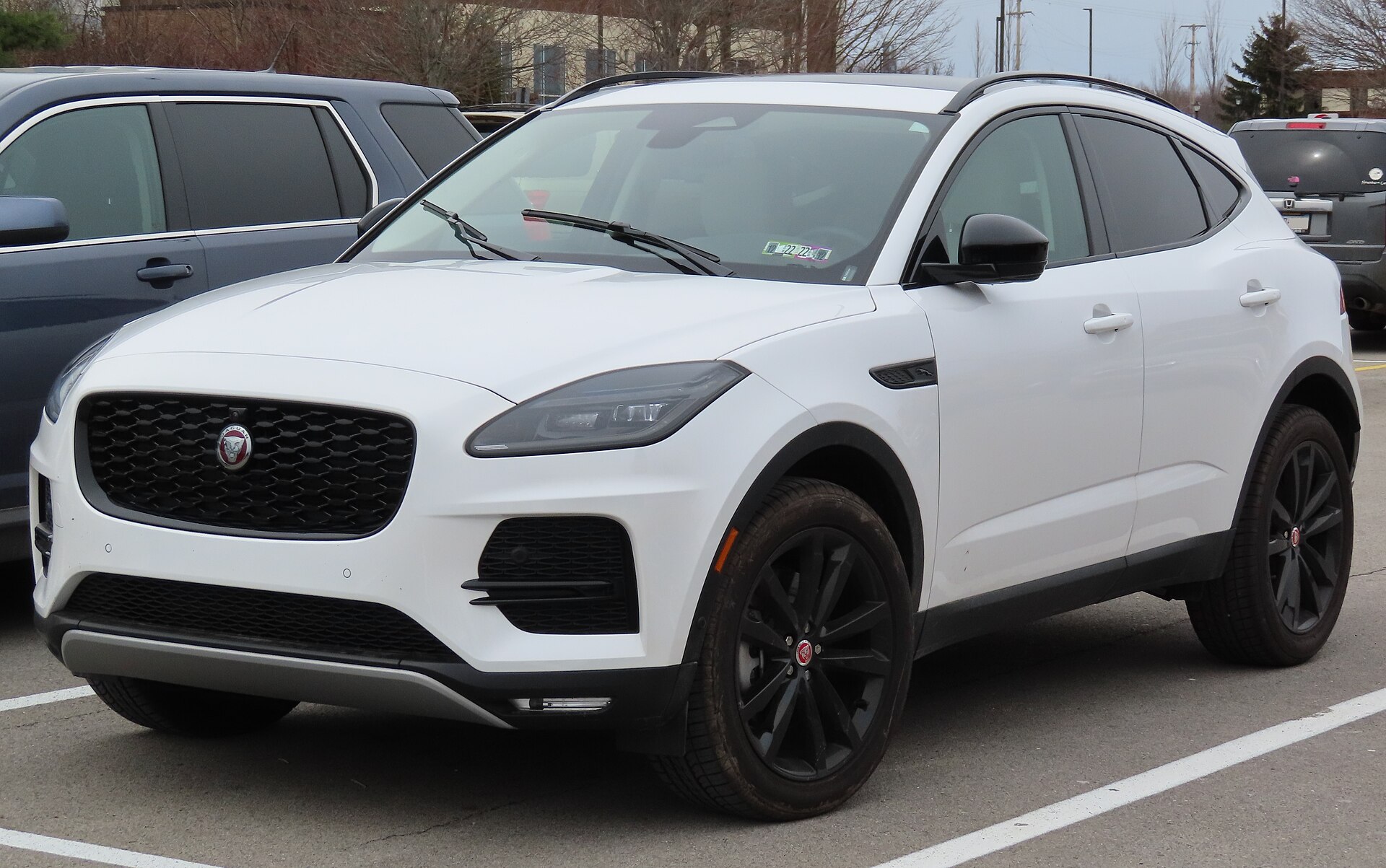
The Jaguar E-Pace is a compact premium SUV that Jaguar sold from 2017 to 2024, built by Magna Steyr in Graz, Austria, and for China in Changshu. There was one generation, the X540, with 2.0-litre Ingenium diesel and petrol engines, a 1.5-litre three-cylinder petrol and, after the facelift, a 227 kW (309 PS) plug-in hybrid. It scored five stars in Euro NCAP's 2017 test and offered a 577-litre boot, but production ended in 2024 as Jaguar prepared to become an electric-only brand.
In short
- Five-door compact SUV (C-segment), front- or all-wheel drive; revealed on 13 July 2017, deliveries from January 2018, production ended in 2024.
- Diesel engines from 110 kW (150 PS) to 177 kW (240 PS), petrol from 118 kW (160 PS) to 221 kW (300 PS), and the P300e plug-in hybrid with 227 kW (309 PS).
- Nine-speed ZF automatic on most versions, eight-speed Aisin automatic on the three-cylinder P160 and P300e.
- Euro NCAP 2017: five stars (adult occupant 86%, child occupant 87%); boot 577 to 1,234 litres.
Safety
-
Euro NCAP 2017
Older protocol · Full Euro NCAP result
Stars from different years and organisations are not directly comparable: test protocols change every few years.
Jaguar E-Pace at a glance
| Specification | Jaguar E-Pace (X540) |
|---|---|
| Segment | Compact premium SUV (C-segment) |
| Production | 2017-2024 |
| Plants | Magna Steyr, Graz, Austria; Chery Jaguar Land Rover, Changshu, China (from 2018) |
| Design | Ian Callum's Jaguar design team |
| Layout | Transverse front engine, front- or all-wheel drive |
| Related models | Range Rover Evoque, Land Rover Discovery Sport |
| Length / wheelbase | 4,395 mm / 2,681 mm |
| Boot | 577 l, 1,234 l with rear seats folded |
| Power range | 110-227 kW (150-309 PS) |
| Euro NCAP | five stars (2017) |
The E-Pace sits below the F-Pace in the Jaguar catalogue.
Launch and history
Jaguar revealed the E-Pace on 13 July 2017 at the ExCeL centre in London, its second production SUV after the F-Pace. At the reveal, stunt driver Terry Grant jumped the car through a 270-degree barrel roll, travelling 15.3 metres through the air, a stunt Jaguar presented as a world record. Customer deliveries started on 20 January 2018.
Unusually for Jaguar, the car was not built in Britain. Magna Steyr assembled it under contract in Graz, Austria, and from 2018 Jaguar's Chinese joint venture with Chery built it in Changshu. The facelift was presented in late 2020 for the 2021 model year and added mild-hybrid and plug-in hybrid drivetrains. Production ended in 2024.

Generations and versions
The E-Pace had one generation. ADAC lists the original car from 2018 to 2020 and the facelift from 2021 to 2024.
| Generation | Code | Years | Body styles | Engines | Power (kW / hp) |
|---|---|---|---|---|---|
| E-Pace | X540 | 2017-2020 | 5-door SUV | 2.0 diesel (D150, D180, D240), 2.0 petrol (P250, P300) | 110-221 kW (150-300 PS) |
| E-Pace (facelift) | X540 | 2020-2024 | 5-door SUV | 2.0 MHEV diesel (D165, D200), 1.5 P160, 2.0 petrol (P200, P250, P300), P300e PHEV | 118-227 kW (160-309 PS) |

Engines, transmissions and performance
| Version | Engine | Power | Torque | Drive |
|---|---|---|---|---|
| D150 | 2.0 Ingenium diesel | 110 kW (150 PS) | 380 Nm | FWD or AWD |
| D165 (MHEV) | 2.0 Ingenium diesel | 120 kW (163 PS) | 380 Nm | FWD or AWD |
| D180 | 2.0 Ingenium diesel | 132 kW (180 PS) | 430 Nm | AWD |
| D200 (MHEV) | 2.0 Ingenium diesel | 150 kW (204 PS) | 430 Nm | AWD |
| D240 | 2.0 Ingenium diesel | 177 kW (240 PS) | - | AWD |
| P160 (MHEV) | 1.5 Ingenium three-cylinder | 118 kW (160 PS) | 260 Nm | FWD |
| P250 | 2.0 Ingenium petrol | 184 kW (249-250 PS) | - | AWD |
| P300 | 2.0 Ingenium petrol | 221 kW (300 PS) | - | AWD |
| P300e (PHEV) | 1.5 three-cylinder + 80 kW motor | 227 kW (309 PS) | - | AWD |
Torque figures for the D165 and D200 come from Auto Express; those for the D150, D180 and P160 come from the German Wikipedia engine table, which is partly garbled, so treat them as indicative. The mild hybrids use a 48-volt system with a synchronous reluctance motor. Most versions used the nine-speed ZF 9HP automatic; the P160 and P300e used an eight-speed Aisin automatic, and the front-drive D165 was also offered with a manual gearbox. Jaguar's Active Driveline AWD, with two electronically controlled clutches on the rear axle, was standard on the most powerful version of each engine.
The P300e combines the 1.5-litre three-cylinder with an 80 kW electric motor and a 15 kWh battery. Auto Express quotes an electric range of up to 38 miles (about 61 km) and a 0-80% charge in about 1 hour 24 minutes on a 7 kW wallbox.

Dimensions, space and boot
| Parameter | Metric | Imperial |
|---|---|---|
| Length | 4,395 mm | 173.0 in |
| Width | 1,984 mm | 78.1 in |
| Height | 1,648 mm | 64.9 in |
| Wheelbase | 2,681 mm | 105.6 in |
| Kerb weight (Euro NCAP test car, 2.0 diesel AWD) | 1,867 kg | 4,116 lb |
| Boot, seats up / folded | 577 / 1,234 l | 20.4 / 43.6 cu ft |
The 577-litre boot is Jaguar's claimed figure. The E-Pace is short for its class at under 4.4 metres, but heavy: the AWD diesel that Euro NCAP tested weighed 1,867 kg. To check whether it fits your garage, use our garage fit tool.

Fuel economy and running costs
| Version (UK official) | Combined | CO2 |
|---|---|---|
| D165 FWD manual | 6.2 l/100 km (45.6 mpg UK) | 162 g/km |
| D165 AWD automatic | 6.5 l/100 km (43.4 mpg UK) | 171 g/km |
| Petrol models | about 9.1 l/100 km (about 31 mpg UK) | - |
| P300e (WLTP) | 1.4 l/100 km (197 mpg UK) | 32 g/km |
Litre figures are conversions of the UK mpg values. As with any plug-in hybrid, the P300e's official figure assumes regular charging. Jaguar's standard warranty is three years with unlimited mileage.
In the UK, Auto Express listed the E-Pace from around GBP 42,000 in 2023 (about EUR 48,000), with the top P300e R-Dynamic HSE Black at more than GBP 54,000 (about EUR 62,000).
Trims and equipment
At launch markets such as South Africa received Standard, S, SE and HSE trims, plus a First Edition for the first year. The R-Dynamic styling pack sat alongside them. In some markets the later line-up consisted of R-Dynamic SE and HSE, with an 11.4-inch touchscreen and Alexa integration.
Safety
Euro NCAP tested the E-Pace in 2017 and awarded five stars, with 86% for adult occupant protection, 87% for child occupant protection, 77% for vulnerable road users and 72% for safety assist. The tested car was a right-hand-drive 2.0 diesel R-Dynamic SE with AWD. Euro NCAP marks the rating as expired from 1 January 2024. Compare it with newer cars in our safety ratings.
Reliability and known issues
The E-Pace did not appear in the Auto Express Driver Power owner survey, so there is no model-specific reliability score. As a brand, Jaguar finished 7th of 29 in 2021 and 6th in 2022. Our sources name no recurring faults for the E-Pace, and we do not invent any; check that recall work has been done on any used car.
Rivals
| Model | Engines | Power (kW / hp) | Boot (l) | Price from (EUR) |
|---|---|---|---|---|
| Jaguar E-Pace (2017-2024) | 1.5 and 2.0 petrol, 2.0 diesel, PHEV | 110-227 kW (150-309 PS) | 577 | about 48,000 (GBP 42,000, UK 2023) |
| BMW X1 F48 (2015-2022) | 1.5-2.0 petrol and diesel, PHEV | 85-170 kW (116-231 PS) | - | - |
| Volvo XC40 (2017-) | petrol, diesel, PHEV, electric | 95-300 kW (129-408 PS) | - | - |
| Audi Q3 F3 (2018-) | 1.4-2.5 petrol, 2.0 diesel, PHEV | - | - | - |
Auto Express also names the BMW X2, Mercedes GLB, Lexus UX and the in-house Range Rover Evoque.
Photo gallery

Jaguar E-Pace in our rankings
- No. 464 of 1011 · Most powerful cars (227 kW · top 46%)
- No. 119 of 253 · Most powerful SUVs and crossovers (227 kW · top 48%)
- No. 634 of 1082 · Longest-running car nameplates (7 years · top 61%)
- No. 77 of 118 · Most powerful British cars (227 kW · top 67%)
More powerful than 54% of ranked cars in the 1CARS catalog (No. 464 of 1011).
FAQ
How many generations of the Jaguar E-Pace are there?
One, the X540, built from 2017 to 2024 with a facelift for the 2021 model year.
Where was the Jaguar E-Pace built?
By Magna Steyr in Graz, Austria, and from 2018 by Chery Jaguar Land Rover in Changshu, China.
How big is the E-Pace's boot?
577 litres with the rear seats up and 1,234 litres with them folded, according to Jaguar's figures quoted by Auto Express.
Is the E-Pace safe?
Euro NCAP gave it five stars in 2017, with 86% for adult and 87% for child occupant protection; the rating expired in 2024.
Is there an electric or hybrid E-Pace?
There was no fully electric E-Pace. The facelift added mild hybrids and the P300e plug-in hybrid with a 15 kWh battery.
Data sources
Data checked by an editor against the sources below.
- Wikipedia - Jaguar E Pace
- Euro NCAP