
 Jaguar XJS
All generations, specs and history
Published Sources (1) Report an error
By Sarah Whitmore, Senior Automotive Writer
- Built
- 1975–1996
- Generations
- 3
- Top power
- 243 kW (330 PS)
Timeline
XJS generations
Click a generation for its own page
- XJ-S Series 1 1975–1981 · Coupe · 211 kW (287 PS)
- XJ-S Series 2 1981–1991 · Coupe, Convertible · 147–220 kW (200–299 PS)
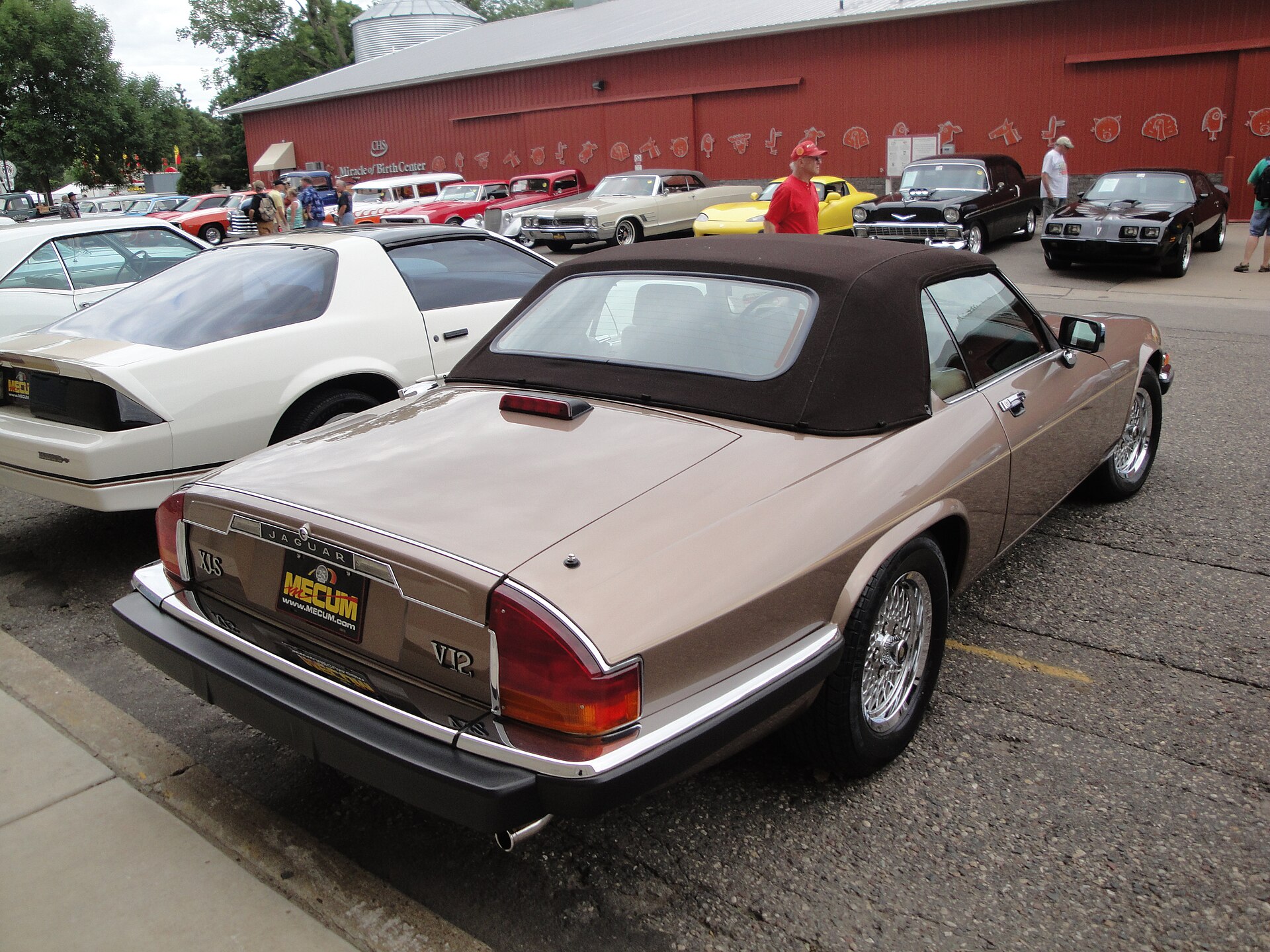
- XJS Series 3 1991–1996 · Coupe, Convertible · 163–243 kW (222–330 PS)
Newest first · 3 generations since 1975
- 1991 Series 3 1991–1996 · Coupe, Convertible · 163–243 kW (222–330 PS)
- 1981 XJ-S Series 2 1981–1991 · Coupe, Convertible · 147–220 kW (200–299 PS)
- 1975 XJ-S Series 1 1975–1981 · Coupe · 211 kW (287 PS)
All generations by year: XJS Series 3 (1991–1996) · XJ-S Series 2 (1981–1991) · XJ-S Series 1 (1975–1981)
Which one is mine?
Pick the year of first registration to see which generation it is.
- XJS Series 3 1991–1996
- XJ-S Series 2 1981–1991
- XJ-S Series 1 1975–1981
The Jaguar XJ-S is the grand tourer that Jaguar built in Coventry from September 1975 to April 1996 as the successor to the E-Type. It began as a V12 coupé with 211 kW (287 PS), gained AJ6 six-cylinder engines and open versions from 1983, and was renamed XJS at the 1991 facelift. Jaguar built 115,413 cars over almost 21 years.
In short
- Built 10 September 1975 to 4 April 1996 in Coventry; 115,413 cars in total.
- 5.3-litre V12 (later HE and 6.0), plus 3.6 and 4.0-litre AJ6 straight-sixes from 1983.
- Coupé throughout; XJ-SC targa 1983-1988 and a full convertible from 1988.
- Won the 1984 European Touring Car Championship drivers' title for Tom Walkinshaw.
Specs by version
Engines
| Version | Engine | Power | Gearbox | Drive | Production years |
|---|---|---|---|---|---|
| XJ-S Series 1 · 5.3 V12 | 5.3 l · 12 cyl · Petrol 5,343 cc | 211 kW 287 PS283 hp | 3-sp Automatic | Rear-wheel drive | 1975–1981 |
| XJ-S Series 2 · 3.6 AJ6 | 6 cyl · Petrol | 163 kW 222 PS219 hp | 5-sp Manual | Rear-wheel drive | 1983–1991 |
| XJ-S Series 2 · 5.3 V12 HE | 5.3 l · 12 cyl · Petrol 5,343 cc | 220 kW 299 PS295 hp | Automatic | Rear-wheel drive | 1981–1991 |
| XJS Series 3 · 4.0 AJ6/AJ16 | 6 cyl · Petrol | 163 kW 222 PS219 hp | - | Rear-wheel drive | 1991–1996 |
| XJS Series 3 · 6.0 V12 | 6.0 l · 12 cyl · Petrol 5,994 cc | 222 kW 302 PS298 hp | 4-sp Automatic | Rear-wheel drive | 1993–1996 |
| XJS Series 3 · XJR-S 6.0 | 6.0 l · 12 cyl · Petrol 5,994 cc | 243 kW 330 PS326 hp | - | Rear-wheel drive | 1991–1993 |
Performance
Show all 5 versions
| Version | Top speed |
|---|---|
| XJ-S Series 1 · 5.3 V12 | 241 km/h150 mph |
| XJ-S Series 2 · 3.6 AJ6 | 225 km/h140 mph |
| XJ-S Series 2 · 5.3 V12 HE | 240 km/h149 mph |
| XJS Series 3 · 6.0 V12 | 260 km/h162 mph |
| XJS Series 3 · XJR-S 6.0 | 254 km/h158 mph |
Dimensions and weight
Show all 1 versions
| Version | Wheelbase |
|---|---|
| XJ-S Series 1 · 5.3 V12 | 2,590 mm102.0 in |
Verified Manufacturer and type-approval data from our catalog · Sources and methodology
Jaguar XJ-S at a glance
| Item | Jaguar XJ-S |
|---|---|
| Years | 1975-1996 (XJ-S to 1991, XJS after the facelift) |
| Production | 115,413 (14,800 pre-HE, 73,207 HE/3.6/XJ-SC, 27,406 facelift) |
| Plant | Coventry, England |
| Body styles | 2+2 coupé; XJ-SC targa cabriolet; convertible (2-seat, later 2+2) |
| Design | Malcolm Sayer, completed by Doug Thorpe's team; facelift by Geoff Lawson |
| Layout | front engine, rear-wheel drive, shortened XJ saloon floorpan |
| Engines | 5,343 cc V12; 5,994 cc V12; 3.6 and 4.0-litre AJ6 straight-six |
| Power | 163 kW (222 PS) 3.6 to 243 kW (330 PS) XJR-S 6.0 |
| Dimensions | about 4,820 mm long, 1,790 mm wide; wheelbase 2,590 mm |
| Top speed | 241 km/h (5.3 V12, Wikipedia DE); Jaguar Heritage gives 229 km/h (142 mph) for a 1975 car |
| 0-100 km/h | 6.8 s manual, 7.9 s automatic (5.3 V12, 1975) |
| Price new | GBP 8,900 in 1975 (V12 coupé) |
Built on a shortened XJ floorpan
The XJ-S used the floorpan of the Jaguar XJ saloon, shortened by about 25 cm. Aerodynamicist Malcolm Sayer drew the early shape; after his death in 1970 Doug Thorpe's in-house team finished it. The flying buttresses behind the side windows came from a shelved mid-engined project derived from the XJ13. Jaguar designed the car only as a closed coupé because it expected new US safety rules to restrict open cars.
The car was shown at the Frankfurt motor show in September 1975, priced at GBP 8,900 in Britain. Jaguar Heritage notes that the price nearly doubled within four years. The 5,343 cc V12 came from the Series 3 E-Type with Lucas fuel injection and was rated at 211 kW (287 PS), or 213 kW (285 bhp) in British figures. A four-speed manual was offered alongside the three-speed Borg Warner automatic, but only 352 manual cars were built before it was dropped around 1978 or 1979, depending on the source. Wikipedia DE gives 0-100 km/h in 6.8 s with the manual.
The XJ-S replaced the open E-Type with a closed four-seater, and early sales were slow. Output fell to just over 1,000 cars in 1980, and production stopped for half of 1981 to clear unsold stock.
HE V12, the AJ6 six and the first open cars
The turnaround began in July 1981 with the V12 HE. Its "Fireball" cylinder heads used a split-level combustion chamber, high compression and a lean mixture, lifting output to 220 kW (295 PS) and cutting fuel consumption by 10-20 percent according to Practical Classics. North American cars were rated at 196 kW (263 hp).
In 1983 Jaguar added the new 3.6-litre AJ6 straight-six with 163 kW (222 PS) and a five-speed Getrag manual gearbox; a ZF automatic followed in 1987. Jaguar Heritage records a 3.6 coupé at GBP 19,248 and 227 km/h (141 mph). The same year brought the XJ-SC, a two-seat targa cabriolet with removable roof panels and a folding rear section. It was built from 1983 with the six and from 1985 with the V12, and 5,013 were made before production ended in January 1988.
American coachbuilder Hess & Eisenhardt converted coupés into full convertibles from 1986, and Jaguar's own convertible was presented at the 1988 Geneva show. Sales peaked at more than 10,000 cars a year in 1988 and 1989.

TWR, the XJR-S and the 1984 ETCC
Tom Walkinshaw Racing turned the XJ-S into a touring car winner. Its first win came at Brno, and in 1984 Walkinshaw took the European Touring Car Championship drivers' title and the team won the Spa 24 Hours. In 1988 Jaguar and TWR formed JaguarSport as a 50:50 company. Its XJR-S started with the 5.3 V12 and from September 1989 used a 6.0-litre V12 with 243 kW (330 PS) and 495 Nm. Wikipedia DE counts about 124 XJR-S 6.0 coupés and 50 convertibles of the post-1991 shape.

The 1991 facelift: XJS under Ford
Ford had bought Jaguar, and in May 1991 it launched a facelift designed by Geoff Lawson. The name lost its hyphen and became XJS. The six grew to 4.0 litres with 163 kW (222 PS), and a 2+2 convertible joined the range. The 6.0-litre V12 followed in 1992 or 1993, depending on the source, with 222 kW (302 PS) and a four-speed automatic. Outboard rear brakes arrived in May 1993 and plastic bumpers replaced the chrome items for the 1993 model year. In 1994 the six became the AJ16 with 171 kW (233 PS).
| Engine | Years | Displacement | Power | Top speed |
|---|---|---|---|---|
| V12 | 1975-1981 | 5,343 cc | 211 kW (287 PS) | 241 km/h |
| V12 HE | 1981-1993 | 5,343 cc | 220 kW (295 PS) | 240 km/h |
| AJ6 3.6 | 1983-1991 | 3.6 l | 163 kW (222 PS) | 225 km/h |
| AJ6 4.0 | 1991-1994 | 4.0 l | 163 kW (222 PS) | 227 km/h |
| AJ16 4.0 | 1994-1996 | 4.0 l | 171 kW (233 PS) | 237 km/h |
| V12 6.0 | 1992/93-1996 | 5,994 cc | 222 kW (302 PS) | 260 km/h |
| XJR-S 6.0 (JaguarSport) | 1989-1993 | 5,994 cc | 243 kW (330 PS) | 254 km/h |
Wikipedia EN gives 227 kW (304 hp) for the production 6.0 V12, while Wikipedia DE and Secret Classics give 222 kW. The last XJS 6.0 coupé and 4.0 convertible left the line on 4 April 1996. Its successor, the XK8, used a modified version of the XJS platform. Rivals over two decades included the Mercedes-Benz SL and the Porsche 928.
Jaguar XJ-S today: what to check when buying
Practical Classics lists the rust spots: rear wheel arches and the rear buttresses, the radius arms and their mountings, behind the bumpers, floorpan and sills, the front crossmembers, the inner wing below the damper mount and blocked sunroof drains. Auto Express adds the screen surrounds and says pre-1994 cars need the closest look, with repairs that can cost thousands.
On the V12 the rearmost spark plugs are hidden under plumbing and are often left until they are damaged; look for oil changes at least every 3,000 miles. Six-cylinder engines need fresh coolant every two years, or the rear of the block sludges, the engine overheats and the head gasket fails. Inboard rear brakes on cars built before May 1993 are often neglected, and steering rack mounting bushes wear. Auto Express rates the electrics of Ford-era 4.0-litre cars as more reliable.
Auction results logged by britishclassiccars.co.uk are the basis for the XJ-S figures below, with sterling turned into euros at roughly 1.15 to the pound (autumn 2026). In August 2026 the median XJ-S sold for about EUR 10,300 (GBP 8,930), with typical results between EUR 6,300 and EUR 15,600. Convertibles had a median of about EUR 11,500 (GBP 10,006) in the same August 2026 data. Auto Express put 4.0 and V12 convertibles at about EUR 11,500-28,800 (GBP 10,000-25,000) in June 2026, with rare 6.0-litre cars up to EUR 46,000 (GBP 40,000). Jaguar's other models are listed in the Jaguar catalogue, and more grand tourers of the era are in our classic cars section.
Jaguar XJS evolution in numbers
Did you know?
- The Jaguar XJS ran for 21 years, from 1975 to 1996, over 3 generations in our catalog.
- The longest-running generation is the XJ-S Series 2 (1981–1991): 10 years.
- The biggest jump in power came with the XJS Series 3: up to 243 kW (330 PS), 23 kW more than the XJ-S Series 2.
Most powerful version, kW
Figures from the 1cars catalog: power is the strongest version of each generation; generations without the figure are left out.
Jaguar XJS: first vs latest generation
| Spec | XJ-S Series 1 | XJS Series 3 | Change |
|---|---|---|---|
| Years | 1975–1981 | 1991–1996 | 16 years apart |
| Most powerful version | 211 kW (287 PS) | 243 kW (330 PS) | +32 kW (+15%) |
| Top speed | 241 km/h | 260 km/h | +19 km/h |
Oldest and newest generation in the 1cars catalog. Power is the strongest version of each; other rows are shown only when both generations have the figure.
Jaguar XJS in our rankings
- No. 1 of 33 · Fastest cars of the 1970s (241 km/h)
- No. 7 of 29 · Fastest cars of the 1990s (260 km/h)
- No. 7 of 23 · Quickest cars of the 1970s, 0–100 (7.9 s)
- No. 8 of 26 · Fastest cars of the 1980s (240 km/h)
- No. 12 of 83 · Most powerful cars of the 1980s (220 kW · top 15%)
- No. 172 of 1135 · Longest-running car nameplates (21 years · top 17%)
Faster than 96% of ranked cars of the 1970s in the 1CARS catalog (No. 1 of 33).
FAQ
How many Jaguar XJ-S were built?
Jaguar built 115,413 XJ-S and XJS cars between September 1975 and April 1996. Of these, 14,800 were early pre-HE V12s, 73,207 were HE, 3.6 and XJ-SC cars, and 27,406 were facelifted XJS models.
Is it XJ-S or XJS?
Both are correct for different years. Jaguar called the car XJ-S from 1975 and dropped the hyphen with the May 1991 facelift, so later cars are badged XJS.
Did the Jaguar XJ-S come with a manual gearbox?
Yes, but rarely. Early V12 cars could be ordered with a four-speed manual, and only 352 were built. From 1983 the 3.6-litre six came with a five-speed Getrag manual gearbox.
What replaced the Jaguar XJ-S?
The Jaguar XK8 replaced it in 1996. The XK8 was built on a modified version of the XJS platform, while the last XJS 6.0 coupé and 4.0 convertible were completed on 4 April 1996.
Data sources
Data checked by an editor against the sources below.
- Wikipedia - Jaguar XJS


