
 Jaguar XK150
Specs, engines and history
Published Sources (1) Report an error
By Sarah Whitmore, Senior Automotive Writer
- Built
- 1957–1961
- Top power
- 198 kW (269 PS)
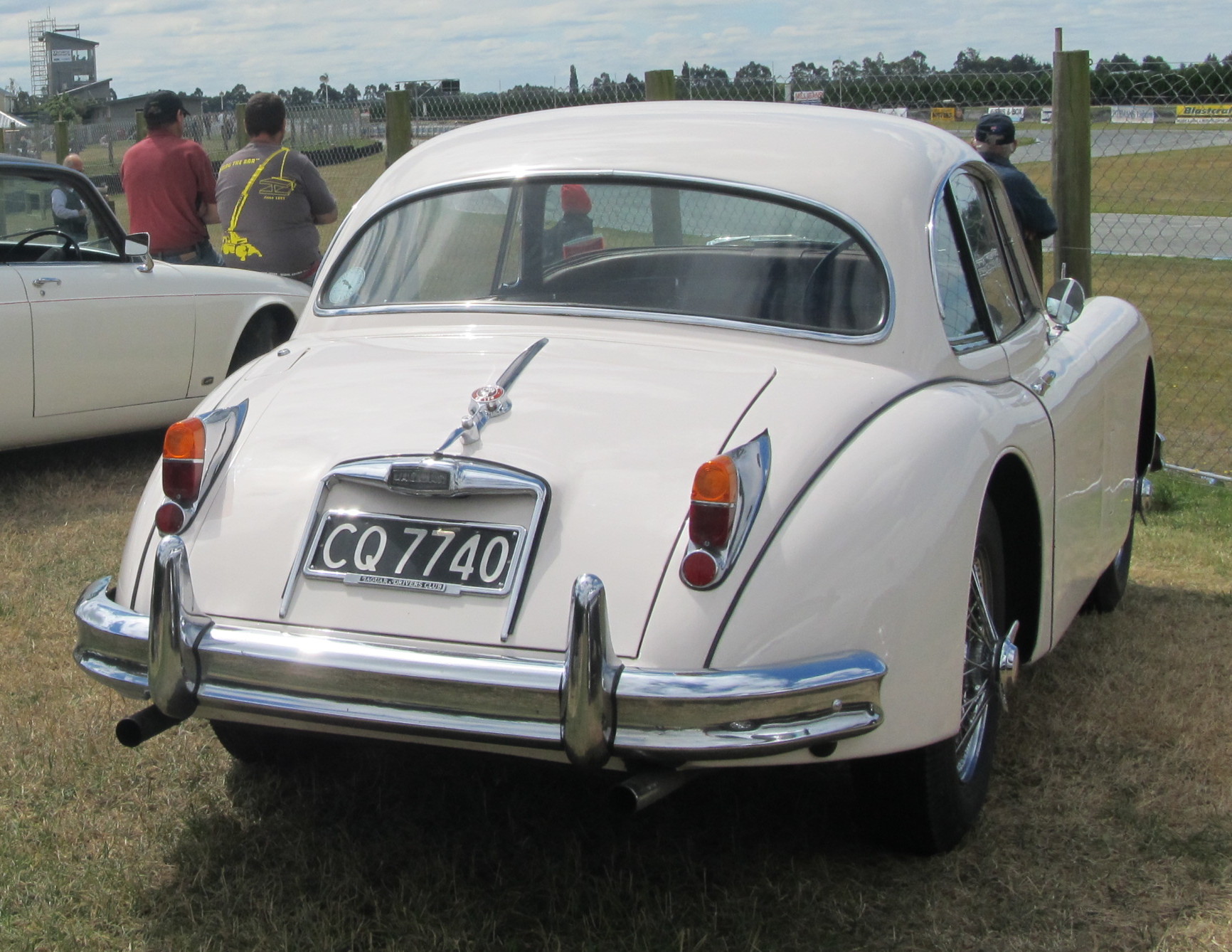
The Jaguar XK150 is the last of the XK sports cars, built in Coventry from May 1957 to 1961 as a fixed-head coupé, drophead coupé and open two-seater. It kept the twin-cam six of the XK120 and XK140 in 3.4- and later 3.8-litre form, with up to 198 kW (265 bhp) in the 3.8 S. It was the first XK offered with four-wheel Dunlop disc brakes, and 9,382 were made.
In short
- Fixed-head and drophead coupés were announced in May 1957; the open two-seater followed in 1958.
- Production by body: 4,445 fixed-head coupés, 2,672 drophead coupés and 2,265 open two-seaters, 9,382 in total.
- The Motor timed a 3.4 S fixed-head coupé at 212 km/h (132 mph) in June 1959, the fastest closed car it had tested.
- Replaced by the E-Type, announced in March 1961.
Specs by version
Engines
| Version | Engine | Power | Drive | Production years |
|---|---|---|---|---|
| 3.4 190 bhp | 3.4 l · 6 cyl · Petrol 3,442 cc | 142 kW 193 PS190 hp | Rear-wheel drive | 1957–1960 |
| 3.8 SE 220 bhp | 3.8 l · 6 cyl · Petrol 3,781 cc | 164 kW 223 PS220 hp | Rear-wheel drive | 1959–1960 |
| 3.4 S 250 bhp | 3.4 l · 6 cyl · Petrol 3,442 cc | 186 kW 253 PS249 hp | Rear-wheel drive | 1958–1960 |
| 3.8 S 265 bhp | 3.8 l · 6 cyl · Petrol 3,781 cc | 198 kW 269 PS266 hp | Rear-wheel drive | 1959–1960 |
Performance
Show all 2 versions
| Version | Top speed |
|---|---|
| 3.4 S 250 bhp | 212 km/h132 mph |
| 3.8 S 265 bhp | 217 km/h135 mph |
Dimensions and weight
Show all 1 versions
| Version | Length | Width | Wheelbase | Kerb weight |
|---|---|---|---|---|
| 3.4 190 bhp | 4,496 mm177.0 in | 1,580 mm62.2 in | 2,591 mm102.0 in | 1,346 kg2,967 lb |
Verified Manufacturer and type-approval data from our catalog · Sources and methodology
Jaguar XK150 at a glance
| Specification | Jaguar XK150 |
|---|---|
| Years | May 1957 to 1961 (Wikipedia gives a last build of October 1960 in the text and March 1961 in the infobox) |
| Production | 9,382 (Hagerty quotes 9,395) |
| Plant | Coventry, England |
| Body styles | fixed-head coupé, drophead coupé, open two-seater (roadster) |
| Layout | front engine, rear-wheel drive, separate chassis, rack-and-pinion steering |
| Engines | 3,442 cc and 3,781 cc twin-cam straight-six |
| Power | 142 kW (190 bhp) 3.4 to 198 kW (265 bhp) 3.8 S |
| Gearboxes | four-speed manual, optional overdrive, or three-speed automatic |
| Brakes | Dunlop discs on all four wheels (listed as optional on base cars) |
| Weight | 1,346 kg (2,968 lb) |
| Wheelbase and length | 2,591 mm (102 in) and 4,496 mm (177 in) |
| Top speed and 0-60 mph | 212 km/h and 7.8 s, 3.4 S fixed-head coupé (The Motor, June 1959) |
| Price new | GBP 2,110 including GBP 623 purchase tax for the 3.4 S fixed-head coupé in 1959 |
Turning the XK sports car into a grand tourer
The XK150 grew out of two predecessors. The Jaguar XK120 of 1948 had introduced the twin-cam six, and the XK140 added rack-and-pinion steering. The XK150 carried the same idea into the late 1950s for a market that lay largely in export, and Wikipedia notes that most export cars were SE models.
Magneto describes the restyle in three points: a one-piece windscreen, a wider bonnet and reshaped wings that hide the disc brakes. The result looked more modern and more like a touring car than the XK120's slim roadster body. The fixed-head and drophead coupés came first in May 1957, and the open two-seater, the XK150's roadster, followed in 1958 as a lighter alternative.

Jaguar XK150 disc brakes, chassis and gearbox
The most important technical change sat behind the wheels. Jaguar had proved Dunlop disc brakes in the C-type racing car, and the XK150 brought them to a production XK; the XK120 and XK140 used drums. Wikipedia lists the discs as an option on the base car, and most SE cars had them. The discs measure 12 in (305 mm). Telescopic dampers, stronger than the lever-arm units of the XK120, and rack-and-pinion steering carried over from the XK140.
The gearbox remained the four-speed Moss unit, which has no synchromesh on first gear and needs care with second. Overdrive was offered, and a three-speed automatic was also available.
XK150 engines: 3.4 and 3.8, SE and S versions
| Version | Capacity | Carburettors | Power | Years |
|---|---|---|---|---|
| 3.4 | 3,442 cc | twin SU HD6 | 142 kW (190 bhp) | 1957-1960 |
| 3.4 SE | 3,442 cc | twin SU HD6, B-type head | 157 kW (210 bhp) | 1958-1960 |
| 3.4 S | 3,442 cc | triple SU HD8, straight-port head | 186 kW (250 bhp) | 1958-1960 |
| 3.8 SE | 3,781 cc | twin SU HD6 | 164 kW (220 bhp) | 1959-1960 |
| 3.8 S | 3,781 cc | triple SU HD8 | 198 kW (265 bhp) | 1959-1960 |
The base 3.4 used a bore and stroke of 83 x 106 mm. Special Equipment (SE) cars from March 1958 had the B-type cylinder head with larger exhaust valves, and the S versions used the straight-port head with three SU HD8 carburettors. Wikipedia's text also quotes 134 kW (180 bhp) for an early B-type engine, which conflicts with its own table, so the table values are used here. The 3.4 S was first offered on the open two-seater, then on the coupés.
In 1959 the bore was increased to 87 mm, giving 3,781 cc. Magneto notes that the bigger engine was Jaguar's response to American V8 rivals. The same 3.4 and 3.8 sizes also powered the Jaguar Mark 2 saloon from 1959.

How fast is the XK150: The Motor road test
The Motor tested a 3.4 S fixed-head coupé in its issue of 10 June 1959. It reached 212 km/h (132 mph) and 0-60 mph in 7.8 seconds, and averaged 22.0 mpg (12.8 L/100 km). The test car cost GBP 2,110 including GBP 623 purchase tax, and the magazine called it the fastest closed car it had tested.
With the 3.8-litre S engine the XK150 reached about 217 km/h (135 mph) and 0-60 mph in about 7.0 seconds, though consumption fell to around 18 mpg (15.7 L/100 km). Magneto lists 136 mph and 7.6 seconds for the 3.8 S fixed-head coupé, so figures vary between sources by a few tenths.

XK150 vs E-Type: why the XK line ended
The E-Type, announced in mid-March 1961, kept the 3.8-litre twin-cam six and ended the XK line. The XK150 therefore spans the gap between the separate-chassis XK sports cars and the Jaguar E-Type. The XK140 is listed as its own model in the catalogue.
Jaguar XK150 today: what to check when buying
Specialist Harry Rochez of Twyford Moors, interviewed by Magneto, starts with the body. Check where the rear wings bolt on, the front suspension mounts and the lower doors, because early doors have wooden frames that rot and push the panel out of line. Bodies were mounted on spacers, so no two cars have identical gaps, and an expensive car should have had a body-off restoration. Ball joints and bushes decide how the car handles.
Ask for a Jaguar Heritage Certificate and compare chassis, engine and body numbers. Rattling timing-chain tensioners and noisy valve gear are common, and many engines have been rebuilt. The Moss gearbox wears second gear and new parts no longer exist, overdrive is sensitive to the oil level, and many owners fit a five-speed conversion. The handbrake is weak. Switches and hood frames are hard to find, and factory right-hand-drive cars command a premium.
Hagerty's US price guide, updated to April 2025, puts a good 1958 XK150 S at about USD 91,100, roughly EUR 80,000 at April 2025 rates. At the top of the market an XK150 S roadster sold for USD 151,200 at Gooding's Pebble Beach auction in 2025, about EUR 130,000. The Jaguar catalogue lists the other XK and saloon models. The XK150 tops the values table in our list of the best British classic sports cars.
Jaguar XK150 in our rankings
- No. 173 of 508 · Lightest cars (1,346 kg · top 35%)
- No. 275 of 772 · Biggest engines: cars (3,781 cc · top 36%)
- No. 196 of 497 · Fastest cars (217 km/h · top 41%)
- No. 53 of 121 · Smallest coupes (4,496 mm · top 44%)
- No. 226 of 505 · Power-to-weight: cars (106 kW/t · top 45%)
- No. 308 of 650 · Smallest cars (4,496 mm · top 48%)
Lighter than 65% of ranked cars in the 1CARS catalog (No. 173 of 508).
FAQ
How many Jaguar XK150s were made?
Jaguar built 9,382 XK150s between 1957 and 1960 or early 1961: 4,445 fixed-head coupés, 2,672 drophead coupés and 2,265 open two-seaters, according to Wikipedia. Hagerty quotes a slightly higher 9,395.
What is the difference between the XK150 and the XK150 S?
The S has a straight-port cylinder head and three SU HD8 carburettors. It produced 186 kW (250 bhp) as a 3.4 and 198 kW (265 bhp) as a 3.8, against 142-164 kW (190-220 bhp) for the standard and SE engines.
How fast is the Jaguar XK150?
The Motor timed a 3.4 S fixed-head coupé at 212 km/h (132 mph) with 0-60 mph in 7.8 seconds in 1959. The 3.8 S is quoted at about 217 km/h (135 mph) and roughly 7 seconds to 60 mph.
How much is a Jaguar XK150 worth?
Hagerty's US price guide put a good 1958 XK150 S at about USD 91,100 in April 2025, roughly EUR 80,000. An XK150 S roadster sold for USD 151,200 at Gooding's Pebble Beach auction in 2025, while standard 3.4 coupés usually trade lower.
Did the XK150 have disc brakes?
Yes. The XK150 was the first XK with Dunlop disc brakes on all four wheels, technology Jaguar had developed on the C-type racer. The XK120 and XK140 had drum brakes.
Data sources
Data checked by an editor against the sources below.
- Wikipedia - Jaguar XK150


