 Jaguar X-Type
Specs, engines and history
Published Sources (1) Report an error
By Felix Hartmann, Automotive Technology & EV Contributor
- Built
- 2001–2009
- Top power
- 170 kW (231 PS)
Which X-Type to buy
Our verdict · Felix Hartmann
- Best all-rounder: a 2.2 diesel (112-114 kW) with the six-speed manual, the strongest and most economical engine.
- For winter roads: a 2.5 or 3.0 V6 with all-wheel drive, the version praised for its grip in snow.
- Most practical: the estate from 2004, with up to about 1,416 l of load space.
- Newest: a 2008-2009 facelift car, which brought the six-speed automatic and the updated styling.
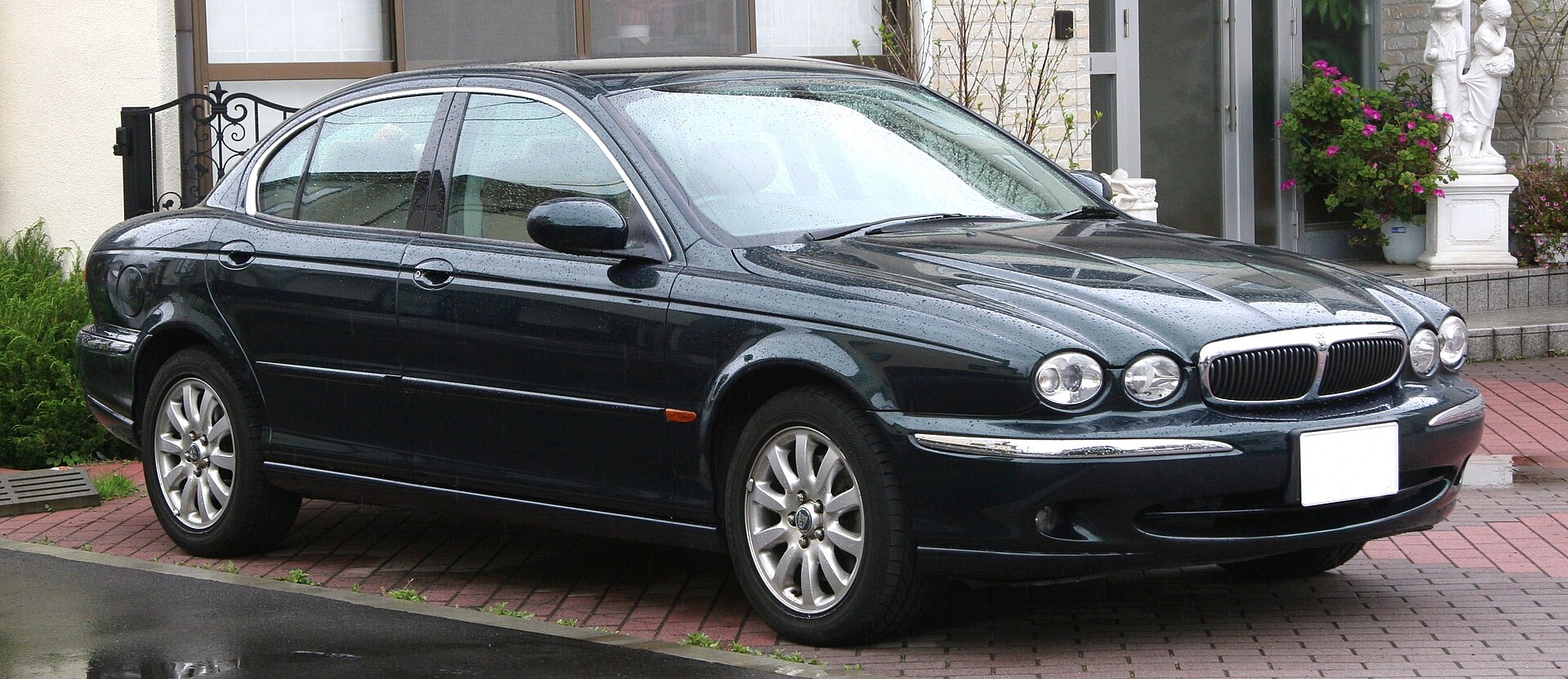
The Jaguar X-Type is the compact executive saloon and estate that Jaguar built at Halewood, near Liverpool, from 2001 to 2009. It used a modified version of the Ford CD132 platform from the Ford Mondeo and was the first Jaguar offered with all-wheel drive, then later with front-wheel drive and four-cylinder diesels. There was only one generation, internally coded X400, with a facelift in 2008; Jaguar replaced it, after a gap, with the XE.
In short
- D-segment compact executive car, four-door saloon (2001-2009) and five-door estate (2004-2009), built at Halewood, UK.
- V6 petrol engines of 2.1, 2.5 and 3.0 litres from 115 kW (156 PS) to 170 kW (231 PS); 2.0 and 2.2 diesels from 94 kW (128 PS) to 114 kW (155 PS).
- All-wheel drive (Jaguar Traction 4) on the larger V6 engines; front-wheel drive on the diesels and the entry V6.
- About 350,000 built: Wikipedia's infobox gives 355,227.
Specs by version
Engines
| Version | Engine | Power | Torque | Gearbox | Drive | Production years |
|---|---|---|---|---|---|---|
| Diesel · 1 version | ||||||
| 2.2 D | 2.2 l · 4 cyl · Diesel 2,198 cc | 114 kW 155 PS153 hp | 360 Nm266 lb-ft | 6-sp Manual | Front-wheel drive | 2007–2009 |
| Petrol · 1 version | ||||||
| 3.0 V6 AWD | 3.0 l · 6 cyl · Petrol 2,967 cc | 170 kW 231 PS228 hp | 279 Nm206 lb-ft | 5-sp Manual | All-wheel drive | 2001–2009 |
Dimensions and weight
Verified Manufacturer and type-approval data from our catalog · Sources and methodology
Jaguar X-Type at a glance
| Specification | Jaguar X-Type |
|---|---|
| Segment | D-segment compact executive car |
| Generation / code | One generation, X400 |
| Production | 2001-2009 (saloon), January 2004-2009 (estate) |
| Plant | Halewood Body & Assembly, Merseyside, UK |
| Platform | Modified Ford CD132 (shared with the Ford Mondeo) |
| Body styles | 4-door saloon, 5-door estate (Sportwagon in the US) |
| Drive | AWD (Traction 4) or FWD |
| Power range | 94-170 kW (128-231 PS) |
| Successor | Jaguar XE |
Jaguar wanted the X-Type to win buyers from the BMW 3 Series, Audi A4 and Mercedes-Benz C-Class, and to double its volume. The early target was 100,000 cars a year. The car is listed with the brand's other models in our Jaguar catalogue.
Generations and model history
The X-Type had a single generation. The saloon was designed by Simon Butterworth, Tadeusz Jelec and Wayne Burgess under Geoff Lawson, with styling cues borrowed from the larger XJ. The estate, which followed in January 2004, was Ian Callum's first Jaguar design.
| Generation | Code | Years | Body styles | Engines | Power (kW / hp) |
|---|---|---|---|---|---|
| X-Type (pre-facelift) | X400 | 2001-2007 | saloon, estate (from 2004) | 2.1, 2.5, 3.0 V6 petrol; 2.0, 2.2 diesel | 94-170 kW (126-228 hp) |
| X-Type (facelift) | X400 | 2008-2009 | saloon, estate | 2.1, 2.5, 3.0 V6 petrol; 2.0, 2.2 diesel | 96-170 kW (128-228 hp) |
At launch every X-Type had all-wheel drive with a viscous coupling and a default torque split of 60:40 between rear and front axles; the viscous coupling was deleted for the 2004 model year. Front-wheel drive versions arrived with the four-cylinder diesels in 2003. In Germany, ADAC lists the entry V6 as the 2.0 V6 from March 2002.
The facelift was revealed at the 2007 Motorexpo at Canary Wharf, London, and went on sale in the UK in March 2008. It brought new front and rear bumpers, door mirrors with integrated indicator repeaters, a 2.2-litre diesel with a particulate filter and a six-speed automatic gearbox. Saloon length grew from 4,672 to 4,716 mm. In July 2009 Jaguar confirmed that production would end, and the XE was confirmed as the eventual successor in March 2014.
Engines, transmissions and performance
All petrol engines are V6 units; the diesels are four-cylinders. Outputs below are from the Wikipedia engine table.
| Engine | Years | Displacement | Power | Torque | Gearbox |
|---|---|---|---|---|---|
| 2.1 V6 petrol | 2001-2007 | 2,099 cc | 115 kW (157 PS) | 201 Nm | 5-speed manual |
| 2.1 V6 petrol | 2007-2008 | 2,099 cc | 115 kW (156 PS) | 196 Nm | 5-speed manual or automatic |
| 2.5 V6 petrol | 2001-2009 | 2,495 cc | 144 kW (196 PS) | 244 Nm | 5-speed manual or automatic |
| 3.0 V6 petrol | 2001-2009 | 2,967 cc | 170 kW (231 PS) | 279 Nm | 5-speed manual or automatic |
| 2.0 diesel | 2003-2007 | 1,998 cc | 94 kW (128 PS) | 331 Nm | 5-speed manual |
| 2.0 diesel | 2007-2009 | 1,998 cc | 96 kW (130 PS) | 330 Nm | 5-speed manual |
| 2.2 diesel | 2003-2007 | 2,198 cc | 112 kW (152 PS) | 366 Nm | 6-speed manual |
| 2.2 diesel | 2007-2009 | 2,198 cc | 114 kW (155 PS) | 360 Nm | 6-speed manual |
| 2.2 diesel DPF | 2007-2009 | 2,198 cc | 107 kW (145 PS) | 360 Nm | 6-speed manual or automatic |
The 3.0 V6 makes its peak power at 6,800 rpm and is the quickest X-Type; the 2.2 diesel delivers its torque from 1,800 rpm and is the more relaxed choice for long distances. The automatic offered with the 2.2 DPF diesel had Jaguar Sequential Shift. ADAC's German price lists show the diesels with 96, 107 and 114 kW, which matches the later outputs above.

Dimensions, space and boot
| Parameter | Metric | Imperial |
|---|---|---|
| Length, saloon (2001-2008 / 2008-2009) | 4,672 / 4,716 mm | 183.9 / 185.7 in |
| Length, estate | 4,712 mm | 185.5 in |
| Width | 1,788 mm | 70.4 in |
| Height, saloon (2001-2008 / 2008-2009) | 1,392 / 1,430 mm | 54.8 / 56.3 in |
| Height, estate | 1,483 mm | 58.4 in |
| Wheelbase | 2,710 mm | 106.7 in |
| Estate load space, seats up (to window line / roof) | about 453 / 680 l | 16 / 24 cu ft |
| Estate load space, rear seats folded | about 1,416 l | 50 cu ft |
Euro NCAP classed the X-Type as a large family car. The estate's reworked rear added about 68 kg (150 lb) over the saloon. We have not found a reliable saloon boot volume, so it is left out here. To check how the 4.7 m body fits your space, use the garage fit tool.

Fuel economy and running costs
Contemporary criticism focused on poor fuel economy of the all-wheel-drive petrol versions, which carry the weight and friction losses of the Traction 4 system. The front-wheel-drive diesels are the economical choice and also avoid the transfer case and rear differential of the AWD cars. Insurance groups and tax bands depend on the engine and the country; you can estimate the running cost of a given version with the fuel cost calculator.
Trims, equipment and prices
German list prices collected by ADAC show the span of the range. Before the facelift, the saloon started at EUR 27,450 for the 2.0D (Germany, 2003) and topped out at EUR 43,980 for the 3.0 V6 Executive AWD automatic (Germany, 2003-2007). The 2.0 V6 started at EUR 28,800 (Germany, 2002), the 2.5 V6 AWD at EUR 33,200 and the 3.0 V6 AWD at EUR 36,900 (Germany, 2003). German trim names included Classic and Executive.
Safety
Euro NCAP tested the X-Type in 2002. It scored 26 of 36 points for adult occupant protection but only 2 of 36 for pedestrian protection, a weak result even by the standards of the time. In Australia, ANCAP gave it 26.40 of 37 points in 2010. The NHTSA rated frontal and side protection in 2004.
Reliability and known issues
Wikipedia summarises the contemporary criticism: the close link with the Mondeo (about 19% of components were shared, mostly hidden parts such as the heating and ventilation units), the limited engine choice at launch, poor economy of the AWD petrols and patchy reliability. On the positive side, Top Gear's Jeremy Clarkson praised the all-wheel-drive car's ability in snow. Commercially, the X-Type never reached its target: sales peaked at about 50,000 in 2003, US sales fell from 21,542 in 2004 to 10,941 in 2005, and Jaguar reportedly lost EUR 4,690 on every car it built.
For a used X-Type, the details matter more than the badge: the transfer case and rear differential on AWD cars, the particulate filter on 2008-2009 2.2 diesels and the service history are the first things to check.

Rivals
| Model | Engines | Power (hp) | Boot (l) | Price from (EUR) |
|---|---|---|---|---|
| Jaguar X-Type | 2.1-3.0 V6 petrol, 2.0-2.2 diesel | 126-228 | estate 453-1,416 | 27,450 (Germany, 2003) |
| BMW 3 Series (E46/E90) | petrol and diesel I4/I6 | - | - | - |
| Audi A4 (B6/B7) | petrol and diesel, quattro AWD | - | - | - |
| Mercedes-Benz C-Class (W203) | petrol and diesel | - | - | - |
| Lexus IS (XE10/XE20) | petrol I6/V6, diesel | - | - | - |
The X-Type was the only car in this group built on a front-wheel-drive platform, which gave it more cabin space for its size but less of the rear-drive balance of the BMW and Mercedes. Use the comparison tool to set it side by side with them.
Jaguar X-Type in our rankings
- No. 67 of 141 · Biggest engines: sedans (2,967 cc · top 48%)
- No. 306 of 627 · Biggest engines: cars (2,967 cc · top 49%)
- No. 87 of 174 · Most powerful sedans (170 kW · top 50%)
- No. 548 of 1082 · Longest-running car nameplates (8 years · top 54%)
- No. 46 of 85 · Most torque: sedans (360 Nm · top 55%)
- No. 100 of 175 · Most powerful diesel cars (114 kW · top 58%)
Bigger engine than 52% of ranked sedans in the 1CARS catalog (No. 67 of 141).
FAQ
How many generations of the Jaguar X-Type are there?
One. The X-Type (X400) was built from 2001 to 2009, with a facelift in 2008. Its successor, the XE, came on a new platform.
Is the Jaguar X-Type a Ford Mondeo?
Not exactly. It uses a modified version of the Mondeo's CD132 platform and shares about 19% of its parts, mostly hidden components, but the engines, body and interior are Jaguar's own.
Is the X-Type all-wheel drive?
At launch, yes: all cars had Traction 4 all-wheel drive. From 2002-2003 Jaguar added front-wheel-drive versions with the entry V6 and the diesels.
Where was the X-Type built?
At Halewood, near Liverpool, in a plant Jaguar renovated for the car.
Data sources
Data checked by an editor against the sources below.