
 Triumph TR6
Specs, engines and history
Published Sources (1) Report an error
By Sarah Whitmore, Senior Automotive Writer
- Built
- 1968–1976
- Top power
- 112 kW (152 PS)
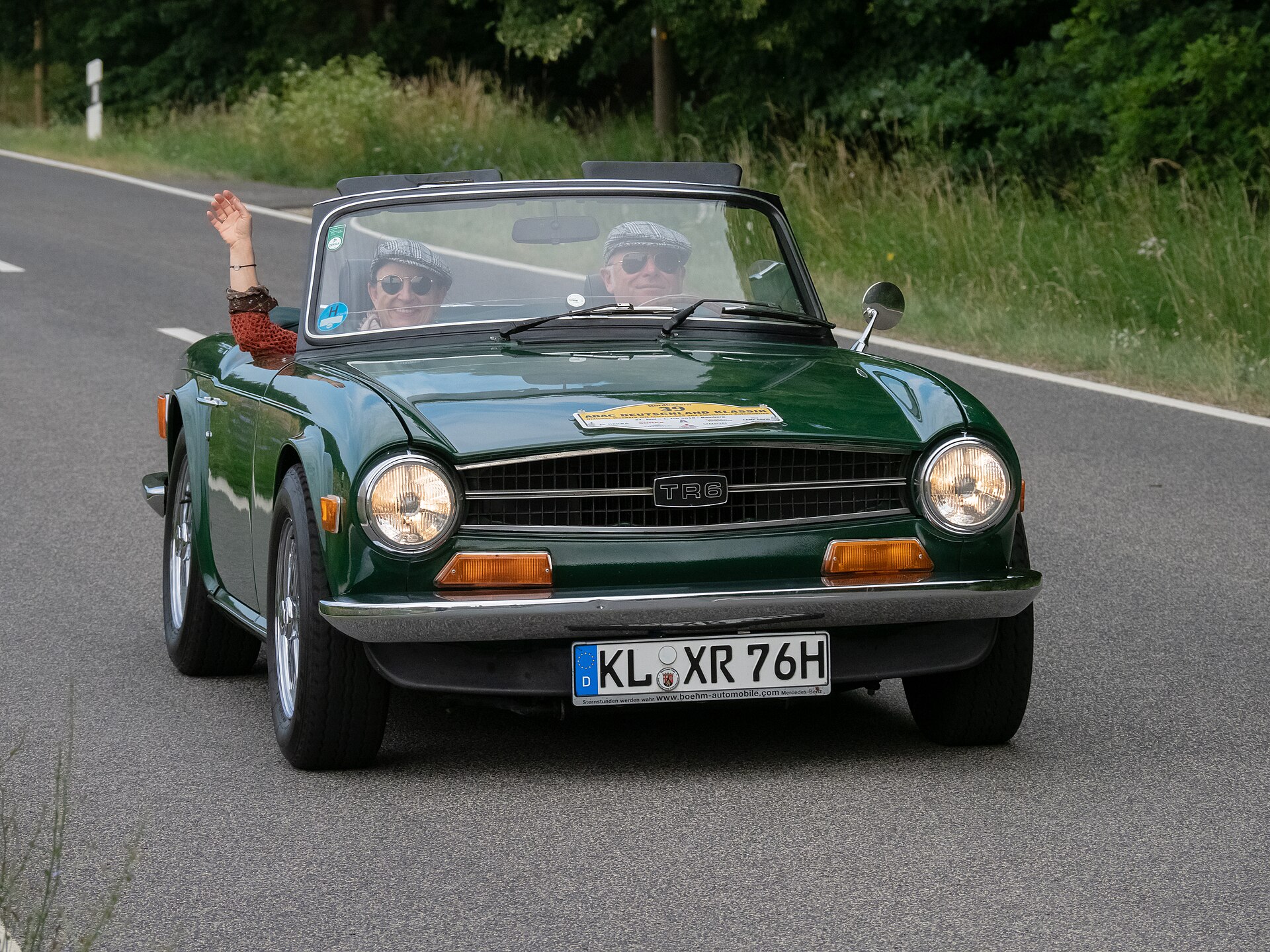
The Triumph TR6 is the two-seat roadster Triumph built in Coventry from September 1968 to July 1976, the last TR on a separate chassis. Karmann reshaped the TR5 body, and the 2,498 cc straight-six came with Lucas fuel injection in Europe, 112 kW (150 bhp) at first, or with twin Stromberg carburettors for the US. Of 91,850 cars, 83,480 were exported.
In short
- Built 1968-1976 in Coventry; shown to the public at the Brussels Motor Show on 14 January 1969.
- 91,850 made: about 13,700 with petrol injection and about 78,100 US-market carburettor cars.
- Power 112 kW (150 bhp) for early injected cars, 93 kW (125 bhp) from 1973, 78-79 kW (104-106 bhp) in the US.
- Successor: the Triumph TR7 wedge, which dropped the six and the separate chassis.
Size at a glance
| Dimensions | Triumph TR6 I |
|---|---|
| Length | 3,950 mm155.5 in |
| Width | 1,550 mm61.0 in |
| Height | 1,270 mm50.0 in |
| Wheelbase | 2,235 mm88.0 in |
Specs by version
Engines
| Version | Engine | Power | Torque | Gearbox | Drive | Production years |
|---|---|---|---|---|---|---|
| 2.5 twin carburettor (US) | 2.5 l · 6 cyl · Petrol 2,498 cc | 78 kW 106 PS105 hp | 194 Nm143 lb-ft | 4-sp Manual | Rear-wheel drive | 1968–1976 |
| 2.5 PI (125 bhp) | 2.5 l · 6 cyl · Petrol 2,498 cc | 93 kW 126 PS125 hp | - | 4-sp Manual | Rear-wheel drive | 1973–1975 |
| 2.5 PI (150 bhp) | 2.5 l · 6 cyl · Petrol 2,498 cc | 112 kW 152 PS150 hp | 222 Nm164 lb-ft | 4-sp Manual | Rear-wheel drive | 1968–1972 |
Performance
Show all 1 versions
| Version | Top speed |
|---|---|
| 2.5 PI (150 bhp) | 193 km/h120 mph |
Dimensions and weight
Show all 1 versions
| Version | Length | Width | Height | Wheelbase | Kerb weight |
|---|---|---|---|---|---|
| 2.5 PI (150 bhp) | 3,950 mm155.5 in | 1,550 mm61.0 in | 1,270 mm50.0 in | 2,235 mm88.0 in | 1,130 kg2,491 lb |
Verified Manufacturer and type-approval data from our catalog · Sources and methodology
Triumph TR6 at a glance
| Item | Triumph TR6 |
|---|---|
| Years | September 1968 to July 1976 (model years 1969-1976) |
| Production | 91,850 (83,480 exported, 8,370 sold in the UK) |
| Plant | Coventry, England; about 3,600 injected cars assembled from kits in Belgium |
| Body | 2-door roadster, optional factory hard top |
| Design | Karmann reworking of the Michelotti TR4/TR5 body |
| Layout | front engine, rear-wheel drive, separate chassis, independent suspension all round |
| Engine | 2,498 cc straight-six, Lucas injection or twin Stromberg carburettors |
| Power | 112 kW (150 bhp) PI; 93 kW (125 bhp) PI from 1973; 78 kW (104 bhp) US |
| Kerb weight | 1,130 kg |
| Top speed | 193 km/h (120 mph), injected car tested by Autocar |
| 0-97 km/h (60 mph) | 8.2 s (Autocar); 8.5 s (Motor, 1969) |
| Price new | GBP 1,334 in 1969; GBP 1,380 with hard top |
Why Triumph asked Karmann to reshape the TR5
The TR5 and its American twin, the carburettor TR250, were on sale for only about 15 months, with 2,947 TR5s and 8,484 TR250s built. Their Michelotti body went back to the TR4 of 1961, and the chassis traced its lineage to the TR2 of 1953. To refresh the car, Leyland signed a contract with Karmann of Osnabrück in 1967.
Karmann changed the wings, bonnet, boot lid, front and rear panels and the external trim, and the result could be readied for production in less than a year. The doors, windscreen and much of the inner body tub carried over, together with the chassis, engine and running gear. The new nose and tail are the most visible result. Triumph showed the car at Brussels on 14 January 1969 at GBP 1,334 (GBP 1,333 19s 1d), or GBP 1,380 with the hard top.
Chassis, gearbox and the Lucas injection
Underneath, the TR6 kept a body-on-frame layout with independent suspension at both ends, including aluminium semi-trailing arms at the rear. Steering was by rack and pinion, with disc brakes at the front and drums at the rear. The four-speed gearbox had synchromesh on all forward gears, and Laycock de Normanville overdrive was an option. The early A-type unit worked on second, third and top with a 22 percent reduction; the later J-type worked only on third and top, with 28 percent.
European cars used the Lucas mechanical petrol injection that Triumph had introduced on the TR5. It is a low-pressure system working at 110 psi, and the rev counter is red-lined at 5,750 rpm. Hagerty UK calls the system largely fit-and-forget, although vapour lock in hot weather can stop a car.

PI, CR and the American carburettor cars
Triumph used commission number prefixes to separate the versions. Injected home-market cars were CP until 1972 and CR afterwards, when lower compression cut power to 93 kW (125 bhp); Classics World gives the compression change as 8.5:1 to 7.75:1. A front spoiler arrived for 1973 too. American cars kept twin Stromberg carburettors and were coded CC, later CF. The injected version ended in 1975, so the last year of production went entirely to the US.
| Version | Years | Fuel system | Power | Torque | Built |
|---|---|---|---|---|---|
| CP (Europe) | 1969-1972 | Lucas injection | 112 kW (150 bhp) | 222 Nm | 13,702 injected in total (CP and CR) |
| CR (Europe) | 1973-1975 | Lucas injection | 93 kW (125 bhp) | - | see above |
| CC (US) | 1969-1972 | twin Stromberg | 78 kW (104 bhp, net) | 194 Nm | 78,147 carburettor cars in total |
| CF (US) | 1973-1976 | twin Stromberg | 79 kW (106 bhp) | - | see above |
The split comes from the TR Register's TR6 registrar via Hagerty UK; it adds up to 91,849, one car short of the usual total. Power figures vary between sources. Wikipedia EN gives 112 kW (152 PS DIN) for the early injected engine, while Wikipedia DE quotes 105 kW (143 PS), and Wikipedia DE also lists a different total of 91,310 cars.
How Autocar, Motor and Motor Sport saw it
Autocar timed an early injected TR6 at 8.2 s from 0-97 km/h and recorded a top speed of 193 km/h (120 mph). Motor's 1969 test returned 188 km/h (117 mph) as a two-way average and 8.5 s to 60 mph, with 13.6 l/100 km (20.8 mpg) overall and about 10.1 l/100 km (28 mpg) when touring. Motor called it "probably the best value for money in open top terms".
Motor Sport ran a mimosa-yellow TR6, registered PGN769L, for a year and 11,300 miles and reported in November 1973. Clive Richardson listed many faults early on but said he came to love the car after 5,000 miles. In the US the TR6 faced a new Japanese six-cylinder from 1969, the Datsun 240Z, while in Britain the Austin-Healey 3000 had left the market in 1967 and the MGC lasted only until 1969.
Why the TR6 ended in 1976
The last carburettor cars were built in July 1976. The TR7, with its wedge-shaped monocoque and four-cylinder engine, had already taken over, so the TR6 closed nearly 25 years of Triumph sports cars on a separate chassis and was the last convertible of that kind from the company. The history of Triumph covers the marque from bicycles to the TR7, and the Triumph catalogue lists the other models.
Triumph TR6 today: what to check when buying
Start with the chassis. Practical Classics and Classics World point to rot just ahead of the rear wheels, where members meet between bracing plates, at the trailing arm mountings and in the T-shaped pressing over the axle. A chassis that sags in the middle shows itself through door gaps that open at the top. On the body, check the front wings around the headlamps, the base of each B-post where it meets the sill, door bottoms, sills, floor, the rear deck seams, rear arch lips and the spare-wheel well.
The straight-six can cover about 120,000 miles with regular oil changes. Check crankshaft end float by pushing and pulling the bottom pulley: excessive movement from worn thrust washers can scrap the engine if ignored. Layshaft bearings rumble in the intermediate gears, clutch release bearings may last only 12,000-20,000 miles in hard use, and differential mounts can fail and mimic driveshaft clunks. Injected cars that smoke black under load are running rich, and the Lucas pump can overheat; a Bosch replacement is a common fix.
Prices for the TR6 draw on the hammer results that britishclassiccars.co.uk collects from public auctions, with each GBP sum multiplied by about 1.15 to give euros at the autumn 2026 rate. In August 2026 the median TR6 sold for about EUR 15,900 (GBP 13,850), with typical results from EUR 11,900 to EUR 21,100. The same August 2026 page puts the best restored UK injected cars at about EUR 28,800-40,300 (GBP 25,000-35,000), while US carburettor cars dominate the records and set the median. Practical Classics adds that converted US cars sell for about 15 percent less than genuine right-hand-drive cars. More British roadsters of the era are listed in our classic cars section.
Triumph TR6 in our rankings
- No. 7 of 22 · Fastest cars of the 1960s (193 km/h)
- No. 8 of 26 · Lightest convertibles and roadsters (1,130 kg)
- No. 9 of 33 · Smallest convertibles and roadsters (3,950 mm)
- No. 48 of 542 · Smallest cars (3,950 mm · top 9%)
- No. 60 of 405 · Lightest cars (1,130 kg · top 15%)
- No. 207 of 402 · Power-to-weight: cars (99 kW/t · top 52%)
Shorter than 91% of ranked cars in the 1CARS catalog (No. 48 of 542).
FAQ
How many Triumph TR6s were made?
Triumph built 91,850 TR6s between 1968 and 1976. Only 8,370 were sold in the UK; 83,480 were exported, nearly all to the US. The TR Register splits them into 13,702 injected cars and 78,147 carburettor cars.
What does PI mean on a TR6?
PI stands for petrol injection, the Lucas mechanical system used on European cars. It gave 112 kW (150 bhp) until 1972 and 93 kW (125 bhp) from 1973, while US cars used twin Stromberg carburettors and about 78 kW.
Who designed the Triumph TR6?
Karmann of Osnabrück reshaped the TR5 for Triumph under a 1967 contract. It changed the nose, tail, wings, bonnet and boot but kept the Michelotti doors, windscreen and central body tub.
What replaced the Triumph TR6?
The Triumph TR7 replaced it. The TR6 was the last TR with a straight-six and a separate chassis, and the last carburettor cars for the US were built in July 1976.
Data sources
Data checked by an editor against the sources below.
- Wikipedia - Triumph TR6


