Triumph — Coventry's Sports Car Name from Bicycles to the TR7
Triumph was a British car maker from Coventry whose name began on bicycles in 1886 and ended on cars in 1984. Siegfried Bettmann's import business turned to bicycles, motorcycles and, from 1923, cars. After a receivership in 1939 the name passed to the Standard Motor Company, which built the TR sports cars, the Herald, the Spitfire and the Michelotti-styled saloons, and later to Leyland and British Leyland. The last Triumph, the Honda-based Acclaim, was replaced in 1984; the trademark now belongs to BMW.
Key takeaways
- Founded in 1885 in London by Siegfried Bettmann as an import agency; the Triumph name was adopted in 1886 and the first car, the 10/20, came in 1923.
- The original company went into receivership in July 1939; Standard bought the remains and the name in November 1944.
- The TR series ran from the TR2 of 1953 to the TR7 and TR8 of 1981; the TR6 alone sold 91,850.
- The marque was retired in summer 1984, when the Rover 200 replaced the Acclaim; BMW has owned the name since 1994.
Triumph at a glance
| Fact | Value |
|---|---|
| Founded | 1885, London, as S. Bettmann & Co. |
| Founders | Siegfried Bettmann and Moritz Schulte |
| Home | Coventry, England (Canley works from 1945) |
| First car | Triumph 10/20, 1923 |
| Owners | Independent to 1939, Thos. W. Ward 1939–1944, Standard 1944–1960, Leyland 1960–1968, British Leyland / BL 1968–1984 |
| Best-known models | TR2–TR8, Herald, Spitfire, GT6, 2000, Stag, Dolomite Sprint |
| Last car | Acclaim (1981–1984), built at Cowley |
| Trademark today | BMW (since the Rover Group purchase of 1994) |
From bicycles to the first Triumph car
Siegfried Bettmann came from Nuremberg. In 1885 he set up S. Bettmann & Co. in London to import European bicycles and sell them under his own trade name, and in 1886 he chose the name Triumph. A second German, Moritz Schulte, joined as partner in 1887. The firm began building its own bicycles in Coventry in 1889, became the Triumph Cycle Co. Ltd. in 1897 and started making motorcycles at its Much Park Street works in 1902. By 1918 it was the largest motorcycle maker in Britain.
Cars followed after the First World War. In 1921, on the advice of general manager Claude Holbrook, Bettmann bought the assets and Clay Lane premises of the Dawson Car Company. The first Triumph car, the 10/20 of 1923, had a 1.4-litre engine and was designed by Lea-Francis, which received a royalty on every car sold. The Super Seven of 1927 was the first Triumph to sell in large numbers and stayed in production until 1934. In 1930 the business was renamed the Triumph Motor Company.

Gloria, Dolomite and the 1939 receivership
Holbrook judged that Triumph could not win in the mass market, so in the early 1930s the company moved up to more expensive cars such as the Southern Cross and the Gloria. Donald Healey joined as experimental manager in 1934 and developed the Dolomite 8, a straight-eight sports car based on the Alfa Romeo 8C 2300; only three were built that year. From 1937 Triumph made its own engines to Healey's designs, and the later Dolomite saloons and roadsters of 1937–1940 had nothing in common with the 1934 car except the name.
To raise money, Triumph sold its bicycle and motorcycle businesses in 1936; the motorcycles went to Jack Sangster of Ariel and became Triumph Engineering Co Ltd, a separate company ever since. It was not enough. In July 1939 the Triumph Motor Company went into receivership. The scrap firm Thos. W. Ward bought it and made Healey general manager, but war stopped car production, and in 1940 bombing destroyed the Holbrook Lane works.
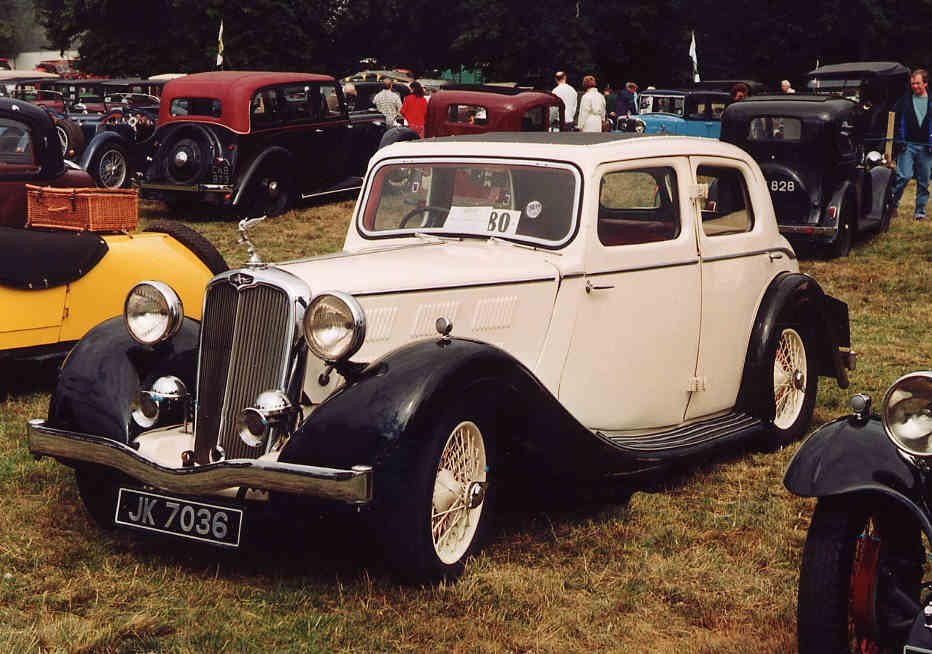
Standard-Triumph and the TR sports cars
In November 1944 the Standard Motor Company bought what was left of Triumph, mainly the name. A new subsidiary, Triumph Motor Company (1945) Limited, moved production to Standard's Canley factory in Coventry. Standard's managing director, Sir John Black, wanted a car to compete with the post-war Jaguars. The 1946 range began with the Triumph Roadster, whose body was aluminium because steel was scarce, followed by the 1800 Town and Country saloon, later called the Renown, and the small Mayflower. The range ended when Black was forced to retire and was not directly replaced.
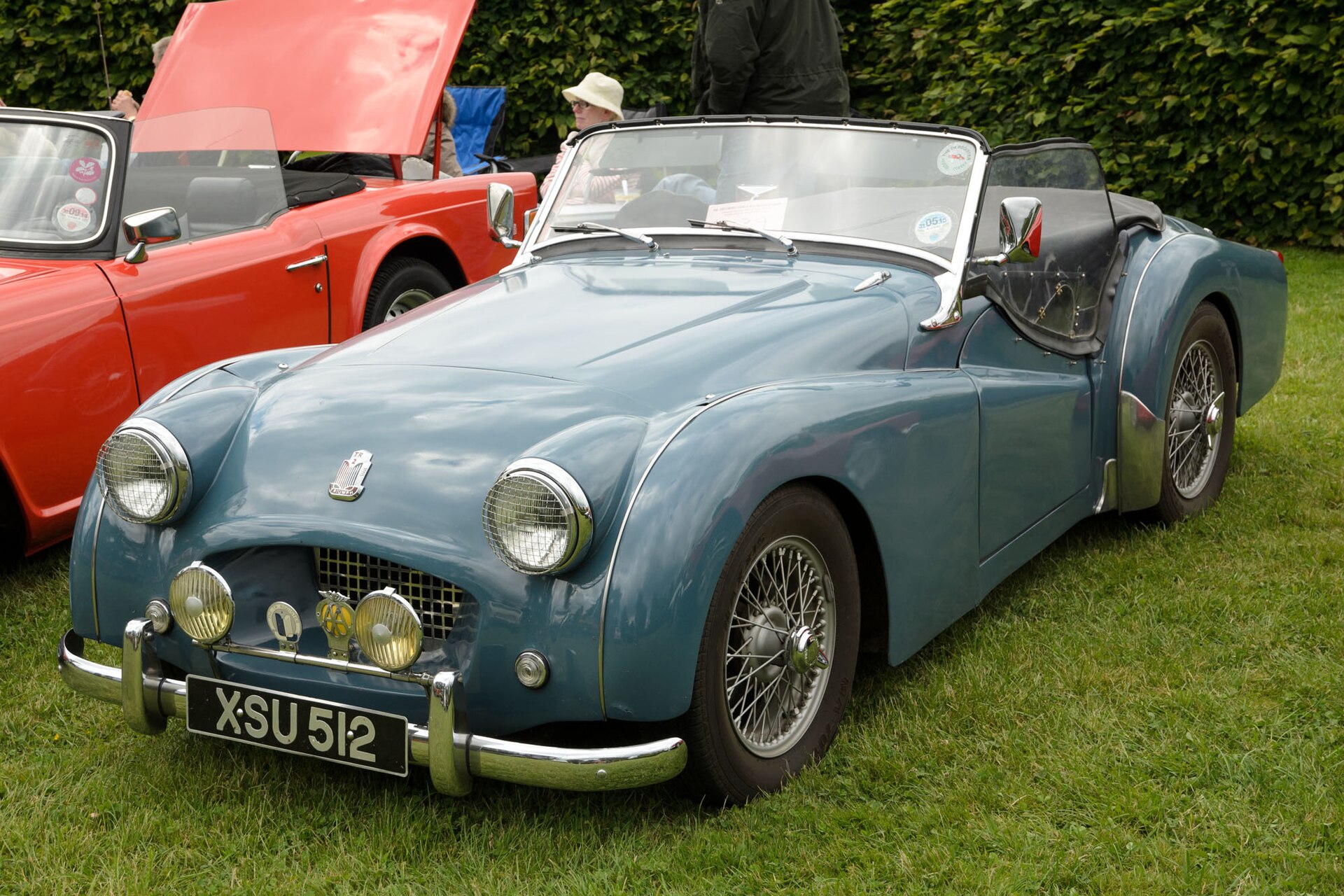
The car that made the name was the TR2 of 1953. Its 1,991 cc four-cylinder engine gave 67 kW (90 bhp). In May 1953 a streamlined "Speedmodel" reached 124.889 mph (about 201 km/h) on the closed Jabbeke motorway in Belgium, and The Motor measured 172.7 km/h on an overdrive car in 1954, when the test car cost £900 including taxes. Customer TR2s finished first, second and fifth in the March 1954 RAC Rally, and works cars came 14th, 15th and 19th at Le Mans in 1955. Triumph built 8,636 TR2 roadsters from 1953 to 1955.
The TR3 (1956–1958) and TR3A (1958–1962) followed, then the TR4 (1961–1965), TR4A (1965–1967) and the TR5 and TR250 of 1967–1968. The TR6, built from 1968 to 1976, kept the TR5 chassis, engines and much of the body tub under a new Karmann-designed nose and tail. Its fuel-injected 2.5-litre straight-six gave 110 kW (150 bhp) in early form, and Autocar recorded 190 km/h. Of 91,850 TR6s, 83,480 were exported, almost all to the United States. The Triumph catalogue lists the models on 1cars.

Herald, Spitfire and the Michelotti years
Because Triumph was the stronger name, Standard-Triumph launched its new small car as the Triumph Herald on 22 April 1959 at the Royal Albert Hall in London. The board had commissioned the Italian designer Giovanni Michelotti, with chief engineer Harry Webster behind the project. The Herald used a separate chassis rather than a monocoque: the body was bolted on, the whole front end tilted forward for access to the engine, and different body styles could share one frame. The first engine was a 948 cc four with 26 kW (34.5 bhp); the 13/60 of later years had 1,296 cc and 45 kW (61 bhp). Sales, slowed at first by a price near £700 including purchase tax, passed half a million by 1971, and kits were assembled in countries from India and South Africa to Peru and New Zealand.
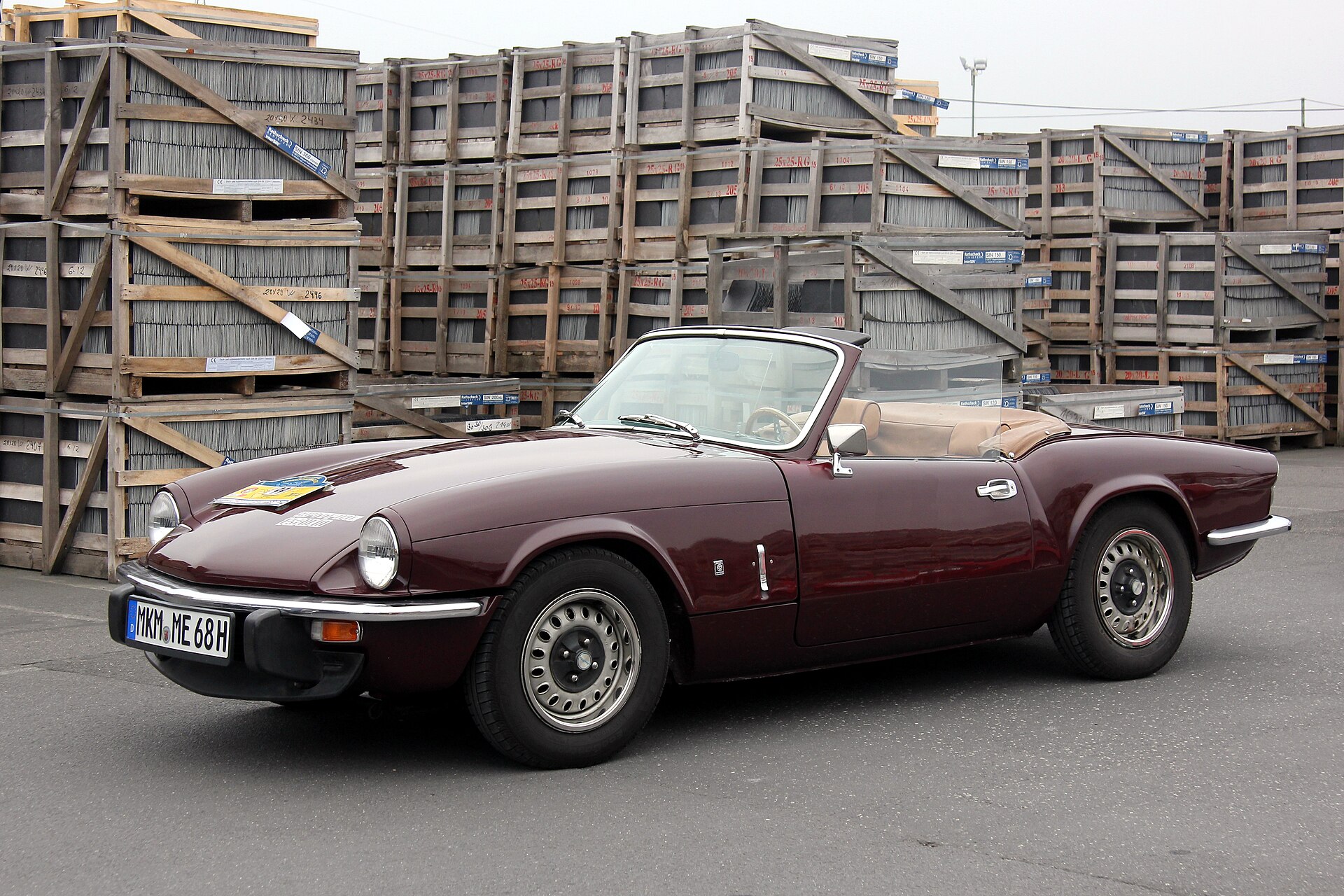
The Herald chassis became the base of a family. The Vitesse added a six-cylinder engine, and the Spitfire of 1962 was a small open two-seater on a shortened frame: 45,763 Mk Is were built, and the final Spitfire 1500 of 1974–1980 sold 95,829. The GT6 of 1966–1973, a six-cylinder fastback Spitfire, reached 40,926. The full story of the small roadster is in the Triumph Spitfire history.
Larger cars followed the same design language. The Triumph 2000 of 1963 replaced the last Standard-badged British car and, with its Mk2 and TC versions, sold 324,652 up to 1977. The 2.5 PI with fuel injection (1968–1975, 58,771 built) was criticised for problems with its injection system. The Stag of 1970–1977 started as a styling exercise that Michelotti cut and shaped from a pre-production 2000 saloon. Webster, by then Director of Engineering, liked it, and it became a four-seat convertible with the 2000's suspension and driveline and Triumph's own 2,997 cc V8. The V8 gained a reputation for overheating, especially in the United States, with water-pump, timing-chain and head-stud problems. Wikipedia gives two production totals for the Stag, 25,939 and 25,877.

Leyland, British Leyland and the TR7
Leyland Motors bought Standard-Triumph in December 1960, and Donald Stokes became chairman of the division in 1963. A plant at Speke, Liverpool, opened in 1960 with capacity for 100,000 cars a year, but it never built more than 30,000. Leyland bought Rover in 1967, and in 1968 it merged with British Motor Holdings to form British Leyland Motor Corporation, which put Triumph in the same group as Austin, Morris, Jaguar and Rover.
Inside British Leyland, Triumph belonged to the Specialist Division, known as Rover Triumph and later Jaguar Rover Triumph. The front-wheel-drive Toledo of 1970 and the Dolomite family of 1972–1980, including the 16-valve Dolomite Sprint, kept the saloons going. The only all-new Triumph started under Rover Triumph was the wedge-shaped TR7 of 1975. It was built at Speke, then at Canley and finally at the Rover plant in Solihull. A V8 version, the TR8, arrived in 1978, and both ended in 1981 when Solihull stopped building road cars.
The Acclaim, the end and BMW
The last Triumph was the Acclaim of 1981–1984, a licence-built version of the Honda Ballade assembled at Cowley in Oxford; 133,625 were made. In 1984 the Rover 200 replaced it, and the Triumph name disappeared that summer, in the same year as Morris. The history of the group that retired both names is in the Rover history.
BMW bought the Rover Group in 1994 and with it the Triumph trademark. When it sold Rover, BMW kept Triumph and Riley, and it refused to sell the name to the Phoenix Consortium. British Motor Heritage holds a licence to use the name for spare parts and servicing. BMW has looked at a revival several times: a roadster based on the Z4 in the early 2000s, a 2005 Designworks proposal and a 2011 European application for the laurel-wreath badge. In 2023 the design house Makkina, with BMW's permission, showed the TR25 concept on the BMW i3S platform to mark one hundred years of Triumph cars.
Triumph timeline
| Year | Event |
|---|---|
| 1885 | S. Bettmann & Co. founded in London |
| 1886 | Triumph name adopted |
| 1902 | First Triumph motorcycles |
| 1923 | First car, the 10/20 |
| 1930 | Company renamed Triumph Motor Company |
| 1936 | Motorcycle business sold |
| 1939 | Receivership (July); Thos. W. Ward takes over |
| 1944 | Standard buys Triumph (November) |
| 1953 | TR2 launched |
| 1959 | Herald launched (22 April) |
| 1960 | Leyland buys Standard-Triumph (December) |
| 1962 | Spitfire launched |
| 1968 | British Leyland formed |
| 1975 | TR7 launched |
| 1981 | TR7 and TR8 end; Acclaim launched |
| 1984 | Last Triumph car; marque retired |
| 1994 | BMW acquires the Triumph name with Rover Group |
Landmark Triumph models
| Model | Years | Why it matters |
|---|---|---|
| 10/20 | 1923–1925 | First Triumph car |
| Super Seven | 1927–1934 | First Triumph sold in large numbers |
| TR2 | 1953–1955 | Start of the TR series, 8,636 built |
| Herald | 1959–1971 | Michelotti design, separate chassis, over half a million sold |
| Spitfire | 1962–1980 | Small roadster on the Herald frame |
| 2000 | 1963–1977 | Executive saloon, 324,652 sold |
| TR6 | 1968–1976 | Best-selling TR of the classic shape, 91,850 built |
| Stag | 1970–1977 | Four-seat V8 convertible |
| Acclaim | 1981–1984 | Last Triumph, built with Honda |
Photo gallery


FAQ
Who founded Triumph?
Siegfried Bettmann, a businessman from Nuremberg, founded the import firm S. Bettmann & Co. in London in 1885 and adopted the Triumph name in 1886. Moritz Schulte joined him in 1887.
Is Triumph the car maker related to Triumph motorcycles?
They share an origin. The motorcycle business was sold in 1936 and has been a separate company since then.
Why did Triumph stop making cars?
British Leyland closed the TR7 and TR8 line in 1981 and replaced the last Triumph, the Acclaim, with the Rover 200 in 1984. The name was retired that summer.
Who owns the Triumph car brand now?
BMW, which acquired it with the Rover Group in 1994 and kept it when it sold Rover.
What was the last Triumph car?
The Acclaim, built at Cowley from 1981 to 1984 under licence from Honda; 133,625 were made.
Sources
- Wikipedia — Triumph Motor Company (accessed 24 Oct 2026)
- Wikipedia — Triumph TR2 (accessed 24 Oct 2026)
- Wikipedia — Triumph TR6 (accessed 24 Oct 2026)
- Wikipedia — Triumph Herald (accessed 24 Oct 2026)
- Wikipedia — Triumph Stag (accessed 24 Oct 2026)
Found a mistake? Report an error