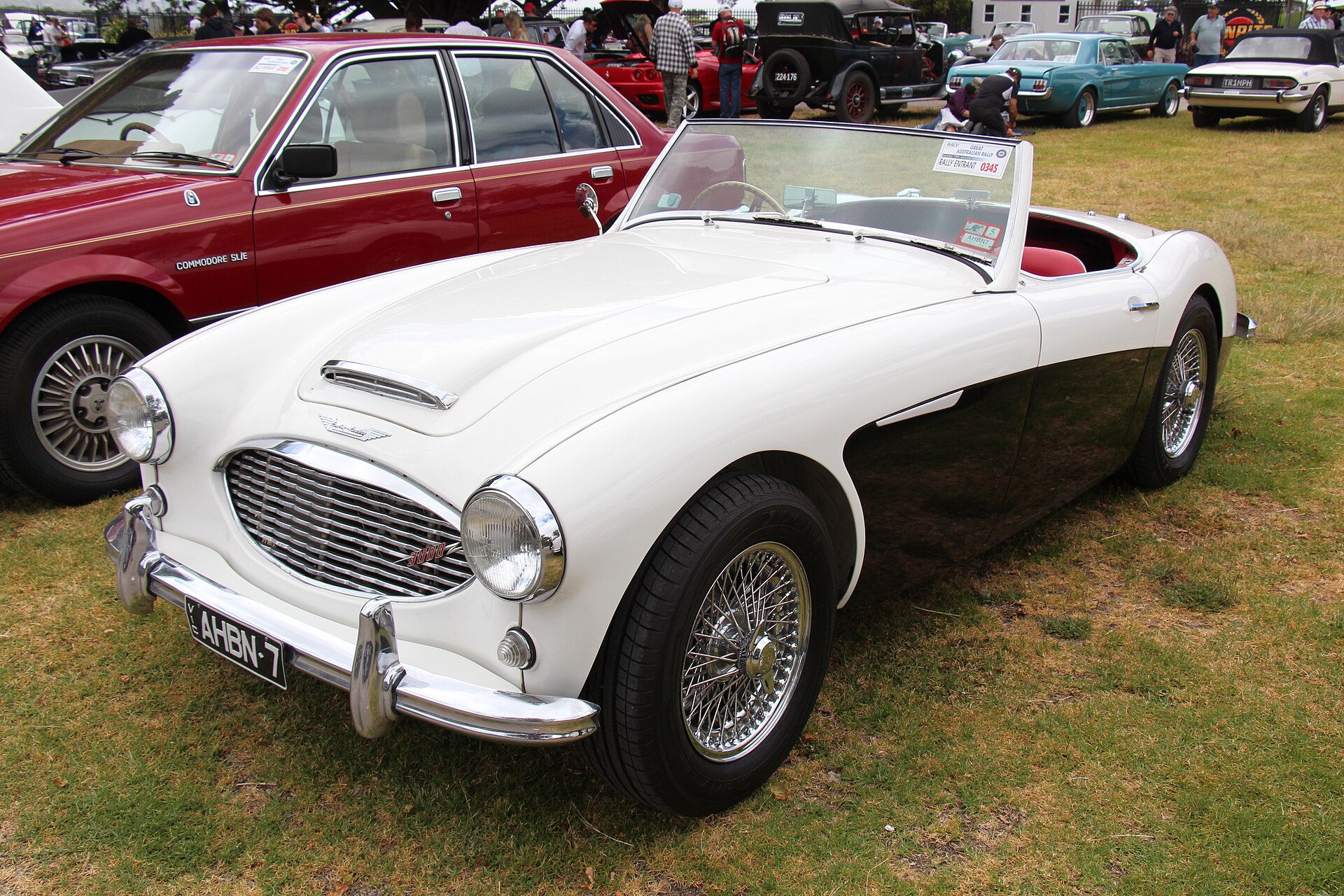
 Austin-Healey 3000
Specs, engines and history
Published Sources (1) Report an error
By Felix Hartmann, Automotive Technology & EV Contributor
- Built
- 1959–1967
- Top power
- 112 kW (152 PS)
Which Austin-Healey 3000 to choose
Our verdict · Felix Hartmann
- For the purest roadster: a Mk I or Mk II BN7 two-seater; the Mk II BN7 is the rarest version, with 355 built.
- For two small rear passengers: any 2+2 car, the BT7, BJ7 or BJ8.
- For performance: a Mk III BJ8 with 112 kW (150 bhp) and standard servo brakes.
- For ground clearance: a BJ8 Phase II from May 1964, with the modified rear chassis.
More British open cars are in the best sports cars list and among the best classic cars of the 1960s.
Austin-Healey was formed in 1952 as a joint venture between two partners. One was the Austin side of BMC, British Motor Corporation, represented by Leonard Lord; the other was the Donald Healey Motor Company of Donald Healey. Its first car, the 100 of 1953, was followed by the six-cylinder 100-6 in 1956, the small Sprite in 1958 and the 3000 in 1959. BMC merged with Jaguar into British Motor Holdings in 1966 and became part of British Leyland in 1968, when Donald Healey left. The 20-year agreement ran out in 1972, and Austin-Healey production stopped.
The 3000 is the best known of the "big Healeys". Announced on 1 July 1959 as the successor to the 100-6, it was built at BMC's MG works in Abingdon, with bodies from Jensen Motors, until the end of 1967. Over eight years it moved from a roadster with side screens to a sports convertible, and its power rose from about 91 kW to 112 kW. It was also a BMC works rally car. Almost all of them went abroad: 91.5 % of the 1963 cars were exported, mostly to North America.
Specs by version
| Version | Engine | Power | Gearbox | Drive | Production years |
|---|---|---|---|---|---|
| Mk I 2.9 I6 | 2.9 l · 6 cyl · Petrol 2,912 cc | - | Manual | Rear-wheel drive | 1959 |
| Mk III 2.9 I6 | 2.9 l · 6 cyl · Petrol 2,912 cc | 112 kW 152 PS150 hp | - | Rear-wheel drive | - |
Verified Manufacturer and type-approval data from our catalog · Sources and methodology
In short
- Built 1959–1967 at Abingdon; 42,926 cars in three Marks (13,650 Mk I, 11,564 Mk II, 17,712 Mk III).
- 2,912 cc BMC C-Series straight-six, from 91 kW (124 PS) in the Mk I to 112 kW (150 bhp) in the Mk III BJ8.
- Front disc brakes from the start; servo assistance optional from 1961 and standard on the Mk III.
- Works rally car of BMC until 1965; replaced by the MGC.
Austin-Healey 3000 at a glance
| Parameter | Metric | Imperial |
|---|---|---|
| Maker | BMC, Austin-Healey; built at the MG works, Abingdon | - |
| Bodies | Jensen Motors | - |
| Production | July 1959 – end of 1967 | - |
| Built | 42,926 | - |
| Body styles | two-seat roadster (BN7), 2+2 roadster (BT7), 2+2 convertible (BJ7, BJ8) | - |
| Engine | BMC C-Series straight-six, 2,912 cc | 177.7 cu in |
| Power | 91 kW (124 PS) Mk I; 101 kW (136 bhp) Mk II; 112 kW (150 bhp) Mk III | - |
| Torque | 226 Nm at 2,700 rpm (Mk I, German Wikipedia) | - |
| Wheelbase | 2,337 mm | 92 in |
| Length × width | 3,988 × 1,524 mm | 157 × 60 in |
| Height | 1,257 mm with hard top | 49.5 in |
| Kerb weight | 1,157 kg | 2,550 lb |
| Predecessor / successor | Austin-Healey 100-6 / MG MGC | - |
The Austin-Healey family
The 3000 was the last step of a line of "big Healeys" that began with the four-cylinder 100. The smaller Sprite ran alongside it from 1958 and outlived it.
| Model | Code | Years | Notes |
|---|---|---|---|
| 100 | BN1 | 1953–1955 | open two-seater |
| 100S | - | 1955 | 50 race-prepared cars |
| 100 and 100M | BN2 | 1955–1956 | - |
| 100-6 | BN4 | 1956–1959 | 2+2 roadster, six cylinders |
| 100-6 | BN6 | 1958–1959 | six-cylinder two-seater |
| 3000 | BN7, BT7, BJ7, BJ8 | 1959–1967 | 2.9-litre six |
| Sprite Mk I | AN5 | 1958–1961 | "Frogeye" in the UK, "Bugeye" in the US |
| Sprite Mk II–IV | HAN6–HAN10 | 1961–1970 | - |
| Sprite | AAN10 | 1971 | UK only, badged as an Austin |
The 3000 kept the layout of the 100-6, and its 3-litre C-Series replaced the 2.6-litre engine of the BN4 and BN6. When the 3000 ended in 1967, only the Sprite remained, and its last version, in 1971, was badged as an Austin.
From the 100-6 to the 3000
The 3000 was a careful update rather than a new car. It kept the wheelbase, body and body styles of the 100-6, but the 2.6-litre engine gave way to the 3-litre C-Series, and front disc brakes were added. BMC claimed 0–60 mph in 11 seconds and 0–100 mph in 31 seconds. Weather protection stayed basic, with a folding plastic hood and detachable side screens. Many items were options: wire wheels, overdrive, a laminated windscreen, a heater, an adjustable steering column, a hard top and two-tone paint. German Wikipedia lists UK prices for some of them, such as £85 for the hard top and £66 for overdrive at the 1959 launch.
Mk I, Mk II and Mk III
| Version | Years | Code | Power | Built |
|---|---|---|---|---|
| Mk I | 1959–1961 | BN7 two-seater / BT7 2+2 | 91 kW (124 PS) | 2,825 + 10,825 = 13,650 |
| Mk II | 1961–1962 | BN7 / BT7, three SU carburettors | 101 kW (136 bhp); 97 kW (132 PS) by German Wikipedia | 355 + 5,096 |
| Mk II convertible | 1962–1963 | BJ7, two SU carburettors | 96 kW (131 PS), German Wikipedia | 6,113 |
| Mk III | 1964–1967 | BJ8 | 112 kW (150 bhp) | 17,712 |
Mk I (1959–1961). The open BN7 two-seater and the 2+2 BT7 were built side by side, and the 2+2 sold almost four times as well.
Mk II (1961–1962). Announced at the end of May 1961, it had three SU HS4 carburettors and an improved camshaft, plus a grille with vertical bars. A brake servo became optional from August 1961. The BN7 Mk II ended in March 1962 after 355 cars, and the BT7 Mk II in June 1962 after 5,096.
BJ7 sports convertible (1962–1963). From the end of August 1962 the 3000 was sold as a sports convertible. Two larger SU HS6 carburettors replaced the three smaller ones; BMC still claimed over 115 mph (185 km/h).
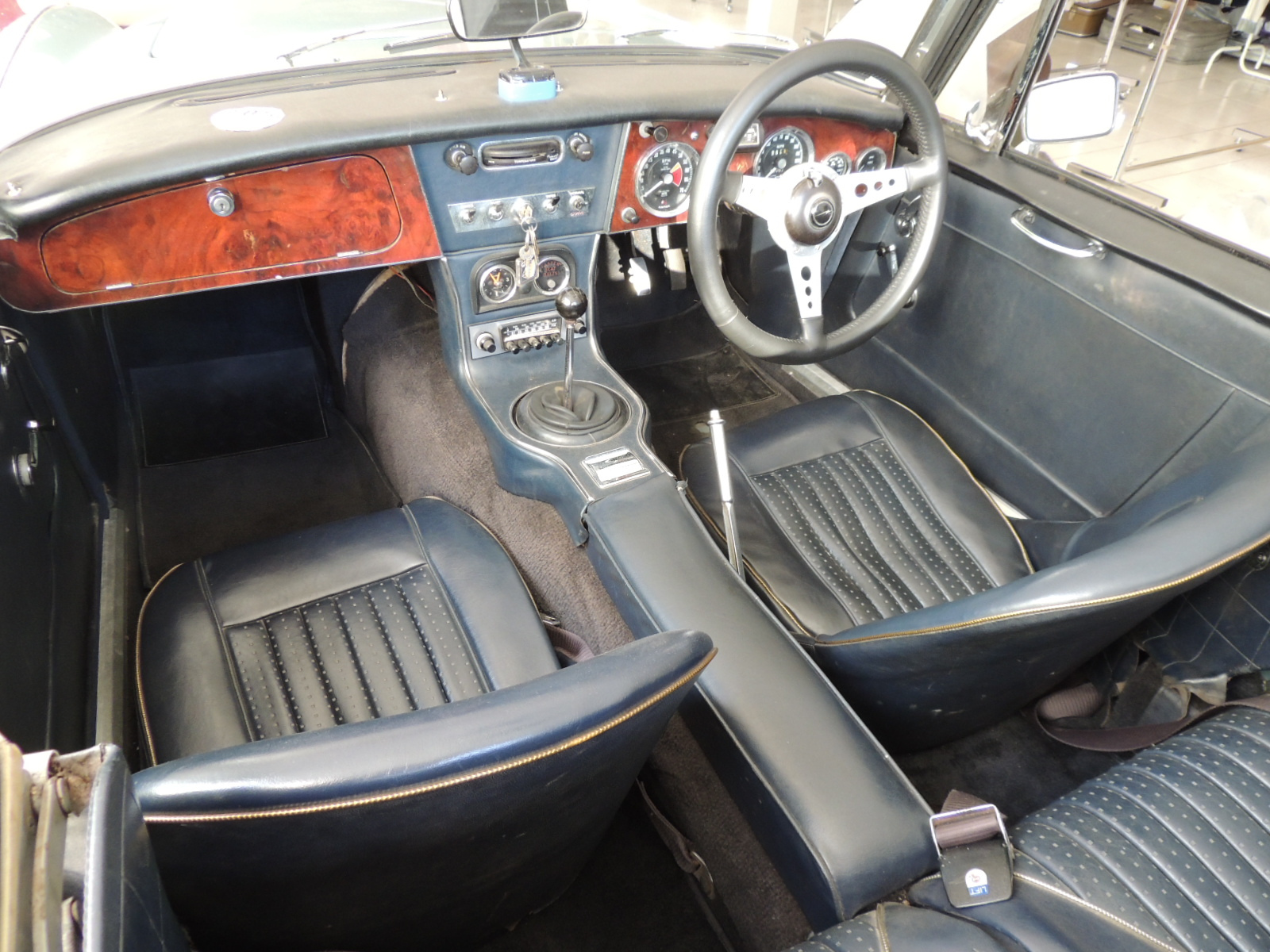
Mk III BJ8 (1964–1967). Announced in February 1964, it had a higher-lift camshaft and SU HD8 carburettors with 2-inch chokes. Together they raised power from 101 kW (136 bhp) to 112 kW (150 bhp). Servo brakes became standard, the seats were trimmed in Ambla vinyl, and a new dashboard put the speedometer and rev counter in front of the driver. The Phase II car from May 1964 had a modified rear chassis for more ground clearance, and separate indicator lights arrived in March 1965.


Road tests and prices
| Test car | Top speed | 0–60 mph | Fuel economy | UK price incl. taxes |
|---|---|---|---|---|
| Mk I BT7, hard top, overdrive (1960) | 115 mph (185 km/h) | 11.7 s | 21.6 mpg (13.1 l/100 km) | £1,326 (1960) |
| Mk II BT7, hard top, overdrive (1961) | 112.9 mph (182 km/h) | 10.9 s | 23.5 mpg (12.0 l/100 km) | £1,362 (1961) |
German Wikipedia gives a UK list price of £1,175 including taxes at the 1959 launch. With 112 kW and 1,157 kg, a Mk III has about 97 kW per tonne. The power-to-weight calculator compares that with later sports cars, and the fuel economy converter turns the imperial mpg figures into litres per 100 km.

Rallying and racing
BMC's competitions department rallied the 3000 from its launch, and the car won its class in many European rallies. The works car registered 727 URX won the Liège–Rome–Liège Rally. On the circuits, DD300 ran in the 1961 24 Hours of Le Mans, and 54 FAC and 56 FAC finished 12th and 25th in the 1963 12 Hours of Sebring. Works development effectively stopped in 1965, mainly because the Mini Cooper S was winning so much. The 3000 is still raced by enthusiasts in classic events.
The end of the big Healey
Healey looked at ways to meet tighter emission and safety rules. Three prototypes of a 4000 Mk IV, with a 3.9-litre aluminium Rolls-Royce engine, were completed in 1966–1967, but the car did not reach production. BMC ended the 3000 at the end of 1967 and replaced it with the MGC, which had a similar but new six-cylinder engine in a newer monocoque body. That car's background is in the history of MG cars. At the 1962 Earls Court Show, Pininfarina had shown a closed grand tourer on the 3000, designed by Pio Manzù.
The Austin-Healey name itself was the subject of several revival plans. They included BMW's Project Warwick concept in 2001, a planned revival at Longbridge by Nanjing Automobile in 2005 and an agreement between Nanjing and Healey interests in June 2007. None led to a production car.

Photo gallery


Austin-Healey 3000 in our rankings
- No. 450 of 912 · Longest-running car nameplates (8 years · top 53%)
- No. 290 of 557 · Biggest engines: cars (2,912 cc · top 53%)
- No. 33 of 49 · Biggest engines: convertibles and roadsters (2,912 cc · top 68%)
- No. 61 of 79 · Most powerful convertibles and roadsters (112 kW · top 78%)
- No. 668 of 859 · Most powerful cars (112 kW · top 79%)
- No. 98 of 109 · Most powerful British cars (112 kW · top 90%)
In production longer than 47% of ranked nameplates in the 1CARS catalog (No. 450 of 912).
FAQ
How many Austin-Healey 3000s were built?
42,926: 13,650 Mk I, 11,564 Mk II and 17,712 Mk III.
What engine does the Austin-Healey 3000 have?
The 2,912 cc BMC C-Series straight-six, with 91 kW (124 PS) in the Mk I and 112 kW (150 bhp) in the Mk III.
What is the difference between BN7, BT7, BJ7 and BJ8?
BN7 is the two-seat roadster, BT7 the 2+2 roadster, and BJ7 and BJ8 are the 2+2 sports convertibles of the Mk II and Mk III.
Where was the Austin-Healey 3000 built?
At BMC's MG works in Abingdon, England, with bodies from Jensen Motors.
What replaced the Austin-Healey 3000?
The MG MGC, launched as the 3000 ended in 1967.
Data sources
Data checked by an editor against the sources below.